
SLIDE 1
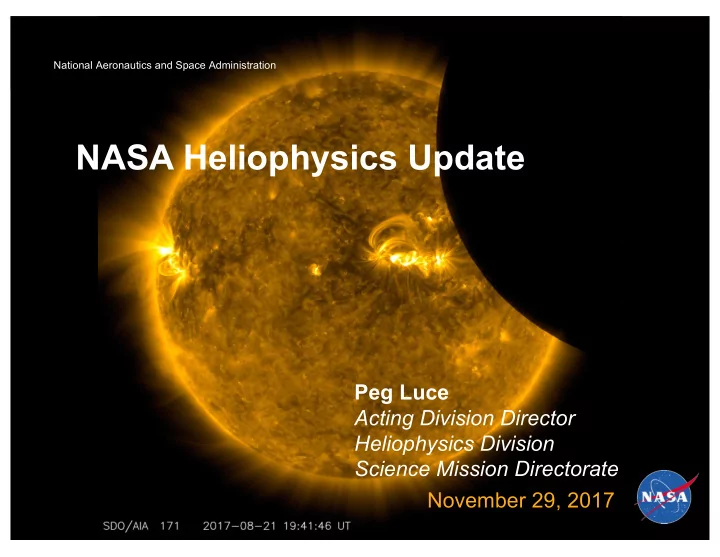
November 29, 2017 Peg Luce Acting Division Director Heliophysics Division Science Mission Directorate
NASA Heliophysics Update
National Aeronautics and Space Administration
1
NASA Heliophysics Update Peg Luce Acting Division Director - - PowerPoint PPT Presentation
National Aeronautics and Space Administration NASA Heliophysics Update Peg Luce Acting Division Director Heliophysics Division Science Mission Directorate November 29, 2017 1 Some Heliophysics Division News Steve Clarke on detail to OSTP
November 29, 2017 Peg Luce Acting Division Director Heliophysics Division Science Mission Directorate
National Aeronautics and Space Administration
1
Steve Clarke on detail to OSTP since July 2017 Peg Luce is Acting Director of Heliophysics Heliophysics Division Director – IPA/Detailee Position, selection in process New faces: Janet Kozyra (recently joined NASA as IPA after NSF IPA assignment from U of Michigan) Jared Leisner (joined from NASA Planetary Science Division) Terry Onsager on detail from NOAA/SWPC started, November 2017 Roshanak Hakimzadeh on detail from GRC started, November 2017 Jim Spann on detail from MSFC, started November 2017 Coming soon on detail: Bill Atkinson from KSC starting January 2018 New Assignments: Elsayed Talaat – Chief Scientist Lika Guhathakurta on detail to Ames since May 2017 Jeff Morrill - LWS Program Scientist Janet Kozyra - LWS Science Lead
3
The NASA FY17 Appropriation and the FY18 President’s Budget Request support the following:
0.0 Complete the current program Extended operations of current operating missions as recommended by the 2015 Senior Review; 5 missions currently in development (SET, ICON, GOLD, SOC and Parker) 1.0 Implement DRIVE (Diversify, Realize, Integrate, Venture, Educate) Implemented DRIVE initiative wedge in FY15; fully funded in FY17 and onwards 2.0 Accelerate and expand Heliophysics Explorer program Decadal recommendation of every 2-3 years; Explorer mission AO released in 2016; plan to release next Explorer AO in 2018. Notional mission cadence will continue to follow Decadal recommendation going forward. 3.0 Restructure STP as a moderate scale, PI-led flight program STP-5 (IMAP) mission AO released with IMAP as a PI- led mission with a LRD ~2024 4.0 Implement a large LWS GDC- like mission Start of mission formulation targeted for NET2019; RFI call for innovative ideas is out; inputs will feed into GDC STDT that will start in 2017.
Solar Orbiter (ESA) Parker Solar Probe ICON
Formulation Implementation Primary Ops Extended Ops
Voyager (2) STEREO (2) SOHO (ESA) ACE SDO RHESSI Hinode (JAXA) IRIS TIMED AIM IBEX WIND TWINS (2) Geotail (JAXA) THEMIS (3) ARTEMIS (2) Van Allen Probes (2) SET-1 GOLD MMS (4)
Solar Orbiter (ESA) Parker Solar Probe ICON
Formulation Implementation Primary Ops Extended Ops
Voyager (2) STEREO (2) SOHO (ESA) ACE SDO RHESSI Hinode (JAXA) IRIS TIMED AIM IBEX WIND TWINS (2) Geotail (JAXA) THEMIS (3) ARTEMIS (2) Van Allen Probes (2) SET-1 GOLD MMS (4)
ICON 2018 Parker Solar Probe July 2018 Solar Orbiter Feb 2019 GOLD Apr 2018
SET Apr 2018
6
The ICON launch, previously scheduled for 12/8/17, has been postponed. NASA and Orbital ATK are addressing an issue with the rocket’s spacecraft separation
an Orbital ATK facility in Gilbert, AZ, until it is shipped for launch. The GOLD Instrument is integrated with the SES-14 spacecraft and proceeding through environmental testing at the Airbus facility in Toulouse, France. All instruments, including the Solar Probe Cup, are integrated with the observatory, which is proceeding through environmental testing. Outgassing of C103 Niobium at high temperature remains under investigation. In September, 3 of 6 separation nuts failed to separate during a test of the 3rd stage to spacecraft interface. An anomaly investigation team, including OSC, ULA, and LSP, recommended corrective actions and subsequent tests, including spacecraft shock/separation tests, have been successful. Qualification of the system is still required. All Solar Orbiter instruments have been delivered to Airbus facility in Stevenage,
The Heliophysics Senior Review Subcommittee (now a subordinate group of a FACA-chartered Committee) met in October and will report to the Heliophysics Advisory Committee this week.
7
ICON Observatory Prior to Close-Out for Shipment to VAFB Parker Solar Probe Installation of the Flight Thermal Protection System at APL, Sep 21
Explorers Living With a Star Solar Terrestrial Probes Research Program
2016 2017 2018 2019 2020 2021 2022
Global-scale Observations of the Limb and Disk (GOLD) April 2018 Solar Orbiter Collaboration (with ESA) February 2019 Space Environment Testbeds (SET) NET April 2018 Parker Solar Probe July 2018 Magnetospheric Multiscale (MMS) March 2015 Ionospheric Connection Explorer (ICON) December 2017
Ongoing Heliophysics Missions Astrophysics Missions Planetary Missions External to SMD
2023 2024 2025
Heliophysics MO 2023* Heliophysics MIDEX 2024* Heliophysics MO 2024*
*Notional
Heliophysics SMEX 2022* Heliophysics MO 2022* Interstellar Mapping and Acceleration Probe (IMAP) 2024* Geospace Dynamics Constellation (GDC) 2025* Green – Oct 2017 Chrisley – Nov 2017 Clark – Dec 2017 Heliophysics Tech MO 2024*
8
competition
9
Phase A competition, LRD ~2022
TRACERS, PUNCH
10
MUSE
Multi-slit Solar Explorer
PUNCH
Polarimeter to Unify the Corona and Heliosphere
FOXSI
Focusing Optics X-ray Solar Imager
TRACERS
Tandem Reconnection and Cusp Electrodynamics Reconnaissance Satellites
MEME-X
Mechanisms of Energetic Mass Ejection eXplorer
competition, LRD varies
selection of ESA M5 mission
CubeSats/SmallSats
for future Decadal Survey missions
11
SunRise
Sun Radio Interferometer Space Experiment
COSIE
Coronal Spectrographic Imager in the EUV
THOR-US
Turbulence Heating ObserveR
AWE
Atmospheric Waves Experiment
signed October 2017
12
13
ELEMENT STEP 1 PROPOSALS (Due Date) STEP 2 PROPOSALS (Due Date) AWARDS (Expected) YEAR 1 ($M) B.2 H-SR 194 177 (25-30) ($6.0M) B.3 H-TIDeS 101 88 (12) ($4.0M-$6.0M) B.4 H-GI Open 193 175 (25-30) ($4.7M) B.5 H-GCR TMS N/A N/A N/A N/A B.6 H-LWS (12/5) (2/6/2018) (15-20) ($3.75M) B.7 H-DEE 15 9 (<=9) ($0.5M) B.8 H-GI MMS 54 (1/11/18) (8-10) ($1.3M) B.9 H-GCR SC TBD TBD TBD TBD
$M FY16 FY17 FY18 FY19 FY20 FY21 FY22 Delta FY18 FY20- FY18
Sounding Rocket Program Office FY15 PBR 48.3 53.0 53.0 53.0 10.7 4.1 FY18 PBR 49.8 53.3 59.0 61.1 63.1 63.1 63.1 Guest Investigator FY15 PBR 8.0 8.0 8.0 8.0 7.2 4.8 FY18 PBR 10.5 11.6 15.2 20.0 20.0 20.0 20.0 Research & Analysis (HSR, H- TIDeS, H- GCR) FY15 PBR 34.0 33.9 33.9 33.9 16.0 8.7 FY18 PBR 36.3 39.4 49.9 58.2 58.6 58.6 58.6 LWS Science FY15 PBR 17.5 17.5 17.5 17.5 7.1 6.3 FY18 PBR 18.4 21.9 29.0 35.5 35.3 35.3 35.3 +$41M +$24M
15
On May 31, the Solar Probe Plus was renamed the Parker Solar Probe in honor of the discovery of the solar wind by Eugene Parker. During the ceremony he received the NASA Distinguished Public Service Award.
Smithsonian Air & Space Museum, Sept 5
Voyager launched into a severe but poorly characterized energetic particle environment, just 20 years into the space age. Its longevity is a testament to the designers and engineers who developed Voyager.
William Shatner sent message to Voyager
17
On October 14, 2014, the NASA/ESA SOHO spacecraft observed a powerful coronal mass ejection (CME) associated with an M1.1 solar flare and tracked it through space. An international team of scientists from Europe and the United States, including two NASA centers, used data from 10 NASA and ESA spacecraft to track the CME from the Sun out to the edge of the heliosphere.
CCMC models were used to simulate the CME passage throughout the solar system and to help identify the October 2014 event as it traveled past NASA and ESA spacecraft.
NASA/ESA SOHO LASCO C2 image taken at 20:48 UT on 14 October 2014. Credit: Witasse, et. al (2017).
Moon’s shadow moving across North America as seen by EPIC
Credit: NASA EPIC Team Credits: Innermost image: NASA/SDO. Ground-based eclipse image: Jay Pasachoff, Ron Dantowitz, Christian Lockwood and the Williams College Eclipse Expedition/NSF/National Geographic Outer image: ESA/NASA/SOHO
Photo Credit: (NASA/Aubrey Gemignani)
19
Polarization Camera Images in 3850 Å Principal Investigator: Nat Gopalswamy
20