
SLIDE 1
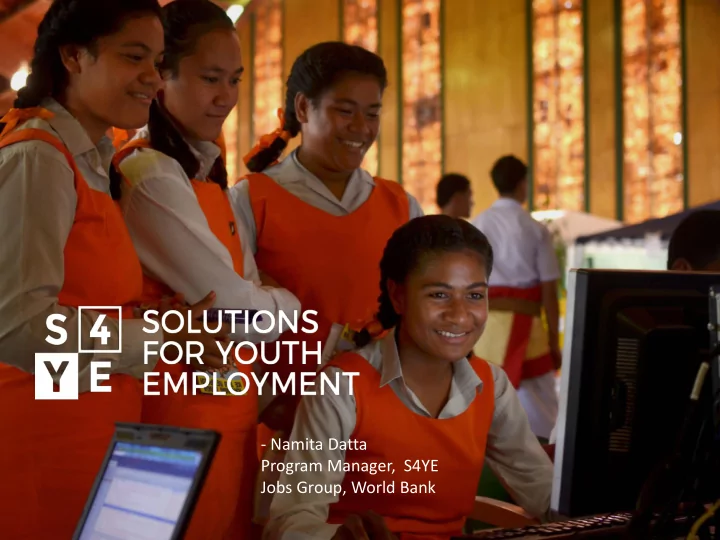
- Namita Datta
Program Manager, S4YE Jobs Group, World Bank
- Namita Datta Program Manager, S4YE Jobs Group, World Bank A - - PowerPoint PPT Presentation
- Namita Datta Program Manager, S4YE Jobs Group, World Bank A Global Crisis 600 MILLION Globally 600 million jobs will be needed to keep employment rates constant. Priority Focus Areas What percentage of evaluated youth employment programs
Program Manager, S4YE Jobs Group, World Bank
A Global Crisis
MILLION
Globally 600 million jobs will be needed to keep employment rates constant.
Priority Focus Areas
What percentage of evaluated youth employment programs have shown any positive impact?
30% 70% Positive Impact No Impact
Youth Employment Programs
Source: Kluve, Jochen and Puerto, Susana and Robalino, David A. and Romero, Jose Manuel and Rother, Friederike and Stöterau, Jonathan and Weidenkaff, Felix and Witte, Marc, Do Youth Employment Programs Improve Labor Market Outcomes? A Systematic Review. IZA Discussion Paper No. 10263.Results from a recent meta analysis
….. are disappointing
Supply Demand
Connecting youth to jobs : leveraging synergies between ‘supply side’ and ‘demand side’ interventions
c) Sector specific approaches: Lead Firm-SME linkage programs, VC development approaches (aggregator models, competitiveness reinforcement initiatives); a) Gaps and mismatches in technical, cognitive and non-cognitive skills: low skill level, skills mismatch a) Training and skills development programs: technical, vocational, behavioral and non-cognitive skills (classroom and OJT, incl. internships, apprenticeships) b) Information gaps, mobility and limited access to networks: lack of information on job opportunities among youth and skills of young applicants by employer b) Employment and intermediation services: information systems, job search assistance and counselling; Transport subsidies , mobility grants to youth c) Little or no work experience among youth: low productivity compared to minimum wage and benefits c) Subsidized employment interventions: wage subsidies (direct payment to employers or workers, tax deductions), public works a) Programs to address financing constraints: lines of credit/guarantees, grants, asset-based finance and other alternative forms of debt (e.g. youth entrepreneurship initiatives may simultaneously address this as well as Steps to design a supply side intervention for youth
STEP 1: IDENTIFY AND TARGET THE POPULATION
The decision to target a defined group should be based on the assessment conducted, and aligned with project objectives and resources, with government priorities, and with existent or expected job opportunities in the labor market
This step needs to clearly define the eligibility criteria and the verification mechanisms
Criterion Description Age Youth (could have more specific criteria e.g. youth in age group 15-18) as compared to adults, elderly Labor Market or Employment Status Generally, eligibility is restricted to unemployed individuals but it could also include inactive (especially amongst youth and women)The objective of this activity is to determine the program’s main target groups and understand the main challenges or constraints they face.
STEP 2: REGISTER, ENSURE ELIGIBILITY, COLLECT INFORMATION ON TARGETED POPULATION AND SELECTED BENEFICIARIES
Outreach to Potential Beneficiaries About the Project
Once the target population has been identified and the targeting methodology determined, a
communications campaign could be developed to inform the target groups of the project, its
The outreach campaign should be launched simultaneously with the initial registration process
to allow potential youth beneficiaries to apply immediately. Selection:
First come first served Ranking /prioritization Lottery/randomization
The objectives of this step are to select project beneficiaries out of eligible candidates who applied to the project and complete the registration process.
STEP 3: PROFILE THE BENEFICIARIES
CLUSTERS. Segmenting the Beneficiaries into Homogenous Groups:
unemployment, education status
STEP 4: DELIVERING AND PAYING FOR INTEGRATED PACKAGES OF SERVICES THROUGH SERVICE PROVIDERS
Design services & payment mechanism Select Providers Contract Providers Monitor performance and evaluate processSelecting the Contracting and Payment Mechanisms There are three types of payment mechanisms:
➢ Fixed-price contracts ➢ Cost-reimbursement contracts ➢ Pure performance-based contracts DESIGNING THE PAYMENT MECHANISM
The proposed payment here is based on the performance of the provider and is divided in three parts:
➢ Unit Cost or Cost Recovery ➢ Bonuses ➢ Minimum standards and Ranking 20% of unit cost (first bar below) if the beneficiary stays on the same job after a period of 6 months Amount should cover all operati rating expenses necessary to deliver an adequate comb mbinati tion and inten tensity ty of services required for each beneficiary to access a job Payment schedule could be designed as follows: 10% of unit cost upon signature 20% of unit cost upon completion of professional plan which could be divided in 2 sets of activities 35% of unit cost upon completion of the first set STEP 5: PUT IN PLACE THE RIGHT MONITORING SYSTEM TO EVALUATE PERFORMANCE
Evidence suggests that a strong monitoring system increases the likelihood that they complete and/or reach better results and avoid unintended consequences.
The ‘Jobs M&E T
by the Jobs Group provides a package of resources for project teams and clients to support mainstreaming the jobs agenda in
HOW TO IMPROVE DESIGN OF A DEMAND SIDE INTERVENTION
IMPROVING DESIGN ON THE DEMAND SIDE
There are four key steps:
Step 1: Establish a Profile of Possible Jobs for the Target Population Step 2: Define the target group of enterprises that need to be supported in
priority
Step 3: Identify the constraints to growth faced by existing enterprises or
entry barriers for new enterprises
Step 4: Design and implement a comprehensive packages of support
services for targeted enterprises
STEP 1: DEFINE THE TARGET YOUTH POPULATION AND ESTABLISH A PROFILING OF THE POSSIBLE JOBS FOR THE TARGET POPULATION
With the target youth population in mind, the team can then assess what types of jobs would
best match the beneficiaries. Different sub-sectors and firms create jobs that have a different composition in terms of gender, age, and skills level.
Given information about the distribution of skills, it is possible to create a typology of
1,100 occupations looking at 35 skills
The literature usually categorizes an occupation based on three main components: Cognitive skills (basic numeracy and literacy, advanced problem-solving and creative and
critical thinking skills)
Social and behavioral skills (conscientiousness, grit and openness to experience) Job-specific technical skills (like engineer or electrician) Having information about the types of suitable occupations then enables an assessment of the
types of economic sub-sectors or value chains that should be targeted in a given region
JOBS CREATED BY SECTOR AND SKILLS LEVEL FOLLOWING A US$10 MILLION INVESTMENT IN LEBANON
STEP 2: DEFINE THE TARGET GROUP OF FIRMS TO BE SUPPORTED
Once potential sub-sectors for engagement have been selected, the next step is to identify the types of enterprises involved in economic activities in the sector or that could enter the sector. There are two dimensions to be considered while defining the target group of firms to be supported:
Size- subsistence, micro, small and medium Age: Startups, existing young enterprises , established stabilized business
Segment of firms Objective(s) for their contribution to the Jobs Agenda More jobs Better jobs Income-generating activities/subsistence entrepreneurs Business survival Transition from unemployment to self- employment Increase in revenues Startups/Microenterprises Business survival More firm entry Start- ups grow and hire additional employees Increase in productivity (and hence increase in salary) Better working conditions Small and Medium Enterprises Firm growth and hiring of additional employees Increase in productivity (and hence increase in salary) Better working conditions Large firms Firm growth, hiring additional employees, more growth of their supply chains (further increase of SMEs/startups I through their supply chains). Increase in productivity (and hence increase in salary) Better working conditions STEP 3: IDENTIFY THE CONSTRAINTS FACED BY THE TARGET GROUP OF FIRMS
Once the target group of firms has been defined, it is then easier to identify their constraints. This can be done through various ways, namely empirical analysis, enterprise surveys and/or consultations.
Constraints that prevent firms to grow and generate more jobs can be either external or internal.
Possible Constraints to Growth and Jobs (demand side) STEP 4: DESIGN AND IMPLEMENT COMPREHENSIVE PACKAGES FOR TARGET GROUP OF FIRMS
Such comprehensive packages could be integrated along a product or value chain like a
strategic investment plan
Or they could be around a region (e.g. targeting a city or region). An entrepreneurship program could be designed as a package of services that address the
specific constraints of firms that have been identified.
▪ Young subsistence entrepreneurs ▪ Startups/promoting high growth entrepreneurs; and ▪ Promoting growth of existing entrepreneurs/ SMEs.
Ba Barriers Type o INTEGRATION – PUTTING IT ALL TOGETHER
DESIGN ELEMENTS TO INTEGRATE SUPPLY AND DEMAND SIDE INTERVENTIONS
Formulating an integrated project development objective (PDO) Setting up or accessing a country specific “Jobs for
Youth Fund
Choosing project locations (spatial alignment) Designing intervention sequencing (time alignment) Choosing value chains/sectors/cluster and youth target groups (beneficiaries
alignment) –
Designing mutually-reinforcing activities Designing integration-supporting incentives for youth or firms-beneficiaries
IMPLEMENTATION PRACTICES TO SUPPORT THE INTEGRATION OF SUPPLY AND DEMAND SIDE PROJECT INTERVENTIONS
Setting up a cross-sectoral technical team that is also mirrored by a cross-
ministerial coordination unit of the country government
Pro-active sharing of project relevant data Joint decision making Deliberate synchronization of efforts Developing and implementing an integrated data management system –
The creation of an online project portal
Developing and implementing an integrated communication strategy Designing an integrated monitoring and evaluation system Capacity building for project stakeholders
CASE 1: Tunisia Youth Economic Inclusion Project
Integrated Jobs Operation in Tunisia
Expression of interest Scoring And Selection Enrollment and profiling Connection to jobs – Tailored support Outreach and Awarenes s 1 2 3 Support to high-potential value chains (VC): 4Component 1: Supply side
Objective: to identify, register, profile and provide services to program beneficiaries to facilitate transitions from unemployment/inactivity into wage or self-employment, or to help them move from low to higher quality jobs. Beneficiaries: Tunisian citizens, aged 18-35 and residents of one of seven selected governorates with a priority given to the most vulnerable.Component 2: Demand side
Objective: to create job opportunities for the youth by supporting high- potential value chains and to fostering entrepreneurship. Entrepreneurship: for micro, small and medium enterprises (matching grants and capacity building) with a priority given to firms in the high- potential value chains. Mapping (data collection and PPD forums), Prioritizing (and defining high-potential VC), Formulating recommendations for these VC. Placement in non-participating firms or in other donor programsComponent 3: Project Management and Monitoring
✓ Emphasis on capacity building and communication with stakeholders ✓ Web-portal to communicate with beneficiaries, track progress of beneficiaries, to collect data, and to ensure a transparent administration of the interventions ✓ Robust impact evaluation in line with the Results Framework: Learning from DoingPerformance: private sector contracting and incentives
CASE 2: Nepal Accelerating Inclusive Jobs Growth
Objective: To create quality jobs and improve labor market outcomes for youth Component 1. Jobs Fund
Jobs Creation Challenge Window Competitively selected firms receive jobs-linked grants to support firms’ expansion plans Employment Support Window Integrated employment services catering to young people and employers
Component 2. e-Employment Services
Facilitate full spectrum of electronic employment support
Accelerating Inclusive Jobs Growth in Nepal
Component 3. Capacity Building, M&E and Project Management
CASE 3: Lebanon National Jobs Creation Program
Lebanon National Jobs Creation Program (PforR)
32 Results Areas
Environment For Private Investment
Creation Through Trade And Investment In Lagging Regions
Women And Youth To Jobs
reforms
investments
agribusiness, ICT
integrated services
etc.
BENEFICIARIES OBJECTIVE OF THE PROGRAMImprove private sector economic
beneficiaries in Lebanon
selected value chains and clusters
aged 18-34, women (18-45), and Syrian refugees
CASE 4: Jordan’s First Equitable Growth and Job Creation Programmatic Development Policy Financing
Jordan First Equitable Growth and Job Creation Programmatic Development Policy Financing
Objective of the DPO: Support Jordan to improve business competitiveness, introduce flexibility in the labor markets and strengthen social assistance, and strengthen fiscal management Pillar 1 – Business Competitiveness: Support the Government’s efforts to improve the competitiveness and ‘ability to export’ of Jordanian businesses Pillar 2 – Labor markets and social assistance: Support the Government’s efforts to foster a more flexible and inclusive labor market to enhance job growth and develop a more effective safety net to protect the poor and vulnerable Pillar 3 – Fiscal management: Support the Government’s fiscal consolidation efforts Measures to reduce the cost- base and ease access to finance for Jordanian businesses, and measures to improve the ability
markets Measures to reduce labor market segmentation, stimulate demand for part-time and temporary employment that youth and women are most likely to take and increase labor force participation for both groups Measures to support private sector participation in the economy through a cascade approach and an update to the approach of managing debt and contingent liabilities
S4YE’s knowledge base
S4YE Baseline Report 2015
Towards Solutions for Youth Employment LinkedIn & S4YE Skills Gap White PaperAnnual Report 2016
Youth on the MoveOnline Blogs and Discussion Brief Series Annual/Thematic Reports
Transportation Costs and Youth Employment The Digital Jobs Typology follows an industry approach to focus on the drivers of digital jobs and related activities supporting the labor market.
Digital Jobs Typology
Design Implications
Featured Case Studies