Name the 3 hip ROM tests the in order in which they are performed - - PowerPoint PPT Presentation

name the 3 hip rom tests the in order in which they are
SMART_READER_LITE
LIVE PREVIEW

Name the 3 hip ROM tests the in order in which they are performed - - PowerPoint PPT Presentation

Name the 3 hip ROM tests the in order in which they are performed here: Image Challenge: Hip, Foot and Ankle UCSF Primary Care Sports Medicine Conference 2018 Carlin Senter, MD Anthony Luke, MD, MPH Associate Professor Professor UCSF


slide-1
SLIDE 1

1

12/13/2018

Carlin Senter, MD Associate Professor UCSF Primary Care Sports Medicine

Image Challenge: Hip, Foot and Ankle

UCSF Primary Care Sports Medicine Conference 2018 Anthony Luke, MD, MPH Professor

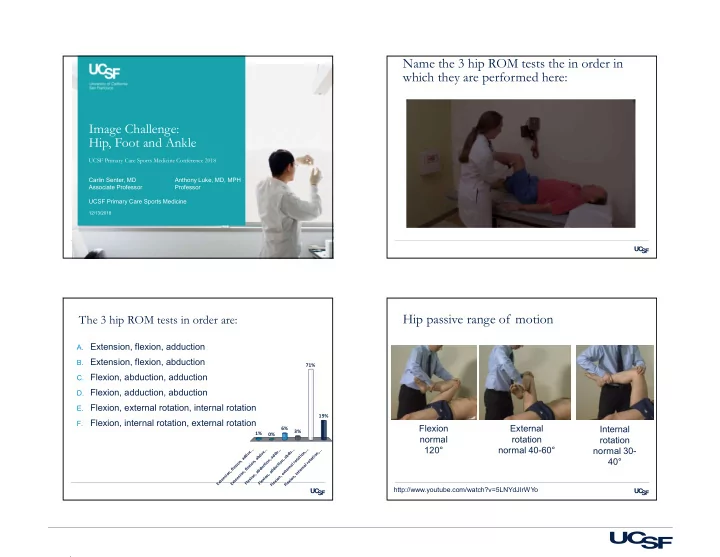
Name the 3 hip ROM tests the in order in which they are performed here:

The 3 hip ROM tests in order are:

  • A. Extension, flexion, adduction
  • B. Extension, flexion, abduction
  • C. Flexion, abduction, adduction
  • D. Flexion, adduction, abduction
  • E. Flexion, external rotation, internal rotation
  • F. Flexion, internal rotation, external rotation

E x t e n s i

  • n

, f l e x i

  • n

, a d d u c . . . E x t e n s i

  • n

, f l e x i

  • n

, a b d u c . . . F l e x i

  • n

, a b d u c t i

  • n

, a d d u . . . F l e x i

  • n

, a d d u c t i

  • n

, a b d u . . . F l e x i

  • n

, e x t e r n a l r

  • t

a t i

  • n

, . . . F l e x i

  • n

, i n t e r n a l r

  • t

a t i

  • n

, . . .

1% 0% 19% 71% 3% 6%

Hip passive range of motion

Flexion normal 120° External rotation normal 40-60° Internal rotation normal 30- 40°

http://www.youtube.com/watch?v=5LNYdJIrWYo

slide-2
SLIDE 2

2

Hip passive range of motion: internal and external rotation 21 y/o soccer player has groin pain with this

  • maneuver. What is the most likely diagnosis?

What is the most likely diagnosis?

  • A. Trochanteric bursitis
  • B. Iliotibial band tendinitis
  • C. Hip flexor tendinitis
  • D. Femoroacetabular impingement
  • E. Sacroiliac joint dysfunction

T r

  • c

h a n t e r i c b u r s i t i s I l i

  • t

i b i a l b a n d t e n d i n i t i s H i p f l e x

  • r

t e n d i n i t i s F e m

  • r
  • a

c e t a b u l a r i m p . . . S a c r

  • i

l i a c j

  • i

n t d y s f u n c t i

  • n

2% 9% 4% 82% 2%

FADIR

  • Flexion
  • Adduction
  • Internal
  • Rotation

http://www.aafp.org/afp/2009/1215/p1429.html

slide-3
SLIDE 3

3

Please focus on L hip. What x-ray findings do you NOT see?

What x-ray findings of the L hip are seen?

  • A. Joint space narrowing
  • B. Subchondral sclerosis
  • C. Subchondral cysts
  • D. Osteophytes
  • E. Femoral neck fracture

J

  • i

n t s p a c e n a r r

  • w

i n g S u b c h

  • n

d r a l s c l e r

  • s

i s S u b c h

  • n

d r a l c y s t s O s t e

  • p

h y t e s F e m

  • r

a l n e c k f r a c t u r e

7% 0% 87% 0% 6%

4 radiographic hallmarks of osteoarthritis

  • 1. Joint space narrowing
  • 2. Subchondral sclerosis
  • 3. Subchondral cysts
  • 4. Osteophytes

Which muscle is weak in this runner?

slide-4
SLIDE 4

4

Which Muscle is weak in this runner?

  • A. Gluteus Minimus
  • B. Gluteus Medius
  • C. Piriformis
  • D. Quadratus Lumborum
  • E. Hamstring
  • F. Rectus abdominis

G l u t e u s M i n i m u s G l u t e u s M e d i u s P i r i f

  • r

m i s Q u a d r a t u s L u m b

  • r

u m H a m s t r i n g R e c t u s a b d

  • m

i n i s

8% 78% 4% 6% 4% 1%

Case: What will this patient have difficulty doing ?

What will this patient have difficulty doing?

A.

Wearing running shoes

B.

Swimming

C.

Going on her toes

D.

Curling her toes

E.

Taking her shoes off

F.

Feeling her little toe

W e a r i n g r u n n i n g s h

  • e

s S w i m m i n g G

  • i

n g

  • n

h e r t

  • e

s C u r l i n g h e r t

  • e

s T a k i n g h e r s h

  • e

s

  • f

f F e e l i n g h e r l i t t l e t

  • e

15% 0% 3% 0% 4% 77%

PT Dysfunction Presentation

  • Usually women > 40 y.o.
  • Weakness with inversion
  • “Too many toes sign”
  • Unable to plantarflex – Single limb heel rise test
slide-5
SLIDE 5

5

Looseness on this Exam is Consistent with Injury to ?

A.

High tibial fibular ligament

B.

Anterior Talofibular ligament

C.

Calcaneal Fibular ligament

D.

Posterior Talofibular ligament

E.

Spring Ligament

H i g h t i b i a l f i b u l a r l i g a m e n t A n t e r i

  • r

T a l

  • f

i b u l a r l i g a . . . C a l c a n e a l F i b u l a r l i g a m e n t P

  • s

t e r i

  • r

T a l

  • f

i b u l a r l i g . . . S p r i n g L i g a m e n t

2% 80% 1% 11% 7%

Ankle Ligaments

Lateral Collateral Complex

  • Anterior talofibular lig.
  • Calcaneofibular lig.
  • Posterior talofibular lig.

Medial Ligament Complex

  • Deltoid ligament
  • Superficial and deep ligaments

What is the difference between these two R knee x-rays taken days apart on the same patient?

1. 2.

The difference between the 2 radiographs:

  • A. Non weight-bearing versus weight-bearing
  • B. Extended versus flexed
  • C. AP versus lateral
  • D. AP versus sunrise view

N

  • n

w e i g h t

  • b

e a r i n g v e r s . . E x t e n d e d v e r s u s f l e x e d A P v e r s u s l a t e r a l A P v e r s u s s u n r i s e v i e w

0% 0% 0% 0%

10

slide-6
SLIDE 6

6

Weight-bearing radiographs increase sensitivity for joint space narrowing

3 views for knee pain

  • Weight bearing

flexed PA (aka notch view)

  • Lateral of affected

side

  • Sunrise or merchant

view

FW B XR

What is the diagnosis?

  • 66 y/o woman
  • Presented to urgent care with sudden severe R shoulder pain

that developed a few days after doing extensive yard work

  • ROM limited to 10 degrees forward flexion, 10 degrees

abduction.

  • Unable to tolerate strength testing of shoulder due to

excruciting pain

What is the diagnosis?

A.

Glenohumeral joint osteoarthritis

B.

Frozen shoulder

C.

Calcific tendinitis

D.

Gout

E.

Polymyalgia rheumatic

F.

Fibromyalgia

Glenohumeral joint oste... Frozen shoulder Calcific tendinitis Gout Polymyalgia rheumatic Fibromyalgia

0% 0% 0% 0% 0% 0%

10

Calcific tendinitis of the shoulder

  • Calcium deposit in rotator cuff tendon, most commonly

supraspinatus at its insertion on greater tuberosity of humerus

  • Can cause severe shoulder pain, causing patient to go to

emergency room

  • Can be asymptomatic, incidentally found on radiographs
  • Diagnosed by radiograph or ultrasound
  • Tx (not a lot of evidence for any of following)
  • Rest, ice, NSAIDs, Physical therapy
  • Subacromial corticosteroid injection  can dissolve calcium

deposition

  • Extracorporeal shock-wave therapy (Bannuru RR et al. Annals

Internal Medicine, 2014)

  • Arthroscopic debridement if above does not resolve symptoms
slide-7
SLIDE 7

7

Case: What nerve is involved here?

What nerve is involved here?

  • A. Superficial branch of the radial nerve
  • B. Axillary nerve
  • C. Suprascapular nerve
  • D. Long thoracic nerve
  • E. Musculocutaneous nerve
  • F. Ulnar nerve

S u p e r f i c i a l b r a n c h

  • f

t h e . . . A x i l l a r y n e r v e S u p r a s c a p u l a r n e r v e L

  • n

g t h

  • r

a c i c n e r v e M u s c u l

  • c

u t a n e

  • u

s n e r v e U l n a r n e r v e

0% 0% 0% 0% 0% 0%

10

Winged scapula

  • Long thoracic nerve = pure motor

nerve

  • Injury  paralysis of serratus anterior

muscle  winged scapula most

  • bvious on a wall pushup
  • Causes
  • Brachial neuritis (Parsonage turner)
  • Trauma or compression
  • Stretch or traction
  • Usually resolves over 1-3 years
  • Physical therapy to maintain range of

motion, strengthen around the injury

UpToDate “Overview of upper extremity peripheral nerve syndromes” accessed 7/15/17.

Have a great evening! See you tomorrow

29