SLIDE 1 NaCl: a new crypto library
- D. J. Bernstein, U. Illinois Chicago
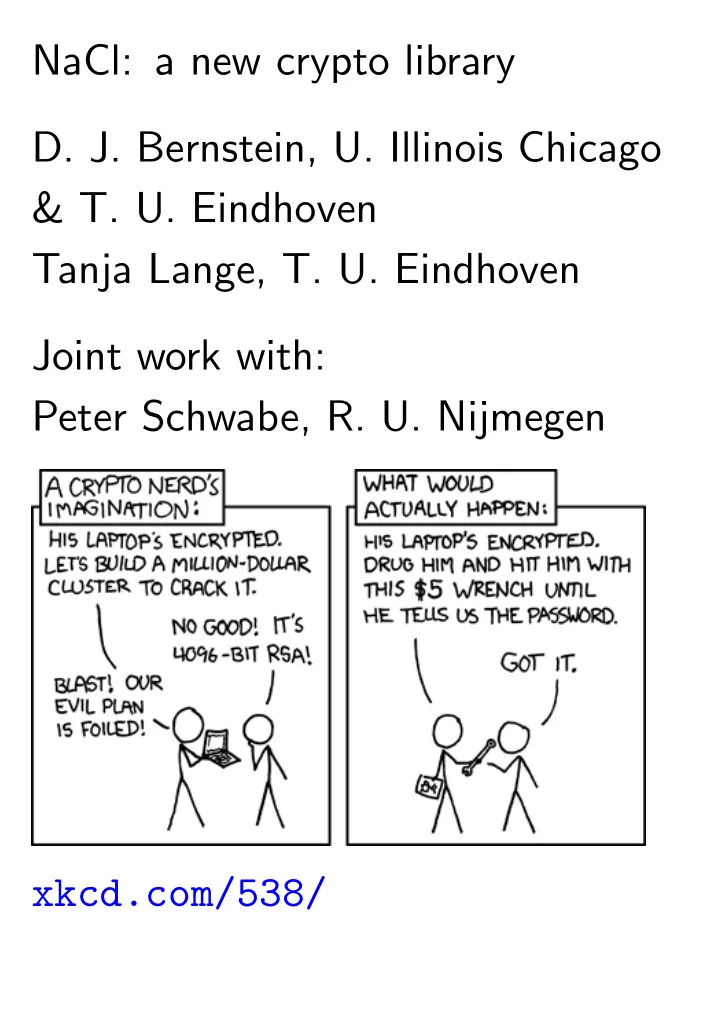
& T. U. Eindhoven Tanja Lange, T. U. Eindhoven Joint work with: Peter Schwabe, R. U. Nijmegen xkcd.com/538/
SLIDE 2
AES-128, RSA-2048, etc. are widely accepted standards. Obviously infeasible to break by best attacks in literature. Implementations are available in public cryptographic libraries such as OpenSSL. Common security practice is to use those implementations.
SLIDE 3 AES-128, RSA-2048, etc. are widely accepted standards. Obviously infeasible to break by best attacks in literature. Implementations are available in public cryptographic libraries such as OpenSSL. Common security practice is to use those implementations. But cryptography is still a disaster! Complete failures
- f confidentiality and integrity.
SLIDE 4
We have designed+implemented a new cryptographic library, NaCl (“salt”), to address the underlying problems. nacl.cr.yp.to: source and extensive documentation. Acknowledgments: code contributions from Matthew Dempsky (Mochi Media), Niels Duif (Eindhoven), Emilia K¨ asper (Leuven), Adam Langley (Google), Bo-Yin Yang (Academia Sinica).
SLIDE 5
Most of the Internet is cryptographically unprotected. Primary goal of NaCl: Fix this. Main task: public-key authenticated encryption. Alice has a message m for Bob. Uses Bob’s public key and Alice’s secret key to compute authenticated ciphertext c. Sends c to Bob. Bob uses Alice’s public key and Bob’s secret key to verify and recover m.
SLIDE 6
Alice using a typical cryptographic library: Generate random AES key. Use AES key to encrypt packet. Hash encrypted packet. Read RSA key from wire format. Use key to sign hash. Read Bob’s key from wire format. Use key to encrypt signature etc. Convert to wire format. Plus more code: allocate storage, handle errors, etc.
SLIDE 7
Alice using NaCl: c = crypto_box(m,n,pk,sk)
SLIDE 8
Alice using NaCl: c = crypto_box(m,n,pk,sk) 32-byte secret key sk. 32-byte public key pk. 24-byte nonce n. c is 16 bytes longer than m. All objects are C++ std::string variables represented in wire format, ready for storage/transmission. C NaCl: similar, using pointers; no memory allocation, no failures.
SLIDE 9
Bob verifying, decrypting: m=crypto_box_open(c,n,pk,sk) Initial key generation: pk = crypto_box_keypair(&sk)
SLIDE 10
Bob verifying, decrypting: m=crypto_box_open(c,n,pk,sk) Initial key generation: pk = crypto_box_keypair(&sk) Can instead use signatures for public messages: pk = crypto_sign_keypair(&sk) 64-byte secret key, 32-byte public key. sm = crypto_sign(m,sk) 64 bytes overhead. m = crypto_sign_open(sm,pk)
SLIDE 11
“This sounds too simple! Don’t applications need more?”
SLIDE 12
“This sounds too simple! Don’t applications need more?” Examples of applications using NaCl’s crypto_box: DNSCurve and DNSCrypt, high-security authenticated encryption for DNS queries; deployed by OpenDNS. QUIC, Google’s TLS replacement. MinimaLT in Ethos OS, faster TLS replacement. Threema, encrypted-chat app.
SLIDE 13 Related projects Various ports, repackaging, language bindings, etc.: e.g., github.com/jedisct1/libsodium TweetNaCl: NaCl in 100 tweets;
- n the path towards full audit.
Bernstein, van Gastel, Janssen, Lange, Schwabe, Smetsers. tweetnacl.cr.yp.to twitter.com/tweetnacl Benchmarking of >1000 crypto implementations using same API: bench.cr.yp.to
SLIDE 14 No secret load addresses 2005 Osvik–Shamir–Tromer: 65ms to steal Linux AES key used for hard-disk encryption. Attack process on same CPU but without privileges. Almost all AES implementations use fast lookup tables. Kernel’s secret AES key influences table-load addresses, influencing CPU cache state, influencing measurable timings
65ms to compute influence−1.
SLIDE 15
Most cryptographic libraries still use secret load addresses but add “countermeasures” intended to obscure influence upon the CPU cache state. Not confidence-inspiring; likely to be breakable.
SLIDE 16
Most cryptographic libraries still use secret load addresses but add “countermeasures” intended to obscure influence upon the CPU cache state. Not confidence-inspiring; likely to be breakable. NaCl systematically avoids all loads from addresses that depend on secret data. Eliminates this type of disaster. Timing attack+defense tutorial: Schwabe talk tomorrow 11:00.
SLIDE 17
No secret branch conditions 2011 Brumley–Tuveri: minutes to steal another machine’s OpenSSL ECDSA key. Secret branch conditions influence timings. Most cryptographic software has many more small-scale variations in timing: e.g., memcmp for IPsec MACs.
SLIDE 18
No secret branch conditions 2011 Brumley–Tuveri: minutes to steal another machine’s OpenSSL ECDSA key. Secret branch conditions influence timings. Most cryptographic software has many more small-scale variations in timing: e.g., memcmp for IPsec MACs. NaCl systematically avoids all branch conditions that depend on secret data. Eliminates this type of disaster.
SLIDE 19
No padding oracles 1998 Bleichenbacher: Decrypt SSL RSA ciphertext by observing server responses to ≈106 variants of ciphertext. SSL first inverts RSA, then checks for “PKCS padding” (which many forgeries have). Subsequent processing applies more serious integrity checks. Server responses reveal pattern of PKCS forgeries; pattern reveals plaintext.
SLIDE 20
Typical defense strategy: try to hide differences between padding checks and subsequent integrity checks. But hard to get this right: see, e.g., Lucky 13 and POODLE.
SLIDE 21
Typical defense strategy: try to hide differences between padding checks and subsequent integrity checks. But hard to get this right: see, e.g., Lucky 13 and POODLE. NaCl does not decrypt unless message is authenticated. Verification procedure rejects all forgeries in constant time. Attacks are further constrained by per-nonce key separation and standard nonce handling.
SLIDE 22
Centralizing randomness 2008 Bello: Debian/Ubuntu OpenSSL keys for 1.5 years had only 15 bits of entropy. Debian developer had removed a subtle line of OpenSSL randomness-generating code.
SLIDE 23
Centralizing randomness 2008 Bello: Debian/Ubuntu OpenSSL keys for 1.5 years had only 15 bits of entropy. Debian developer had removed a subtle line of OpenSSL randomness-generating code. NaCl uses /dev/urandom, the OS random-number generator. Reviewing this kernel code is much more tractable than reviewing separate RNG code in every security library.
SLIDE 24 Centralization allows OS to merge many entropy sources into pool feeding many applications. Merging is deterministic and
- auditable. Can survive many
bad/failing/malicious sources if there is one good source.
SLIDE 25 Centralization allows OS to merge many entropy sources into pool feeding many applications. Merging is deterministic and
- auditable. Can survive many
bad/failing/malicious sources if there is one good source. Huge step backwards: Intel’s RDRAND in applications. Single entropy source; no backup; likely to be poorly cloned; backdoorable (CHES 2013); non-auditable. Not used in NaCl.
SLIDE 26
Avoiding unnecessary randomness 2010 Bushing–Marcan–Segher– Sven: Sony ignored ECDSA requirement of new randomness for each signature. ⇒ Signatures leaked PS3 code-signing key.
SLIDE 27
Avoiding unnecessary randomness 2010 Bushing–Marcan–Segher– Sven: Sony ignored ECDSA requirement of new randomness for each signature. ⇒ Signatures leaked PS3 code-signing key. NaCl has deterministic crypto_box and crypto_sign. Randomness only for keypair. Eliminates this type of disaster. Also simplifies testing. NaCl uses automated test battery from bench.cr.yp.to.
SLIDE 28
Avoiding pure crypto failures 2008 Stevens–Sotirov– Appelbaum–Lenstra–Molnar– Osvik–de Weger exploited MD5 ⇒ rogue CA cert.
SLIDE 29
Avoiding pure crypto failures 2008 Stevens–Sotirov– Appelbaum–Lenstra–Molnar– Osvik–de Weger exploited MD5 ⇒ rogue CA cert. 2012 Flame: new MD5 attack.
SLIDE 30 Avoiding pure crypto failures 2008 Stevens–Sotirov– Appelbaum–Lenstra–Molnar– Osvik–de Weger exploited MD5 ⇒ rogue CA cert. 2012 Flame: new MD5 attack. Fact: By 1996, a few years after the introduction of MD5, Preneel and Dobbertin were calling for MD5 to be scrapped. NaCl pays attention to cryptanalysis and makes very conservative choices
- f cryptographic primitives.
SLIDE 31 Speed Crypto performance problems
- ften lead users to reduce
cryptographic security levels
- r give up on cryptography.
Example 1: Google SSL used RSA-1024 until 2013. Security note: Analyses in 2003 concluded that RSA-1024 was breakable; e.g., 2003 Shamir–Tromer estimated 1 year, ≈107 USD. RSA Labs and NIST response: Move to RSA-2048 by 2010.
SLIDE 32
Example 2: Tor used RSA-1024 until 2013 switch to Curve25519. Example 3: DNSSEC uses RSA- 1024: “tradeoff between the risk of key compromise and performance: : : ” Example 4: OpenSSL on ARM uses secret AES load addresses. Example 5:
https://sourceforge.net/account
is protected by SSL but
https://sourceforge.net/develop
turns off crypto: redirects to
http://sourceforge.net/develop.
SLIDE 33
NaCl has no low-security options. e.g. crypto_box always encrypts and authenticates. e.g. no RSA-1024; not even RSA-2048.
SLIDE 34 NaCl has no low-security options. e.g. crypto_box always encrypts and authenticates. e.g. no RSA-1024; not even RSA-2048. Remaining risk: Users find NaCl too slow ⇒ switch to low-security libraries
- r disable crypto entirely.
SLIDE 35 NaCl has no low-security options. e.g. crypto_box always encrypts and authenticates. e.g. no RSA-1024; not even RSA-2048. Remaining risk: Users find NaCl too slow ⇒ switch to low-security libraries
- r disable crypto entirely.
How NaCl avoids this risk: NaCl is exceptionally fast. Much faster than other libraries. Keeps up with the network.
SLIDE 36
NaCl operations per second for any common packet size, using AMD Phenom II X6 1100T CPU ($190 in 2011): crypto_box: >80000. crypto_box_open: >80000. crypto_sign_open: >70000. crypto_sign: >180000.
SLIDE 37
NaCl operations per second for any common packet size, using AMD Phenom II X6 1100T CPU ($190 in 2011): crypto_box: >80000. crypto_box_open: >80000. crypto_sign_open: >70000. crypto_sign: >180000. Handles arbitrary packet floods up to ≈30 Mbps per CPU, depending on protocol details.
SLIDE 38 But wait, it’s even faster!
- 1. Pure secret-key crypto
for any packet size: 80000 1500-byte packets/second fill up a 1 Gbps link.
- 2. Pure secret-key crypto
for many packets from same public key, if application splits crypto_box into crypto_box_beforenm and crypto_box_afternm.
SLIDE 39
- 3. Very fast rejection
- f forged packets
under known public keys: no time spent on decryption. (This doesn’t help much for forgeries under new keys, but flooded server can continue providing fast service to known keys.)
- 4. Fast batch verification,
doubling speed of crypto_sign_open for valid signatures.
SLIDE 40 Also fast on small devices. “NEON crypto” (CHES 2012)
- n 1GHz ARM Cortex-A8 core:
498349 cycles (2000/second) + 7.78 cycles/byte (1 Gbps) for box; and for verify: 624846 cycles (1600/second).
SLIDE 41 Also fast on small devices. “NEON crypto” (CHES 2012)
- n 1GHz ARM Cortex-A8 core:
498349 cycles (2000/second) + 7.78 cycles/byte (1 Gbps) for box; and for verify: 624846 cycles (1600/second). 1GHz Cortex-A8 was high-end smartphone core in 2010: e.g., Samsung Exynos 3110 (Galaxy S); TI OMAP3630 (Motorola Droid X); Apple A4 (iPad 1/iPhone 4).
SLIDE 42 Also fast on small devices. “NEON crypto” (CHES 2012)
- n 1GHz ARM Cortex-A8 core:
498349 cycles (2000/second) + 7.78 cycles/byte (1 Gbps) for box; and for verify: 624846 cycles (1600/second). 1GHz Cortex-A8 was high-end smartphone core in 2010: e.g., Samsung Exynos 3110 (Galaxy S); TI OMAP3630 (Motorola Droid X); Apple A4 (iPad 1/iPhone 4). 2013: Allwinner A13, $5 in bulk.
SLIDE 43
Cryptographic details The main NaCl work we did: achieve very high speeds without compromising security. ECC, not RSA: much stronger security record. Curve25519, not NSA/NIST curves: safecurves.cr.yp.to Salsa20, not AES: much larger security margin. Poly1305, not HMAC: information-theoretic security. EdDSA, not ECDSA: collision-resilience et al.
SLIDE 44
Case study: EdDSA 1985 ElGamal signatures: (R; S) is signature of M if BH(M) ≡ ARRS (mod q) and R; S ∈ {0; 1; : : : ; q − 2}. Here q is standard prime, B is standard base, A is signer’s public key, H(M) is hash of message. Signer generates A and R as secret powers of B; easily solves for S.
SLIDE 45 1990 Schnorr improvements:
- 1. Hash R in the exponent:
BH(M) ≡ AH(R)RS. Reduces attacker control.
- 2. Replace three exponents
with two exponents: BH(M)=H(R) ≡ ARS=H(R). Saves time in verification.
- 3. Simplify by relabeling S:
BH(M)=H(R) ≡ ARS. Saves time in verification.
BH(R;M) ≡ ARS. ⇒ Resilient to H collisions.
SLIDE 46
- 5. Eliminate inversions for signer:
BS ≡ RAH(R;M). Simpler, faster.
- 6. Compress R to H(R; M).
Saves space in signatures.
- 7. Use half-size H output.
Saves space in signatures.
SLIDE 47
- 5. Eliminate inversions for signer:
BS ≡ RAH(R;M). Simpler, faster.
- 6. Compress R to H(R; M).
Saves space in signatures.
- 7. Use half-size H output.
Saves space in signatures. Subsequent research: extensive theoretical study of security of Schnorr’s system.
SLIDE 48
- 5. Eliminate inversions for signer:
BS ≡ RAH(R;M). Simpler, faster.
- 6. Compress R to H(R; M).
Saves space in signatures.
- 7. Use half-size H output.
Saves space in signatures. Subsequent research: extensive theoretical study of security of Schnorr’s system. But patented. ⇒ DSA, ECDSA avoided most improvements.
SLIDE 49
- 5. Eliminate inversions for signer:
BS ≡ RAH(R;M). Simpler, faster.
- 6. Compress R to H(R; M).
Saves space in signatures.
- 7. Use half-size H output.
Saves space in signatures. Subsequent research: extensive theoretical study of security of Schnorr’s system. But patented. ⇒ DSA, ECDSA avoided most improvements. Patent expired in 2008.
SLIDE 50
EdDSA (CHES 2011 Bernstein– Duif–Lange–Schwabe–Yang): Use elliptic curves in “complete −1-twisted Edwards” form. ⇒ very high speed, natural side-channel protection, no exceptional cases. Skip signature compression. Support batch verification. Use double-size H output, and include A as input. Generate R deterministically as a secret hash of M. ⇒ Avoid PlayStation disaster.