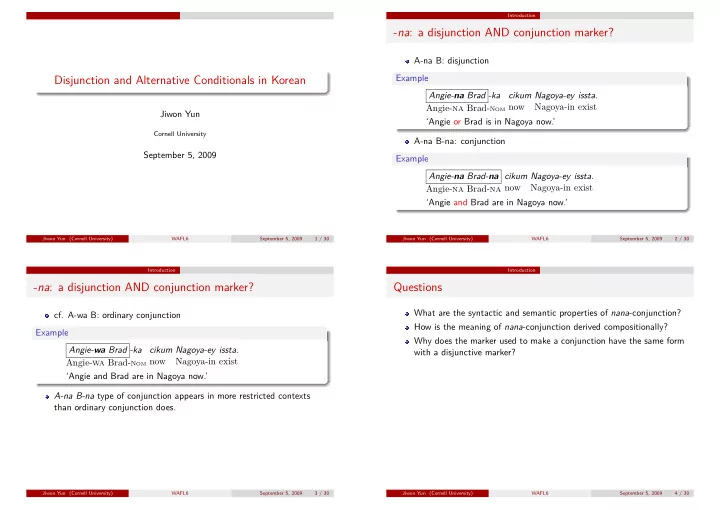
- na : a disjunction AND conjunction marker? A-na B: disjunction - - PowerPoint PPT Presentation

na a disjunction and conjunction marker
SMART_READER_LITE
LIVE PREVIEW

- na : a disjunction AND conjunction marker? A-na B: disjunction - - PowerPoint PPT Presentation

Introduction - na : a disjunction AND conjunction marker? A-na B: disjunction Example Disjunction and Alternative Conditionals in Korean Angie- na Brad -ka cikum Nagoya-ey issta. now Nagoya-in exist Angie- na Brad- N OM Jiwon Yun Angie


slide-1
SLIDE 1

Disjunction and Alternative Conditionals in Korean

Jiwon Yun

Cornell University

September 5, 2009

Jiwon Yun (Cornell University) WAFL6 September 5, 2009 1 / 30 Introduction

  • na: a disjunction AND conjunction marker?

A-na B: disjunction Example Angie-na Brad -ka Angie-na Brad-NOM cikum now Nagoya-ey Nagoya-in issta. exist ‘Angie or Brad is in Nagoya now.’ A-na B-na: conjunction Example Angie-na Brad-na Angie-na Brad-na cikum now Nagoya-ey Nagoya-in issta. exist ‘Angie and Brad are in Nagoya now.’

Jiwon Yun (Cornell University) WAFL6 September 5, 2009 2 / 30 Introduction

  • na: a disjunction AND conjunction marker?
  • cf. A-wa B: ordinary conjunction

Example Angie-wa Brad -ka Angie-wa Brad-NOM cikum now Nagoya-ey Nagoya-in issta. exist ‘Angie and Brad are in Nagoya now.’ A-na B-na type of conjunction appears in more restricted contexts than ordinary conjunction does.

Jiwon Yun (Cornell University) WAFL6 September 5, 2009 3 / 30 Introduction

Questions

What are the syntactic and semantic properties of nana-conjunction? How is the meaning of nana-conjunction derived compositionally? Why does the marker used to make a conjunction have the same form with a disjunctive marker?

Jiwon Yun (Cornell University) WAFL6 September 5, 2009 4 / 30

slide-2
SLIDE 2

Data: the properties of nana-conjunction Compatibility with an explicit case marker

Compatibility with an explicit case marker

Ordinary conjunctions can be followed by a case marker Example Angie-wa Angie-wa Brad-ka Brad-NOM cikum now Nagoya-ey Nagoya-in issta. exist ‘Angie and Brad are in Nagoya now.’ nana-conjunctions cannot be followed by a case marker. Example Angie-na Angie-na Brad-na-(*ka) Brad-na-(NOM) cikum now Nagoya-ey Nagoya-in issta. exist ‘Angie and Brad are in Nagoya now.’

Jiwon Yun (Cornell University) WAFL6 September 5, 2009 5 / 30 Data: the properties of nana-conjunction Givenness

Givenness

The conjuncts in nana-conjunction are a set of compatible things given in the previous discourse. Example A: na-nun I-TOP Angie-hako Angie-and Brad-lul Brad-ACC cohahay. like ‘I like Angie and Brad.’ B: Angie-na Angie-na Brad-na Brad-na cikum now Nagoya-ey Nagoya-in isse. exist ‘Angie and Brad are in Nagoya now.’

Jiwon Yun (Cornell University) WAFL6 September 5, 2009 6 / 30 Data: the properties of nana-conjunction Givenness

Givenness

The conjuncts in nana-conjunction are a set of compatible things given in the previous discourse.

e.g. nana-conjunction cannot be used to make the answer part to a question.

Example A: nwuka who.NOM cikum now Nagoya-ey Nagoya-in isse? exist ‘Who are in Nagoya now?’ B: #Angie-na Angie-na Brad-na Brad-na cikum now Nagoya-ey Nagoya-in isse. exist ‘Angie and Brad are in Nagoya now.’

Jiwon Yun (Cornell University) WAFL6 September 5, 2009 7 / 30 Data: the properties of nana-conjunction Exhaustivity

Exhaustivity

Example Andrew-na Andrew-na Brad-na Brad-na Chris-na Chris-na uica-ey chair-in ancaissta. sit ‘Andrew, Brad and Chris are sitting in a chair.’

Jiwon Yun (Cornell University) WAFL6 September 5, 2009 8 / 30

slide-3
SLIDE 3

Data: the properties of nana-conjunction Exhaustivity

Exhaustivity

In nana-conjunction, every given alternative should be exhaustively listed. Example #Andrew-na Andrew-na Brad-na Brad-na uica-ey chair-in ancaissta. sit ‘(intended meaning: Both Andrew and Brad are sitting in a chair.)’

Jiwon Yun (Cornell University) WAFL6 September 5, 2009 9 / 30 Data: the properties of nana-conjunction Distributivity

Distributivity

  • rdinary conjunction: collective vs. distributive readings

Example Andrew-wa Andrew-and Brad-wa Brad-and Chris-ka Chris-NOM nonmwun-ul paper-ACC hana

  • ne

nayssta. submit ‘Andrew, Brad, and Chris have submitted a paper.’ collective reading distributive reading

Jiwon Yun (Cornell University) WAFL6 September 5, 2009 10 / 30 Data: the properties of nana-conjunction Distributivity

Distributivity

nana-conjunction: only a distributive reading is possible Example Andrew-na Andrew-na Brad-na Brad-na Chris-na Chris-na nonmwun-ul paper-ACC hana

  • ne

nayssta. submit ‘Andrew, Brad, and Chris (each) have submitted a paper.’

Jiwon Yun (Cornell University) WAFL6 September 5, 2009 11 / 30 Data: the properties of nana-conjunction Summary

Interim Summary I

The properties of nana-conjunction:

Incompatibility with case markers Givenness Exhausitivity Distributivity

Where do they come from??

Jiwon Yun (Cornell University) WAFL6 September 5, 2009 12 / 30

slide-4
SLIDE 4

Analysis: Alternative Conditional Alternative Conditionals

Alternative Conditionals

Alternative Conditional (AC): another reapeated -na construction

p-na q-na r ‘Whether p or q, r’

Example John-i John-NOM palphyo-ha-na presentation-do-na Bill-i Bill-NOM palphyoha-na presentation-do-na Mary-nun Mary-TOP yelsimhi attentively tululkesita. listen ‘Whether John or Bill gives a presentation, Mary will be listening attentively.’ In this sentence -na is a clausal ending rather than a nominal ending, and the two clauses marked by -na make a conditional-like adjunct clause together.

Jiwon Yun (Cornell University) WAFL6 September 5, 2009 13 / 30 Analysis: Alternative Conditional Alternative Conditionals

Conjunctive Meaning of Alternative Conditionals

p-na q-na r ‘Whether p or q, r’ entails both ‘If p, r’ and ‘If q, r’ Example John-i John-NOM palphyo-ha-na presentation-do-na Bill-i Bill-NOM palphyoha-na presentation-do-na Mary-nun Mary-TOP yelsimhi attentively tululkesita. listen ‘Whether John or Bill gives a presentation, Mary will be listening attentively.’ → ‘If John gives a presentation, Mary will be listening attentively.’ → ‘If Bill gives a presentation, Mary will be listening attentively.’ Both p and q provide sufficient condition for the occurrence of the event denotated by the main clause.

Jiwon Yun (Cornell University) WAFL6 September 5, 2009 14 / 30 Analysis: Alternative Conditional Alternative Conditionals

Conjunctive Meaning of Alternative Conditionals

Then, what is the meaning of the clause p-na q-na itself? If we assume that the basic semantic interpretation of ACs is a conditional with a disjunctive antecedent, we can explain the conjunctive flavor of ACs in terms of logical properties of conditional and disjunction. SDA (simplification of disjunctive antecedent) (Loewer 1976) SDA (p ∨ q) ⊃ r ≡ (p ⊃ r) ∧ (q ⊃ r)

Jiwon Yun (Cornell University) WAFL6 September 5, 2009 15 / 30 Analysis: Alternative Conditional Alternative Conditionals

The Semantic Representation of Alternative Conditionals

The semantic representation of alternative conditionals Example p1-na p2-na · · · pn-na q = ((p1 → q) ∧ (p2 → q) ∧ · · · ∧ (pn → q))

Jiwon Yun (Cornell University) WAFL6 September 5, 2009 16 / 30

slide-5
SLIDE 5

Analysis: Alternative Conditional Analysis

nana-conjunction = Alternative Conditional with pro-drop

Proposal: nana-conjunction is actualy an alternative conditional with pro-drop. Example Annie-na Annie-na Becky-na Becky-na yeypputa. pretty ‘Both Annie and Becky are pretty.’ Example [ ei Annie-na ei Becky-na] [ ei yeypputa] . ei.NOM Annie-na ei.NOM Becky-na ei.NOM pretty The nominals that appear before -na are actually predicates. The subjects of the nominal predicates and the co-indexed argument in the main clause is omitted.

Jiwon Yun (Cornell University) WAFL6 September 5, 2009 17 / 30 Analysis: Alternative Conditional Analysis

nana-conjunction = Alternative Conditional with pro-drop

semantic representation of nana-conjunction Formula ∀[(being_A(x) → pretty(x)) and (being_B(x) → pretty(x))] I assume that the nominals that appear before -na are actually

  • ne-place predicates, s.t. they take an individual argument and return

true iff the individual is equivalent to the denotation of the nominal. We could assume an implicit copula verb between the nominal and

  • na (cf. Chung 1996).
  • na has an allomoph -ina, and the copula verb in Korean is i.

The co-indexed null elements in the adjunct and main clauses introduce free variables in the semantic representation The alternative conditional marker -na makes a conditional A conditional introduces an unselective universal operator if no explicit quantification is provided in the context (Heim 1982) The universal operator binds the free variables

Jiwon Yun (Cornell University) WAFL6 September 5, 2009 18 / 30 Analysis: Alternative Conditional Analysis

Properties of nana-conjunction: revisited

Alternative conditionals show Givenness and Exhaustivity

all conditions are given all given conditions should be listed

Example John-i John-NOM palphyo-ha-na presentation-do-na Bill-i Bill-NOM palphyoha-na presentation-do-na Mary-nun Mary-TOP yelsimhi attentively tululkesita. listen ‘Whether John or Bill gives a presentation, Mary will be listening attentively.’

Jiwon Yun (Cornell University) WAFL6 September 5, 2009 19 / 30 Analysis: Alternative Conditional Analysis

Properties of nana-conjunction: revisited

Incompatibility with case markers

na-conjunctive nominals are not followed by case markers because they are actually adjunct clauses.

Distributivity

by SDA (simplification of disjunctive antecedent) Example ∀[(Andrew(x) or Brad(x) or Chris(x)) → submit_paper(x)] ≡ ∀[(Andrew(x) → submit_paper(x)) and (Brad(x) → submit_paper(x)) and (Chris(x) → submit_paper(x))] This property also could be related to the reason why nana-conjunction marker has the same form with a disjunction marker.

Jiwon Yun (Cornell University) WAFL6 September 5, 2009 20 / 30

slide-6
SLIDE 6

Analysis: Alternative Conditional Summary

Interim Summary II

The properties of nana-conjunction can be neatly explained by the alternative conditional approach.

Givenness and Exhausitivity are original properties of alternative conditionals. Distributivity is explained by SDA. Incompatibility with case markers is due to the clausal structure.

Jiwon Yun (Cornell University) WAFL6 September 5, 2009 21 / 30 Extension: wh-na construction

wh-na: distributive universal

The alternative conditional approach to nana-conjunction can be extended to explain another puzzling expression, wh-na. wh-na: distributive universal Example nwukwu-na who-na aisu ice khulim-ul cream-ACC cohahanta. like ‘Everyone likes ice cream.’ The meaning of -na in previous works

question marker (Chung 1996) concessive marker (Lee 2003, Yoon 2004) disjunctive marker (Haspelmath 1995, Choi 2007)

Jiwon Yun (Cornell University) WAFL6 September 5, 2009 22 / 30 Extension: wh-na construction

wh-na and nana-conjunction

wh-words: sets of individuals (Hamblin 1973) Example nwukwu-na who-na aisu ice khulim-ul cream-ACC cohahanta. like ‘Everyone likes ice cream.’ Annie-na Annie-na Becky-na Becky-na · · · · · · Zelda-na Zelda-na aisu ice khulim-ul cream-ACC cohahanta. like The universal reading of wh-na comes from exhausitivity of alternative conditionals.

Jiwon Yun (Cornell University) WAFL6 September 5, 2009 23 / 30 Extension: wh-na construction

The semantic representation of -na revisited

The semantic representation of alternative conditionals Example p1-na p2-na · · · pn-na q = ((p1 → q) ∧ (pi → q) ∧ · · · ∧ (pi → q)) it was hard to extract the meaning of -na itself from this representation.

Jiwon Yun (Cornell University) WAFL6 September 5, 2009 24 / 30

slide-7
SLIDE 7

Extension: wh-na construction

The semantic representation of -na revisited

Now I assume that -na takes a set of condition propositions as argument, and it appears in the semantic representation only once, as in wh-na. The apparent multiple occurrence of -na could be spreading/concord effect. The semantic representation of alternative conditionals (revised) Example {p1, p2, · · · , pn}-na q = ∀pi[(pi ∈ p) ⊃ (pi → q))], where p is a set of propositions {p1, p2, · · · , pn} The semantic representation of -na in alternative conditionals Example

  • na = λpλq[∀pi[(pi ∈ p) ⊃ (pi → q))]],

where p is a set of propositions {p1, p2, · · · , pn}

  • na takes a set of condition propositions and a consequent proposition

Jiwon Yun (Cornell University) WAFL6 September 5, 2009 25 / 30 Extension: wh-na construction

distributivity of wh-na

wh-na shows the same rigorous distributivity as nana-conjunction. Example Nwukwu-na who-na nonmwun-ul paper-ACC hana

  • ne

nayssta. submit ‘Everyone has submitted a paper.’

Jiwon Yun (Cornell University) WAFL6 September 5, 2009 26 / 30 Extension: wh-na construction

Compatibility with case markers of wh-na

wh-na followed by a case marker is marginal, but doesn’t seem impossible a Google search nwukwu-na-ka (nominative) 181,000 nwukwu-na-lul (accusative) 10,500 nwukwu-na ‘everyone’ 11,500,000

  • cf. nana-conjunction is incompatible with a case marker

ne-na na-na-ka (nominative) 1 ne-na na-na-lul (accusative) ne-na na-na ‘Both you and me’ 40,300 wh-na is in the process of grammaticalization (cf. Haspelmath 1995, Yoon 2004)? Possibly.

Jiwon Yun (Cornell University) WAFL6 September 5, 2009 27 / 30 Conclusion Conclusion

Conclusion

nana-conjunction and wh-na both are originated from alternative conditionals. The alternative conditional approach gives a unified and neat explanation for the syntactic and semantic properties of both structures.

Jiwon Yun (Cornell University) WAFL6 September 5, 2009 28 / 30

slide-8
SLIDE 8

Conclusion References

References I

Choi, Jinyoung. 2007. Free choice and negative polarity: a compositional analysis of Korean polarity sensitive items. Doctoral Dissertation, University of Pennsylvania. Chung, Daeho. 1996. On the representation of Q and Q-dependencies. Doctoral Dissertation, University of Southern California. Hamblin, Charles Leonard. 1973. Questions in Montague English. Foundations of Language 10:41–53. Haspelmath, Martin. 1995. Diachronic sources of ‘all’ and ‘every’. In Quantification in natural languages, ed. Emmon Bach, Eloise Jelinek, and Angelika Kratzer, 363–382. Kluwer Academic Publishers. Heim, Irene. 1982. The semantics of definite and indefinite noun phrases. Doctoral Dissertation, University of Massachusetts, Amherst.

Jiwon Yun (Cornell University) WAFL6 September 5, 2009 29 / 30 Conclusion References

References II

Lee, Chungmin. 2003. Negative polarity items and free choice in Korean and Japanese: A contrastive study . Loewer, Barry. 1976. Counterfactuals with disjunctive antecedents. Journal of Philosophy 73:531–537. Yoon, Jeong-Me. 2004. Unified clausal approach to wh-constructions in Korean revisited: an analysis based on reanalysis. Studies in Generative Grammar 14-1:3–38.

Jiwon Yun (Cornell University) WAFL6 September 5, 2009 30 / 30