SLIDE 1 The Traveling Salesman Problem
Problem statement: A travelling salesman must visit every city in his territory exactly
- nce and then return to his starting point. Given the cost of travel between all pairs
- f cities, find the minimum cost tour.
§
NP-Complete Problem
§
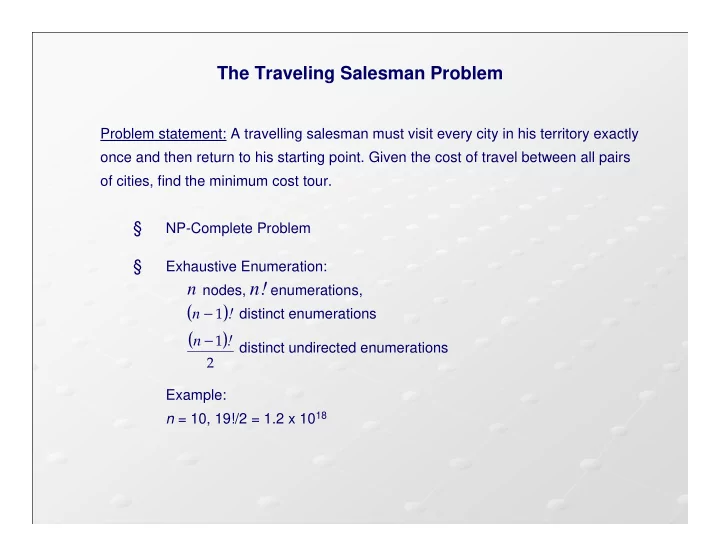
Exhaustive Enumeration: nodes, enumerations, distinct enumerations distinct undirected enumerations Example: n = 10, 19!/2 = 1.2 x 10¹⁸
n
! n
( )!
n
1
−
( )
2 1 !
n −
SLIDE 2
The Traveling Salesman Problem
TSP: find the shortest tour connecting a set of cities. Following Hopfield & Tank (1985) a tour can be represented by a permutation matrix:
1 2 3 4 A 1 B 1 C 1 D 1 Tour: BACD
SLIDE 3 The Traveling Salesman Problem
The TSP, showing a good (a) and a bad (b) solution to the same problem Network to solve a four-city TSP. Solid and open circles denote units that are
- n and off respectively when the net is
representing the tour 3-2-4-1. The connections are shown only for unit n22; solid lines are inhibitory connections
- f strength –dij, and dotted lines are uni-
form inhibitory connections of strength –γ. All connections are symmetric. Thresholds are not shown.
(a) (b)
1 2 3 4 1 2 3 4 Stop City
d12 d23
SLIDE 4
Artificial Neural Network Solution
Solution to n-city problem is presented in an n x n permutation matrix V X = city i = stop at wich the city is visited Voltage output: VX,i Connection weights: TXi,Yj n2 neurons VX,i = 1 if city X is visited at stop i dXY = distance between city X and city Y
SLIDE 5 Artificial Neural Network Solution
We want to minimize the total distance
Each city must be visited once Each stop must contain one city The matrix must contain n entries
( )
1 1 1
2
− + ≠
+ =
∑ ∑ ∑
i , Y i , Y i , X X X Y i XY
V V V d D E
∑ ∑ ∑
≠
=
X i i j j , X i , X V
V A E
2
2
∑ ∑ ∑
≠
=
i X X Y i , Y i , X V
V B E
2
3 2 4
2
− =
∑ ∑
X i i , X
n V C E
SLIDE 6 Artificial Neural Network Solution
- A, B, C, and D are positive constants
- Indici modulo n
Total cost function La funzione energia della rete di Hopfield è:
( )
1 1 2
2 2 2 2
− + ≠ ≠ ≠
+ + − + + =
∑ ∑ ∑ ∑ ∑ ∑ ∑ ∑ ∑ ∑ ∑
i , Y i , Y i , X X X Y i XY X i i , X i X X Y i , Y i , X X i i j j , X i , X
V V V d D n V C V V B V V A E
Xi i X Xi Yj Xi Y X j i Yj , Xi
V I V V T E
∑ ∑ ∑
− − =
2 1
SLIDE 7 Weights of the Network
The coefficients of the quadratic terms in the cost function define the weights
- f the connections in the network
{Inhibitory connection in each row} {Inhibitory connection in each column} {Global inhibition} {Data term} {Corrente esterna eccitatoria}
( )
( )
( )
1 1
1 1
− + +
− − − − − − =
i , j i , j XY XY ij ij XY Yj , Xi
Dd C B A T δ δ δ δ δ δ ≠ = = j i if j i if
ij
1
δ
n Xi
C I =
SLIDE 8 Experiments
- 10-city problem, 100 neurons
- Locations of the 10 cities are chosen randomly with uniform p.d.f. in unit square
- Parameters: A = B = 500, C = 200, D = 500
- The size of the squares correspond to the value of the voltage output
at the corresponding neurons.
- Path: D-H-I-F-G-E-A-J-C-B
SLIDE 9 TSP – Un’altra formulazione
Un altro modo per esprimere i vincoli del TSP (cioè matrice di permutazione) è il seguente :
vincolo sulle righe vincolo sulle colonne
La funzione energia diventa : Vantaggio : minor numero di parametri (A,B,D)
2 2
1 2 ∑ ∑
− =
X i i X
V A E
2 3
1 2 ∑ ∑
− =
i X i X
V B E
( )
3 2 1 1
2
E E V V V d D E
i Y i Y i X X X Y i Y X
+ + + =
− + ≠
∑ ∑ ∑
SLIDE 10
Problema delle n regine
Si può costruire una rete n x n in cui il neurone ( i, j ) è attivo se e solo se una regina occupa la posizione ( i, j ) Ci sono 4 vincoli :
1.
solo una regina in ciascuna riga
2.
solo una regina in ciascuna colonna
3.
solo una regina in ciascuna diagonale
4.
esattamente n regine sulla scacchiera
SLIDE 11
Problema delle n regine
La matrice dei pesi si determina così : A ≡ peso inibitorio sulle righe B ≡ peso inibitorio sulle colonne C ≡ peso inibitorio “globale” D ≡ peso inibitorio sulle diagonali
( ) ( ) ( )( )
k i l k , j i l k , j i k i l j k i l j l k , j i
D C B A T δ δ δ δ δ δ δ − + + + − + − = −
− − + +
1 1 1
SLIDE 12
Reti di Hopfield per ottimizzazione
Problemi associati con il modello di Hopfield originale : 1) numero di connessioni O(n4) e numero di unità O(n2) 2) difficoltà per la determinazione dei parametri A, B, C, D 3) le soluzioni ottenute sono raramente “matrici di permutazione” 4) difficoltà nell’evitare i minimi locali