
SLIDE 1
- Prof. Marcello Pelillo
Ca’ Foscari University of Venice a.y. 2016/17
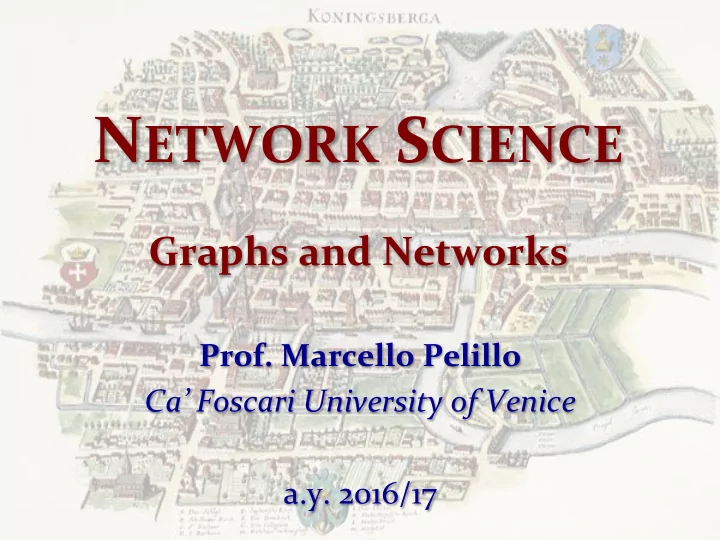
N ETWORK S CIENCE Graphs and Networks Prof. Marcello Pelillo Ca - - PowerPoint PPT Presentation
N ETWORK S CIENCE Graphs and Networks Prof. Marcello Pelillo Ca Foscari University of Venice a.y. 2016/17 Section 1 The Bridges of Konigsberg Drawing Curves with a Single Stroke Knigsberg (todays Kaliningrad, Russia)
Ca’ Foscari University of Venice a.y. 2016/17
Section 1
Drawing Curves with a Single Stroke…
Königsberg (today’s Kaliningrad, Russia)
Konigsberg’s People
Immanuel Kant (1724 – 1804) David Hilbert (1862 – 1943) Gustav Kirchhoff (1824 – 1887)
Can one walk across the seven bridges and never cross the same bridge twice?
Network Science: Graph Theory
THE BRIDGES OF KONIGSBERG
Can one walk across the seven bridges and never cross the same bridge twice?
Network Science: Graph Theory
THE BRIDGES OF KONIGSBERG
1735: Euler’s theorem: (a) If a graph has more than two nodes of odd degree, there is no path. (b) If a graph is connected and has no odd degree nodes, or two such vertices, it has at least one path. Euler’s solution is considered to be the first theorem in graph theory.
The Bridges Today
A “Local” Variation of Euler’s Problem
Graphs and networks after the “bridges”
1930)
Section 2
COMPONENTS OF A COMPLEX SYSTEM
Network Science: Graph Theory
§ components: nodes, vertices N § interactions: links, edges L § system: network, graph
(N,L)
network often refers to real systems
Language: (Network, node, link)
graph: mathematical representation of a network
Language: (Graph, vertex, edge)
We will try to make this distinction whenever it is appropriate, but in most cases we will use the two terms interchangeably.
NETWORKS OR GRAPHS?
Network Science: Graph Theory
A COMMON LANGUAGE
Network Science: Graph Theory
N=4 L=4
The choice of the proper network representation determines our ability to use network theory successfully. In some cases there is a unique, unambiguous representation. In other cases, the representation is by no means unique. For example, the way we assign the links between a group of individuals will determine the nature of the question we can study.
CHOOSING A PROPER REPRESENTATION
Network Science: Graph Theory
If you connect individuals that work with each other, you will explore the professional network.
CHOOSING A PROPER REPRESENTATION
Network Science: Graph Theory
If you connect those that have a romantic and sexual relationship, you will be exploring the sexual networks. CHOOSING A PROPER REPRESENTATION
Network Science: Graph Theory
If you connect individuals based on their first name (all Peters connected to each other), you will be exploring what? It is a network, nevertheless.
CHOOSING A PROPER REPRESENTATION
Network Science: Graph Theory
Links: undirected (symmetrical) Graph: Directed links : URLs on the www phone calls metabolic reactions
Network Science: Graph Theory
UNDIRECTED VS. DIRECTED NETWORKS
Undirected Directed
A B D C L M F G H I
Links: directed (arcs). Digraph = directed graph: Undirected links : coauthorship links Actor network protein interactions
An undirected link is the superposition of two opposite directed links. A G F B C D E
Section 2.2 Reference Networks
NETWORK NODES LINKS N L DIRECTED UNDIRECTED WWW Power Grid Mobile Phone Calls Email Science Collaboration Actor Network Citation Network
Protein Interactions Webpages Power plants, transformers Subscribers Email addresses Scientists Actors Paper Metabolites Proteins Links Cables Calls Emails Co-authorship Co-acting Citations Chemical reactions Binding interactions Directed Undirected Directed Directed Undirected Undirected Directed Directed Undirected 325,729 4,941 36,595 57,194 23,133 702,388 449,673 1,039 2,018 1,497,134 6,594 91,826 103,731 93,439 29,397,908 4,689,479 5,802 2,930 Internet Routers Internet connections Undirected 192,244 609,066
Section 2.3
Node degree: the number of links connected to the node.
kB = 4
NODE DEGREES
Undirected
In directed networks we can define an in-degree and out-degree. The (total) degree is the sum of in- and out-degree. Source: a node with kin= 0; Sink: a node with kout= 0.
2 k in
C =
1 k out
C
= 3 =
C
k
Directed
A G F B C D E
A B
kA =1
Network Science: Graph Theory
A BIT OF STATISTICS
BRIEF STATISTICS REVIEW
Four key quantities characterize a sample of N values x1, ... , xN : Average (mean): The nth moment:
…
∑
= + + + =
=
x x x x N N x 1
N i i N 1 2 1
…
∑
= + + + =
=
xn x x x N N x 1
n n n N n i i N 1 2 1
Standard deviation:
∑
σ
( )
= −
=
N x x 1
x i i N 2 1
. Distribution of x: where px follows
∑δ
= p N 1
x x x i , i
N – the number of nodes in the graph
∑
=
≡
N i i
k N k
1
1
in N 1 i
i
N 1 i in i in
k k , k N 1 k , k N 1 k = ≡ ≡
= =
k ≡ 2L N
k ≡ L N
Network Science: Graph Theory
AVERAGE DEGREE
Undirected Directed
A F B C D E j i
Network Science: Graph Theory
Average Degree
NETWORK NODES LINKS N L k DIRECTED UNDIRECTED WWW Power Grid Mobile Phone Calls Email Science Collaboration Actor Network Citation Network
Protein Interactions Webpages Power plants, transformers Subscribers Email addresses Scientists Actors Paper Metabolites Proteins Links Cables Calls Emails Co-authorship Co-acting Citations Chemical reactions Binding interactions Directed Undirected Directed Directed Undirected Undirected Directed Directed Undirected 325,729 4,941 36,595 57,194 23,133 702,388 449,673 1,039 2,018 1,497,134 6,594 91,826 103,731 93,439 29,397,908 4,689,479 5,802 2,930 Internet Routers Internet connections Undirected 192,244 609,066 6.33 4.60 2.67 2.51 1.81 8.08 83.71 10.43 5.58 2.90
Degree distribution
P(k): probability that a randomly chosen node has degree k Nk = # nodes with degree k P(k) = Nk / N ➔ plot
DEGREE DISTRIBUTION
DEGREE DISTRIBUTION
Section 2.4
Aij=1 if there is a link between node i and j Aij=0 if nodes i and j are not connected to each other.
Network Science: Graph Theory
ADJACENCY MATRIX
Note that for a directed graph (right) the matrix is not symmetric. 4 2 3 1 2 3 1 4
Aij = 1 Aij = 0
if there is a link pointing from node j and i if there is no link pointing from j to i.
Aij = 1 1 1 1
Aij = 1 1 1 1 1 1 1 1
ki = Aij
j =1 N
∑
ADJACENCY MATRIX AND NODE DEGREES
Undirected
2 3 1 4
Aij = 1 1 1 1 1 1 1 1 ⎛ ⎝ ⎜ ⎜ ⎜ ⎜ ⎞ ⎠ ⎟ ⎟ ⎟ ⎟
k j = Aij
i=1 N
∑
L = 1 2 ki
i=1 N
∑
= 1 2 Aij
ij N
∑ Directed
kj
Aij
i=1 N
∑
L = ki
in i=1 N
∑
= k j
j=1 N
∑
= Aij
i, j N
∑
4 2 3 1
Aij = 1 1 1 1 ! " # # # # $ % & & & &
Aij = A ji Aii = 0 Aij ≠ A ji Aii = 0
kin
i = N
X
j=1
Aij
a a b c d e f g h a 0 1 0 0 1 0 1 0 0 1 0 0 1 0 1 0 b 1 0 1 0 0 0 0 1 1 0 1 0 0 0 0 1 c 0 1 0 1 0 1 1 0 0 1 0 1 0 1 1 0 d 0 0 1 0 1 0 0 0 0 0 1 0 1 0 0 0 e 1 0 0 1 0 0 0 0 1 0 0 1 0 0 0 0 f 0 0 1 0 0 0 1 0 0 0 1 0 0 0 1 0 g 1 0 1 0 0 0 0 0 1 0 1 0 0 0 0 0 h 0 1 0 0 0 0 0 0 0 1 0 0 0 0 0 0
ADJACENCY MATRIX
Network Science: Graph Theory
b e g a c f h d
Section 4
The maximum number of links a network
Lmax = N 2 ⎛ ⎝ ⎜ ⎞ ⎠ ⎟ = N(N −1) 2
A graph with degree L=Lmax is called a complete graph, and its average degree is <k>=N-1
Network Science: Graph Theory
COMPLETE GRAPH
Most networks observed in real systems are sparse: L << Lmax
<k> <<N-1.
WWW (ND Sample): N=325,729; L=1.4 106 Lmax=1012 <k>=4.51 Protein (S. Cerevisiae): N= 1,870; L=4,470 Lmax=107 <k>=2.39 Coauthorship (Math): N= 70,975; L=2 105 Lmax=3 1010 <k>=3.9 Movie Actors: N=212,250; L=6 106 Lmax=1.8 1013 <k>=28.78
(Source: Albert, Barabasi, RMP2002)
Network Science: Graph Theory
REAL NETWORKS ARE SPARSE
ADJACENCY MATRICES ARE SPARSE
Network Science: Graph Theory
Section 2.6
WEIGHTED AND UNWEIGHTED NETWORKS
Section 2.7
bipartite graph (or bigraph) is a graph whose nodes can be divided
into two disjoint sets U and V such that every link connects a node in U to
Examples:
Hollywood actor network Collaboration networks Disease network (diseasome)
BIPARTITE GRAPHS
Network Science: Graph Theory
Goh, Cusick, Valle, Childs, Vidal & Barabási, PNAS (2007)
GENE NETWORK – DISEASE NETWORK
Network Science: Graph Theory
The human diseaseome is a biparIte network, whose nodes are diseases (U) and genes (V), in which a disease is connected to a gene if mutaIons in that gene are known to affect the parIcular disease
HUMAN DISEASE NETWORK
Section 2.8
A path is a sequence of nodes in which each node is adjacent to the next one Pi0,in of length n between nodes i0 and in is an ordered collection of n+1 nodes and n links
P
n = {i0,i1,i2,...,in}
P
n = {(i0,i 1),(i 1,i2),(i2,i3),...,(in−1,in)}
Network Science: Graph Theory
PATHS
The distance (shortest path, geodesic path) between two nodes is defined as the number of edges along the shortest path connecting them. *If the two nodes are disconnected, the distance is infinity. In directed graphs each path needs to follow the direction of the arrows. Thus in a digraph the distance from node A to B (on an AB path) is generally different from the distance from node B to A (on a BCA path).
Network Science: Graph Theory
DISTANCE IN A GRAPH Shortest Path, Geodesic Path
D C A B D C A B
Nij,number of paths between any two nodes i and j:
Length n=1: If there is a link between i and j, then Aij=1 and Aij=0 otherwise. Length n=2: If there is a path of length two between i and j, then AikAkj=1, and AikAkj=0 otherwise. The number of paths of length 2:
N
ij
(2) =
Aik
k=1 N
∑
Akj = [A2]ij
Length n: In general, the number of paths of length n between i and j is*
N
ij
(n) = [An]ij
*holds for both directed and undirected networks.
Network Science: Graph Theory
NUMBER OF PATHS BETWEEN TWO NODES Adjacency Matrix
Distance between node 0 and node 4:
Network Science: Graph Theory
FINDING DISTANCES: BREADTH FIRST SEARCH
Network Science: Graph Theory
1 1 1 1 2 2 2 2 2 3 3 3 3 3 3 3 3 4 4 4 4 4 4 4 4
Network Science: Graph Theory
Network Science: Graph Theory
1 1 1 1 2 2 2 2 2 3 3 3 3 3 3 3 3 4 4 4 4 4 4 4 4
Distance between node 0 and node 4:
Network Science: Graph Theory
FINDING DISTANCES: BREADTH FIRST SEARCH
1 1 1
Network Science: Graph Theory
1 1 1 1 2 2 2 2 2 3 3 3 3 3 3 3 3 4 4 4 4 4 4 4 4
Distance between node 0 and node 4:
Network Science: Graph Theory
FINDING DISTANCES: BREADTH FIRST SEARCH
1 1 1 2 2 2 2 2
Network Science: Graph Theory
1 1
Distance between node 0 and node 4:
FINDING DISTANCES: BREADTH FIRST SEARCH
Network Science: Graph Theory
1 1 1 2 2 2 2 2 3 3 3 3 3 3 3 3 4 4 4 4 4 4 4 4
FINDING DISTANCES: BREADTH FIRST SEARCH
The computaIonal complexity of the BFS algorithm, represenIng the approximate number of steps the computer needs to find dij on a network of N nodes and L links, is O(N + L)
TESTING BIPARTITENESS
BFS can be used to test biparIteness, by starIng the search at any vertex and giving alternaIng labels to the verIces visited during the search. That is, give label 0 to the starIng vertex, 1 to all its neighbors, 0 to those neighbors' neighbors, and so on. If at any step a vertex has (visited) neighbors with the same label as itself, then the graph is not biparIte. If the search ends without such a situaIon occurring, then the graph is biparIte. Note A graph is biparIte iff it contains no odd cycle. Try here!
Diameter ( dmax ): the maximum distance between any pair of nodes in the graph. where dij is the distance from node i to node j Average distance ( <d> ): for a connected graph
d ≡ 1 N(N −1) dij
j≠i
i
Network Science: Graph Theory
NETWORK DIAMETER AND AVERAGE DISTANCE
dmax ≡ max
i≠j dij
Network Science: Graph Theory
PATHOLOGY: summary
2 5 4 3 1
l1→4 l1→4 l1→5
Shortest Path
l1→5 = 2 l1→4 = 3
The path with the shortest length between two nodes (distance).
Network Science: Graph Theory
PATHOLOGY: summary
2 5 4 3 1 Diameter
l1→4 = 3
2 5 4 3 1 Average Path Length
(l1→2 + l1→3 + l1→4+ + l1→5 + l2→3 + l2→4+ + l2→5 + l3→4 + l3→5+ + l4→5) /10 = 1.6
The longest shortest path in a graph The average of the shortest paths for all pairs of nodes.
Network Science: Graph Theory
PATHOLOGY: summary
2 5 4 3 1 Cycle
A path with the same start and end node.
Network Science: Graph Theory
PATHOLOGY: summary
2 5 4 3 1 2 5 4 3 1 Eulerian Path Hamiltonian Path
A path that visits each node exactly once. A path that traverses each link exactly once.
Section 2.9
Connected (undirected) graph: any two vertices can be joined by a path. A disconnected graph is made up by two or more connected components. Bridge: if we erase it, the graph becomes disconnected. Largest Component: Giant Component The rest: Isolates
Network Science: Graph Theory
CONNECTIVITY OF UNDIRECTED GRAPHS
D C A B F F G D C A B F F G
The adjacency matrix of a network with several components can be written in a block- diagonal form, so that nonzero elements are confined to squares, with all other elements being zero:
Network Science: Graph Theory
CONNECTIVITY OF UNDIRECTED GRAPHS Adjacency Matrix
Strongly connected directed graph: has a path from each node to
every other node and vice versa (e.g. AB path and BA path).
Weakly connected directed graph: it is connected if we disregard the
edge directions.
Network Science: Graph Theory
CONNECTIVITY OF DIRECTED GRAPHS
D C A B F G E E C A B G F D
Section 2.9
Section 10
What fraction of your neighbors are connected? Node i with degree ki ei = number of links between the ki neighbors of i Note: 0 ≤ Ci ≤ 1
Network Science: Graph Theory
CLUSTERING COEFFICIENT
Cliques
vertices
contained in a larger one
cardinality The clique number, denote ω(G), is the cardinality of a maximum clique. Independent set: clique on the complement of G Given an unweighted undirected graph G=(V,E):
Section 11
Degree distribution: P(k) Path length: <d> Clustering coefficient:
Network Science: Graph Theory
THREE CENTRAL QUANTITIES IN NETWORK SCIENCE
3
Aij = 1 1 1 1 1 1 1 1 ⎛ ⎝ ⎜ ⎜ ⎜ ⎜ ⎞ ⎠ ⎟ ⎟ ⎟ ⎟ Aii = 0 Aij = A ji L = 1 2 Aij
i, j=1 N
∑
< k >= 2L N Aij = 1 1 1 1 ⎛ ⎝ ⎜ ⎜ ⎜ ⎜ ⎞ ⎠ ⎟ ⎟ ⎟ ⎟
Aii = 0 Aij ≠ A ji L = Aij
i, j=1 N
∑
< k >= L N
Network Science: Graph Theory
GRAPHOLOGY 1
Undirected Directed
1 4 2 3 2 1 4
Actor network, protein-protein interactions WWW, citation networks
Aij = 1 1 1 1 1 1 1 1 ⎛ ⎝ ⎜ ⎜ ⎜ ⎜ ⎞ ⎠ ⎟ ⎟ ⎟ ⎟
Aii = 0 Aij = A ji L = 1 2 Aij
i, j=1 N
∑
< k >= 2L N
Aij = 2 0.5 2 1 4 0.5 1 4 ⎛ ⎝ ⎜ ⎜ ⎜ ⎜ ⎞ ⎠ ⎟ ⎟ ⎟ ⎟
Aii = 0 Aij = A ji L = 1 2 nonzero(Aij)
i, j=1 N
∑
< k >= 2L N
Network Science: Graph Theory
GRAPHOLOGY 2
Unweighted
(undirected)
Weighted
(undirected)
3 1 4 2 3 2 1 4
protein-protein interactions, www Call Graph, metabolic networks
Aij = 1 1 1 1 1 1 1 1 1 1 ⎛ ⎝ ⎜ ⎜ ⎜ ⎜ ⎞ ⎠ ⎟ ⎟ ⎟ ⎟
Aii ≠ 0 Aij = Aji L = 1 2 Aij + Aii
i=1 N
∑
i, j=1,i≠j N
∑
Aij = 2 1 2 1 3 1 1 3 ⎛ ⎝ ⎜ ⎜ ⎜ ⎜ ⎞ ⎠ ⎟ ⎟ ⎟ ⎟
Aii = 0 Aij = Aji L = 1 2 Aij
i, j=1 N
∑
< k >= 2L N
Network Science: Graph Theory
GRAPHOLOGY 3
Self-interactions Multigraph
(undirected)
3 1 4 2 3 2 1 4
Protein interaction network, www Social networks, collaboration networks
Aij = 1 1 1 1 1 1 1 1 1 1 1 1 ⎛ ⎝ ⎜ ⎜ ⎜ ⎜ ⎞ ⎠ ⎟ ⎟ ⎟ ⎟
Aii = 0 Ai≠ j =1 L = Lmax = N(N −1) 2 < k >= N −1
Network Science: Graph Theory
GRAPHOLOGY 4
Complete Graph (Clique)
(undirected)
3 1 4 2
Actor network, protein-protein interactions
Network Science: Graph Theory
GRAPHOLOGY: Real networks can have multiple characteristics
WWW > directed multigraph with self-interactions Protein Interactions > undirected unweighted with self-interactions Collaboration network > undirected multigraph or weighted. Mobile phone calls > directed, weighted. Facebook Friendship links > undirected,
unweighted.