My Obstetrician Got However Me Fired : How work notes can be I am - - PowerPoint PPT Presentation

my obstetrician got
SMART_READER_LITE
LIVE PREVIEW

My Obstetrician Got However Me Fired : How work notes can be I am - - PowerPoint PPT Presentation

10/27/2016 I have no financial disclosures My Obstetrician Got However Me Fired : How work notes can be I am not a lawyer nor a Human harmful Resources expert and how to make them better Rebecca Jackson, MD, Obstetrics, Gynecology


slide-1
SLIDE 1

10/27/2016 1

Department of Obstetrics, Gynecology & Reproductive Sciences

My Obstetrician Got Me Fired:

How work notes can be harmful… and how to make them better

Rebecca Jackson, MD,

Obstetrics, Gynecology and Reproductive Sciences Zuckerberg San Francisco General Hospital University of California, San Francisco

Department of Obstetrics, Gynecology & Reproductive Sciences

I have no financial disclosures

However…… I am not a lawyer nor a Human Resources expert

2 Department of Obstetrics, Gynecology & Reproductive Sciences

Partners

  • Joan Hastings JD
  • Liz Morris JD
  • Sharon Terman JD
  • Julia Parish JD
  • Jenna Gerry JD

Department of Obstetrics, Gynecology & Reproductive Sciences

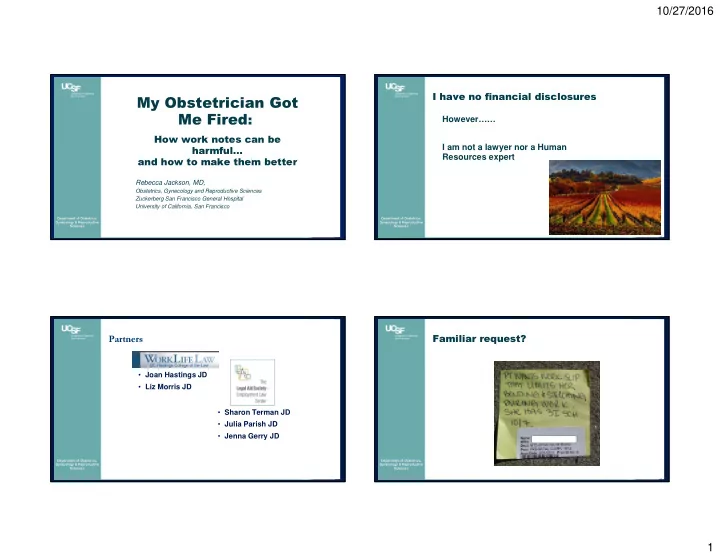
Familiar request?

4

slide-2
SLIDE 2

10/27/2016 2

Young vs UPS

Department of Obstetrics, Gynecology & Reproductive Sciences

Preview

  • Why we should care
  • Is it safe for women to work in

pregnancy?

  • The minimum we need to know about

leave and accommodations

  • How to write a work modification or

leave letter to protect our patients’ jobs and pay

6 Department of Obstetrics, Gynecology & Reproductive Sciences

US Working Mothers

  • 67% of first time mothers work, most work

full-time, over 80% work well into the 3rd trimester (EEOC)

  • 40% of mothers are the primary

breadwinners for families in the US today

  • Juggling work, pregnancy, motherhood is
  • stressful. Worse is losing a job just as you

are about to start/enlarge your family

  • The US lacks social supports and social

protection to buffer against stresses

(Glynn, S.J. Center for American Progress 2012)

Department of Obstetrics, Gynecology & Reproductive Sciences

Pregnancy discrimination prevalence

  • In a structured interview study of 165

working women, 69% reported at least one form of workplace adversity during pregnancy

  • Higher prevalence in public vs. privately

insured women

(Cooklin, Rowe & Fisher, 2007)

2000 4000 6000 8000 1997 2010

EEOC Pregnancy Discrimination Charges

slide-3
SLIDE 3

10/27/2016 3

Department of Obstetrics, Gynecology & Reproductive Sciences

Work accommodations for pregnancy

  • In a national survey of working

pregnant women, more than half felt they needed a change in their job duties or schedule

  • ~40% of them never requested an

accommodation

  • Of those who did, at least 13% were

denied.

9

Declercq ER, J Perinat Educ 2014

Department of Obstetrics, Gynecology & Reproductive Sciences

It still happens. Employers….

  • Fire women when they divulge pregnancy
  • Decide what a pregnant woman should and

shouldn’t do at work (“shouldn’t you be at home

growing your baby?!)

  • Hold pregnant women to higher standards—

they are forced to “prove” themselves capable

  • Tell them they can’t have time off to go to

prenatal appointments

  • Force them out on leave rather than making

simple accommodations

EEOC cases

Department of Obstetrics, Gynecology & Reproductive Sciences

Today, we’re the only advanced country on Earth that doesn’t guarantee paid sick leave or paid maternity leave to our workers. Forty-three million workers have no paid sick leave. Forty-three

  • million. Think about that. And that forces too

many parents to make the gut-wrenching choice between a paycheck and a sick kid at home. So I’ll be taking new action to help states adopt paid leave laws of their own."

Department of Obstetrics, Gynecology & Reproductive Sciences

US lacks a paid national maternity leave policy

  • The Family Medical Leave Act (FMLA)

guarantees unpaid job protected leave for up to 12 weeks

  • Restricted to:

– Women who have worked for an employer for at least 1250 hours/year – Employer must have at least 50 employees

  • Less than 50% of US workers are covered

by FMLA

  • 20% of new mothers are eligible
slide-4
SLIDE 4

10/27/2016 4

Department of Obstetrics, Gynecology & Reproductive Sciences

Is it safe to work while pregnant?

13 Department of Obstetrics, Gynecology & Reproductive Sciences

Safety of working during pregnancy

  • Early studies focused on concerns around workplace

exposures and teratogens for the fetus

  • More recent evidence examines associations between

certain working conditions and SAB, PTB, and other ob

  • utcomes.

– Evidence low quality: observational studies, mostly retrospective, many do not control for confounders, often assess for occupational exposure AFTER delivery (recall bias) – Work types are inconsistently defined making comparison between studies difficult and many studies include only first trimester employment

  • Bottom line: Use caution when interpreting—results

could be due to bias/confounding especially for odds ratios <2.0)

14 Department of Obstetrics, Gynecology & Reproductive Sciences

Preterm delivery and work

  • Being employed (vs not) doesn’t increase risk
  • For physically demanding work, most prospective

studies show no increased risk of PTD but a few do

  • Multiple meta-analyses:

– Physically demanding work (prolonged standing, heavy lifting, physical exertion, occupational fatigue and demanding posture): OR 1.3 (1.1-1.6) (van

Beukering, 2014)

– Work>40h, stand>4 hr, shift work: OR 1.1-1.2

(Palmer, 2013)

– Higher quality studies had lower OR’s

  • OR <1.5 likely due to bias and confounding

15 Department of Obstetrics, Gynecology & Reproductive Sciences

What does ACOG say?

  • Not much
  • Guidelines for Perinatal Care (7th edition):

16

slide-5
SLIDE 5

10/27/2016 5

Department of Obstetrics, Gynecology & Reproductive Sciences

Other guidelines about work in pregnancy?

American Medical Association Council

  • n Scientific Affairs. Effects of

pregnancy on work performance. JAMA 1984;251:1995-7.

17 Department of Obstetrics, Gynecology & Reproductive Sciences

What does UpToDate say?

SUMMARY AND RECOMMENDATIONS —

  • Systematic reviews have generally concluded that

standard working conditions present little hazard to maternal or child health. A woman with an uncomplicated pregnancy who is employed where there are no greater potential hazards than those encountered in routine daily life may continue to work without interruption until the

  • nset of labor. However, the physical demands of the

woman's job should be considered on a case-by-case basis, especially in women at higher risk of preterm delivery or who have medical or obstetrical disorders that are unstable or associated with impaired placental perfusion (eg, preeclampsia, fetal growth restriction). Similarly, avoidance of possibly toxic exposures during pregnancy is prudent.

Department of Obstetrics, Gynecology & Reproductive Sciences

What about lifting?

  • Physically demanding work is associated with low

back pain, musculoskeletal disorders

  • Proposed guidelines for lifting published in AJOG

in 2013

  • Use an NIOSH “lifting equation” to determine the

RWL=recommended weight limit, the load nearly all healthy workers can lift up to 8 hrs per day without LBP

  • For non-pregnancy, max RWL=51 lbs in ideal lift (2

hands, close to body, no twisting, starting lift at 28-52 inches off the floor)

  • As the distance between the load and the worker

increases (eg in pregnancy), the RWL decreases

McDonald, AJOG, 2013

Department of Obstetrics, Gynecology & Reproductive Sciences

McDonald, AJOG, 2013

slide-6
SLIDE 6

10/27/2016 6

Department of Obstetrics, Gynecology & Reproductive Sciences

Take-away on lifting…. The limits might be less than we think….

  • Infrequent lifting

– Early pregnancy: 36 lbs – After 20 wks: 26 lbs

  • Less than 1 hour of lifting per day:

– Early pregnancy: 30 lbs – After 20 wks: 22 lbs

  • >1 hour of lifting per day:

– Early pregnancy: 18 lbs – After 20 wks: 13 lbs

21

36 26 22 30 18 13

Department of Obstetrics, Gynecology & Reproductive Sciences

WORK NOTES

22 Department of Obstetrics, Gynecology & Reproductive Sciences

When caring for or interacting with pregnant patients, how often do employment-related issues come up (such as leave, disability, work modifications)?

  • A. Never
  • B. Sometimes
  • C. Around half the time
  • D. Most of the time
  • E. Nearly always

23 Never Sometimes Around half the time Most of the time Nearly always

0% 29% 26% 27% 18%

Department of Obstetrics, Gynecology & Reproductive Sciences

How can writing a work note be harmful?

  • Ms. Smith, a 28 year old G2 P1 at 22 weeks gestation, asks

you to write a letter to her employer to limit her lifting. She is not having any issues related to the lifting but is worried that it may cause problems in the future. She works as a stocker in a large retail store and lifting is a major part of her job. You write the note as requested and at her next visit Ms. Smith asks that her medical leave papers be signed because her employer told her she must go out on leave because she can no longer lift. The rest of her pregnancy is uneventful and she has a cesarean delivery. She returns post-partum and informs you that she was terminated from her job because her 4 months

  • f leave was consumed before she was ready to return to

work.

slide-7
SLIDE 7

10/27/2016 7

Department of Obstetrics, Gynecology & Reproductive Sciences

WHAT HAPPENED?

  • Lifting is an “essential function” of Ms.

Smith’s job

  • If her employer doesn’t have a “light

duty” option, she will have to go out on leave because your note just excluded her from doing the essence of her job

  • In most states, leave is limited to 3
  • months. (4mos in California)
  • After 4 months, Ms. Smith is now 38 wks

and not ready to return to work so she was fired.

Department of Obstetrics, Gynecology & Reproductive Sciences

Our notes really do matter….

  • In Young vs UPS, it was the doctor’s note

advising against lifting that started the process that led to her losing her job

  • Mullet vs Wayne-Dalton:

– A pregnant hardware assembler took 30 day medical leave for a pregnancy complication. – At the end of her leave, her doctor’s note said she could return to work but at no more than 8 hours per day – She was fired because she couldn’t return to “full duty” which at this job meant 10 hours per day

26 Department of Obstetrics, Gynecology & Reproductive Sciences

Before you write that note…What is the minimum you need to know about employment rights and laws?

CLC 230 & 231: Ca Labor Codes

PDA: Pregnancy Discrimination Act

Department of Obstetrics, Gynecology & Reproductive Sciences

True or False: All working women are protected by FMLA?

  • A. True
  • B. False

28

True False

76% 24%

slide-8
SLIDE 8

10/27/2016 8

Department of Obstetrics, Gynecology & Reproductive Sciences

True or False: The California State Disability Program protects a woman’s job while she is out

  • n leave?
  • A. True
  • B. False

29 T r u e F a l s e

56% 44%

Department of Obstetrics, Gynecology & Reproductive Sciences

True or False: Undocumented immigrants are 1)protected by employment laws and 2) are eligible for disability payments?

  • A. First part is true, 2nd part is false
  • B. First part is false, 2nd part is true
  • C. Both parts are true
  • D. Both parts are false

30 F i r s t p a r t i s t r u e , 2 n d p a r t i s . . . F i r s t p a r t i s f a l s e , 2 n d p a r t i . . . B

  • t

h p a r t s a r e t r u e B

  • t

h p a r t s a r e f a l s e

39% 27% 20% 13%

Department of Obstetrics, Gynecology & Reproductive Sciences

Workplace Concerns of Pregnant Workers

1.Discrimination for being pregnant 2.Job-protected time off (leave) to recover, receive treatment (ie job is kept for her until her return from leave) 3.Getting paid while taking time off work 4.Accommodations at work (modified duties, schedules, transfers, etc.) to keep her working as long as safely possible.

IMPORTANT:

Wage replacement ≠Job protection Job Protection ≠ Wage Replacement

Department of Obstetrics, Gynecology & Reproductive Sciences

Reference: Laws that Protect Pregnant Workers

  • 1. Discrimination for being pregnant Federal Pregnancy

Discrimination Act (PDA); CA: similar but more inclusive law

  • 2. Job-protected time off (leave) FMLA; CA: Pregnancy

Disability Leave (PDL) + Ca Family Rights Act (CFRA) = additional time for bonding after recovery

  • 3. Getting paid while taking time off work Federal=0; CA:

Partial (55%) wage replacement thru: State Disability Insurance (SDI) + CA Paid Family Leave (PFL)= additional paid time off for bonding; SF: Paid Parental Leave Ordinance (increases payment to full salary)

  • 4. Accommodations at work. Federal: Amended Americans

with Disability Act (AADA); Ca: similar but more inclusive law

Each law has different eligibility criteria such as size of employer, length

  • f employment,

etc

slide-9
SLIDE 9

10/27/2016 9

Department of Obstetrics, Gynecology & Reproductive Sciences

Paid Leave (Wage Replacement)

  • 3 states (CA, NJ, RI) offer paid leave through short-term

disability insurance. NY will begin in 2018

  • Thru SDI, CA offers partial pay (55%, max $1129/wk):

– Pre-natal leave up to 4 weeks; Post-birth 6-8 wks (NSVD vs C/S) – Starting 2018: AB 908 increases the amount to 70% for low income and 60% for others starting when

  • In addition, CA Paid Family Leave allows 6 more wks of

55% wages after the disability expires. However, many not eligible for this. (will also go up to 70%/60%)

  • In SF, Paid Parental Leave Ordinance PPLO will provide

full salary for 6 wks after birth starting in Jan 2017 for companies with >50 employees Remember: wage replacement is separate from job protection

Department of Obstetrics, Gynecology & Reproductive Sciences

Wage replacement vs Job Protection: Ca workers

34

Typically 4 wks before, 6 wks after del but up to 12 wks or 4 mos if medical indication

SDI= State Disability Insurance (red form, CA) PPLO-Paid parental Leave Ordinance (SF) PFL=Paid Family Leave (CA) FMLA= Federal Medical Leave Act PDL =CA Pregnancy Disability Leave CFRA =Ca Family Rights Act

PPLO- SF;

6 wks fully paid for bonding

55% 55%

Department of Obstetrics, Gynecology & Reproductive Sciences

Reference: Eligibility and Benefits

35

55% of salary up to $1129/wk for up to 52 wks, elig: all who get paycheck, even if undocumented; req med certification 6 wks additional partial salary for bonding within 1 yr

  • r caring for ill family members, same elig and $ as

SDI, both parents elig, can be intermittent

FMLA: 50+ employees, >1 yr work at >1/2 time; PDL: 5+ employees; Either can be used for prenatal care, protect job, maintain insurance; Request from employer. Same as FMLA. Use for bonding within 1 yr after recovered from disability. Maintain insurance and job, non-birth parent also eligible; Request from employer.

SF PPLO:

full salary for 6 wks, 20+ employees, phasing in starting in 2017

Department of Obstetrics, Gynecology & Reproductive Sciences

Are pregnant women disabled or not?

Answer: Not just by being pregnant

  • ADA 1990: The “Normal Pregnancy” Doctrine: Limitations

caused by ordinary, non-complicated pregnancies generally not disabilities, and generally not eligible for accommodations

  • ADAAA 2008: Expanded the definition of disability to

include less severe, shorter lasting impairments. – A pregnancy-related impairment that substantially limits a major life activity is a disability – Reasonable accommodations required for those with disability

  • SO even if your state doesn’t have a specific pregnancy

law, your patient may be eligible for accommodations under the ADA
slide-10
SLIDE 10

10/27/2016 10

Department of Obstetrics, Gynecology & Reproductive Sciences

What if I don’t work in California?

http://babygate.abetterbalance.org

37 Department of Obstetrics, Gynecology & Reproductive Sciences 38

http://babygate.abetterbalance.org/new- jersey An example

  • f info

found at babygate

Department of Obstetrics, Gynecology & Reproductive Sciences

Pregnancy & Disability Leave Pearls

Job Protected Leave:

– Legislation varies state to state – Is FINITE no matter the worker’s circumstance – In most states, is unpaid. In CA, partial wage replacement if disabled – An employer cannot place a worker on leave without medical reason

  • Wage replacement in CA:

– Nearly everyone who gets a paycheck is eligible for SDI, even undocumented workers – DOES NOT protect the job. Must ask employer separately for that.

  • Even if a worker is not eligible for FMLA or other state

protections, might be eligible under ADA if she has a pregnancy-related condition that limits major bodily functions

Department of Obstetrics, Gynecology & Reproductive Sciences

How to write a better work note

40

slide-11
SLIDE 11

10/27/2016 11

Department of Obstetrics, Gynecology & Reproductive Sciences

What is the difference between leave and accommodation

  • Accommodation= work modification that allows a

woman to keep working and therefore keep earning

  • salary. Obtain via request to the employer.
  • Leave= job protection while out with a medical or

mental health issue. Typically unpaid (or paid at reduced salary) and of limited duration such that when it expires, the employee may be terminated if not physically able to return to job. Obtain via request to the employer.

– Paid leave programs (like SDI) do not protect a worker’s job (FMLA and similar laws do that). The SDI does not communicate with the employer.

41 Department of Obstetrics, Gynecology & Reproductive Sciences

Why Pregnancy Accommodations Are Important

1) Enable pregnant workers to continue working safely and supporting themselves/families 2) Continued employment and associated benefits (health insurance, etc.) 3) Termination and forced unpaid leave causes stress and other problems 4) Big impact on low wage workers who tend to have less flexibility, benefits, and protections

Department of Obstetrics, Gynecology & Reproductive Sciences

When she asks for a note….

  • Explore why— worry vs medical necessity/

relief of symptoms

  • What are her essential duties?
  • What are the options for accommodation ie

what does she think is possible at her work

  • Explain implications of:
  • 1. Limiting essential duties leave
  • 2. Leave Time limited and unpaid or partially

paid

  • 3. If Leave expires can be terminated

Department of Obstetrics, Gynecology & Reproductive Sciences

Writing a better work restriction note

  • 1. Only suggest work restrictions when medically
  • necessary. Start small and scale up.
  • 2. Ask patient what she does at work. Will she still be

able to do her essential job?

– If not leave may be the only option

  • 3. Suggest a “reasonable” accommodation.

– If she is a checker, ask for a stool.

  • 4. Be as specific as possible:

– Don’t say frequent breaks, say 10 minute breaks every 3 hours to have a snack and check blood glucose

  • 5. Inform patient about risks of job restrictions
  • 6. Know something about workplace rights and leave
slide-12
SLIDE 12

10/27/2016 12

Department of Obstetrics, Gynecology & Reproductive Sciences

Medically necessary?

  • A pregnancy-related impairment that

substantially limits a major life activity is a disability.

  • Major life activity = ADLs but also include
  • peration of major bodily functions: GI, GU, MS,

skin, hem, reproductive – Eg. Pregnancy-related joint laxity or lumbar lordosis LBP inability to bend/twist/lift – Pregnancy-related carpal tunnel syndrome

  • This determination is entirely our decision

– Rarely will it be challenged by courts, but employers might be skeptical

45 Department of Obstetrics, Gynecology & Reproductive Sciences 46

www.pregnantatwork.org

Department of Obstetrics, Gynecology & Reproductive Sciences 47 Department of Obstetrics, Gynecology & Reproductive Sciences

Essential elements of a work modification note in California

1. State patient is pregnant and requires accommodation (this triggers CA legal protections, not necessary to specify the exact condition) 2. Identify limitations (be specific, only request if medically necessary) 3. State that patient is able to continue working with an accommodation(s) 4. Suggest accommodation(s)

– Beware of “light duty”

5. Duration of the accommodation

*In CA: To trigger legal protection, you must reveal patient is pregnant but do not need to reveal the specific condition

slide-13
SLIDE 13

10/27/2016 13

Department of Obstetrics, Gynecology & Reproductive Sciences

Examples of specific, clear limitations

  • Must eat snacks every 2-3 hours
  • May not lift more than 50 lbs more than 3 times

per day

  • May not be exposed to [toxin]
  • Is unable to stand in one place for more than 1

hour without 15 minutes of sitting

  • Must be within 15 minutes of a restroom
  • Must consume water every xx minutes

throughout the day

Department of Obstetrics, Gynecology & Reproductive Sciences

Examples of accommodations

  • Allow sitting
  • Allow breaks every xx hours to stretch/move
  • Allow bathroom breaks every hour
  • Allow time off for medical appointments,

expected to be every 1-2 wks

  • Provide assistive equipment to lift more

than xx pounds

  • Move workstation closer to restroom
  • Allow telecommuting
  • Provide private space for checking blood

glucose or BP (preferably not the bathroom)

Department of Obstetrics, Gynecology & Reproductive Sciences 51

www.pregnantatwork.org

Department of Obstetrics, Gynecology & Reproductive Sciences

What is wrong with light duty?

  • Light duty typically has a proscribed meaning

in HR Departments.

  • Requires a formal company policy
  • Typically is reserved for those who are injured
  • n the job
  • If a company doesn’t have a light duty option
  • r policy, asking for light duty means the

patient may need to go out on leave

  • Better to ask for what she needs specifically

and then she will work with her employer to see if those needs can be met

slide-14
SLIDE 14

10/27/2016 14

Department of Obstetrics, Gynecology & Reproductive Sciences

Why does the employer keep asking for more information?

Interactive Process

  • After you request accommodation, employee

(pt) and employer work to see if request can be granted.

  • Employer may need to offer different

accommodation and may need to know if that is acceptable medically

  • Employer may say that they can’t grant the

accommodation and ask for patient to go out on leave consider referral to legal services

  • Employers MAY NOT decide to send a woman
  • ut on leave

Department of Obstetrics, Gynecology & Reproductive Sciences

Test your knowledge: Is this legal?

  • Laura, a program counselor for people with

disabilities, was pregnant with her first child. Her doctor gave her a note recommending that she refrain from bending and twisting when tying down wheelchairs to a bus. Laura gave the note to her supervisor, who promptly forced Laura to take an early unpaid pregnancy leave, even though Laura was perfectly able to continue working for several more months with the modification her doctor advised.

Department of Obstetrics, Gynecology & Reproductive Sciences

PWFA: Pregnant Workers Fairness Act

  • The PWFA would require employers to grant

pregnant workers the same accommodations that employers are already required to provide to workers with disabilities under the Americans with Disabilities Act.

  • Similar to CA laws
  • Necessary because the ADA doesn’t do a

good job with pregnancy

  • Failed last year. Unclear if will be introduced

again this year

55 Department of Obstetrics, Gynecology & Reproductive Sciences

Resources

Resources for providers

  • Note writing: Pregnant@work.
  • Laws and rights in each state:

http://babygate.abetterbalance.org Resources for Patients

  • Equal Rights Advocates’ Advice

and Counseling Hotline at 800-839- 4372

  • Legal Aid Society–Employment

Law Center’s Work and Family Helpline at 800-880-8047

  • WorkLife Law’s free legal

hotline: hotline@worklifelaw.org or (415) 565-4640

  • A Better Balance’s legal hotline:

(212) 430-5982 in New York, or (615) 915-2417 in Tennessee.

56

www.pregnantatwork.org