Multimodal Deep Learning Ahmed Abdelkader Design & Innovation - - PowerPoint PPT Presentation

ā–¶
multimodal deep learning
SMART_READER_LITE
LIVE PREVIEW

Multimodal Deep Learning Ahmed Abdelkader Design & Innovation - - PowerPoint PPT Presentation

Multimodal Deep Learning Ahmed Abdelkader Design & Innovation Lab, ADAPT Centre Talk outline What is multimodal learning and what are the challenges? Flickr example: joint learning of images and tags Image captioning: generating


slide-1
SLIDE 1

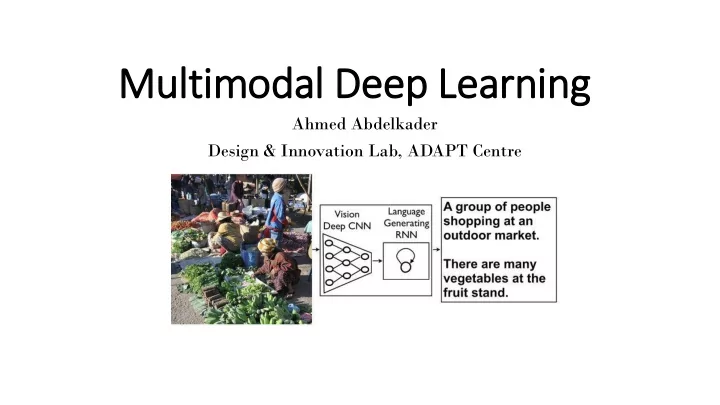
Multimodal Deep Learning

Ahmed Abdelkader Design & Innovation Lab, ADAPT Centre
slide-2
SLIDE 2

Talk outline

  • What is multimodal learning and what are the challenges?
  • Flickr example: joint learning of images and tags
  • Image captioning: generating sentences from images
  • SoundNet: learning sound representation from videos
slide-3
SLIDE 3

Talk outline

  • What is multimodal learning and what are the challenges?
  • Flickr example: joint learning of images and tags
  • Image captioning: generating sentences from images
  • SoundNet: learning sound representation from videos
slide-4
SLIDE 4

Deep learning success in single modalities

slide-5
SLIDE 5

Deep learning success in single modalities

slide-6
SLIDE 6

Deep learning success in single modalities

slide-7
SLIDE 7

What is multimodal learning?

  • In general, learning that involves multiple modalities
  • This can manifest itself in different ways:
  • Input is one modality, output is another
  • Multiple modalities are learned jointly
  • One modality assists in the learning of another
  • …
slide-8
SLIDE 8

Data is usually a collection of modalities

  • Multimedia web content
slide-9
SLIDE 9

Data is usually a collection of modalities

  • Multimedia web content
  • Product recommendation systems
slide-10
SLIDE 10

Data is usually a collection of modalities

  • Multimedia web content
  • Product recommendation systems
  • Robotics
slide-11
SLIDE 11

Why is multimodal learning hard?

  • Different representations

Images Text Real-valued Discrete, Dense Sparse

slide-12
SLIDE 12

Why is multimodal learning hard?

  • Different representations
  • Noisy and missing data
slide-13
SLIDE 13

How can we solve these problems?

  • Combine separate models for single modalities at a higher level
  • Pre-train models on single-modality data
  • How do we combine these models? Embeddings!
slide-14
SLIDE 14

Pretraining

  • Initialize with the weights from another

network (instead of random)

  • Even if the task is different, low-level

features will still be useful, such as edge and shape filters for images

  • Example: take the first 5 convolutional

layers from a network trained on the ImageNet classification task

slide-15
SLIDE 15

Embeddings

  • A way to represent data
  • In deep learning, this is usually a high-dimensional vector
  • A neural network can take a piece of data and create a corresponding

vector in an embedding space

  • A neural network can take a embedding vector as an input
  • Example: word embeddings
slide-16
SLIDE 16

Word embeddings

  • A word embedding: word high-dimensional vector In deep
  • Interesting properties
slide-17
SLIDE 17

Embeddings

  • We can use embeddings to switch between modalities!
  • In sequence modeling, we saw a sentence embedding to switch

between languages for translation

  • Similarly, we can have embeddings for images, sound, etc. that allow

us to transfer meaning and concepts across modalities

slide-18
SLIDE 18

Talk outline

  • What is multimodal learning and what are the challenges?
  • Flickr example: joint learning of images and tags
  • Image captioning: generating sentences from images
  • SoundNet: learning sound representation from videos
slide-19
SLIDE 19

Flickr tagging: task

Images Text

slide-20
SLIDE 20

Flickr tagging: task

Images Text

  • 1 million images from flickr
  • 25,000 have tags
  • Goal: create a joint representation of images and text
  • Useful for Flickr photo search
slide-21
SLIDE 21

Flickr tagging: model

Pretrain unimodal models and combine them at a higher level

Image-specific model text-specific model

slide-22
SLIDE 22

Flickr tagging: model

Pretrain unimodal models and combine them at a higher level

Image-specific model text-specific model

slide-23
SLIDE 23

Flickr tagging: model

Pretrain unimodal models and combine them at a higher level

slide-24
SLIDE 24

Flickr tagging: example outputs

Salakhutdinov Bay Area DL School 2016

slide-25
SLIDE 25

Flickr tagging: example outputs

Salakhutdinov Bay Area DL School 2016

slide-26
SLIDE 26

Flickr tagging: visualization

Salakhutdinov Bay Area DL School 2016

slide-27
SLIDE 27

Flickr tagging: multimodal arithmetic

Kiros, Salakhutdinov, Zemel 2015

slide-28
SLIDE 28

Talk outline

  • What is multimodal learning and what are the challenges?
  • Flickr example: joint learning of images and tags
  • Image captioning: generating sentences from images
  • SoundNet: learning sound representation from videos
slide-29
SLIDE 29

Example: image captioning

Show and Tell: A Neural Image Caption Generator Vinyals et al. 2014

slide-30
SLIDE 30

Example: image captioning

A young girl asleep W __ A young girl Inception CNN W Inception CNN

slide-31
SLIDE 31

Example: image captioning

A young girl asleep W __ A young girl Inception CNN W Inception CNN Language Model Image Model

slide-32
SLIDE 32

Human: A young girl asleep on the sofa cuddling a stuffed bear. Computer: A close up of a child holding a stuffed animal.

slide-33
SLIDE 33

Human: A view of inside of a car where a cat is laying down. Computer: A cat sitting on top of a black car.

slide-34
SLIDE 34

Human: A green monster kite soaring in a sunny sky. Computer: A man flying through the air while riding a snowboard.

slide-35
SLIDE 35

Caption model for neural storytelling

We were barely able to catch the breeze at the beach, and it felt as if someone stepped

  • ut of my mind. She was in love with him for

the first time in months, so she had no intention of escaping. The sun had risen from the ocean, making her feel more alive than normal. She's beautiful, but the truth is that I don't know what to do. The sun was just starting to fade away, leaving people scattered around the Atlantic Ocean. I’d seen the men in his life, who guided me at the beach once more. Jamie Kiros, www.github.com/ryankiros/neural-storyteller

slide-36
SLIDE 36

Talk outline

  • What is multimodal learning and what are the challenges?
  • Flickr example: joint learning of images and tags
  • Image captioning: generating sentences from images
  • SoundNet: learning sound representation from videos
slide-37
SLIDE 37

SoundNet

  • Idea: learn a sound representation from unlabeled video
  • We have good vision models that can provide information about

unlabeled videos

  • Can we train a network that takes sound as an input and learns object

and scene information?

  • This sound representation could then be used for sound classification

tasks

Aytar, Vondrick, Torralba. NIPS 2016

slide-38
SLIDE 38

SoundNet training

Aytar, Vondrick, Torralba. NIPS 2016

slide-39
SLIDE 39

SoundNet training

Loss for the sound CNN:

Aytar, Vondrick, Torralba. NIPS 2016

slide-40
SLIDE 40

SoundNet training

Loss for the sound CNN:

š‘¦ is the raw waveform š‘§ is the RGB frames š‘•(š‘§) is the object or scene distribution š‘”(š‘¦; šœ„) is the output from the sound CNN Aytar, Vondrick, Torralba. NIPS 2016

slide-41
SLIDE 41

SoundNet visualization

Aytar, Vondrick, Torralba. NIPS 2016

slide-42
SLIDE 42

SoundNet visualization

What audio inputs evoke the maximum

  • utput from this

neuron? Aytar, Vondrick, Torralba. NIPS 2016

slide-43
SLIDE 43

SoundNet: visualization of hidden units

https://projects.csail.mit.edu/soundnet/

slide-44
SLIDE 44

Conclusion

  • Multimodal tasks are hard
  • Differences in data representation
  • Noisy and missing data
slide-45
SLIDE 45

Conclusion

  • Multimodal tasks are hard
  • Differences in data representation
  • Noisy and missing data
  • What types of models work well?
  • Composition of unimodal models
  • Pretraining unimodally
slide-46
SLIDE 46

Conclusion

  • Multimodal tasks are hard
  • Differences in data representation
  • Noisy and missing data
  • What types of models work well?
  • Composition of unimodal models
  • Pretraining unimodally
  • Examples of multimodal tasks
  • Model two modalities jointly (Flickr tagging)
  • Generate one modality from another (image captioning)
  • Use one modality as labels for the other (SoundNet)
slide-47
SLIDE 47

https://www.amazon.co.uk/Deep-Learning-TensorFlow-Giancarlo-Zaccone/dp/1786469782

slide-48
SLIDE 48

Questions?