SLIDE 1
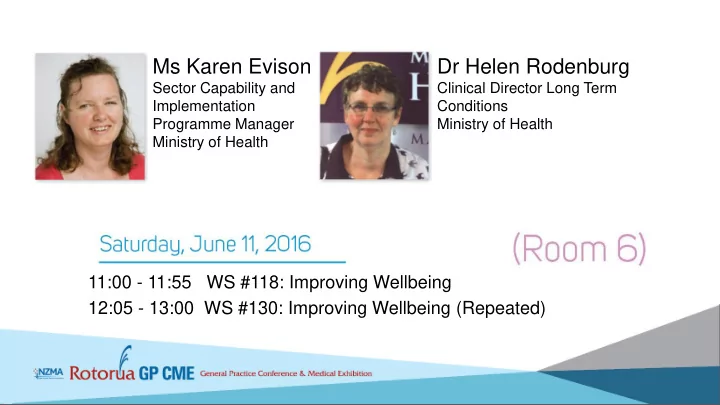
Ms Karen Evison
Sector Capability and Implementation Programme Manager Ministry of Health
11:00 - 11:55 WS #118: Improving Wellbeing 12:05 - 13:00 WS #130: Improving Wellbeing (Repeated)
Dr Helen Rodenburg
Clinical Director Long Term Conditions Ministry of Health
SLIDE 2
Improving Wellbeing
Live well, stay well, get well Living well with diabetes Karen Evison Helen Rodenburg June 2016
SLIDE 3 Aims of the day
Context! (NZ Health Strategy, Diabetes Plan) Achieving the best possible outcomes Referral and support options “Tools”, care plans, supporting self management Obesity
2
SLIDE 4 NZ Health Strategy Five strategic themes to guide us forward
3
SLIDE 5 Implementation – the Roadmap
SLIDE 6 People Powered
5
- Build health literacy and active two-way
engagement
- Build the consumer movement
‘People drive what matters most in health’ ‘New Zealanders are health smart’
SLIDE 7 Closer to Home
6
- Shift services
- Tackle long-term conditions and obesity
- Make greater use clinical networks to strengthen
collaborative approaches to long-term conditions
- Support the spread of best practice over time
‘We provide customised care for people who need it most’ ‘We have the most adaptive, diverse and agile workforce’
SLIDE 8 Value and High Performance
7
- Improve performance and outcomes
- Align funding
- Target investments
- Improve quality and safety
‘Our health system delivers results through smart investment’ ‘We make our health system easy, convenient, and simple’
SLIDE 9 One Team
8
- Enhance cross-sector whole-of-system
working
- Build leadership and manage talent
- Support a sustainable and adaptive
workforce
‘We are growing a united team to lead NZ’s health future’ ‘We are committed to giving the best direction for our health system’
SLIDE 10 Smart System
9
- Strengthen national analytical capability
- Use electronic records and patient portals
- Strengthen the impact of health research and
technology
‘We are at the forefront of emerging technology and innovation’ ‘Our health system understands all aspects of peoples’ lives’
SLIDE 11 “Living Well with Diabetes” Priority areas:
- 1. Prevent high-risk people from developing type 2 diabetes
- 2. Enable effective self-management
- 3. Improve quality of services
- 4. Detect diabetes early and reduce the risk of complications
- 5. Provide integrated care
- 6. Meet the needs of children and adults with type 1 diabetes
10
SLIDE 12 Progress to date
- 1. Prevent high-risk people from developing type 2 diabetes
- Understanding diabetes stocktake and advisory group
- Updating prediabetes advice
- Community pilots around weight reduction- Wehi, Weightwatchers
2.Enable effective self-management
- Updated self management advice
- Project for primary care workforce supporting self management
- SMS4BG –expanding txt based advice
11
SLIDE 13 Progress to date
3.Improve quality of services
- Implementing 20 quality standards
4.Detect diabetes early and reduce the risk of complications
- Implement new retinal screening guidance
- BPAC and Kidney Health NZ supporting implementation of CKD decision support in primary
care
- Podiatry update
- Enhanced mental health support for people with poorly controlled diabetes and children
(and families) with type 1 -2 DHB initial project
12
SLIDE 14 Progress to date
- 5. Provide integrated care
- Updated LTC service spec from July 2016
- Link with other work such as childhood obesity, healthy families
- 6. Meet the needs of children and adults with type 1 diabetes
- Paediatric services, standards and workforce planning
- Quality standards for people with type 1 diabetes – progress
Enablers:
- Diabetes Leadership group established
- Work on consistent measurement
13
SLIDE 15
Global report on diabetes WHO
“Effective approaches to prevent type 2 diabetes include
policies and practices across whole populations and within specific settings that contribute to good heath for everyone regardless of whether they have diabetes, such as exercising regularly, eating healthily, avoiding smoking, and controlling BP” WHO 2016
A challenge is to join up personal and population approaches in a complex area….
SLIDE 16
At Risk populations
“Prediabetes” a risk factor not a condition Severe mental illness- Diabetes – death rate 3 times (www.tepou.co.nz/equallywell) Obesity Ethnicity, family etc Balance of solutions between health, community and self/ whanau
SLIDE 17 Wellbeing
“While people with good health tend to have high wellbeing this is not always the case- 38% of people with poor health have high wellbeing and 18% of people with good health have low wellbeing”
http://www.ons.gov.uk/ons/rel/wellbeing/measuring-national-well-being/health
- -2013 in “Wellbeing why it Matters to Policy” DOH.
SLIDE 18
C
Evolved Chronic Care Model
SLIDE 19 “Patient Activation”
- Health literacy targeted interventions can improve safety, satisfaction and reduce
- hospitalisation. 1
- Interface with health professionals: “What matters to you”
- Specific Community support
- Self management groups eg Stanford- effective for people with mental health problems
- Support groups
- Peer support (mental health evidence)
- Pre-existing skills and need to reduce disparities
1.Integrating health literacy with health care performance DeWalt and McNeill 2013
SLIDE 20 Examples of patient activation -prediabetes
The risk of progression for pre diabetes* to Type 2 diabetes can be substantially reduced through lifestyle modification.
*HbA1c in the range 41-49 mmol/mol
SLIDE 21 Example of two Programmes
Habour Sport Sports Bay of Plenty
Programme
- Weekly (weeks 1-12) and then
fortnightly (weeks 13-24) sessions with a Healthy Lifestyle Coordinator
- 1:1 dietitian consultations and
nutritional workshops
- 1:1 psychology consultations or group
psychotherapy
- Weekly exercise options
- Advisors supported clients to set
and achieve nutrition and physical activity related goals.
- Nutrition educational sessions
- Offered new options and/or
linked to existing physical activity.
- Monthly follow-up meetings for
up to 6-months Participants
- 331 people enrolled; 287 (87%)
completed initial 12-week programme
- 79% aged 50+; 63% women
- 174 people enrolled
- 65% aged 50+; 68% women
Results at 6 months*
- 80% reduced HbA1c
- 66% reduced HbA1c
*only measured in those who completed the 6 month follow-up
SLIDE 22 Barriers
Barriers to participant behaviour change:
- Health literacy
- Many patients, especially those from Pacific populations, had an
- verall low understanding of the relevance of pre-diabetes and
consequences.
- Patients don’t see the need for support
- Significant time commitments (work, family, church)
- Lack of transport
- Mental health and social issues
SLIDE 23 Barriers
Patient contact and follow-up can be difficult:
- did not have telephones, or changed their
phone number
- those who changed addresses frequently
- those who do not succeed in their behaviour
change are often reluctant to be contacted
SLIDE 24 Programme components that facilitate change
- Support from peers
- Accountability – e.g. a commitment contract at enrolment that set out
the expectations of the programme
- Participant engagement - Activities that are geared to the right level of
health literacy are important
- Relevance to a wide audience - programmes need to be generic in their
content, but allowing for tailoring where possible.
- Integration of behavioural support
- Tailored support for practices
- Primary care follow up
- Resources
SLIDE 25
Activated people -Self Management
Helps people develop the knowledge skills and confidence to manage their own health Can improve self esteem and confidence to perform tasks of every day life Can reduce attendance in primary and secondary care Can be one on one (motivational interviewing, health coaching, behavior change etc) Group (Stanford model widely used) Health literacy an important component Peer learning and support
SLIDE 26 Benefits of Care Planning
Bycroft, J. Health Navigator NZ, 2015
SLIDE 27 Self management and shared care projects
Three demonstrations sites established: 1/Manawanui Whai Ora Kaitiaki - Hauraki PHO and Healthcare NZ Case managers and navigators support process of holistic and care planning for people with complex, chronic conditions and history of high hospital admissions. 2/Self management and shared care programme - Alliance Health plus Group (Stanford based) self management programmes delivered by practices 3/Shared care and self management project – Procare (Pukekohe and Clendon) Linked with At Risk Individuals programme, people enrolled had up to 12 months of co-ordinated care and transition at end of this as needed.
26
SLIDE 28 Self management and shared care projects (lessons)
Practice-level culture change often required to establish a more holistic view of wellbeing - feedback from clients useful to assist with this Care planning process – dedicated time essential with person to develop their care plan Barriers to participant behaviour change included: health literacy (eg relevance of pre-diabetes diagnosis), differing perception of need - ”I am too old for that” Programme components that facilitated engagement were: peer support, regular contact with the same practitioner, built in accountability, clear messages Self management guidance link http://www.health.govt.nz/publication/self-management-support- people-long-term-conditions
SLIDE 29 Improving self management support
Health Navigator Charitable Trust and Health Literacy NZ have been selected to develop training and resources ‘to support PHOs and primary care providers to further implement self-management support with consumers’ A three phase plan has now been developed which includes: a scoping phase In practice trial national training. If this might suit your practice you can contact them:
Pat Flanagan at patat375@xtra.co.nz Janine Bycroft at janine@healthnavigator.org.nz
28
SLIDE 30 Equality vs Equity
29
SLIDE 31 Improving Health…
- Excellent medical care
- Shared decision making , goal setting
- Risk factors:
Smoking CVDRA Now : Obesity: practice based support, children
30
SLIDE 32
Primary Care “GPs cannot afford to side-line obesity management. Even though it may not be the initial reason for encounter, weight is likely to be the most prevalent modifiable risk factor associated with patients’ long- term health. Without further strategies to support GP’s in their management of patients’ weight, obesity will continue to be an expense and long-term public health issue.”
Jansen, S Desbrow, B, and Bell, L (2015) Obesity management by general practitioners: the unavoidable necessity, Australian Journal of Primary Health, 21, 366-368.
SLIDE 33 Western Bay of Plenty –supporting weight management in primary care Three stages Ask Brief advice Ongoing support or Onward referral ASK
- Are you concerned about your weight or shape?
- Are you concerned about your eating patterns?
SLIDE 34 Western Bay of Plenty –supporting weight management in primary care
Brief advice:
- Main dietary intervention to encourage fruit and vegetable consumption.
- Brief validated questions and advice on:
current “fruit and vegetable” intake reducing inactivity
SLIDE 35 Western Bay of Plenty –supporting weight management in primary care Offer support or Onward referral Following the brief intervention :
- Regular contact (phone/txt/email)
- Further support to maintain dietary change – from
health professionals such as dietitian, behaviour coach
SLIDE 36 Western Bay of Plenty –supporting weight management in primary care
Interim Results
- 30% of those followed up lost more than 5% of body
weight
- Tool and resources easy to use - clinicians reported
increased confidence when managing weight
- Most useful resources posters (encouraging consumption
- f fruit and vegetables and water as a drink)
SLIDE 37 Western Bay of Plenty –supporting weight management in primary care
Resources
http://weightmanagement.wboppho.org.nz/
http://baynav.bopdhb.govt.nz/public-health/weightmanagement/?pathways
SLIDE 38 Eating and Activity Guidelines for New Zealand Adults
The Guidelines Statements now recommend people choose mostly ‘whole’ and less processed foods. Evidence shows dietary patterns that include vegetables and fruit, whole grains, legumes, nuts, dairy (including low-fat options) and seafood, but that are low in processed meat, refined grains, saturated fat, added sugar and salt are the healthiest. http://www.health.govt.nz/publication/eating-and-activity-guidelines-new- zealand-adults
37
SLIDE 39 Overview of Childhood Obesity Plan
- The Government announced the Childhood Obesity Plan on October 19, 2015. The package
- f initiatives aims to prevent and manage obesity in children and young people up to 18 years
- f age.
- The Plan has three focus areas made up of 22 initiatives (either new or an expansion of
existing initiatives) :
- Targeted interventions for those who are obese, increasing over time
- Increased support for those at risk of becoming obese
- Broad approaches to make healthier choices easier for all New Zealanders.
- The focus is on food, the environment and being active at each life stage, starting during
pregnancy and early childhood. The package brings together initiatives across government agencies, the private sector, communities, schools, families and whanau.
- Information can be found on the following website: http://www.health.govt.nz/
SLIDE 40 The target - Raising Healthy Kids
“By December 2017, 95 percent of obese children identified in the Before School Check (B4SC) programme will be offered a referral to a health professional for clinical assessment and family based nutrition, activity and lifestyle interventions.”
- The target is a small but important component of a wider focus on childhood obesity
- A place to intervene early
- Most referrals from the B4SC will be to general practice as health care home
- Supporting continuity
- Not a compliance exercise – general practice role is seeing the child and their whānau to manage any
clinical risk associated with obesity; encouraging whānau to take some action; appropriate referrals ;to regularly monitor child’s growth
- Importance of acknowledging the referral
SLIDE 41
Recommended referral pathway
SLIDE 42 Questions? Comments
41
Thanks for coming and thanks for all the work you do