Morphogenesis cell-based modelling in developmental biology Walter - - PowerPoint PPT Presentation

morphogenesis
SMART_READER_LITE
LIVE PREVIEW

Morphogenesis cell-based modelling in developmental biology Walter - - PowerPoint PPT Presentation

Morphogenesis cell-based modelling in developmental biology Walter de Back Collegium Budapest Institute for Advanced Study Animal Coat Pattern's, Turing's Patterns Morphogenesis, Cellular Potts model Dictyostelium d ., Evolution of

slide-1
SLIDE 1

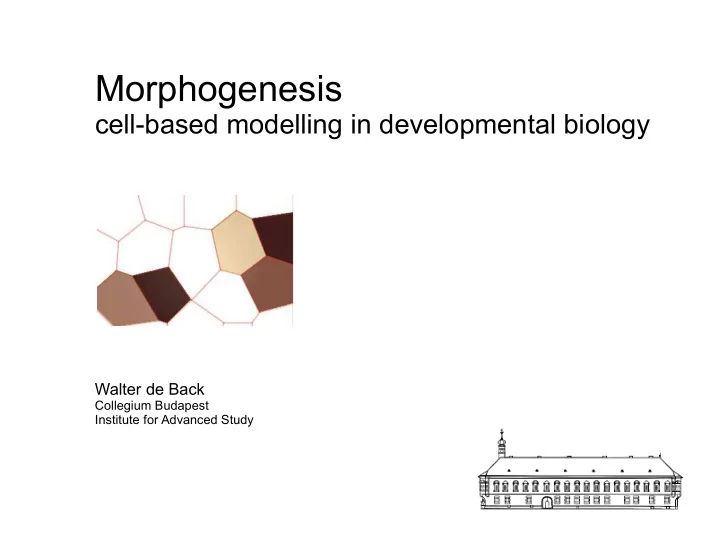
Morphogenesis

cell-based modelling in developmental biology

Walter de Back

Collegium Budapest Institute for Advanced Study

slide-2
SLIDE 2

Animal Coat Pattern's, Turing's Patterns Morphogenesis, Cellular Potts model Dictyostelium d., Evolution of morphogenesis

slide-3
SLIDE 3

Patterns

slide-4
SLIDE 4

Turing Patterns

Alan Turing, 1950

slide-5
SLIDE 5

Turing Patterns

Murray 1981

Varying parameters such as relative diffusion, domain size and shape, many patterns are possible

slide-6
SLIDE 6

Patterns

Turing: The stripes are easy, but what about the horse part?

slide-7
SLIDE 7

From Genes to Organisms Via the Cell

  • Neo-Darwinism:

– Genetic reductionism, esp. in the era of genomics – Organisms cannot be reduced to their genes

  • Need for a theory of morphogenesis

– Development: genotype-phenotype mapping – How does it influence evolution?

  • Inter-cellular vs. Intra-cellular mechanisms

– Cell-based modelling

slide-8
SLIDE 8

Cell sorting through diff. adhesion

Glazier, Graner, 1991

  • Cell migrate and sort

themselves based on different intercellular adhesion properties

  • Cell-oriented models

– Cells are point-like entities – Cells are spherical – Cells are flexible deformable entities that try to optimize shape

slide-9
SLIDE 9

Cellular Potts model

aka Glazier-Graner-Hogeweg model

  • Two-scale cellular automata model
  • Biological cell consist of many lattice sites with same ’state’

– Properties: type, volume, growth constant, etc.

  • Between cells:

– Free energy bond Jij where i and j are the types of the cells – Sites changes state as to minimize free energy

slide-10
SLIDE 10
slide-11
SLIDE 11
slide-12
SLIDE 12
  • Dd morphodynamics:
  • Aggregation
  • Stream formation
  • Slug formation
  • Slug phototaxis
  • Fruiting body culmination
  • Minimizing the role of gene regulation, instead:
  • cell signalling
  • cell adhesive movements

Dictyostelium

slide-13
SLIDE 13
slide-14
SLIDE 14
slide-15
SLIDE 15

Evolution of morphologenesis

Hogeweg, 2005

  • Putting it back together

– Within cell dynamics (gene regulation) – Between cell dynamics (adhesion, signalling) – Evolutionary dynamics (fitness differentiation)

slide-16
SLIDE 16
slide-17
SLIDE 17
slide-18
SLIDE 18
slide-19
SLIDE 19
slide-20
SLIDE 20