Moore Catchment Council The Last Stand - Whats wrong with our - - PowerPoint PPT Presentation

moore catchment council the last stand what s wrong with
SMART_READER_LITE
LIVE PREVIEW

Moore Catchment Council The Last Stand - Whats wrong with our - - PowerPoint PPT Presentation

Moore Catchment Council The Last Stand - Whats wrong with our environmental laws? 5 September 2018 Declan Doherty Principal Solicitor Environmental Defenders Office WA A community legal centre specialising in public interest


slide-1
SLIDE 1

A community legal centre specialising in public interest environmental law A community legal centre specialising in public interest environmental law
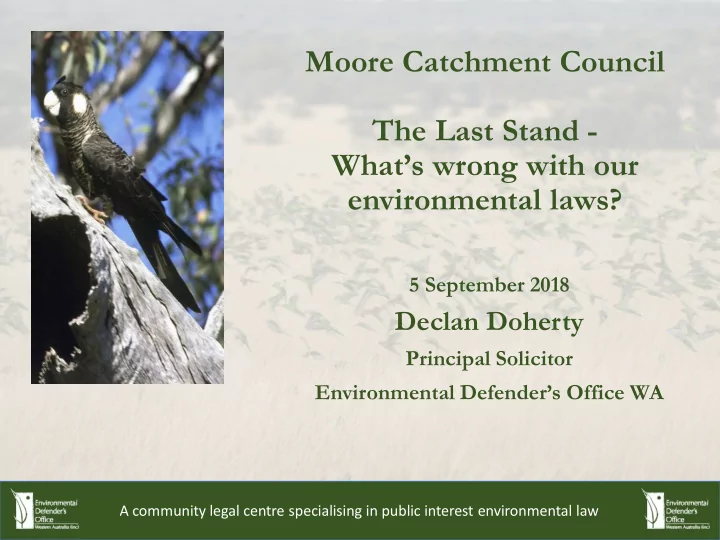
Moore Catchment Council The Last Stand - What’s wrong with our environmental laws?

5 September 2018

Declan Doherty

Principal Solicitor Environmental Defender’s Office WA

slide-2
SLIDE 2

A community legal centre specialising in public interest environmental law A community legal centre specialising in public interest environmental law

Today’s presentation...

  • About the Environmental Defender’s Office

Western Australia

  • Focus - Clearing in WA - State Legislation
  • Environmental Protection Act 1986 (WA)
  • Biodiversity Conservation Act 2016 (WA)
  • Environmental Protection (Clearing of Native Vegetation)

Regulations 2004 (WA)

  • Problems with the law
  • Potential areas of reform
  • Discussion and questions throughout!
slide-3
SLIDE 3

A community legal centre specialising in public interest environmental law A community legal centre specialising in public interest environmental law

EDOWA – the State’s public interest environmental lawyers

  • We are a not for profit community legal centre
  • Our work – public interest environmental law:
  • Litigation and legal advice;
  • Community legal education;
  • Environmental policy and law reform;
  • Fundraising!
  • We act for a range of clients:
  • Community groups
  • NGOs
  • Traditional owners
slide-4
SLIDE 4

A community legal centre specialising in public interest environmental law A community legal centre specialising in public interest environmental law

EDOs across Australia

  • EDOWA founded in 1996
  • EDO in every State and

Territory (except Victoria)

  • EDOs of Australia

established in 1996

  • Independent but collaborate
  • n issues of national

significance (including law reform submissions)

slide-5
SLIDE 5

A community legal centre specialising in public interest environmental law A community legal centre specialising in public interest environmental law

What is a public interest environmental law issue?

  • has significance beyond a material or financial interest of a particular person or

group

  • involves a real threat to environment
  • has the capacity to result in good environmental outcomes;
  • concerns manner in which the environment is regulated; and
  • raises matters regarding the interpretation and

administration of the law We use the law to protect habitat!

slide-6
SLIDE 6

A community legal centre specialising in public interest environmental law A community legal centre specialising in public interest environmental law

Some key elements of public interest environmental law Not in all jurisdictions (hence the

need for reform!)

  • Right to access information (not just

through FOI)

  • Right to have a say (public

participation)

  • Independent EIA & decision makers
  • Right to bring legal action, eg:
  • Merits review
  • Judicial review
  • Civil enforcement
  • Mining Act – Minister’s ‘public

interest’ discretion (eg Helena Aurora Range)

  • May involve a specialised court or

tribunal

  • In NSW / Qld
  • Not WA (Ministerial appeals

instead)

slide-7
SLIDE 7

A community legal centre specialising in public interest environmental law A community legal centre specialising in public interest environmental law

Many of the problems with our “environmental laws” sit across a large list

  • f laws:

Examples of Laws:

  • Environmental Protection Act

1986 (WA)

  • Mining Act 1978 (WA)
  • Mining Rehabilitation Fund Act

2012

  • Petroleum & Geothermal

Energy Resources Act 1967 (WA)

  • Planning and Development Act

2005 (WA)

  • Biodiversity Conservation Act

2006 (WA)

  • Rights in Water & Irrigation Act

1914 (WA)

  • Environment Protection and

Biodiversity Conservation Act 1999 (Cth)

Examples of issues:

  • Illegal land clearing, pollution

and environmental harm

  • Environmental impact

assessment

  • Licensing / works approvals
  • Environmental considerations in

mining, petroleum and resources operations

  • Planning assessment

considerations of environmental

  • Duties of directors and

management of companies

slide-8
SLIDE 8

A community legal centre specialising in public interest environmental law A community legal centre specialising in public interest environmental law

Clearing of native vegetation: “a key threat to WA’s biodiversity” (EPA)

  • Significant clearing has occurred historically in the

wheatbelt and south-west. Much of it incentivised.

  • 133,700 ha were cleared in the 8 years leading up to 2017.
  • But information and figures are not accurate:
  • Lack of environmental data (EPA)
  • Clearing under exemptions not recorded

EPA Annual Report (2015/16): “Clearing of native vegetation is a key threat to WA’s

  • biodiversity. The EPA is particularly concerned by the

cumulative impact of clearing in the Perth, Peel, Wheatbelt and Pilbara regions” “With multiple agencies involved and no single, consistent mechanism for recording approved clearing there is currently no reliable means to determine how much native vegetation has been approved to clear, or how much is cleared in any given year, State-wide”

slide-9
SLIDE 9

A community legal centre specialising in public interest environmental law A community legal centre specialising in public interest environmental law

Focus today is on the WA laws relating to land clearing, however problems are consistent across all laws

State  Environ

  • nmental P

Prot

  • tection
  • n

Act 1 1986 986 (WA) Biod

  • diversity C

Con

  • nservation
  • n

Act 201 2016 6 (WA) Federal Environ

  • nmental P

Prot

  • tection
  • n

and B Biodiver ersity y Conservation A Act 1999 999 (Cth)

  • Both State and Commonwealth laws regulate

land clearing in Western Australia

  • It is an offence to clear native legislation unless

authorised or exempt under the law

slide-10
SLIDE 10

A community legal centre specialising in public interest environmental law A community legal centre specialising in public interest environmental law

Environmental P Protection Act 1986 (WA) (EP Act)

  • State legislation passed in 1986
  • Object is to protect the environment of the State
  • Establish an independent Environmental Protection Authority (EPA)
  • Principles of ecologically sustainable development
  • Pollution / environmental harm offences
  • 2003 – Clearing laws introduced
  • Section 51C – Offence to clear native vegetation unless:
  • obtain a clearing permit; or
  • clearing is “exempt” under
  • Schedule 6 of EP Act; or
  • Clearing Regulations
slide-11
SLIDE 11

A community legal centre specialising in public interest environmental law A community legal centre specialising in public interest environmental law

Key terms “clearing” and “native vegetation” are defined broadly

The Environmental Protection Act defines clearing as:

  • the killing or destruction of;
  • the removal of;
  • the severing or ringbarking of trunks or stems of;
  • or the doing of any other substantial damage to, some OR all of the native

vegetation in an area Native Vegetation is:

  • Indigenous aquatic or terrestrial vegetation
  • Includes dead vegetation (unless excluded in the regulations)
  • Does not include vegetation in a plantation
  • Includes regrowth / rehabilitation
slide-12
SLIDE 12

A community legal centre specialising in public interest environmental law A community legal centre specialising in public interest environmental law

EP Act – Part V – Assessment and approval of clearing permits

  • Applications assessed by DWER / DMIRS (depending on activity)
  • Permit assessment reliant on quality of survey information and analysis of this

information by consultants on behalf of the developer

  • In assessing an application the Department must “have regard to...the

clearing principles” (EP Act, Schedule 5)

  • Circumstances in which native vegetation “should not be cleared”
  • DWER / DMIRS’ assessment as to whether clearing is at variance with

clearing principles will depend on quality of information before it (including survey information)

  • Written reason if approved clearing “seriously at variance” with a clearing

principle

slide-13
SLIDE 13

A community legal centre specialising in public interest environmental law A community legal centre specialising in public interest environmental law

Some examples of the Clearing Principles – Sch 5, EP Act

Native vegetation should not be cleared if —

  • it comprises a high level of biological diversity; or
  • it comprises the whole or a part of, or is necessary for the maintenance
  • f, a significant habitat for fauna indigenous to Western Australia;
  • it includes, or is necessary for the continued existence of, rare flora;
  • it comprises the whole or a part of, or is necessary for the maintenance
  • f, a threatened ecological community;
  • it is significant as a remnant of native vegetation in an area that has

been extensively cleared;

  • it is growing in, or in association with, an environment associated with

a watercourse or wetland;

  • the clearing of the vegetation is likely to have an impact on the

environmental values of any adjacent or nearby conservation area;

slide-14
SLIDE 14

A community legal centre specialising in public interest environmental law A community legal centre specialising in public interest environmental law

There are over 40 categories of exemptions from the requirement to obtain a clearing permit

Exemptions under EP Act, Schedule 6:

  • Clearing undertaken pursuant to Ministerial Statement (i.e.

for significant projects that have been assessed by EPA and approved by Minister)

  • Clearing done to give effect to another written law Certain

authorisations under the Bush F Fires Act and Fir ire B Brig igades Ac Act.

  • Grazing of stock on a Pastoral Lease if in accordance with

that lease and the Land Administration Act 1997

  • The taking of flora authorised under the Wildlife Conservation

Act 1950 (WA)

  • Clearing for a subdivision approval authorised under the

Planning and Development Act 2005 (WA)

slide-15
SLIDE 15

A community legal centre specialising in public interest environmental law A community legal centre specialising in public interest environmental law

There are over 40 categories of exemptions from the requirement to obtain a clearing permit

Exemptions under the Clearing Regulations:

  • Cannot be in an “environmentally sensitive area”
  • 26 separate “exemptions” for clearing under the regulations.
  • Types / limitations on clearing
  • Who can undertake or authorise clearing
  • Examples to follow….
slide-16
SLIDE 16

A community legal centre specialising in public interest environmental law A community legal centre specialising in public interest environmental law

Examples of exemptions under the Clearing Regulations

  • Clearing for Fire hazard reduction (Item 3)
  • Clearing along fence lines (Items 10 and 11)
  • Clearing Vehicular or walking tracks (Items 12 and 13)
  • Clearing Isolated trees (Item 19)
  • Clearing for maintenance in existing transport

corridors (Item 22)

  • Clearing for bypass roads (Item 21)

Application of 5ha per year limit for some exemptions.

slide-17
SLIDE 17

A community legal centre specialising in public interest environmental law A community legal centre specialising in public interest environmental law

Specific examples of clearing permit exemption – roads

Item 22 – Maintenance in existing transport corridors:

  • Stretch of road or railway
  • To ‘maintain the efficacy and safety of the infrastructure’ / ‘provide access

to the infrastructure to maintain it’ – ‘to the extent necessary’

  • Only if previously cleared ‘lawfully’ in the last 10 years
  • Definitions?

Item 23 – Infrastructure maintenance: ‘Clearing that is the result of infrastructure maintenance activity’ Various circumstances:

  • Maintenance of existing infrastructure (definition?)
  • Road realignment / widening if road existed prior to clearing laws

coming into force in 2003;

slide-18
SLIDE 18

A community legal centre specialising in public interest environmental law A community legal centre specialising in public interest environmental law

So, why are our current environmental laws are failing to protect nature?

slide-19
SLIDE 19

A community legal centre specialising in public interest environmental law A community legal centre specialising in public interest environmental law

“Much of the current confusion and distress surrounding environmental issues

can be traced to deci ecisions that w wer ere e nev ever er co consci ciously y made, e, but s simply y res esulted ed from a a s ser eries es o

  • f s

small deci ecisions. No one purposely planned to destroy almost 50% of the existing marshland along the costs of Connecticut and Massachusetts...In fact, preservation would have been supported. However, thr hrough h hu hund ndreds o

  • f little decisions

ns...a major

  • r d

decision

  • n in favour of extensive wetlands conversion was made without

ever addressing the issue directly... The ecological integrity of the Florida Everglades has suffered, not from a single adverse decision, but from a m mult ltitude o

  • f s

small p ll pin p pricks...[including] independent choices to add one more drainage canal, one more roadway, one more retirement village, and one more well to provide Miami with drinking water....It is n not cl clea ear h how t the e “deci ecision” t to d deg egrade t e the E e Ever erglades es ca can b be e rev ever ersed ed... ... Each threatened and endangered species, with a few exceptions, owes its special status to a series of small decisions....[They] have all suffered from the combined effects of single decisions about habitat conversion or over-exploitation” . Environmental degradation and the tyranny of small decisions

[William Odum (1982)]

slide-20
SLIDE 20

A community legal centre specialising in public interest environmental law A community legal centre specialising in public interest environmental law

Discretion and lack of “agency forcing” provisions in legislation

  • Environmental laws often provide a “regulatory toolbox” of options
  • But are these tools used or effectively implemented?
  • EDO assessment:

“While the laws in some jurisdictions look good on paper, they are not effectively implemented….For example, int nterim cons nservation o n orders a and nd m mana nagement nt pl plans ns a are no not u utilised i in n Vic ictoria ia, no native plants have been declared prescribed species on private land in South Australia, no

  • critical ha

habi bitats ha have be been n listed a and nd no no i int nterim pr protection n orders ha have be been n decl eclared ed in T Tasmania, and no essential habitat declarations have been made in Northern Territory. Key ey provisions a are e often en discr cret

  • etionary. Critical tools such as recovery plans and threat abatement

plans are not mandatory. Time frames for action and performance indicators are largely absent”

  • Lack of “agency forcing” provisions.
  • For example: requirement to list threatened species after receiving advice from

independent expert scientific committee (currently lacking in new Biodiversity Conservation Act).

slide-21
SLIDE 21

A community legal centre specialising in public interest environmental law A community legal centre specialising in public interest environmental law

Some concerns with State clearing laws (not an exhaustive list!)

  • Majority of permits are routinely approved (many of them small areas) by well

meaning people

  • Significant decision-making discretion (eg permits granted even if at variance with

clearing principles)

  • No consideration of cumulative impacts or connectivity in clearing decisions (or in

clearing principles)

  • Clearing can be approved by multiple decision makers
  • Eg: EPA; DWER; DMIRS; WAPC; Local Government
  • Decisions not co-ordinated / different standards / siloed approach
  • Political focus on “regulatory efficiency” / reduction of “green tape”
  • Too many flexible and unenforceable exemptions at selection of developer
  • Eg: for safety / efficacy (see example above)
  • 5ha per year
  • Planning schemes considered “assessed” even if “not assessed” by EPA – therefore

exempt

  • No requirement to notify / report clearing under exemption (information gap)
  • Many unenforceable conditions.
  • Eg requirement to minimise clearing “as far as is practicable”
  • Lack of enforcement of illegal clearing
slide-22
SLIDE 22

A community legal centre specialising in public interest environmental law A community legal centre specialising in public interest environmental law

Some concerns with Commonwealth law (EPBC Act)

(not an exhaustive list!)

  • EPBC Act – Intended to protect Matters of National Environmental

Significance (MNES) (eg listed species)

  • Require assessment and approval to impact MNES
  • No ability for 3rd party (community) referral to regulator (need to rely on

proponent / State)

  • Decision maker = Minister (political), advised by Department
  • Political – eg recent focus on “one stop shop” / quick approvals for industry
  • Eg: Bilateral assessment process (ie State assessment)
  • Lack of enforcement / oversight esp in WA
  • No regard to cumulative impacts / connectivity
slide-23
SLIDE 23

A community legal centre specialising in public interest environmental law A community legal centre specialising in public interest environmental law

How could our environmental laws better protect nature?

  • Greater opportunity for public participation in environmental decision-making
  • Greater transparency (eg access to information without needing FOI process)
  • A new Commonwealth EPA, independent of government
  • Revision of vegetation clearing laws, eg:
  • Tighten up exemptions and require clearing under exemption to be reported
  • Role of clearing principles
  • Remove delegation to DMIRS
  • Independent Land & Environment Court in WA allowing 3rd party standing to

take action

  • Costs protections for community seeking to use courts to protect environment

in public interest

  • Protection of conservation corridors in law (Gondwana Link) See Birdlife

(“Restoring the Balance”) and APEEL materials

  • Enshrine rights for nature in Constitution
slide-24
SLIDE 24

A community legal centre specialising in public interest environmental law A community legal centre specialising in public interest environmental law

How could our environmental laws better protect nature?

  • Review of the relationship between part IV and part V of the Environmental

Protection Act 1986 (WA)

  • Greater transparency in the processes of issuing clearing permits and their

enforcement

  • Better monitoring, mapping and reporting of clearing
  • Reduce the use of offsets to justify clearing permits
  • Better data (eg requirement to report clearing under exemptions)
  • Greater focus on enforcement rather than “streamlining approvals process”
slide-25
SLIDE 25

A community legal centre specialising in public interest environmental law A community legal centre specialising in public interest environmental law

Some encouraging news: Victorian Environmental Protection Amendment Bill 2018

  • Will repeal the Environmental Protection Act 1970
  • Major expansion of scope of Victoria’s environmental

protection regime.

  • For example:
  • Duty imposed on any person (including companies) to minimise

risks to the environment

  • Greater reporting requirements to notify of pollution incidents
  • Increased penalties
  • Greater provision of company environmental data and

performance to public

  • Ability for community to apply to court for orders restraining a

breach of law without EPA involvement if EPA fails to act

slide-26
SLIDE 26

A community legal centre specialising in public interest environmental law A community legal centre specialising in public interest environmental law

Thank you!

Contact us: Ph: 9420 7271 ddoherty@edowa.org.au http://www.edowa.org.au/ http://www.edowa.org.au/support-us/donate/

Photo Courtesy Cara Ratajczak