
SLIDE 1
National Park Service U.S. Department of the Interior Montezuma Castle – Tuzigoot National Monuments Arizona
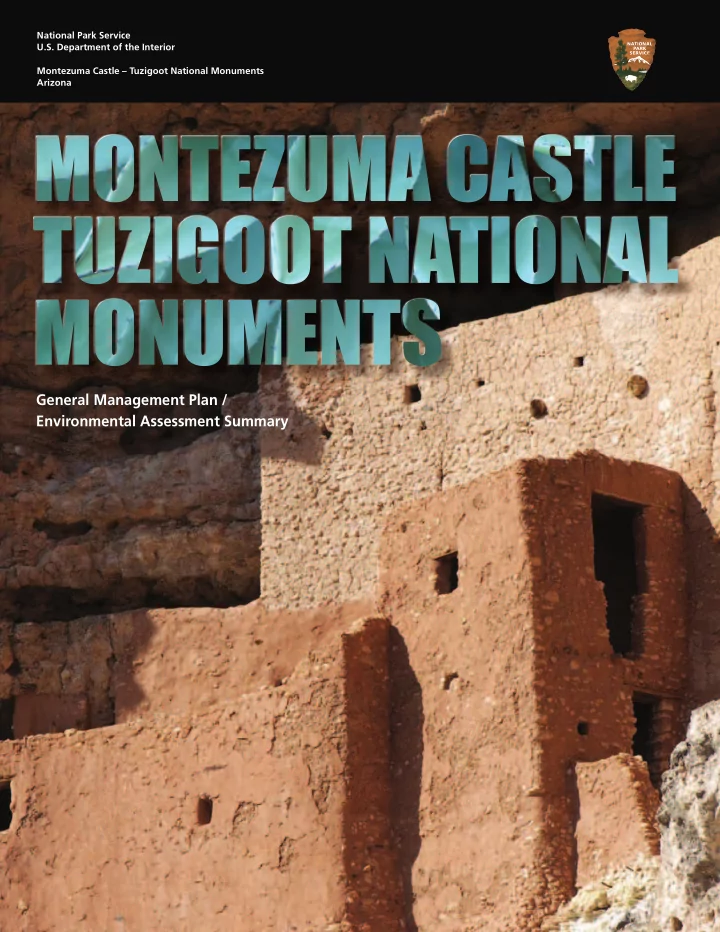
MONTEZUMA CASTLE TUZIGOOT NATIONAL MONUMENTS General Management - - PDF document
National Park Service U.S. Department of the Interior Montezuma Castle Tuzigoot National Monuments Arizona MONTEZUMA CASTLE TUZIGOOT NATIONAL MONUMENTS General Management Plan / Environmental Assessment Summary February 2011 Dear
National Park Service U.S. Department of the Interior Montezuma Castle – Tuzigoot National Monuments Arizona
February 2011 Dear Friends, Neighbors, and Partners of Montezuma Castle and Tuzigoot National Monuments, The Monument staff and I are pleased to present to you the Montezuma Castle and Tuzigoot National Monuments General Management Plan
information of the larger General Management Plan/Environmental
participation and reflects valued input. Before selecting the preferred alternative, we considered all comments and suggestions. The National Monument units in the Verde Valley — Montezuma Castle, Montezuma Well, and Tuzigoot — protect and interpret the legacy of the Sinagua culture, a native people who flourished in the area for centuries. The valley offered a home site with ample riparian resources and diversity in the biological transition of desert, grassland, and forest vegetation zones. The mission of the National Park Service requires us to manage these special places in a way that allows them to be enjoyed not just by those who are here today, but also by generations that follow. We wish to extend our appreciation to those who worked with us during this long-term vision planning process. Together we developed a final plan that maintains a variety of interpretation and educational experiences while continuing to preserve and protect the nationally significant cultural resources in the riparian setting. Thank you for your ongoing interest, support, and participation in the future of Montezuma Castle, Montezuma Well, and Tuzigoot national monuments. We could not have done this without public interest. Kathy M. Davis Superintendent
CHAPTER 1 — INTRODUCTION .................................................................................................... 5 Overview of Montezuma Castle and T uzigoot National Monuments ................................7 Purpose and Need for the General Management Plan / Environmental Assessment ....10 Planning Issues and Opportunities ........................................................................................11 CHAPTER 2 — BACKGROUND ................................................................................................... 13 Foundation for Planning and Management .........................................................................15 Purpose .......................................................................................................................15 Signifjcance .................................................................................................................16 Fundamental Resources and Values .......................................................................17 Primary Interpretive Themes ...................................................................................19 Special Mandates and Administrative Commitments ..........................................20 Servicewide Mandates and Policies ........................................................................20 Guiding Management Principles and Strategies Management ...........................................22 Manage and Protect Cultural Resources ................................................................22 Manage and Protect Natural Resources .................................................................24 External Infmuences - Private and Public Partners, Owners of Adjacent Land, and Government Agencies ....................................30 Ensure Sustainability by Employing User (Carrying) Capacity...........................30 Provide Orientation, Interpretation, and Education ............................................31 CHAPTER 3 — THE PLAN AND ENVIRONMENTAL ASSESSMENT ................................................. 33 Management Zones .................................................................................................................35 Interpretive Historic ..................................................................................................36 Park Operations .........................................................................................................36 Resources and Research ...........................................................................................37 Interaction and Discovery ........................................................................................37 Description of the Plan ...........................................................................................................40 Concept and General Management Strategies ......................................................40 Conditions and Actions Common to All Three Sites ............................................40 Boundary Adjustments, Land Purchases, And Easements ..................................41 Cost Estimates ............................................................................................................41 Afgected Environment and Implementation Impacts .........................................................42 Cultural Resources ....................................................................................................42 Natural Resources .....................................................................................................44 Visitor Use and Experience ......................................................................................46 Socioeconomics .........................................................................................................46 Monument Operations ............................................................................................46
Mitigation Measures ................................................................................................................47 General ........................................................................................................................47 Natural Resources .....................................................................................................49 Visitor Safety and Experiences ................................................................................52 Hazardous Materials .................................................................................................52 Scenic Resources .......................................................................................................52 Socioeconomics .........................................................................................................52 Sustainable Design and Aesthetics ..........................................................................52 User (Carrying) Capacity ........................................................................................................53 Park Operations Zone ...............................................................................................54 Interpretive Historic Zone .......................................................................................54 Interaction and Discovery Zone ..............................................................................55 Resources and Research Zone .................................................................................56 Plan Implementation and Future Studies / Plans Needed ..................................................56 Conclusion ................................................................................................................................58 APPENDIXES AND INDEX ............................................................................................................ 59 Appendix A: Legal Mandates .................................................................................................61 Appendix B: Parcel Maps ........................................................................................................66 Index ..........................................................................................................................................69
Alternative B – Castle Site, Montezuma Castle National Monument ...............................66 Alternative B – Well Site, Montezuma Castle National Monument ..................................67 Alternative B – T uzigoot National Monument .....................................................................68
1: Vicinity Map of Montezuma Castle National Monument, Montezuma Well Site, and T uzigoot National Monument. .........................................................................................8
1: Montezuma Castle and T uzigoot National Monuments Management Zones ...........38-39 2: Cost Summary for Preferred Plan ...........................................................................................43
7
Montezuma Well) and Tuzigoot National Monument are National Park Service (NPS) units in central Arizona. The monuments are within a 30-minute drive of each other and are managed collectively under a single administrative
Hundreds of species of insects, arachnids and other invertebrates find a home in the unique ecosystems of Montezuma Castle National
harmless tarantulas as well as highly venomous black widow spiders and bark
inhabitants pose little threat to humans. The invertebrates found at Montezuma Castle and Montezuma Well reveal extraordinary evolutionary adaptations for survival in an arid desert environment. Montezuma Well Bark scorpion
CHAPTER 1 — INTRODUCTION 8
Figure 1. Vicinity Map
Montezuma Castle National Monument, Montezuma Well Site, and Tuzigoot National Monument. Montezuma Castle National Monument was established in 1906 by presidential proclamation under the authority of the Antiquities Act (Presidential Proclamation
see Appendix A). Since then, Congress passed legislation in 1937, 1959, 1978, and 2003 expanding the boundary of the monument to better protect the natural and cultural resources adjacent to the clifg
greatest ethnological value and scientifjc interest.” T
Monument contains 1,004 acres within its
and the 278-acre well site. Montezuma Castle National Monument is approximately 3 miles east of I-17 exit 289. The monument preserves a prehistoric structure known as Montezuma Castle, which is a 20-room, fjve-story clifg dwelling built by the prehistoric Sinagua culture. It is
North America. The National Monument has a visitor center, a bookstore, and a museum
MONTEZUMA CASTLE – TUZIGOOT NATIONAL MONUMENTS 9
Turquoise
that include exhibits and artifacts depicting the lifestyle, history, and culture of the Sinaguan, who built Montezuma Castle. The Castle itself is not open to the public, but a trail below the Castle ofgers many panoramic viewpoints. The monument also contains restrooms, a picnic area, and a parking facility for cars, buses, and recreational vehicles. An administrative building housing ranger operations and housing are south
Montezuma Well, located approximately 4 miles east of I-17, exit 293, was added in 1943 as a 261-acre detached unit of Montezuma Castle National Monument through an act of Congress (October 19, 1943, 57 Stat. 572; see Appendix A). In 1959, 17 acres were authorized by an act of Congress (June 23, 1959, 73 Stat. 108; see Appendix A) “to facilitate the administration and protection” of the monument. Montezuma Well preserves an unusual example of a spring-fed, large, limestone sink and archeological sites representing the prehistoric Sinagua as well as Apache and Yavapai people. Montezuma Well contains a picnic area, restrooms, hiking trails, a visitor contact station, bulletin boards displaying visitor information, a small parking area, an administrative building and two ranger houses. Tuzigoot National Monument was established by Presidential Proclamation No. 2344 on July 25, 1939 (see Appendix A). The boundary was expanded by an act of Congress in 1965 and again in
2005.The establishing presidential proclamation states that “certain Government-owned lands (43 acres) in the state of Arizona have situated thereon historic and prehistoric structures and other objects of historic
such lands as a national monument to be known as Tuzigoot National Monument.” This 382-acre monument is approximately 20 miles northwest of I-17 exit 287 (Arizona Highway 260), near the town
with a collection of Sinaguan artifacts, a nature trail, restrooms, an administrative building, a parking facility, and a 110 room prehistoric pueblo. See Appendix B for maps
CHAPTER 1 — INTRODUCTION 10
eneral management plans are needed to meet the requirements of the National Parks and Recreation Act of 1978 and NPS policy, which mandate development of a general management plan for each unit in the national park system. As the responsible agency, the National Park Service prepared the general management plan to establish and articulate a management philosophy and framework for long-term (15 to 20 years) decision-making and problem solving in units of the national park system. The general management plan provides comprehensive, integrated guidance for preserving cultural resources, perpetuating natural systems, providing opportunities for visitor enjoyment and understanding, and establishing the
the plan. The General Management Plan for Montezuma Castle and Tuzigoot national monuments was needed because the last comprehensive planning efgort for these national monuments was completed in
Verde Valley has increased substantially and continues to grow. This growth has resulted in changes in land use near the monuments. Visitation to the monuments also has increased
have occurred within the past decade. Each
visitor expectations, how visitors access and use the monuments, facilities needed to support visitor uses, how resources are managed and protected, and how the National Park Service conducts its operations. In the alternatives that are based on the monuments’ mission, purpose, and signifjcance, the plan determines the areas to which resource protection and desired visitor use conditions are applied to achieve the management goals of the
more detailed implementation plans, which tier from the general management plan. The environmental assessment was prepared in compliance with the National Environmental Policy Act to provide the decision-making framework that 1) analyzes a reasonable range of alternatives to meet objectives of the proposal, 2) evaluates potential issues and impacts to the monuments’ resources and values, and 3) identifjes mitigation measures to lessen the degree or extent of these impacts. Resource topics were included because impacts that may be greater than minor include cultural resources, natural resources, visitor use and experience, socioeconomics, and monument operations. Other resource topics were dismissed because the plan would result in negligible or minor efgects. This document is a summary of the approved General Management Plan / Environmental
full, 324-page document by visiting http:// parkplanning.nps.gov.
Hackberry
MONTEZUMA CASTLE – TUZIGOOT NATIONAL MONUMENTS 11
n issue is an opportunity, confmict,
management of public lands. The general public, NPS stafg, and other agencies and organizations helped identify issues and concerns during scoping (early information gathering) for the general management plan. The general management plan helps determine the best mix of resource protection and visitor use beyond what is prescribed by law and policy to preserve the monuments’ cultural and natural resources while encouraging visitors and employees to understand and appreciate their value. The following issues and
Castle and Tuzigoot national monuments:
additional opportunities exist to expand the stories being told at the monuments to link the prehistoric cultures with contemporary people and whether to expand the areas available within the monuments for visitors to explore.
should interact with the resources of the monuments, including the variety and locations of monument resources that are accessible to visitors and the means of accessing resources.
character and level of development within the monuments and whether to expand existing facilities or construct additional facilities at the monuments to accommodate visitors and monument
and maintenance facilities were outside the monument boundaries. There are two distinct General Services Administration leases on the headquarters and maintenance facilities. The plan needs to examine how best to accommodate these monument management functions.
Service needs to work in partnerships with the other land management entities, local communities, tribes, and
issues and opportunities.
legislated boundaries that have not been
resources that, if acquired, would protect additional resources associated with the monuments’ purpose. The plan needs to provide guidance for managing these lands if they are acquired. A boundary adjustment study, still under consideration, is beyond the scope of the general management plan.
Arizona Grape
CHAPTER 1 — INTRODUCTION 12
National Monument contains approximately 300 acres of mine tailings and other land disturbed by mining
contain resources related to the purpose and signifjcance of the monument, are recontoured and revegetated but highly disturbed by mining activity, and are contaminated by hazardous substances. The plan needs to evaluate whether the monument boundary should be adjusted to eliminate these tailings areas, while retaining remaining suitable lands.
a degraded condition and actions to restore the marsh are underway. The long-term objectives for restoration need to be supported within the management framework of the plan.
increased since the 1940s, peaking at 1.2 million visitors in the mid-1990s. Although visitation has declined since the late 1990s, the population of the surrounding region is growing rapidly, and development of tourism in the area is expected to continue. The present visitor contact station at Montezuma Well is small, outdated, and limited in its ability to serve visitors. Expanded visitor contact would improve Montezuma Well’s ability to interpret early regional land use. Each unit is readily accessible from Camp Verde, Cottonwood, Clarkdale, Jerome, and Sedona.
a lack of connectedness of the sites and their stories. If visitor interaction with monument resources increased, cultural and natural resources could experience additional efgects. New wayside exhibits are being developed to better connect sites with interpretive information.
because the current General Services Administration lease with the Yavapai Apache Nation for maintenance space was
storage at the three sites would improve monument operations because it would be more effjcient to provide workspace and store equipment within the units that use them most frequently rather than in one central area.
acquire private land holdings within the monument boundaries, including land
and Gold, Inc. (except for the mine tailings at Tuzigoot, which the monument does not wish to acquire), or work with Freeport McMoRan and other entities to protect the land for public use rather than development.
the Verde Valley are changing. During the life of the general management plan, these changes could have an efgect on visitation and resource conditions of the monuments.
In 1933, “Castle A,” a 45-50 room, pueblo ruin was excavated uncovering a wealth of artifacts and greatly enhancing our understanding
inhabited this riparian “oasis” along Beaver Creek for over 400 years.
15
urpose statements reaffjrm the reasons for which the monuments were set aside as units of the national park system and provide the foundation for management and use of the monuments. The statements below are based on the monuments’ legislation and legislative history and on NPS policies. The purposes of Montezuma Castle and Tuzigoot national monuments are as follows:
related resources within Montezuma Castle, Montezuma Well, and Tuzigoot
to the mix of desert and riparian habitats to maintain sustainable cultural and natural landscapes
continuing cultural adaptations to a desert environment
Beaver Creek. Desert tarantula
CHAPTER 2 — BACKGROUND 16
Signifjcance statements build on the monument’s purpose and clearly state why, within a national context, the monument’s resources and values are important enough to warrant the designation as a national park
and values central to managing the area and express the importance of the area to our natural and cultural heritage. The primary signifjcance of Montezuma Castle and Tuzigoot national monuments is summarized as follows:
most accessible, and best-preserved Sinaguan clifg dwelling in the Southwest.
known pueblos.
development of Tuzigoot illustrate Depression-era (Civilian Works Administration, Works Project Administration, and Civilian Conservation Corps) pioneering archeological efgorts in the Southwest and were instrumental in the preservation and accessibility of this and other national monuments.
collections constitute
largest artifact assemblages, including trade ware,
culture of the Verde Valley.
limestone sink connected to remnants of an extensive prehistoric irrigation system via a natural outlet.
Montezuma Well has substantial scientifjc value and contains species not found in any other waters in the world.
through the present and have enormous learning potential about the relationship between humans and their environment.
monuments are signifjcant to native tribes, as evidenced by oral histories, the archeological record, and continuing practices and
association with the monuments.
fjrst four national monuments created through the Antiquities Act of 1906, afgording the fjrst federal protection of archeological resources.
Processing a western diamondback rattlesnake outside the Montezuma Castle Visitor Center. Amaranth
MONTEZUMA CASTLE – TUZIGOOT NATIONAL MONUMENTS 17
Fundamental resources and values are a monument’s attributes — its features, systems, processes, experiences, stories, scenes, sounds, smells, opportunities for visitor enjoyment, or others — that are critical to achieving the monument’s purpose and to maintaining its signifjcance. Other important resources and values are additional monument attributes that are noteworthy but not related to the monument’s purpose and signifjcance. Fundamental resources and values warrant primary consideration during planning and management or are important to monument management and planning. The fundamental resources and values for the Montezuma Castle and Tuzigoot national monuments are grouped into the following three categories: cultural connectivity, structures and related resources and values, and natural features. Cultural Connectivity. The cultural connectivity category lists the fundamental resources and values that support an understanding of the monuments’ role within larger geographic networks of exploration, settlement, resource development, and trade from prehistoric time to today. The fundamental resources and values in this category also support an understanding of continuing cultural adaptation to the desert environment.
visitors to experience and understand the line-of-sight relationships among the prehistoric pueblos that were regularly spaced, approximately 1.8 miles apart, along the major drainages of the Verde
see pueblos (e.g., Sacred Mountain and Thoeny at Montezuma Well, the Salt Mine Pueblo at Montezuma Castle, and Bridgeport Pueblo, Tuzigoot Extension, and Hatalacva at Tuzigoot).
the monuments boundaries that reveal patterns in prehistoric land use and the related opportunity to contrast the similarities and difgerences in land use to human’s relationship with the environment from prehistoric to modern times.
understand the role of the Verde Valley as a major trading hub and an exporter of argillite, salt, and copper derivatives.
revealing the role of the Verde River, Montezuma Well, Tavasci Marsh, Beaver Creek, and Wet Beaver Creek in prehistoric and historic trade, travel, exploration, and settlement of the area.
Olla at the Tuzigoot Museum. Buckwheat kernals
CHAPTER 2 — BACKGROUND 18
Structures and Related Resources and
and values category lists the fundamental resources and values that support preservation and understanding of the prehistoric and historic structures and related resources and values of the monuments. Montezuma Castle — The prehistoric Sinagua structures and related resources of the Castle, including four clifg dwellings and fjve rock shelters on the limestone face of the north bank of Beaver Creek, three agricultural sites evidenced by small stone structures in the fmoodplain of Beaver Creek, one or two room masonry structures, a bedrock mortar site southeast of the Castle in the inner channel of Beaver Creek, and two lithic scatter sites above the Castle and between the Castle’s access road and Highway 17. The high degree of architectural integrity of the Castle clifg dwelling including the adobe-and- cobble masonry building construction, viga- and-latilla roof construction, and the three- sided alcove niche carved into the limestone clifgs sheltering the clifg dwelling. Montezuma Well — The prehistoric Hohokam and Sinagua structures and related resources, including 22 rock shelters sites within the inside rim of Montezuma Well and the limestone clifgs overlooking arable land or prehistoric irrigation ditches, two pueblos sites on the south rim of Montezuma Well, several one or two room masonry structures, agricultural features including well-preserved segments of a prehistoric irrigation canal system, artifact scatters, a burial ground, and a prehistoric cobble concentration at the edge of a clifg overlooking the irrigation canal. Tuzigoot — The prehistoric Sinagua structures and archeological evidence used to understand the sociopolitical organization of this large cluster settlement, including Tuzigoot Pueblo
two-to-fjve-room masonry structure on the eastern slope of Tuzigoot Hill. Natural Features. The natural features category lists the following fundamental resources and values that support protection and understanding of the signifjcant natural features and ecological processes of the monuments:
monuments, including the spring-fed, large, limestone sink of Montezuma Well; the spring-fed Tavasci Marsh draining onto the fjelds below; the limestone formations
Beaver Creek; and the Verde River.
Kinosternon sonoriense (Sonoran mud turtle), Hyalella montezuma (amphipod), and Erpobdella montezuma (leech).
related to the integration of dessert and riparian landscapes.
Montezuma Castle.
MONTEZUMA CASTLE – TUZIGOOT NATIONAL MONUMENTS 19
Other Important Resources and Values. The monuments also have the following noteworthy resources and values that are less than “fundamental,” but that remain important. For cultural connectivity, one noteworthy resource and value is the partnerships with tribes, adjacent land owners, and local private and public agencies. For structures and related resources and values, additional and important structures include the structures (museum and offjces, storage tool house, pump house, and retaining wall) and pioneering archeological technologies developed at Tuzigoot by the Works Progress Administration and Civilian Conservation Corps. They also include structures and site features associated with 19th century homesteading activities, including the Back Cabin, the smokehouse structure, and irrigation ditch. In addition, important natural features include the following:
Beaver Creek that function as wildlife corridors and habitat for birds and mammals
Montezuma Well and Tuzigoot sites
and Castle sites
Montezuma Well
Primary interpretive themes are the key ideas through which the monuments’ resource values are conveyed to the public. They connect monuments’ resources and values to the purpose and signifjcance, providing the building blocks on which the interpretive program is based. The primary interpretive themes for Montezuma Castle and Tuzigoot national monuments are the following:
continuum of occupation in the Southwest and demonstrate how contemporary cultures are linked to, and identify with, this place.
a diversity of plants and animals and serve an important role in scientifjc discovery and species survival as habitat is lost to development worldwide.
monuments serve as benchmarks of pioneering archeological efgorts in the Southwest and demonstrate evolving scientifjc inquiry, methods, and interpretations that help us understand past human experiences and how they inform the present.
Valley demonstrate how, through migration, travel, and trade along natural corridors, cultures infmuence and afgect
Montezuma Castle and Tuzigoot national monuments illustrate the NPS mission of protecting exemplary sites that contribute to our national identity while providing authentic places and experiences for people to connect to their heritage.
CHAPTER 2 — BACKGROUND 20
Special mandates and administrative commitments refer to monument-specifjc
are often established concurrently with the creation of a unit of the national park system and include the following:
the Montezuma Well site of Montezuma
partially maintained by Yavapai County. The National Park Service and the county work collaboratively to ensure that this road is maintained for public transit.
partnership with Western National Parks Association to manage the sales of interpretation-related merchandise, such as books, at the Montezuma Castle and Tuzigoot visitor centers. This partnership is governed by the laws of the state of Arizona and NPS policy. The sale of merchandise provides a service to visitors and provides funds for management of the monuments.
Many management directives are specifjed in laws and policies guiding the National Park Service and, therefore, are not subject to alternative approaches. For example, there are laws about managing environmental quality (such as air quality, threatened and endangered species, and wetlands), laws governing the preservation of cultural resources (such as the National Historic Preservation Act), and laws about providing public services (such as barrier-free access). A general management plan is not needed to decide, for example, that it is appropriate to protect endangered species, control exotic species, protect archeological sites, conserve artifacts, and provide access to people with impaired mobility. The National Park Service Organic Act (16 United States Code, section 1) provides the fundamental management direction for all units of the national park service. In this act, the National Park Service is charged to: Promote and regulate the use of the Federal areas known as national parks, monuments, and reservations…by such means and measure as conform to the fundamental purpose of said parks, monuments and reservations, which purpose is to conserve the scenery and the natural and historic
provide for the enjoyment of the same in such manner and by such means as will leave them unimpaired for the enjoyment of future generations. The National Park System General Authorities Act (16 United States Code, section 1a-1 et seq.) affjrms that while all national park system units “though distinct in character, are united through their inter-related purposes and resources into one national park system as cumulative expressions of a single national heritage.” The act makes it clear that the
Park staff deploying turtle traps at Montezuma Well.
MONTEZUMA CASTLE – TUZIGOOT NATIONAL MONUMENTS 21
Organic Act and other protective mandates apply equally to all units of the system. Further, it states that NPS management of park units “shall not be exercised in derogation of the values and purposes for which these various areas have been established.” The Organic Act and the General Authorities Act prohibit any impairment of monument
plan includes determinations of whether the actions associated with the alternatives would result in impairment of the resources that collectively compose the monuments’ “scenery and the natural and historic objects and the wild life therein.” Unless an activity is required by statute, the National Park Service cannot allow visitor uses in the monuments that would involve or result in any of the following, which are listed in section 8.2 of NPS Management Policies 2006:
park’s desired conditions for natural and cultural resources as identifjed through the park’s planning process
environment for visitors or employees
future generations to enjoy, learn about, or be inspired by park resources or values
» park programs or activities » an appropriate use » the atmosphere of peace and tranquility, or the natural soundscape maintained in wilderness and natural, historic, or commemorative locations within the park » NPS concessioner or contractor
The National Park Service has established policies for all units under its stewardship. These are identifjed and explained in the guidance manual, NPS Management Policies
the general management plan, including the no-action alternative, incorporate and comply with the provisions of these mandates and policies.
Arizona black rattlesnake. Cattails
CHAPTER 2 — BACKGROUND 22
uiding management principles and strategies shape the ways that monument stafg manage the fundamental resources and values, within the limitations imposed by servicewide and special mandates, to preserve the monuments’ signifjcance, fulfjll the monuments’ purpose, and achieve the monuments’ mission. These principles and strategies guide management under all three alternatives described in the general management plan document. Some of these principles and strategies describe approaches that the monuments are currently taking; others are not currently being implemented but are consistent with NPS policy and are not
National Environmental Policy Act and National Historic Preservation Act compliance documentation for the implementation of actions under these principles and strategies and of actions taken under the selected alternative.
The protection of cultural resources is essential for understanding the past, present, and future relationship of people with the area. Montezuma Castle and Tuzigoot national monuments are part of the NPS Vanishing Treasures Initiative, which provides emergency measures to protect structures in imminent danger, evaluates structures to determine treatment priority, and trains a younger workforce in the craft skills needed for archeological preservation. The strategies enable the National Park Service to preserve unimpaired the monuments’ cultural resources while encouraging visitors and employees to understand and appreciate their value.
Western black widow
MONTEZUMA CASTLE – TUZIGOOT NATIONAL MONUMENTS 23
Archeological, Historic Structures, Cultural Landscapes, and Ethnographic
archeological, historic structures, cultural landscapes, and ethnographic resources are as follows:
inventory cultural resources in accordance with the National Historic Preservation Act and other applicable regulations and policies.
resources to develop a more accurate predictive model of prehistoric site distribution and address related research questions.
resources to determine their eligibility for listing in the National Register of Historic Places.
measures to prevent impacts on known signifjcant sites from visitors and project- related disturbances.
consultation to increase the understanding
continue to consult with and seek to improve working relations with federally recognized tribes and the state historic preservation offjcer on surveys, studies, excavations, and actions that potentially could afgect cultural resources.
stabilization of prehistoric and historic structures when necessary. Museum and Archival Collections. The strategies for managing museum and archival collections are as follows:
collection according to NPS policies. While the collection will continue to contain primarily archeological artifacts and archival documents, managers should look for opportunities to expand holdings
paleontological, and geological specimens.
artifact and specimen exhibits and storage according to NPS museum standards.
artifacts, specimens, and archival materials in the museum collection. Relationships with Native Americans. The National Park Service recognizes that the monuments have long occupied a prominent position for Native Americans in the Verde
that traditional Native American ties to the monuments are recognized and will strive to maintain positive, productive government-to- government relationships with tribes that are culturally associated with the monuments. The viewpoints and needs of tribes will continue to be respected, and issues that arise will be promptly addressed. Native American values will be considered in the management and
relationship with the tribes, the National Park Service will carry out the following strategies and actions:
CHAPTER 2 — BACKGROUND 24
government-to-government relations with federally recognized tribes that have traditional ties to resources within the monuments to ensure productive, collaborative working relationships.
understanding of the signifjcance of the monuments’ resources and landscapes to Native American people through cooperative research and sharing.
and preserve the sites, resources, landscapes, and structures of signifjcance to the federally recognized tribes as required under federal laws and Management Policies 2006.
protecting the monuments’ natural and cultural resources of interest and concern to them.
monuments’ interpretation program to promote accuracy of information about Native American cultural values and enhance public appreciation of those values.
American activities in the monuments to the extent allowed by applicable laws and regulations.
tribes concerning issues and proposed actions that might afgect Native Americans.
The protection, study, and management of the monuments’ natural resources and processes are essential for achieving the monuments’ purposes and mission goals. The following principles and strategies will help the National Park Service retain the ecological integrity
monuments, including natural resources and
that the monuments’ natural features are unimpaired; the areas continue to be dynamic, biologically diverse environments; and the monuments are recognized and valued as an
conservation, education, and public use. Inventory and Monitoring. Knowing the condition of natural resources in a national park unit is fundamental to the National Park Service’s ability to protect and manage that unit. Montezuma Castle and T uzigoot national monuments are confronted with increasingly complex and challenging issues, and the National Park Service needs scientifjcally credible data to make management decisions. Inventories involve compiling existing information and collecting new
the accurate statement of the condition
natural or unimpaired state.
Desert jackrabbit.
MONTEZUMA CASTLE – TUZIGOOT NATIONAL MONUMENTS 25
A long-term ecosystem monitoring program is necessary to enable managers to:
conditions in time to develop and implement efgective mitigating measure
make decisions benefjting the monuments
pristine sites for comparison with areas
actions and obtain more accurate assessments of progress towards management goals Using monitoring information will increase confjdence in managers’ decisions and improve their ability to manage natural resources. Strategies for inventorying and monitoring include the following:
term monitoring programs to address the status and health of the resources. Identify key indicators of resource or ecosystem conditions and monitor them over the long term to record changes in ecosystem health.
and invertebrate animal species, vascular and nonvascular plant species, and air, water, and geologic resources in the monuments.
Desert Inventory and Monitoring
collaborators to inventory resources and monitor vital components of the
better assess the condition of monuments’ resources and trends and to develop databases, data analyses, and retrieval tools so that the usefulness of natural resource information can be improved.
Redwinged blackbird at Tavasci Marsh.
CHAPTER 2 — BACKGROUND 26
Air Quality. Montezuma Castle and T uzigoot national monuments are designated class II areas under the Clean Air Act. The National Park Service has a responsibility to protect air quality under both the 1916 Organic Act and the Clean Air Act. Accordingly, the National Park Service will seek to achieve the best possible air quality in the monuments to (1) preserve natural resources and systems; (2) preserve cultural resources; and (3) sustain visitor enjoyment, human health, and scenic vistas. Vegetation, visibility, water quality, wildlife, historic and pre-historic structures and
elements of the monuments’ environment are sensitive to air pollution. The National Park Service will actively promote and pursue measures to protect resource from the adverse impacts of air pollution. The National Park Service will use the following strategies to address air quality in the monuments:
with administrative and recreational use of the monuments.
quality planning and research, and the implementation of air quality standards.
night sky and scenic vistas as natural and cultural resources as an inspiration for visitor enjoyment. Natural Sounds. Visitors have the
to experience natural sounds, and the experience of reverence for cultural resources and other experiential qualities of a cultural monument are sensitive to intrusions of human-caused noise. It is important to protect the natural soundscape for wildlife species as well. A natural, intact soundscape is important for animal communication, territory establishment, courtship and mating, nurturing young, and efgective use of habitat. The sounds of modern society are generally confjned to the developed areas in the
will include protecting the monuments’ natural sounds as a contribution to visitor enjoyment and protecting natural sounds for the benefjt of wildlife. Fire Management. Prescribed and wildland fjre will be used as a tool to meet resource management objectives. The following strategies will ensure that wildland fjre will be used efgectively to protect resources:
management plan for the monuments.
groups, state and federal agencies, and tribes to manage fjre in the monuments and the region.
restore native plant species and control nonnative plant species. Geologic Features. Montezuma Castle and Tuzigoot national monuments contain unique
implement the following policies and strategies to ensure that the geologic features are not substantially degraded and the scenic views remain unimpaired:
MONTEZUMA CASTLE – TUZIGOOT NATIONAL MONUMENTS 27
features to assess their condition.
proceed unimpeded. Intervention in natural geologic processes will be permitted
necessary in emergencies that threaten human life and property, or when there is no other way to protect cultural resources
programs to educate visitors and the public about geology.
soil resources and prevent to the extent possible its removal or contamination.
and take actions to reduce impacts on geologic resources. Paleontological Resources. Montezuma Castle and Tuzigoot national monuments contain paleontological resources. The following strategies will be implemented to better understand and protect these resources:
ensure that these nonrenewable resources are not lost.
resources in their geologic context, which provides information about the ancient environment.
agencies and with academic institutions to conduct paleontological research.
with the monuments’ collection management plan. Threatened or Endangered Species. The Endangered Species Act mandates that agencies, including the National Park Service, promote the conservation of all federally listed threatened or endangered species and their critical habitats within the monuments’
including those that are listed at the federal or state levels, are known to exist in and around the monuments and to use habitats in the
taken to protect special-status species:
(U.S.) Fish and Wildlife Service (USFWS) and Arizona Game and Fish Department to ensure that the National Park Service’s actions help special status species to
species are found in areas that would be afgected by construction, visitor use, or restoration activities proposed under any
Park Service will consult with the above agencies and will then try to avoid or mitigate any potential adverse impacts.
to inventory, monitor, protect, and perpetuate the natural distribution and abundance of all special-status species and their essential habitats in Montezuma Castle and Tuzigoot national monuments. These species and their habitats will be specifjcally considered in ongoing planning and management activities.
CHAPTER 2 — BACKGROUND 28
processes will be relied on to maintain native plants and plant communities. Communities will include the diverse species, genetic variability, plant associations, and successional stages representing an ecologically functioning
manage the monuments’ vegetation:
determine the species present and monitor communities to identify changes in their condition. Continue to inventory rare plants.
in the monuments. Continue to work with
and with private landowners to prevent the spread of invasive plant species across monument boundaries.
suitable habitat exists and restoration is compatible with social, political, and ecological conditions. Wildlife and Fish. The following policies and strategies will ensure that native wildlife and fjshes are protected:
and fjsh through baseline inventories and use long-term monitoring to identify and evaluate changes.
minimizing human impacts on native animals and minimizing human infmuence
animal populations. Rely on ecological processes to control populations of native species to the greatest extent practical.
and habitats of migratory species, such as birds, that use the monuments. Cooperate with others to enhance the preservation of the populations and habitats of migratory species outside the monuments.
Prickly pear cactus.
MONTEZUMA CASTLE – TUZIGOOT NATIONAL MONUMENTS 29
visitors and the general public about wildlife issues and concerns.
species whenever such species threaten monument resources or public health and when control is prudent and feasible.
suitable habitat exists and restoration is compatible with social, political, and ecological conditions. Ecosystem Management. T
future conditions for monument resources, a regional perspective must be considered, and it must be recognized that actions taken on lands
afgect the monuments. Many of the threats to monument resources, such as invasive species and water pollution, come from outside the
is required to understand and manage the monuments’ natural resources, and must be based on an understanding of the health and condition of the ecosystem. Cooperation, coordination, and partnerships with agencies and neighbors are crucial to meet
the monuments. This approach to ecosystem management may involve many parties and could include cooperative arrangements with federal and state agencies, tribes, or private landowners to address trans-boundary issues. The following strategies will allow the National Park Service to lead in resource stewardship and the conservation of ecosystem values within and outside the monuments. They also will allow the National Park Service to maintain good relations with owners of adjacent property, surrounding communities, and private and public groups that afgect and are afgected by the monuments. The strategies involve active involvement of monument stafg members to resolve external issues and ensure that the monuments’ values are not compromised:
U.S. Forest Service, Arizona State Parks, Arizona Game and Fish Department, Native American tribes, and other owners
enhance the ecosystem.
species in the region.
community to further the knowledge
monuments.
species of concern and reintroduce extirpated native species when practical.
CHAPTER 2 — BACKGROUND 30
The National Park Service recognizes that Montezuma Castle and Tuzigoot national monuments are part of a greater area and that actions in the monuments afgect the social, political, ecological, and historical condition
The management of the monuments infmuences local economies through tourism expenditures and the goods and services the National Park Service purchases to support operations. T
continues to have good relations with area landowners and communities, and to ensure that the monuments are managed actively to resolve external issues and concerns, the following strategies will be implemented:
public and private organizations to achieve the purposes and missions of the monuments. Seek partnerships for resource protection, research, education, visitor enjoyment, visitor access, and management.
neighbors and encourage compatible uses of adjacent lands by keeping landowners, land managers, tribes, local governments, and the public informed about monument management activities. Consult periodically with landowners and communities that afgect or potentially are afgected by the monuments’ visitors and management actions.
agencies and tribal governments. In particular, to meet mutual management needs, maintain a close working relationship with the federally recognized tribes, U.S. Forest Service, U.S. Fish and Wildlife Service, Arizona State Parks, Arizona Game and Fish Department, and
General management plans must identify and implement commitments for user capacities for all areas of the monument. The National Park Service defjnes user capacity as the type and level of visitor use that can be accommodated while sustaining the quality of a monument’s resources and visitor opportunities consistent with the purposes of the monument. It is not necessarily a set of numbers or limits, but rather a process involving monitoring, evaluation, actions (managing visitor use), and adjustments to ensure monument values are protected. The premise behind this process is that with any use of public lands comes some level of impact that must be accepted. Therefore, the National Park Service has the responsibility to decide what level of impact is acceptable and what actions are needed to keep impacts within acceptable limits. Instead of solely tracking and controlling user numbers, the monument stafg manages the levels, types, behaviors, and patterns of visitor use and other public uses as needed to manage the condition
test the efgectiveness of management actions and provides a basis for informed adaptive management of public use.
MONTEZUMA CASTLE – TUZIGOOT NATIONAL MONUMENTS 31
The described desired conditions related to resource protection, visitor experiences, and general levels of development form the foundation for user capacity decisions. Specifjc indicators and standards will be monitored to confjrm that the desired conditions are achieved or maintained. Actions that could be implemented if the standards are exceeded are included in either the general management plan or subsequent action plans. An indicator is used to track desired conditions to determine whether they are being met. A standard is basically the minimum acceptable desired condition. User capacity decision-making, which continues indefjnitely, involves monitoring the indicators, determining whether standards are met, and taking management actions to minimize impacts when needed. At Montezuma Castle and Tuzigoot national monuments, managers initially will monitor facility-wide use levels and patterns. At the Castle, where crowded conditions that could afgect sustainability occasionally
monitoring and focused management to achieve desired conditions. Adjustments in the type of monitoring at specifjc sites and throughout the monuments will be made as
sustainability is provided in the “User (Carrying) Capacity” section in chapter 3.
A variety of methods are used to orient visitors at Montezuma Castle and Tuzigoot national monuments, provide information about the monuments, and interpret the monuments’
continue to pursue strategies to ensure that information is available so that visitors can plan a rewarding visit to the monuments. Increasing outreach and educational programs will help connect diverse audiences to the monuments’ resources, build a local and national constituency, and gain public support for protecting the monuments’ resources. Continuing to provide interpretation
and recreational ties with the monuments and their cultural and natural heritage. The strategies for managing orientation, interpretation, and education will be as follows:
information, orientation, and interpretive
and technologies to increase the visibility
programs and to make people aware of issues facing Montezuma Castle and T uzigoot national monuments.
programs include key resource issues, management priorities, public safety, and demonstrate standards for interpretive competencies identifjed and outlined by the NPS Interpretive Development Program.
Sacred datura, an evening blooming plant.
CHAPTER 2 — BACKGROUND 32
partnerships with local communities, public and private agencies, organizations, stakeholders, and land managers in the region so that visitors can better learn about the abundance, variety, and availability
and interpretive opportunities. This will
attractions to see.
information they need for self- management and how to enjoy the monuments in a safe, low-impact manner.
national parks, educational institutions, and other organizations to enrich interpretive and educational opportunities regionally and nationally.
for visitors to form their own intellectual and emotional connections to resource meaning for as many audiences as practical and possible by providing a variety of both personal and non-personal interpretive services.
A few desert animals are primarily active during the day,
squirrels, chipmunks, lizards, snakes, hawks, and eagles. Many animals have a temperature range in which they are active, so their active times of day adjust to the season. Snakes and lizards go into an active state
active during the day during the late spring and early fall, and become crepuscular during the heat of summer. Many insects also alter their times of activity, which in turn influences the activity of insect eaters. King snake.
35
in the establishing legislation, the national monuments’ purpose and signifjcance statements, and the servicewide mandates and policies described earlier. Within these parameters, the National Park Service solicited input from the public, NPS stafg, other government agencies, tribal offjcials, and other organizations regarding issues and desired conditions for the national monuments. Planning team members gathered information about existing visitor use and the condition of the national monuments’ facilities and resources. They considered which areas of the national monuments attract visitors, and which areas have sensitive resources. Using this information, the planning team developed four management zones and alternatives to refmect the range of ideas proposed by NPS stafg and the public. This chapter describes the management zones and the preferred plan for managing the national monuments for the next 15 to 20 years. Also it describes the afgected environment and user carrying capacity. Management zones defjne specifjc resource conditions and visitor experiences to be achieved and maintained in specifjed areas of the national monuments under each action alternative. Each zone includes the types of activities and facilities that are appropriate in that management zone. The management zones were developed as part of this planning efgort and, therefore, are not applied or mapped for the no-action alternative. In formulating the alternatives, the management zones were placed
Although Montezuma Castle is small in size, many species
mammals, lizards, and insects are seen most frequently, though seasons and weather play a large role in determining what animals are active. Montezuma Castle.
CHAPTER 3 — THE PLAN AND ENVIRONMENTAL ASSESSMENT 36
in difgerent locations or confjgurations on a map of the monuments according to the intent (concept) of each alternative. That is, the alternatives represent difgerent ways to apply the management zones to the national monuments.
In this management zone, formal, structured education and visitor services are emphasized with high use and resources in good condition. Location examples include: existing facilities for visitor services (Montezuma Castle), existing roads and two parking lots at Well and picnic area (Montezuma Well), and existing visitor center and trails at pueblo (Tuzigoot).
Tuzigoot’s Tavasci Marsh and Black Hills.
In this management zone, park operations are emphasized with substantial levels of resource modifjcation and little or no visitor use. Location examples include: stafg housing and sewage lagoons (Montezuma Castle), current housing and maintenance area east of Back cabin (Montezuma Well), and the current housing and maintenance area north of the pueblo (Tuzigoot).
Work at the Experimental Kochia Plot to remove the invasive plant. Source: Case Griffing, NPS.
Table 1 presents the management zones for Montezuma Castle and Tuzigoot national
experiences, and appropriate activities and facilities are described for each management
management zones for the monuments.
MONTEZUMA CASTLE – TUZIGOOT NATIONAL MONUMENTS 37
In this management zone, resource protection and research are emphasized with limited use and resources in improving or pristine condition. Location examples include most of the three sites of the national monuments.
V i e w
M
t e z u m a C a s t l e .
In this management zone, self-exploration and interactive education are emphasized with moderate use and resources in good condition. Location examples include: corridor along Montezuma Castle Road (Montezuma Castle), area south and west of the picnic area (Montezuma Well), and areas east, north, and south of the pueblo (Tuzigoot).
View of Tuzigoot Pueblo.
CHAPTER 3 — THE PLAN AND ENVIRONMENTAL ASSESSMENT 38
Feature Park Operations Interpretive Historic Interaction and Discovery Resources and Research Zone concept Operations are emphasized with substantial levels of resource modification and little or no visitor use. Formal, structured education and visitor services are emphasized with high use and resources in good condition. Self-exploration and interactive education are emphasized with moderate use and resources in good condition. Resource protection and research are emphasized with limited use and resources in improving or pristine condition. Natural resource conditions Natural resources may be modified for NPS operational needs. Natural resources may be manipulated in small areas to minimize impacts relating to visitor use. Natural resources may be manipulated to include features to tell the history of the area. Management is limited to moving toward self- sustaining communities and ecological systems of native plants and animals. Cultural resource condition Properties eligible for or listed in the National Register
the Archeological Resources Preservation Act definition
are preserved. Additions or modifications are allowed
affect resource integrity. Stabilization and intensive preservation maintenance of all resource fabric associated with the National Register- eligible or – listed properties
Resources Preservation Act definition of archeological resources is a high management priority. Some modifications to cultural resources to support visitor activities may be appropriate. Stabilization and intensive preservation maintenance of all resource fabric associated with National Register- eligible or – listed properties
Resources Preservation Act definition of archeological resources is a high management priority. Archeological sites and other cultural resources that are eligible for or listed in the National Register or that fit the Archeological Resources Preservation Act definition of archeological resources are managed for their protection and research. Hydrologic processes Natural hydrologic processes are likely to be disturbed to protect infrastructure, but mitigation is used to minimize off-site impacts. Natural hydrologic processes and water features may be stabilized to control erosion and deposition to protect cultural sites and landscapes. Natural hydrologic processes and water features are an important component of the historic scene and, to the extent practical, are managed to reflect period conditions. Natural hydrologic processes are primarily undisturbed except for management needed to repair past damage or protect cultural resources. Natural sights and sounds Natural sights and sounds may be compromised by the presence of vehicles and high levels of human activity. A moderate noise level often
vehicles and voices. Human- related sights predominate. Natural conditions are less important to the visitor experience than in other zones. Natural sounds and scenic quality are important to the visitor experience and/
Periodic, low-intensity noise comes from vehicles and human voices. Natural sights predominate. Natural sounds and scenic quality are important. Natural sounds and sights
rare, of low intensity, and mainly from outside the zone (such as vehicle noise). Tolerance for impacts from human use Area has a high tolerance for resource impacts. Area has a moderate tolerance relating to development and visitor use. Area has a low tolerance relating to development and visitor use. Area has a very low tolerance to development and visitor use. Resource protection takes precedence. Visitor experience Visitor access is restricted. Amenities and services are available to welcome and orient visitors to the monuments and to support day-use activities. Visitors have a formal, structured, educational experience. Most time spent in this zone is on a hardened, designated route with numerous interpretive message highlighting monument themes. Visitors experience resources and education opportunities that represent time periods from the Sinaguan culture to the 1860s. Contact with cultural and natural resources provides opportunities for visitor learning, mostly through self-discovery and
learning aids may be provided, such as trails, signs, and programs. Access by visitors is highly regulated because of the sensitivity of resources. Guided walks may provide limited access and an in- depth learning opportunity.
Table 1: Montezuma Castle and Tuzigoot National Monuments Management Zones
MONTEZUMA CASTLE – TUZIGOOT NATIONAL MONUMENTS 39
Feature Park Operations Interpretive Historic Interaction and Discovery Resources and Research Interpretation, education, and
These activities do not occur in this zone. Formal, structured
this area and could include guided programs and contact with roving interpreters. Opportunities for all ages and abilities to learn about monument resources are a high priority. All monument themes are introduced. Opportunities primarily are self-directed with signs and brochures. Cultural demonstrations linking prehistoric to contemporary cultures could occur. To the extent permissible under section 5.3.5.2.4 of Management Policies 2006, recreated land use scenes, such as prehistoric or historic farming, could be provided to illustrate the historic landscape. Primarily, these areas would be interpreted indirectly in other areas of the monuments. Use levels, density, and encounters Visitor use does not occur in this zone. High levels of activity predominate with a very high probability of encounters with other visitors and NPS
handled effectively. Moderate levels of activity
moderate probability of encountering other visitors and NPS staff. Except for a limited number
has very low levels of visitor use, low visitor density, and few encounters with others. Appropriate activities Visitor use does not occur in this zone. Activities include walking, natural and cultural resource
picnicking, and photography. Special events could be allowed with a permit. Activities include resource education, interpretive walks, natural and cultural resource
Activities include guided, interpretive hikes; photography; resource
Level of challenge, adventure, and time commitment Visitor use does not occur in this zone. This zone provides a low level
A short time commitment is needed to experience this zone. This zone provides a moderate level of challenge and adventure, and requires a moderate time commitment. A moderate to high time commitment is needed to access and experience this zone. Challenge and adventure are not appropriate users. Types of facilities Monument administration facilities in this zone include headquarters, maintenance areas, housing, and other facilities necessary for the management of the monuments. This zone includes visitor centers, fee stations, comfort stations, picnic areas, roads, parking lots, paved or hardened trails, benches, wayside exhibits, kiosks, and education facilities. Commercial visitor service and facilities could be based in this area. Regulatory and interpretive signs are common. Facilities in this zone include interpretive signs and natural- surface trails that reflect historic conditions as much as possible. Other facilities, such as farm plots, represent periods of significance. Improvements that facilitate interpretation and safety are small and blend with the environment. This zone does not have any development for visitor use. Visitor management Visitor activities do not occur in this zone. Physical controls, such as fencing and barriers, and providing tools for visitor self-management, such as prohibiting climbing, restrict visitor access and accommodate high use while protect resources. Providing tools for visitor self-management, such as prohibiting climbing, ensure resource protection while accommodating moderate use. Regulatory controls on visitor access, such as allowing only guided trips or access for approved research, results in low use and ensure resource protection. Threshold for triggering visitor management actions Visitor activities do not occur in this zone. Thresholds are low for safety issues, moderate for resource protection, and moderate for visitor experience. Thresholds are moderate for safety issues, low for resource protection, and low for visitor experience. Thresholds are moderate for safety issues, low for resource protection, and high for visitor experience.
Table 1: Montezuma Castle and Tuzigoot National Monuments Management Zones, Cont.
CHAPTER 3 — THE PLAN AND ENVIRONMENTAL ASSESSMENT 40
he main emphasis of the plan is to connect the three sites (Montezuma Castle, Montezuma Well, and Tuzigoot) with improved regional
would be introduced to all three sites and their related interpretive themes through coordinated messaging among the three sites. Visitors would travel to the sites to learn about the prehistoric and historic stories associated with human settlement of the Verde Valley.
would provide spectacular views from below the Castle along Beaver Creek.
prehistoric and historic farming activities that were possible in the area because of the presence of water.
perspective of daily life in a hilltop pueblo, providing demonstrations and programs associated with the socioeconomic activities of the area.
enhanced with Verde Valley organizations, land owners, and government agencies to ensure awareness of the signifjcance of the monuments and the important role that regional activities and land uses can play in the protection of monument resources. Managers would continue to follow the special mandates, administrative commitments, and servicewide mandates and policies that were described in “Foundation for Planning and Management” in chapter 2.
Features of the plan that would apply at Montezuma Castle, Montezuma Well, and Tuzigoot include the following.
be increased through expansion of the monuments’ resource stabilization program and active participation in the NPS inventory and monitoring program.
improved through partnerships that focus
increased information dissemination, and pre-trip planning services. Visitors would learn about prehistoric and historic human settlements in the Verde Valley and how each of the monument sites and other sites in the region provides opportunities to experience these stories fjrst hand.
Copper
MONTEZUMA CASTLE – TUZIGOOT NATIONAL MONUMENTS 41
programs, and cultural demonstrations would highlight the major themes.
most of the privately owned lands within the legislated boundaries through trade
for the mine tailings at Tuzigoot, which would be removed from the legislated
contain resources related to the purpose and signifjcance of the monument, and are highly disturbed by mining
interested in acquiring the relatively intact acreage on the bench northwest of the ruins, which has archeological sites. Operational effjciency would be improved through the development of workspace and storage among the three sites to replace ofgsite workspace and storage lost with the expiration of the General Services Administration lease with the Yavapai Apache Nation for the current maintenance facility. (The administrative headquarters under a difgerent General Services Administration lease from that of the maintenance facility would remain in Camp Verde.)
trails, would be constructed in already disturbed areas or on existing pathways, social trails, or management use trails. Trails would be clearly marked and would avoid archeological sites. Disturbance to sensitive areas, such as archeological sites
species, would also be avoided whenever possible or mitigated.
The boundary of Tuzigoot National Monument was expanded by Congress in
324 acres in a land exchange, the National Park Service did not own any of the land in the boundary expansion. Because the mine tailings area does not contain resources related to the purpose and signifjcance of the monument, and is highly disturbed by mining activity, it would be removed from Tuzigoot National Monument’s legislated boundary. The National Park Service would look to acquiring the other land suitable within the monument boundary, including that owned by Freeport McMoRan Copper and Gold, Inc. (minus the tailings), or work cooperatively with Freeport McMoRan and other entities to protect the land for public use consistent with the general management plan zoning intent.
The cost fjgures presented are intended only to provide an estimate of the relative costs. The National Park Service and industry cost estimating guidelines were used to develop the costs (in 2008 dollars) to the extent possible, but the estimates should not be used for budgeting purposes. Specifjc costs will be determined in subsequent, more detailed planning and design exercises, and considering the design of facilities, identifjcation of detailed resource protection needs, and changing visitor expectations. Actual costs to the National Park Service will vary depending
CHAPTER 3 — THE PLAN AND ENVIRONMENTAL ASSESSMENT 42
and on contributions by partners and
approved plan will depend on future NPS funding levels and servicewide priorities, and
approval of a general management plan does not guarantee that funding and staffjng needed to implement the plan will be forthcoming. Full implementation of the plan could be many years in the future. Table 2 presents the plan’s cost summary.
Tuzigoot national monuments were established to preserve the important and unique archeological resources present within the monuments. The installation of new facilities in areas of previous disturbance and following site-specifjc archeological surveys would result in very low levels of impacts on archeological resources. The actions of the preferred alternative will have no adverse efgect on archeological resources and will contribute to benefjcial cumulative efgects through expanded archeological site monitoring programs. Therefore, there will be no impairment of archeological resources. Prehistoric and Historic Structures and
national monuments were established to preserve important prehistoric and historic
benefjcial to the resource because of continued monitoring efgorts and intensive preservation treatments and stabilization of the monuments’ principal prehistoric and historic structures. The actions of the preferred alternative will have no adverse efgect on prehistoric and historic structures and buildings and will contribute a small increment to benefjcial cumulative efgects. Therefore, there will be no impairment of prehistoric and historic structures and buildings.
Mountain lion / Puma
MONTEZUMA CASTLE – TUZIGOOT NATIONAL MONUMENTS 43
Table 2: Cost Summary for Preferred Plan
Annual operating costs (ONPS)a $1,802,000 Additional staff b 1 GS9 ranger – community outreach 1 GS9 ranger – interpretation 2 WG7 maintenance mechanics 1 GS11 biologist Currently planned costs (one-time costs)c $1,034,000 Montezuma Castle – Castle Unit Expand parking lot (25 cars) $65,000 Expand parking lot (35 cars) $0 Construct park headquarters $0 Rehabilitate historic maintenance building $200,000 Designated trails $50,000 Relocate picnic area $0 Construct vehicle access/parking on plateau $0 Operations Facility $1,000,000 Montezuma Castle – Well Unit Contruct visitor ramada $250,000 Construct visitor centerc Designated trails $50,000 Construct modest work space and storage building $490,000 Tuzigoot Designated trails $150,000 Construct marsh boardwalk (1000 feet) $270,000 Construct modest work space and storage building $490,000 Restore and rehabilitate Tavasci Marsh $953,000 Total Costsd $6,804,000 Total one-time costse $5,002,000 Facility costs $3,015,000 Non-facility costs $963,000
supplies, staff salaries and benefits, leasing, and other materials. Cost and staffing estimates assume that the alternative is fully implemented as described in the narrative.
visitor services, protect resources, and generally support the monuments’ operations. The FTE number indicated ONPS-funded NPS staff only, not volunteer positions or positions funded by partners. FTE salaries and benefits are included in the annual operating costs.
CHAPTER 3 — THE PLAN AND ENVIRONMENTAL ASSESSMENT 44
Cultural Landscapes. The cultural landscapes, including the vistas between structures, have been identifjed as one of the fundamental resources of the monuments. There is some potential for impacts as a result
such as vandalism and erosion. The National Park Service would continue efgorts to reduce the impacts on cultural landscapes through law enforcement, public education, and implementation of the secretary’s standards. The actions of the preferred alternative will have no adverse efgect on cultural landscapes and will contribute a small increment to benefjcial cumulative efgects. Therefore, there will be no impairment of cultural landscapes. Ethnographic Resources and Traditional Cultural Properties. Montezuma Castle and Tuzigoot national monuments were established to preserve cultural and ethnographic resources and traditional cultural properties. Although no ethnographic resources or traditional cultural properties have been evaluated at the monuments, resources within the monuments are treated as eligible for consideration. Therefore, ongoing consultation with Native American tribes is expected to have a benefjcial
will have no adverse efgect on traditional cultural properties or ethnographic resources, and will contribute to a benefjcial cumulative
cultural properties.
geology of the monuments was identifjed as a fundamental resource for the monuments because the hydrology was one of the reasons for the settlement in the Verde Valley. Impacts to fmoodplains will be negligible due to a mix
control, and construction of a boardwalk at Tavasci Marsh that may include potential increased visitor use and access through trails. However, the relatively small areas impacted and the mitigation methods (including closure
and appropriate design of the boardwalk) will also reduce the impacts to fmoodplains. Therefore, no impairment will occur.
a fundamental resource, but the association
monuments identifjes it as an important resource for protection. Impacts to soils will be very slight and adverse due to trails construction and expansion of the visitor center, but the level of impact will be low due to the relatively small area impacted and the use
will not rise beyond the negligible range. Therefore, no impairment of soils will occur.
identifjed as an important resource because
to understanding the role of the Verde River, Montezuma Well, Tavasci Marsh, Beaver Creek, and Wet Beaver Creek in prehistoric and historic trade, travel, exploration, and
minor, short-term, adverse impacts during construction efgorts, but impacts will be mitigated through methods such as closure
revegetation in certain areas, and control methods employed for nonnative species. Impacts to vegetation will be very low. Therefore, there will be no impairment
MONTEZUMA CASTLE – TUZIGOOT NATIONAL MONUMENTS 45
identifjed as a fundamental resource for the
wetlands include marsh restoration to maintain existing hydrologic functions in Tavasci Marsh at Tuzigoot National Monument and a proposed boardwalk to provide education and interpretation of the marsh resource. The marsh restoration activities as well as trail construction will contribute a negligible adverse impact to wetlands, but the relatively slight impacts will be mitigated through trail closure to allow for vegetation to recover and the proper design of the boardwalk to limit impacts to a very small footprint that requires no removal of vegetation. The adverse impacts will be very slight. Therefore, there will be no impairment of wetlands.
wildlife, were identifjed as part of the fundamental resources for the monuments. The nature of the impacts would be potential disturbance to the areas from the development and access of trails. Impacts to wildlife may rise to a level of minor, short-term, adverse impacts due to construction activities, but the impacts will be mitigated by timing construction to avoid nesting seasons, and in the long term the impacts from visitors will return to a very low level. Therefore, no impairment of wildlife will occur. Threatened and Endangered Species. The natural resources, including wildlife, and threatened and endangered species were identifjed as part of the fundamental resources for the monuments. The nature of the impacts would be potential disturbance to the area from the development and access of trails. The impacts on threatened and endangered species will primarily be minor and benefjcial due to habitat restoration, with some negligible adverse impacts on habitat during construction that will be mitigated by timing construction activities to avoid impacts. The National Park Service made a determination and received concurrence from the USFWS that may afgect but not likely to adversely afgect all threatened, endangered, candidate species, and critical habitat. The impact will not exceed a negligible level during construction and habitat restoration efgort. Therefore, no impairment will occur.
Bobcat. Most desert animals are nocturnal, meaning they are active primarily at night. This can be an adaptation to both predation and hot summer daytime temperatures. Nocturnal animals include small desert rodents, skunks, ringtails, foxes, bobcats, mountain lions, bats, and owls.
CHAPTER 3 — THE PLAN AND ENVIRONMENTAL ASSESSMENT 46
Moderate to major, benefjcial efgects would result from the increased diversity in opportunities to view and learn about the monuments’ prime cultural resources. Connecting the three sites in the monuments via a central orientation facility in the Verde Valley would increase exposure of visitors to all three sites and provide a better understanding
Verde Valley. Providing more trail opportunities and cultural programs would make visits to each site more exciting, interesting, and inviting for repeat visitation. Cumulative efgects on visitor use and experience would be benefjcial and moderate to major. In conclusion, the plan would contribute to moderate to major cumulative benefjts.
The efgects of the plan on socioeconomic conditions in the Verde Valley would be short- term, benefjcial, and minor. Cumulative efgects would be short and long-term, minor, and benefjcial, except that land use changes could result in long-term, minor to moderate, adverse impacts to groundwater resources connected to Montezuma Well.
Implementation of the plan would result in long-term, minor to moderate, benefjcial efgects on monument operations because of increased and improved space for monument
visitors and resources. There would be long- term, minor, adverse impacts due the addition
the plan would contribute long-term, minor benefjcial efgects on monument operations, resulting in cumulative negligible to minor benefjts for monument operations.
Montezuma Castle Visitor Center.
MONTEZUMA CASTLE – TUZIGOOT NATIONAL MONUMENTS 47
Service with managing the lands under its stewardship “…in such manner and by such means as will leave them unimpaired for the enjoyment of future generations” (NPS Organic Act, 16 U.S. Code 1). As a result, NPS stafg routinely evaluates and implements mitigation whenever conditions occur that could adversely afgect the sustainability of national park system resources. The following mitigation measures and best management practices will be applied to avoid or minimize potential impacts from implementation of the plan.
and compliance, and make efforts to avoid adverse impacts through use of the Secretary of the Interior’s Standards for Archeology and Historic Preservation and by using screening and/or sensitive design that will be compatible with historic resources. If adverse impacts cannot be avoided, mitigate those impacts through a consultation process with all interested parties.
monuments for archeological, historical, and ethnographic resources and for cultural and ethnographic landscapes. Conduct archaeological surveys in unsurveyed areas where development will occur to determine the extent and signifjcance of archeological resources.
landscapes in the monuments and identify treatments to ensure their preservation.
resource inventory, and National Register
information about the location and signifjcance of cultural resources is lacking, including development of a multiple property historic context for National Register eligibility for archeological resources in the Verde Valley. Incorporate results of these efgorts into site-specifjc planning and compliance documents.
discovered during any construction, stop work in that location until the resources are properly recorded by the National Park Service and evaluated under the Archeological Resources Protection Act and the eligibility criteria of the National Register of Historic Places. Because stopping construction can be expensive, preconstruction resourse inventories and assessments will be conducted to minimize the probability of work stoppage. If, in consultation with the Arizona state historic preservation offjcer, the resources are determined eligible for listing, implement appropriate measures either to avoid further resource impacts or to mitigate the loss or disturbance of the resources.
identifjcation of and assistance in accessing alternative resource gathering areas, continuation of access to traditional use and spiritual areas, and screening new development from traditional use areas.
CHAPTER 3 — THE PLAN AND ENVIRONMENTAL ASSESSMENT 48
resource inventory, and National Register
information about the location and signifjcance of cultural resources is lacking. Incorporate the results of these efgorts into site-specifjc planning and compliance documents.
documentation according to standards
Survey/Historic American Engineering Survey as defjned in the Re-engineering Proposal (October 1, 1997). The level
photography, archeological data recovery, and/or a narrative history, will depend
and individual attributes (such as an individually signifjcant structure or individual elements of a cultural landscape) and be determined in consultation with the state historic preservation offjcer (SHPO). When demolition of historic structure is proposed, architectural elements and
rehabilitating similar structures, or they may be added to the monuments’ museum
alteration of the human environment and reasons for that alteration will be interpreted to monument visitors.
facilities in previously disturbed or existing developed areas. Design facilities to avoid known or suspected archeological resources.
design features to avoid efgects on cultural
relatively limited and will be located on sites that blend with cultural landscapes and are not adjacent to ethnographic
screening to minimize impacts on cultural landscapes and ethnographic resources.
programs to respect, and leave undisturbed, tribal ofgerings and archeological resources.
guidelines on the display and care of
exhibits in the visitor center. Irreplaceable items will be kept above the 500-year fmoodplain.
Snow at Montezuma Well, by Greg Webb.
MONTEZUMA CASTLE – TUZIGOOT NATIONAL MONUMENTS 49
Air Quality. Mitigation measures to minimize, avoid, and ofgset adverse efgects on air quality could include implementation of a dust abatement program for any construction. Standard dust abatement measures could include the following elements:
Nonnative and Exotic Species. Implement a noxious weed abatement program. Standard measures could include the following elements:
equipment arrives on site free of mud and seed-bearing material
weed-free
to construction
topsoil before construction by methods such as topsoil segregation, storage, or herbicide treatment
Natural Sounds. Standard noise abatement measures that will be implemented during construction to mitigate impacts to natural soundscapes could include the following elements:
nearby noise-sensitive uses
techniques wherever feasible
impact tools when feasible
sensitive uses as possible
Mitigation measures to minimize, avoid, and
following elements:
for development
time that soil is left exposed and by applying other erosion control measures in construction areas, such as erosion matting, silt fencing, and sedimentation basins, to reduce erosion, surface scouring, and discharge to water bodies
construction areas with native plants in a timely manner
CHAPTER 3 — THE PLAN AND ENVIRONMENTAL ASSESSMENT 50
Rare, Threatened, and Endangered Species and Species of Concern. Mitigation actions will occur during normal monument
after construction to minimize immediate and long-term impacts to rare, threatened, and endangered species. These actions will vary by specifjc project and area. Many of the measures listed below for vegetation and wildlife also will benefjt rare, threatened and endangered species by helping to preserve
threatened, and endangered species will include the following:
endangered species as warranted.
avoid adverse efgects on rare, threatened, and endangered species. If avoidance is infeasible, minimize and compensate for adverse efgects on rare, threatened, and endangered species as appropriate and in consultation with the appropriate resource agencies.
and/or monitoring plans as warranted. Plans should include methods for implementation, performance standards, monitoring criteria, and adaptive management techniques.
efgects of nonnative plants and wildlife on rare, threatened, and endangered species.
threatened, or endangered species’ habitats to avoid, ofgset, and minimize potential adverse efgects on the habitat or species. This could include trail or area closures, temporary or seasonal restrictions, or rerouting of visitor access.
avoid, and ofgset adverse efgects on vegetation could include the following:
as trails, for signs of native vegetation
revegetation of disturbed areas with native plants, erosion control measures, and barriers to control potential impacts on plants from trail erosion or the creation of social trails.
and use barriers and closures to prevent trampling and loss of vegetation in other riparian areas.
areas, including construction sites, and require the use of native species. Revegetation plans should specify such features as seed and plant sources, seed and plant mixes, and soil preparation. Use salvaged vegetation to the extent possible.
Southwestern willow flycatcher.
MONTEZUMA CASTLE – TUZIGOOT NATIONAL MONUMENTS 51
Water Resources. T
during construction, mitigation will include the following:
for leaks of petroleum and other chemicals.
monuments, it may be appropriate to build runofg fjltration and sedimentation systems to minimize water pollution from larger parking areas.
could include the following:
programs, restrictions on visitor activities, and monument ranger patrols.
construction scheduling, biological monitoring, erosion and sediment control, use of fencing or other means to protect sensitive resources adjacent to construction, removal of all food-related items or rubbish, topsoil salvage, and
construction monitoring by resource specialists as well as treatment and reporting procedures.
wetlands, the National Park Service will do the following:
measures during construction. Wetlands will be delineated by qualifjed NPS stafg
marked before construction work.
interpretive purposes and to minimize impacts on vegetation and wildlife.
to prevent damage caused by equipment, erosion, and siltation.
animals and restore natural water fmows.
Barn owl.
CHAPTER 3 — THE PLAN AND ENVIRONMENTAL ASSESSMENT 52
Visitor safety, use, and experience will be protected and enhanced with the following:
efgects of construction on visitor safety and experience.
and education programs to promote understanding among visitors.
management, as outlined in the user capacity section in the environmental assessment, when resource and visitor experience conditions trend toward or violate a user capacity standard.
visitor education, site management, visitor use regulations, rationing or reallocation
Mitigation measures to minimize, ofgset,
efgects from hazardous materials will include the following:
control program for hazardous materials.
hazardous materials storage and handling, and for spill containment, cleanup, and reporting.
involving hazardous materials to upland and or nonsensitive areas.
Mitigation measures are designed to minimize visual intrusion. These include the following:
boardwalks and fences to route people away from sensitive natural and cultural resources while still permitting access to important viewpoints.
avoid or minimize adverse efgects on natural and cultural resources and visual intrusion into the natural viewshed and/or landscape.
where appropriate.
During the future planning and implementation of the approved management plan for the monuments, the National Park Service will work with local communities and county governments to further identify potential impacts and mitigation measures that will best serve the interests and concerns
local communities. Partnerships will be pursued to improve the quality and diversity of community amenities and services.
Projects will avoid or minimize adverse impacts
projects, such as buildings, utilities, roads, bridges, and trails, or reconstruction projects, such as road improvements, building rehabilitation, and utility upgrades, will be designed to work in harmony with the
MONTEZUMA CASTLE – TUZIGOOT NATIONAL MONUMENTS 53
surroundings, particularly in historic districts. Projects will reduce, minimize, or eliminate air and water nonpoint source pollution. Projects will be sustainable whenever practicable, by recycling and reusing materials, minimizing materials, minimizing energy consumption during the construction, and minimizing energy consumption during the construction, and minimize energy consumption throughout the lifespan of the project.
eneral management plans for national park system units must address user capacity management. The National Park Service defjnes user capacity as the type and level of use that can be accommodated while sustaining the quality of a park unit’s resources and visitor
involves establishing desired conditions, monitoring, evaluating, and taking actions (managing visitor use) to ensure that park unit values are protected. The premise is that with any use on public lands comes some level of impact that must be accepted; therefore it is the responsibility of the National Park Service to decide what level of impact is acceptable and what management actions are needed to keep impacts within acceptable limits. Instead of just tracking and controlling user numbers, NPS stafg manage the levels, types, and patterns of visitor use and other public uses as needed to preserve the condition of the resources and quality of the visitor experience. The monitoring component of this process helps NPS stafg evaluate the efgectiveness of management actions and provides a basis for informed management of public use. This section includes potential indicators, standards, and potential management actions for each management zone that would be implemented as needed during the life of this plan. The recommended indicators and standards help translate the broader descriptions of desired conditions, which are qualitative in nature, into something
suggested for monitoring key aspects of visitor experiences and resources at the monuments. As indicators are identifjed in the future, standards that represent the points where visitor experience and resource conditions become unacceptable in each zone would be defjned based on management goals. Existing facilities generally provide good visitor
and, based on projected trends, will continue to function well. However, high volumes of use in the peak season can cause crowding in the visitor center at Montezuma Castle and along the main trail to the Castle viewing area. If use increases, or the patterns or timing of use changes, crowding may get worse. Because of the occasional problems of crowded conditions at the Castle, the indicator for “number of people per hour” is being developed for the general management
that stafg take appropriate action to disperse use throughout the monument or during the day or season to mitigate crowded conditions, as needed.
Bat
CHAPTER 3 — THE PLAN AND ENVIRONMENTAL ASSESSMENT 54
The monument stafg is already monitoring bus
to actively disperse bus use throughout the day by requiring buses to arrive and depart at defjned times and reduce use during the mid-day, peak hours. The increases in trail
the action alternatives should improve visitor
current high-use areas. The monument stafg will continue monitoring use levels and patterns. If these change signifjcantly in any of the zones, the stafg will initiate more systematic monitoring of user capacity indicators to ensure protection of desired conditions. The potential indicators include, but are not limited to the topics of vandalism, looting,
points; litter; user-created trails; human-caused noise; and introduction of invasive plants. Before new areas of the monuments in the interaction and discovery zone are opened to visitors, the stafg will select key indicators to monitor like those proposed in the zone
established in these areas, it is important for the monument stafg to monitor conditions to ensure that new use in these areas does not have unexpected or unintended consequences. The selection of any indicators and standards for monitoring or for implementation of any management actions that afgect use would comply with the National Environmental Policy Act, the National Historic Preservation Act, and other laws, regulations, and policies as
inform the public of progress and proposed revisions to indicators and standards through regular reporting on the user capacity program.
No indicators are identifjed for user capacity because public use is not generally permitted in this zone.
This zone includes high levels of development and physical controls on visitor movement, which should substantially control visitor use
continually monitored in this zone to identify trends based on data collected at the entrance gate, on traffjc counters, and through regular
The indicator and standard for the number
Castle would be implemented. The indicator, related monitoring, and management actions are below. Monument stafg are developing the standard for this indicator.
Hairpin exhibit at the Tuzigoot Museum.
MONTEZUMA CASTLE – TUZIGOOT NATIONAL MONUMENTS 55
The indicator will be the number of people per hour entering the monument. Other indicators that may be considered in this zone for future monitoring at any of the popular sites in the monuments might include:
as the Castle’s visitor center, the rim
such as the Montezuma Well picnic area
close to public use, such as the walls of the Tuzigoot Pueblo or the walls of the dwelling structures at Montezuma Well Monument stafg will periodically monitor the indicator using methods that may include traffjc counters, cash-register receipts, and
day during both peak and ofg-peak season. If monitoring indicates that the indicator is approaching the standard, future management actions could include any or all of the following:
visitor use throughout the day, week, or
visitor education to alert visitors to less busy times of the day, week, or season to plan their trips; and the use of intelligent transportation system (ITS) signs in town that indicate that the Castle is full to encourage visitors to delay their arrival.
use during peak times. Under this approach, visitor reservations may be required to visit the Castle during peak hours of peak days,
manage the arrival of their vehicles to ofg- peak times, days, or months.
actions such as the closure of the parking lot and/or loop trail during peak hours of peak-season days. Other potential management actions to address changes in conditions could include expanding education and orientation messages, restoring disturbed sites, redirecting use to less busy areas, regulating visitor use (for example, reducing parking capacity), and increasing physical controls on use, such as installing fencing or other barriers.
This zone includes low levels of development and physical controls on visitor movement. Use levels and patterns will be monitored to identify trends in use through data collected as part of regular monument stafg patrols. Other indicators that may be considered in this zone for future monitoring might include user-created trails, litter, human-caused noise, looting and vandalism of archeological sites near designated trails, and invasive plants. The range of potential management actions to address changes in conditions could include expanding education (particularly “leave no trace” messages); restoring disturbed sites; restricting use through actions such as a permit system, closure of areas, or guided only trips; and increasing enforcement patrols.
CHAPTER 3 — THE PLAN AND ENVIRONMENTAL ASSESSMENT 56
This zone would have low levels of use, all of which would be managed on guided tours, so no indicators of user capacity are
monitor for vandalism, looting, or theft of archeological resources.
mplementation of the approved plan depends on future funding. The approval
indicate that the funding needed to implement all of its provisions will be immediately
plan could be many years in the future. Other factors will also afgect the implementation of the approved plan. After the general management plan for the monuments is completed and approved, other more detailed studies and plans would be needed to implement specifjc actions. As required, additional environmental compliance (National Environmental Policy Act, National Historic Preservation Act, and other relevant laws and policies), and public involvement would be conducted, as articulated in Director’s Order 75A: Civic Engagement and Public Involvement. Additional studies would include, but would not be limited to, the following:
National Monument to remove the mine tailings.
and assessments (including ethnobotanical studies) at both national monuments.
national monuments.
View from Montezuma Castle.
MONTEZUMA CASTLE – TUZIGOOT NATIONAL MONUMENTS 57
both monuments to identify specifjc strategies and determine priorities for the management and protection of these resources.
and services at both monuments (completed).
naturally functioning and stable condition.
compliance, if necessary, for specifjc actions within this general management plan, such as increased parking at Montezuma Castle and a visitor contact station at Montezuma Well.
actions that could impact fmoodplains or wetlands or their associated values in all three sites of the monument. Compliance could include statements of fjndings for actions not exempt under Director’s Order 77-1: Wetlands Management or Director’s Order 77-2: Floodplain Management.
(currently underway).
then upgrade and post boundary fence.
trails development at the Montezuma Well unit.
enhance visitor facilities.
Tavasci Marsh, NPS photo by Sharlot Hart.
CHAPTER 3 — THE PLAN AND ENVIRONMENTAL ASSESSMENT 58
ased on the environmental analysis as documented in the environmental assessment, together with the capability of the mitigation measures to avoid, reduce, or eliminate impacts, and with the due consideration for the nature of public comments, the results determine that the approved plan is not a major federal action signifjcantly afgecting the quality of the human environment. Negative environmental impacts that could occur are no more than minor to moderate in intensity. There are no signifjcant impacts on public health, public safety, threatened or endangered species, sites
National Register of Historic Places, or other unique characteristics of the region. No highly uncertain or controversial impacts, unique or unknown risks, signifjcant cumulative efgects,
Implementation of the plan will not violate any federal, state, or local environmental protection law. Based on the above information, it has been determined that an environmental impact statement is not required for this project and thus will not be prepared. The plan can be implemented as soon as practicable but not sooner than 30 days following the date of the approval of the General Management Plan.
Coyote.
MONTEZUMA CASTLE – TUZIGOOT NATIONAL MONUMENTS 61
Praying mantis
APPENDIXES AND INDEX 62
Montezuma Castle
MONTEZUMA CASTLE – TUZIGOOT NATIONAL MONUMENTS 63
APPENDIXES AND INDEX 64
Tuzigoot Pueblo
MONTEZUMA CASTLE – TUZIGOOT NATIONAL MONUMENTS 65
APPENDIXES AND INDEX 66
MONTEZUMA CASTLE – TUZIGOOT NATIONAL MONUMENTS 67
APPENDIXES AND INDEX 68
MONTEZUMA CASTLE – TUZIGOOT NATIONAL MONUMENTS 69
Montezuma Well
APPENDIXES AND INDEX 70
MONTEZUMA CASTLE – TUZIGOOT NATIONAL MONUMENTS 71
APPENDIXES AND INDEX 72
MONTEZUMA CASTLE – TUZIGOOT NATIONAL MONUMENTS 73
Redwinged blackbird
APPENDIXES AND INDEX 74
MONTEZUMA CASTLE – TUZIGOOT NATIONAL MONUMENTS 75
APPENDIXES AND INDEX 76
MONTEZUMA CASTLE – TUZIGOOT NATIONAL MONUMENTS 77
academic institutions 27 access 10, 18, 20, 30, 38, 39, 43, 44, 45, 47, 50, 52 act of Congress 9 administrative commitments 20, 40 air pollution 26 air quality 20, 26, 49 Antiquities Act 8, 16 archeological sites 20, 41, 55 archival collections 23 Arizona Game and Fish 27, 29, 30 Arizona State Parks 29, 30 artifacts 9, 13, 20, 23, 48
Back cabin 19, 36 Back ranch 9 Beaver Creek 13, 15, 17, 18, 19, 20, 40, 44 Beaver Creek Road 20 best management practices 47, 52 Bridgeport Pueblo 17
Camp Verde 12, 41 conservation 24, 27, 29 cost 41, 42, 43 cultural connectivity 17, 19 cultural resources 1, 8, 10, 16, 20, 21, 22, 23, 24, 26, 27, 38, 46, 47, 48, 52
ecosystem management 29 ecosystem monitoring 25 education 15, 24, 30, 31, 36, 37, 38, 39, 40, 44, 45, 50, 51, 52, 55 education programs 31, 51, 52 endangered species 20, 27, 41, 45, 50, 58 Endangered Species Act 27 environmental assessment 10, 52, 58 erosion 38, 44, 49, 50, 51 ethnographic, 23 exotic species 20
fjre management 26 fmoodplain 18, 48 Freeport McMoRan Copper and Gold, Inc 12, 41 fundamental resources and values 17, 18
General Services Administration 11, 12, 41 geological specimens 23
APPENDIXES AND INDEX 78
geologic features 26, 27
Hatalacva 17 hiking 9 historic biological 23 Hohokam 9, 18
interpretation 1, 15, 19, 20, 24, 31, 39, 41, 43, 45 invasive plants 28, 54, 55 invasive species 29 inventories 25, 28, 47, 57
management zones 35, 36 mine tailings 12, 41, 56 mitigation measures 10, 47, 52, 58 monitoring 25, 27, 28, 30, 31, 40, 42, 50, 51, 53, 54, 55 Montezuma Castle National Monument 4, 7, 8, 9 Montezuma Well 1, 4, 7, 8, 9, 12, 15, 16, 17, 18, 19, 20, 36, 37, 40, 44, 46, 48, 55, 57, 67 museum 8, 9, 17, 19, 23, 46, 48, 54
National Environmental Policy Act 10, 22, 54, 56 National Historic Preservation Act 20, 22, 23, 54, 56 National Parks and Recreation Act of 1978 10 National Park Service Organic Act 20 National Park System General Authorities Act 20 National Register of Historic Places 23, 38, 47, 48, 58 Native Americans 23, 24 native plants 28, 38, 49, 50 natural features 17, 18, 19, 24 natural resources 10, 11, 12, 24, 25, 26, 29, 38, 45 natural sounds 26 nonrenewable resources 27 NPS Management Policies 2006 21 NPS Vanishing Treasures Initiative 22
paleontological 23, 27 paleontological resources 27 parking 9, 36, 39, 43, 51, 55, 57 picnic area 9, 36, 37, 43, 55 prescribed 11 Presidential Proclamation No. 696 8 Presidential Proclamation No. 2344 9 primary interpretive themes 19 private landowners 28, 29 public use 12, 24, 30, 41, 53, 54, 55 pueblo 13, 36, 37, 40
MONTEZUMA CASTLE – TUZIGOOT NATIONAL MONUMENTS 79
recreation 19 research 23, 24, 26, 27, 29, 30, 37, 38, 39, 47, 48 resource stewardship 24, 29
Sacred Mountain 17 Salt Mine Pueblo 17 signifjcance statements 35 Sinaguan 9, 16, 38 socioeconomic conditions 46 soil 27, 44, 49, 50 Sonoran Desert Inventory and Monitoring Network 25 special mandates 22, 40 special-status species 27 structures and related resources and values 17, 18, 19
Tavasci Marsh 12, 17, 18, 25, 36, 43, 44, 45, 57 Thoeny 17 threatened and endangered species 20, 45, 50 traffjc 54, 55 trails 9, 36, 38, 39, 41, 43, 44, 45, 50, 52, 54, 55, 57 Tuzigoot Extension 17 Tuzigoot Hill 18 Tuzigoot National Monument 4, 7, 8, 9, 12, 37, 41, 45, 56, 68
user capacity 30, 31, 52, 53, 54, 56 U.S. Fish and Wildlife Service 27, 30, 45 U.S. Forest Service 29, 30
variability 28 vegetation 1, 28, 44, 45, 49, 50, 51, 55 vehicles 9, 38, 55 Verde River 17, 18, 19, 44 Verde Valley 1, 10, 11, 12, 16, 17, 19, 23, 40, 44, 46, 47 viewshed 52 visitor access 30, 39, 50 visitor center 8, 9, 36, 43, 44, 48, 53, 55 visitor contact station 9, 12, 57 visitor enjoyment 10, 17, 26, 30
water pollution 29, 51 Western National Parks Association 20 Wet Beaver Creek 17, 18, 19, 44 wetlands 20, 45, 51, 57 wildland fjre 26 wildlife 19, 26, 28, 29, 38, 45, 50, 51
Yavapai Apache Nation 12, 41 Yavapai County 20
As the nation’s principal conservation agency, the Department of the Interior has responsibility for most of our nationally owned public lands and natural resources. This includes fostering sound use of our land and water resources; protecting our fjsh, wildlife, and biological diversity; preserving the environmental and cultural values of our national parks and historic places; and providing for the enjoyment of life through outdoor recreation. The department assesses our energy and mineral resources and works to ensure that their development is in the best interests
department also has a major responsibility for American Indian reservation communities and for people who live in island territories under U.S. administration. NPS MOCA 309/107725 • TUZI 309/107726; June 2011/Printed on recycled paper.
National Park Service U.S. Department of the Interior