SLIDE 1
Monte Carlo Simulations in Statistical Physics
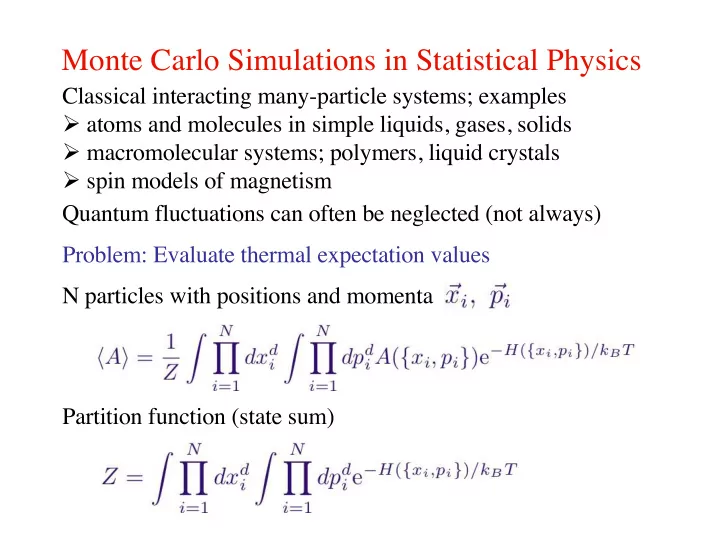
Classical interacting many-particle systems; examples Ø atoms and molecules in simple liquids, gases, solids Ø macromolecular systems; polymers, liquid crystals Ø spin models of magnetism Quantum fluctuations can often be neglected (not always) Problem: Evaluate thermal expectation values N particles with positions and momenta Partition function (state sum)
SLIDE 2
Hamiltonian (energy function) for identical particles in potential U and with pair-interaction V If the observable A is velocity-independent (real-space correlation functions, response of local density to external perturbations, etc.), the momentum integrals cancel Only the potential energy matters
SLIDE 3
For the kinetic energy the position integrals cancel Most of statistical physics concerns velocity-independent quantities; the mathematical problem of interest is With N approaching infinity (thermodynamic limit) Few exact solutions; numerical simulations for finite N important This gives the equipartition theorem
SLIDE 4
Lattice and spin models
Spin models, describing magnetism of solids with spinful atoms Ø large spin S behaves as classical angular momentum Ø quantum fluctuations important for small S (1/2,1,3/2) Degrees of fredom “live” on vertices of a lattice Ø Continuous or discrete variables on the vertices Interactions: often of the Heisenberg form
SLIDE 5
Ising models
Two states on each lattice site Can arise for quantum mechanical S=1/2: Strong anisotropies; z-interactions can dominate This is the Ising model Ø important in the theory of magnetism Ø also effective model for other stat mech problems (“lattice gases”, binary alloys, atom adsorption on surfaces,...) With only nearest-neighbor interactions (J), the Ising model can be solved analytically in 1D and 2D Ø Numerical simulations important in most other cases
SLIDE 6
Two-dimensional Ising model
denotes nearest neighbors Ferromagnetic or antiferromagnetic ground state (T=0) Related by transformation: on one sublattice Thermal expectation value of some quantity A
SLIDE 7
Phase transition
Spontaneous ordering (symmetry breaking) at critical temperature magnetization (ferromagnet) sublattice (staggered) magnetization (antiferromagnet) Tc/J = 2/ ln(1 + √ 2)