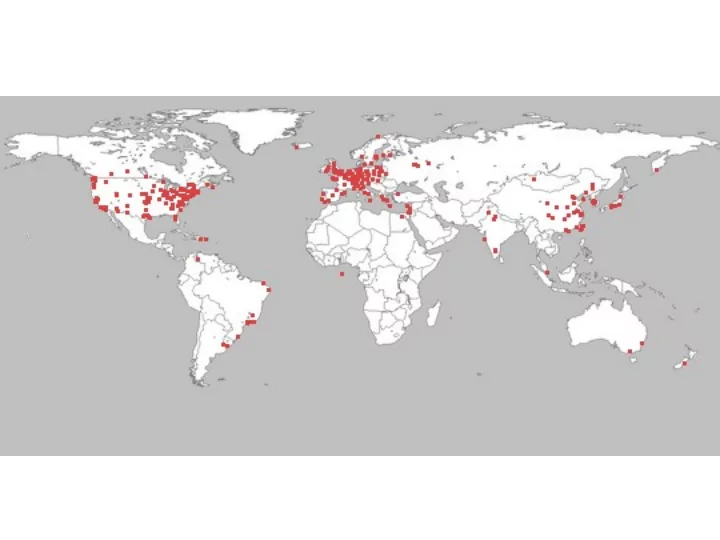
SLIDE 1
SLIDE 2 Monitoring PlanetLab Monitoring PlanetLab
- Keeping PlanetLab up and running 24-7 is a major
challenge
- Users (mostly researchers) need to know which nodes are
up, have disk space, are lightly loaded, responding promptly, etc.
- CoMon [Pai & Park] is one of the major tools used to
monitor the health, performance and security of the system
SLIDE 3
Persistent, Local Archive (Raw Data)
CoMon System Structure CoMon System Structure
Fetching Engine Node-Centric Format Slice-Centric Format ? ?? ? ? ? ? ? Queries Alerts
SLIDE 4 Related Systems – AT&T Web Hosting Related Systems – AT&T Web Hosting
- An order of magnitude more complex than CoMon
- Many machines monitoring many AT&T servers
– programs executed on remote machines to extract information – centralized archives, reports and alerts
- Extremely complex architecture
– scripts and C programs and information passed through undocumented environment variables – you’d better hope the wrong guy doesn’t get hit by a bus!
SLIDE 5 Related Systems – Coral CDN Related Systems – Coral CDN [Freedman]
[Freedman]
- 260 nodes worldwide
- periodic archiving for health, performance and research via
scripts, perl and C
- data volume causes many annoyances:
– too many files to use standard unix utilities
SLIDE 6 Related Systems – bioPixie Related Systems – bioPixie [Troyanskaya et al.]
[Troyanskaya et al.]
- An online service that pulls together information from a
variety of other genomics information repositories to discover gene-gene interactions
– micro-array data, gene expression data, transcription binding sites – curated online data bases – source characteristics range from: infrequent but large new data dumps to modestly sized, regular (ie: monthly) dumps
- Most of the data acquisition is only partly automated
SLIDE 7 Related Systems – Cosmological Data Related Systems – Cosmological Data
- Sloan Digital Sky Survey: mapping the entire visible
universe
- Data available: Images, spectra, “redshifts,” object lists,
photometric calibrations ... and other stuff I know even less about
SLIDE 8
Research Goals Research Goals
To make acquiring, archiving, querying, transforming and programming with distributed ad hoc data so easy a caveman can do it.
SLIDE 9 Research Goals Research Goals
To support three levels of abstraction/user communities:
– the computational scientist:
- wants to study biology, physics; does not want to “program”
- uses off-the-shelf tools to collect data & take care of errors,
load a database, edit and convert to conventional formats like XML and RSS – the functional programmer:
- likes to map, fold, and filter (don’t we all?)
- wants programming with distributed data to be just about as
easy as declaring and programming with ordinary data structures – the tool developers:
- enjoys reading functional pearls about the ease of developing
apps using HOAS and tricked-out, type-directed combinators
- develop new generic tools for user communities
SLIDE 10
Language Support for Language Support for Distributed Ad Hoc Data Distributed Ad Hoc Data
In Collaboration With: Daniel S. Dantas, Kathleen Fisher, Limin Jia, Yitzhak Mandelbaum, Vivek Pai, Kenny Q. Zhu
David Walker Princeton University
SLIDE 11 Approach Approach
- Provide a domain-specific language extension for specifying
properties of distributed data sources including:
– Location or access function or data generation procedure – Availability (schedule of information availability) – Format (uses PADS/ML as a sublanguage) – Proprocessing information (decompression/decryption) – Failure modes
- From these specifications, generate “feeds” with nice
interfaces for functional programmers and tool developers
– streams of meta-data * data pairs – meta data includes schedule time, arrival time, location, network and data error codes
SLIDE 12
Local Archive (Raw Data)
System Architecture System Architecture
Fetching Engine Data Description Archive Config RSS Tool DB Tool Alert Tool RSS Config DB Config Alert Config Custom Tool RSS Feed DB Alert File Data Interface Generation Custom Result Managed by Naive User Managed by Average Programmer Managed by Tool Developer
SLIDE 13 Back to CoMon ... Back to CoMon ...
ptype ‘a entry(name) = ... ptype ‘a entry_list(name) = ... ptype source = { date : pfloat64 entry("Date"); vm_stat : pint entry_list("VMStat"); cpu_use : pint entry_list("CPUUse"); dns_fail : pfloat32 entry_list("DNSFail"); rwfs : pint entry("RWFS"); ... } Date: 1202486984.709880 VMStat: 10 14 64 22320 24424 409284 0 0 4891 796 1971 2399 61 59 0 17 CPUUse: 60 100 DNSFail: 0.0 -1.0 0.0 -1.0 RWFS: 221 ... Every node delivers this data every 5 minutes CoMonFormat.pml [see Mandelbaum’s thesis]
SLIDE 14 ComonSimple.fml ComonSimple.fml
let sites = [ "http://planet-lab1.cs.princeton.edu:3121"; “http://pl1.csl.utoronto.ca:3121"; "http://plab1-c703.uibk.ac.at:3121"; ] feed comon = base {| sources = all sites; schedule = Schedule.every (~timeout: Time.seconds 60.) (~start: Time.now()) (Time.seconds 300.); format = CoMonFormat.Source; |} useful libraries declare feed primitive feed fetch from all sites in list fetch every 5 minutes; start now parse data from site using this pads/ml spec timeout after 1 minute
SLIDE 15
Tool Configs Tool Configs
Tool archive { arch_dir = “temp/”; log_file_name = “comon”; max_file_count = 1; compress_files = true; } Tool rss { title = “PlanetLab Disk Usage”; link = “http://comon.cs.princeton.edu”; desc = “This rss feed provides PlanetLab Disk usage info”; schedule = Some (Time.seconds 300.); path = comon.source.entries.diskusage ; rssfile = Some “rssdir/comon.rss”; } Tool accum { minalert = false; maxalert = false; lesssig = Some 3; moresig = Some 3; useralert = fn x -> x; slicesize = Some 1000; slicefile = Some “accumslice.xml”; totalfile = Some “accum.xml”; } Tool rrd { ... } Tool select { ... } Tool print { ... } tool name parameters
SLIDE 16
Tool Results Tool Results
temp/ comon_time_loc.zip comon.log archive: rss_dir/ comon.rss rssfeed: rss reader rrd: accum: <feed_accumulator> <net_errors> <error> <errcode>1</errcode> <errmsg>Misc HTTP error</errmsg> ...
SLIDE 17
A More Advanced Example: CoMon.fml A More Advanced Example: CoMon.fml
Nodelist.pml CoMonFormat.pml Nodelist.txt CoMon.fml comon/
SLIDE 18 Format Descriptions Format Descriptions
ptype nodeitem = Comment of '#' * pstring_SE(peor) | Data of pstring_SE(peor) ptype source = nodeitem precord plist (No_sep, No_term) plab1-c703.uibk.ac.at plab2-c703.uibk.ac.at #planck227.test.ibbt.be #pl1.csl.utoronto.ca #pl2.csl.utoronto.ca #plnode01.cs.mu.oz.au #plnode02.cs.mu.oz.au... Nodelist.txt: Nodelist.pml:
ptype ‘a entry(name) = ... ptype ‘a entry_list(name) = ... ptype source = { date : pfloat64 entry("Date"); vm_stat : pint entry_list("VMStat"); ... } CoMonFormat.pml (as before):
SLIDE 19
let isNode item = match item with Hosts.Data s -> true | _ -> false let makeURL (Nodelist.Data s) = "http://" ^ s ^ ":3121" feed nodelists = base {| sources = all ["file:///" ^ Sys.getcwd () ^ "/nodelist"]; schedule = Schedule.every (Time.hours 24.); format = Nodelist.Source; |} feed comon = foreach nodelist in nodelists create base {| sources = all (List.map makeURL (List.filter isNode nodelist)); schedule = Schedule.every (~start:Time.now()) (~duration:Time.hours 24.) (Time.minutes 5.); format = CoMonFormat.Source; |} CoMon.fml: find local nodelist filter out comment lines construct URL syntax repeatedly get current nodelist grab it every day fetch every 5 min all day long
SLIDE 20
AT&T Web Hosting AT&T Web Hosting
Nodelist.pml Ping.pml Nodelist.txt Pulse.fml comon/ Uptime.pml uptime() ping()
SLIDE 21
let isNode item = match item with Hosts.Data s -> true | _ -> false let mk_host (Hosts.Data h) = h feed hostList = base {| sources = all ["file:///" ^ Sys.getcwd () ^ "/machine_list"]; schedule = Schedule.every (~start:(Time.now())) (Time.hours 24.); format = Hosts.Source; |} feed hosts = {| mk_host n | n <- (flatten hostList), isNode n |} feed stats = foreach h in hosts create let s = Schedule.once (~timeout: Time.seconds 60.) () in ( base {| sources = proc ("ping -c 2 " ^ h); format = Ping.Source; schedule = s; |}, base {| sources = proc ("ssh " ^ h ^ " uptime"); format = Uptime.Lines; schedule = s; |} ) Pulse.fml: get hostlists create intermediate feed of hosts execute ping format Ping.Source execute uptime pair results in feed
SLIDE 22
Formal Semantics Formal Semantics
Feed Typing Rules: G |- F : t feed Denotational Semantics: [[ F ]] : universe -> environment -> (meta * value) set where type universe = location * time -> value * time type environment = variable -> value type meta = time * ...
SLIDE 23 Questions I have Questions I have
- What are the essential language constructs/combinators?
- What are the essential tools we need to provide to our
naive users?
- What are the canonical interfaces we should be providing?
- How would I implement this in Haskell or Clean or F#?
SLIDE 24 Conclusion Conclusion
- PADS/D is (will be!) a high-level, declarative language
designed to make it easy to specify:
– where your data is located – how your data is generated – when your data is available – what preprocessing needs to be done – how to handle failure conditions
- And generate useful processing tools:
– archiver, rss feeds, database, error profiler, debugging printer, ...
- And facilitate functional programming with distributed data
SLIDE 25
SLIDE 26 Example program Example program
- pen Feedmain
- pen ComonSimple
let myspec = comon let emptyT () = Hashtbl.create 800 let addT t idata = let (meta, data) = (IData.get_meta idata, IData.get_contents idata) in ... let printT t = ... let getload idata = match (IData.get_contents i) with None -> None | Some d -> List.hd (d.loads.2) (* every 600 seconds output the 10 locations with the least load *) let rec findnodes f = let (slice, rest) = sliceuntil (later_than (Time.now() +. 600.)) f in let loads = mapi getload slice in let loadT = foldi addT emptyT loads in let _ = printT loadT in findnodes rest findnodes (to_feed myspec)
SLIDE 27 Formal Typing Formal Typing
Feed Typing Rules: G |- F : t feed Example Rules: G |- F1 : t1 feed G |- F2 : t2 feed
- G |- (F1,F2) : t1 * t2 feed
G |- F1 : t1 feed G,x:t1 |- F2 : t2 feed
- G |- foreach x in F1 create F2 : t2 feed