MoDvaDon for local bindings We want local bindings = a way to name - - PowerPoint PPT Presentation

modvadon for local bindings
SMART_READER_LITE
LIVE PREVIEW

MoDvaDon for local bindings We want local bindings = a way to name - - PowerPoint PPT Presentation

MoDvaDon for local bindings We want local bindings = a way to name things locally in Local Bindings and Scope funcDons and other expressions. Why? These slides borrow heavily from Ben Woods Fall 15 slides, some of which are For style


slide-1
SLIDE 1

Local Bindings and Scope

CS251 Programming Languages

Fall 2018, Lyn Turbak

Department of Computer Science Wellesley College

These slides borrow heavily from Ben Wood’s Fall ‘15 slides, some of which are in turn based on Dan Grossman’s material from the University of Washington.

MoDvaDon for local bindings

We want local bindings = a way to name things locally in funcDons and other expressions. Why? – For style and convenience – Avoiding duplicate computaDons – A big but natural idea: nested funcDon bindings – Improving algorithmic efficiency (not “just a liQle faster”)

2 Local Bindings & Scope

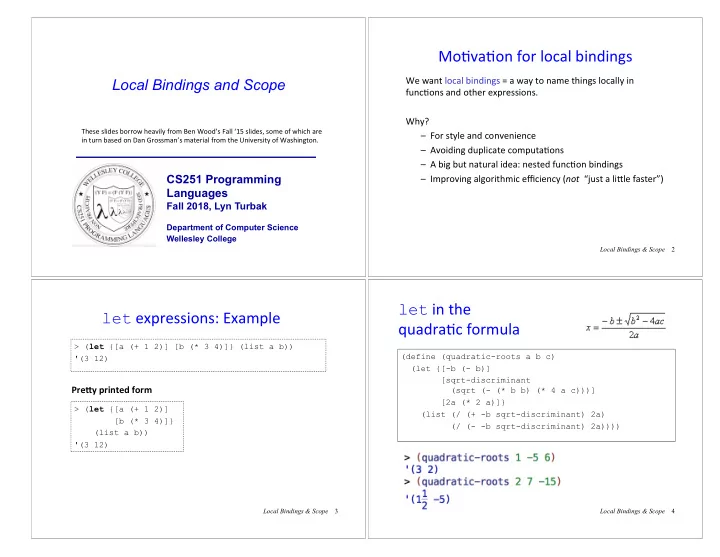
let expressions: Example

> (let {[a (+ 1 2)] [b (* 3 4)]} (list a b)) '(3 12) > (let {[a (+ 1 2)] [b (* 3 4)]} (list a b)) '(3 12)

Pre$y printed form

3 Local Bindings & Scope

let in the quadraDc formula

(define (quadratic-roots a b c) (let {[-b (- b)] [sqrt-discriminant (sqrt (- (* b b) (* 4 a c)))] [2a (* 2 a)]} (list (/ (+ -b sqrt-discriminant) 2a) (/ (- -b sqrt-discriminant) 2a))))

4 Local Bindings & Scope

slide-2
SLIDE 2

Formalizing let expressions

2 quesDons:

  • Syntax:

– Each Idi is any identiier, and Ebody and each Ei are any expressions

  • Evaluation:

– Evaluate each expression Ei to value Vi in the current dynamic environment. – Evaluate Ebody[V1,…Vn/Id1,…,Idn]in the current dynamic environment. Result of whole let expression is result of evaluating Ebody. (let {[Id1 E1] ... [Idn En]} Ebody)

a new keyword!

5 Local Bindings & Scope

Parens vs. Braces vs. Brackets

> (let {[a (+ 1 2)] [b (* 3 4)]} (list a b)) '(3 12) > (let ((a (+ 1 2)) (b (* 3 4))) (list a b)) '(3 12) > (let [[a (+ 1 2)] [b (* 3 4)]] (list a b)) '(3 12) > (let [{a (+ 1 2)} (b (* 3 4))] (list a b)) '(3 12) As matched pairs, they are interchangeable. Differences can be used to enhance readability.

6 Local Bindings & Scope

let is an expression

A let-expression is just an expression, so we can use it anywhere an expression can go. Silly example: (+ (let {[x 1]} x) (let {[y 2] [z 4]} (- z y)))

7 Local Bindings & Scope

let is just syntactic sugar!

(let {[Id1 E1] … [Idn En]} Ebody) desugars to ((lambda (Id1 … Idn) Ebody) E1 … En) Example: (let {[a (+ 1 2)] [b (* 3 4)]} (list a b)) desugars to ((lambda (a b) (list a b)) (+ 1 2) (* 3 4))

8 Local Bindings & Scope

slide-3
SLIDE 3

Avoid repeated recursion

Consider this code and the recursive calls it makes – Don’t worry about calls to first, rest, and null? because they do a small constant amount of work

(define (bad-maxlist xs) (if (null? xs)

  • inf.0

(if (> (first xs) (bad-maxlist (rest xs))) (first xs) (bad-maxlist (rest xs)))))

9 Local Bindings & Scope

Fast vs. unusable

bm 50,…

(if (> (first xs) (bad-maxlist (rest xs))) (first xs) (bad-maxlist (rest xs)))

bm 49,… bm 48,… bm 1 bm 1,… bm 2,… bm 3,… bm 50

bm 50

250 times

bm 2,… bm 3,… bm 3,… bm 3,…

(bad-maxlist (range 1 51)) (bad-maxlist (range 50 0 -1))

10 Local Bindings & Scope

Some calculaDons

Suppose one bad-maxlist call’s if logic and calls to null?, first?, rest take 10-7 seconds total – Then (bad-maxlist (list 50 49 … 1)) takes 50 x 10-7 sec – And (bad-maxlist (list 1 2 … 50)) takes (1 + 2 + 22 + 23 + … + 249 ) x 10-7 = (250 - 1) x 10-7 = 1.12 x 10⁸ sec = over 3.5 years – And (bad-maxlist (list 1 2 … 55)) takes over 114 years – And (bad-maxlist (list 1 2 … 100)) takes over 4 x 10¹⁵ years. (Our sun is predicted to die in about 5 x 10⁹ years) – Buying a faster computer won’t help much J The key is not to do repeated work! – Saving recursive results in local bindings is essential…

11 Local Bindings & Scope

Efficient maxlist

(define (good-maxlist xs) (if (null? xs)

  • inf.0

(let {[rest-max (good-maxlist (rest xs))]} (if (> (first xs) rest-max) (first xs) rest-max))))

gm 50,… gm 49,… gm 48,… gm 1 gm 1,… gm 2,… gm 3,… gm 50

12 Local Bindings & Scope

slide-4
SLIDE 4

Transforming good-maxlist

(define (good-maxlist xs) (if (null? xs)

  • inf.0

(let {[rest-max (good-maxlist (rest xs))]} (if (> (first xs) rest-max) (first xs) rest-max)))) (define (good-maxlist xs) (if (null? xs)

  • inf.0

(( (fst rest-max) ; name fst too! (if (> fst rest-max) fst rest-max)) (first xs) (good-maxlist (rest xs))))) (define (good-maxlist xs) (if (null? xs)

  • inf.0

(max (first xs) (good-maxlist (rest xs))))) (define (max a b) (if (> a b) a b))

13 Local Bindings & Scope

Your turn: sumProdList

(sumProdList '(5 2 4 3)) –> (14 . 120) (sumProdList '()) –> (0 . 1)

14 Local Bindings & Scope

Given a list of numbers, sumProdList returns a pair of (1) the sum of the numbers in the list and (2) The product of the numbers in the list Define sumProdList. Why is it a good idea to use let in your definiDon?

and and or sugar

(and) desugars to #t (and E1) desugars to E1 (and E1 …) desugars to (if E1 (and …) #f) (or) desugars to #f (or E1) desugars to E1 (or E1 …) desugars to (let ((Id1 E1)) (if Id1 Id1 (or …)) where Id1 must be fresh – i.e., not used elsewhere in the program.

  • Why is let needed in or desugaring but not and?
  • Why must Id1 be fresh?

15 Local Bindings & Scope

Scope and Lexical Contours

scope = area of program where declared name can be used. Show scope in Racket via lexical contours in scope diagrams. (define add-n (λ ( x ) (+ n x )) ) (define add-2n (λ ( y ) (add-n (add-n y )))) (define n 17) (define f (λ ( z ) (let {[ c (add-2n z ) ] [ d (- z 3) ]} (+ z (* c d ))) ) )

16 Local Bindings & Scope

slide-5
SLIDE 5

DeclaraDons vs. References

A declara7on introduces an idenDfier (variable) into a scope. A reference is a use of an idenDfier (variable) within a scope. We can box declaraDons, circle references, and draw a line from each reference to its declaraDon. Dr. Racket does this for us (except it puts ovals around both declaraDons and references). An idenDfier (variable) reference is unbound if there is no declaraDon to which it refers.

17 Local Bindings & Scope

Scope and Define Sugar

(define (add-n x ) (+ n x ) ) (define (add-2n y ) (add-n (add-n y )) ) (define n 17) (define (f z ) (let {[ c (add-2n z ) ] [ d (- z 3) ]} (+ z (* c d ))) ) )

18 Local Bindings & Scope

Shadowing

(let {[x 2]} (- (let {[x (* x x)]} (+ x 3)) x )) An inner declaraDon of a name shadows uses of outer declaraDons

  • f the same name.

Can’t refer to

  • uter x here.

19 Local Bindings & Scope

Alpha-renaming

(define (f w z) (* w (let {[c (add-2n z)] [d (- z 3)]} (+ z (* c d))))))

Can consistently rename idenDfiers as long as it doesn’t change the “wiring diagram” between uses and declaraDons.

(define (f c d) (* c (let {[b (add-2n d)] [c (- d 3)]} (+ d (* b c)))))) (define (f x y) (* x (let {[x (add-2n y)] [y (- y 3)]} (+ y (* x y)))))) OK Not OK

20 Local Bindings & Scope

slide-6
SLIDE 6

Scope, Free Variables, and Higher-order FuncDons

(define (make-sub n ) (λ ( x ) (- x n )) ) (define (map-scale factor ns ) (map (λ ( num ) (* factor num )) ns) ) In a lexical contour, an idenDfier is a free variable if it is not defined by a declaraDon within that contour. Scope diagrams are especially helpful for understanding the meaning of free variables in higher order funcDons.

21 Local Bindings & Scope

Compare the Values of the Following

(let {[a (+ 2 3)] [b (* 3 4)]} (list a (let {[a (- b a)] [b (* a a)]} (list a b)) b)) (let {[a (+ 2 3)] [b (* 3 4)]} (list a (let {[a (- b a)]} (let {[b (* a a)]} (list a b))) b))

22 Local Bindings & Scope

More sugar: let*

(let* {} Ebody) desugars to Ebody (let {[a (+ 2 3)] [b (* 3 4)]} (list a (let* {[a (- b a)] [b (* a a)]} (list a b)) b)) (let* {[Id1 E1] …} Ebody) desugars to (let {[Id1 E1]} (let* {…} Ebody)) Example (same as 2nd example on previous slide)

23 Local Bindings & Scope

Local funcDon bindings with let

  • Silly example:
  • Private helper functions bound locally = good style.
  • But can’t use let for local recursion. Why not?

(define (quad x) (let ([square (lambda (x) (* x x))]) (square (square x))))

(define (up-to-broken x) (let {[between (lambda (from to) (if (> from to) null (cons from (between (+ from 1) to))))]} (between 1 x)))

24 Local Bindings & Scope

?

slide-7
SLIDE 7

letrec to the rescue!

(define (up-to x) (letrec {[between (lambda (from to) (if (> from to) null (cons from (between (+ from 1) to))))]} (between 1 x)))

In (letrec {[Id1 E1] ... [Idn E1]} Ebody), Id1 … Idn are in the scope of E1 … En .

25 Local Bindings & Scope

Even BeQer

(define (up-to-better x) (letrec {[up-to-x (lambda (from) (if (> from x) null (cons from (up-to-x (+ from 1)))))]} (up-to-x 1)))

  • FuncDons can use bindings in the environment where they are

defined: – Bindings from “outer” environments

  • Such as parameters to the outer funcDon

– Earlier bindings in the let-expression

  • Unnecessary parameters are usually bad style

– Like to in previous example

26 Local Bindings & Scope

Mutual Recursion with letrec

(define (test-even-odd num) (letrec {[even? (λ (x) (if (= x 0) #t (odd? (- x 1))))] [odd? (λ (y) (if (= y 0) #f (even? (- y 1))))]} (list (even? num) (odd? num)))) > (test-even-odd 42) '(#t #f) > (test-even-odd 17) '(#f #t)

27 Local Bindings & Scope

Exercise: let vs. let* vs. letrec

(let {[f (λ (x) (/ x 2))] [g (λ (y) (+ y 1))] [h (λ (a b) (+ a b))]} (let {[f (λ (y) (- y 1))] [g (λ (n) (if (<= n 0) 1 (h n (g (f n)))))] [h (λ (a b) (* a b))]} (list (f 10) (g 4) (h 2 3))))

28 Local Bindings & Scope

  • What is the value of the above expression?
  • What is its value if the inner let is replaced by let*
  • What is its value if the inner let is replace by letrec?
slide-8
SLIDE 8

Local definiDons are sugar for letrec

(define (up-to-alt x) (define (up-to-x from) (if (> from x) null (cons from (up-to-x (+ from 1))))) (up-to-x 1)) (define (test-even-odd num) (define (even? x) (if (= x 0) #t (not (odd? (- x 1))))) (define (odd? y) (if (= y 0) #f (not (even? (- y 1))))) (list (even? num) (odd? num)))

29 Local Bindings & Scope

The following internal defines desugar to the letrecs studied in previous slides

Nested funcDons: style

  • Good style to define helper functions inside the functions they

help if they are: – Unlikely to be useful elsewhere – Likely to be misused if available elsewhere – Likely to be changed or removed later

  • A fundamental trade-off in code design: reusing code saves

effort and avoids bugs, but makes the reused code harder to change later

30 Local Bindings & Scope

Local Scope in other languages

31 Local Bindings & Scope var w = 2; var x = 3; function f(y) { if (y > x) { var z = y - x; } else { var z = y * w; } w = y + z; return y * z; } w = 2 x = 3 def f(y): global w if y > x: z = y - x else: z = y * w w = y + z return y * z public static int w = 2; public static int x = 3; public static int f (int y) 
 { int z; if (y > x) { z = y - x; } else { z = y * w; } w = y + z; return y * z; }

JavaScript Java Python

In all 3 languages, f(8) returns 28 and a following f(10) returns 70

  • Java requires z to be declared outside if if it’s used in both branches, because each

{ … } defines a new scope. But in JavaScript and Python, any declaraDon has scope of enDre funciton body regardless of where declaraDon is.

  • Python uses = to both declare and re-assign, so needs global declaraDon when

assigning to global variable.

  • JavaScript and Python allow local funcDon decls; Java has local class (not method) decls
  • No let-like expression in Python/JavaScript, but can be simulated by

calling local or anonymous funcDon.

Racket kernel declara7ons:

  • definiDons: (define Id E)

Racket kernel expressions

  • literal values (numbers, boolean, strings): e.g. 251, 3.141, #t, "Lyn"
  • variable references: e.g., x, fact, positive?, fib_n-1
  • condiDonals: (if Etest Ethen Eelse)
  • funcDon values: (lambda (Id1 … Idn) Ebody)
  • funcDon calls: (Erator Erand1 … Erandn)

Note: arithmetic and relational operations are really just function calls!

  • (new) local recursion: (letrec {[Id1 E1] … [Idn En]} Ebody)

Racket Syntac7c Sugar

  • (define (Idfun Id1 … Idn) Ebody)
  • (and E1 … E2)
  • (or E1 … E2)
  • (let {[Id1 E1] … [Id1 E1]}

]} Ebody )

  • (let* {[Id1 E1] … [Id1 E1]}

]} Ebody )

Racket Language Summary So Far

32

Local Bindings & Scope

Racket Built-in Func7ons

+, -, *, /, min min, max max, … <, <= <=, =, >= >=, >, cons cons, car car, cdr cdr, list list, first first, second second, …, rest rest