SLIDE 1
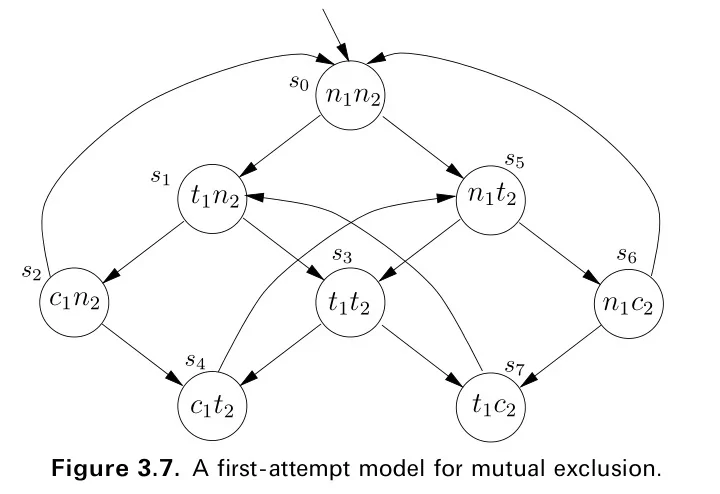
n1n2 t1n2 c1n2 t1t2 n1t2 n1c2 t1c2 c1t2
s0 s1 s2 s4 s3 s5 s6 s7 Figure 3.7. A first-attempt model for mutual exclusion.
SLIDE 2
s0 n1n2 s1 s2 s4 s3
t1n2 c1n2 c1t2
s5
n1c2
s7
n1t2 t1c2 t1t2 t1t2
s9 s6
Figure 3.8. A second-attempt model for mutual exclusion. There are now two states representing t1t2, namely s3 and s9.
SLIDE 3
MODULE main VAR request : boolean; status : {ready,busy}; ASSIGN init(status) := ready; next(status) := case request : busy; 1 : {ready,busy}; esac; LTLSPEC G(request -> F status=busy)
SLIDE 4
req ready busy req ¬req busy ready ¬req
SLIDE 5
SLIDE 6 MODULE main VAR pr1: process prc(pr2.st, turn, 0); pr2: process prc(pr1.st, turn, 1); turn: boolean; ASSIGN init(turn) := 0;
LTLSPEC G!((pr1.st = c) & (pr2.st = c))
LTLSPEC G((pr1.st = t) -> F (pr1.st = c)) LTLSPEC G((pr2.st = t) -> F (pr2.st = c))
- - ‘negation’ of strict sequencing (desired to be false)
LTLSPEC G(pr1.st=c -> ( G pr1.st=c | (pr1.st=c U (!pr1.st=c & G !pr1.st=c | ((!pr1.st=c) U pr2.st=c))))) MODULE prc(other-st, turn, myturn) VAR st: {n, t, c}; ASSIGN init(st) := n; next(st) := case (st = n) : {t,n}; (st = t) & (other-st = n) : c; (st = t) & (other-st = t) & (turn = myturn): c; (st = c) : {c,n}; 1 : st; esac; next(turn) := case turn = myturn & st = c : !turn; 1 : turn; esac; FAIRNESS running FAIRNESS !(st = c)
Figure 3.10. SMV code for mutual exclusion. Because W is not sup- ported by SMV, we had to make use of equivalence (3.3) to write the no-strict-sequencing formula as an equivalent but longer formula in- volving U.
SLIDE 7
cn0 tn0 tc0 tt0 nn0 ct0
1,2 2 1 1 1 2 1,2 1 2 2 2 2 1 1 2 1 1,2 1 1,2 1,2 1 2 2 2 1 2 1 1 1 2 1 2 2
nn1 tn1 cn1 ct1 nt1 tt1 nc1 tc1
1,2 2
nc0 nt0
1,2 2 1 1,2 1,2 1 1,2
Figure 3.11. The transition system corresponding to the SMV code in Figure 3.10. The labels on the transitions denote the process which makes the move. The label 1, 2 means that either process could make that move.
SLIDE 8
MODULE main VAR ferryman : boolean; goat : boolean; cabbage : boolean; wolf : boolean; carry : {g,c,w,0}; ASSIGN init(ferryman) := 0; init(goat) := 0; init(cabbage) := 0; init(wolf) := 0; init(carry) := 0; next(ferryman) := 0,1; next(carry) := case ferryman=goat : g; 1 : 0; esac union case ferryman=cabbage : c; 1 : 0; esac union case ferryman=wolf : w; 1 : 0; esac union 0; next(goat) := case ferryman=goat & next(carry)=g : next(ferryman); 1 : goat; esac; next(cabbage) := case ferryman=cabbage & next(carry)=c : next(ferryman); 1 : cabbage; esac; next(wolf) := case ferryman=wolf & next(carry)=w : next(ferryman); 1 : wolf; esac; LTLSPEC !(( (goat=cabbage | goat=wolf) -> goat=ferryman) U (cabbage & goat & wolf & ferryman)) Figure 3.12. NuSMV code for the ferryman planning problem.