Modernizing Census Bureau Economic Statistics through Web Scraping - - PowerPoint PPT Presentation

modernizing census bureau economic statistics through web
SMART_READER_LITE
LIVE PREVIEW

Modernizing Census Bureau Economic Statistics through Web Scraping - - PowerPoint PPT Presentation

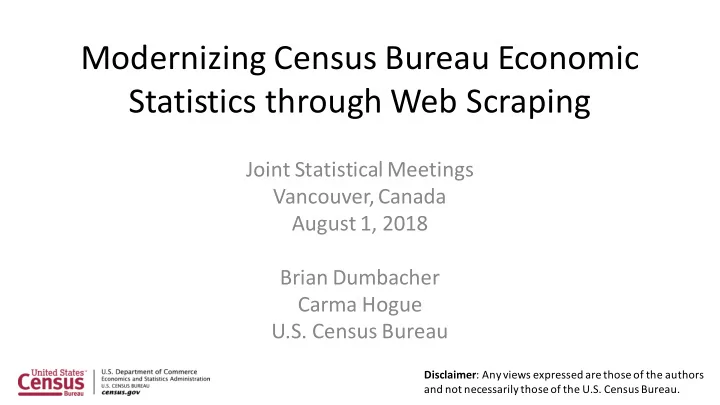
Modernizing Census Bureau Economic Statistics through Web Scraping Joint Statistical Meetings Vancouver, Canada August 1, 2018 Brian Dumbacher Carma Hogue U.S. Census Bureau Disclaimer : Any views expressed are those of the authors and not


slide-1
SLIDE 1

Joint Statistical Meetings Vancouver, Canada August 1, 2018 Brian Dumbacher Carma Hogue U.S. Census Bureau

Modernizing Census Bureau Economic Statistics through Web Scraping

Disclaimer: Any views expressed are those of the authors and not necessarily those of the U.S. Census Bureau.

slide-2
SLIDE 2

Outline

  • Big Data Context
  • Web Scraping Background
  • Scraping Assisted by Learning (SABLE)

– State Government Tax Revenue Collections – Public Pension Statistics

  • Securities and Exchange Commission (SEC) Filing Metadata
  • Building Permit Data
  • Efforts to Improve Sampling Frames
  • Next Steps with Web Scraping
slide-3
SLIDE 3

Big Data Context

  • U.S. Census Bureau’s Economic Directorate has been

researching alternative data sources and Big Data methodologies

  • Evaluation criteria include

– Quality – Cost – Skillset

  • Machine learning, “tableplots” for edit reduction, web

scraping, and web crawling are beneficial methods

slide-4
SLIDE 4

Web Scraping Background

  • For many economic surveys, respondent data or equivalent-

quality data are available online

– Respondent websites – Public filings with the SEC – Application Programming Interfaces (APIs) – Publications on state and local government websites

  • Current data collection efforts along these lines are manual
  • Going directly to online sources and collecting data passively

could reduce respondent and analyst burden

slide-5
SLIDE 5

Web Scraping Background (cont.)

  • Web scraping: automated process of collecting data from an
  • nline source
  • Web crawling: automated process of systematically visiting

and reading web pages

  • Policy issues

– Informed consent – Websites of private companies vs. government websites – Statistics Canada’s “About us” page informs data users and respondents about web scraping

Source: Statistics Canada. (2018). About us. Accessed July 6, 2018. https://www.statcan.gc.ca/eng/about/about

slide-6
SLIDE 6

SABLE

  • Scraping Assisted by Learning
  • Collection of tools for

– Crawling websites – Scraping documents and data – Classifying text

  • Models based on text analysis and machine learning
  • Implemented using free, open-source software

– Apache Nutch – Python

slide-7
SLIDE 7

Three Main Tasks

Crawl Scrape Classify

  • Scan website
  • Find documents and

extract text

  • Apply classification

model to predict whether document contains useful data

  • Apply model to learn the

location of useful data

  • Extract numerical values

and corresponding text

  • Preprocess data
  • Apply classification

model to map text to Census Bureau definitions and classification codes Given a website, Given a document classified as useful, Given scraped data,

slide-8
SLIDE 8

Architecture Design

Parameter files Programs Word files Folders

NLTK

Firewall External public website Crawl results

slide-9
SLIDE 9

Moving to a Production Environment

  • Authority to Operate

– Risk profile and security assessment – Documentation and procedures – Audit trail system – Subversion for code management

  • SABLE repository on the Census Bureau’s GitHub account

– https://www.github.com/uscensusbureau/SABLE – Programs, supplementary files, examples, and documentation

slide-10
SLIDE 10

State Government Tax Revenue Collections

  • Data on state government tax revenue collections can be found
  • nline in Comprehensive Annual Financial Reports (CAFRs) and
  • ther publications
  • Used SABLE to find additional online sources in Portable Document

Format (PDF)

– Crawled websites of state governments – Discovered approximately 60,000 PDFs – Manually classified a simple random sample of 6,000 PDFs as “Useful” or “Not Useful” – Applied machine learning to build text classification models based on

  • ccurrences of word sequences
slide-11
SLIDE 11

Example Document

Source: New Hampshire Department of Administrative Services. Accessed July 6, 2018. https://das.nh.gov/accounting/FY%2018/Monthly_Rev_May.pdf

slide-12
SLIDE 12

Pension Statistics

  • Likewise, data on public pension funds can be found online and

in CAFRs

  • Examine feasibility of scraping service cost and interest

statistics

  • Create a data product based on the largest publicly

administered pension plans

  • Two-stage approach

– Identify tables using occurrences of word sequences – Apply scraping algorithm based on table structure

slide-13
SLIDE 13

Examples of Key Word Sequences

Source: Comprehensive Annual Financial Report For Fiscal Years Ended June 30, 2016 and 2015; Santa Barbara County Employees’ Retirement System; A Pension Trust Fund for the County of Santa Barbara, California. Accessed July 6, 2018. http://cosb.countyofsb.org/uploadedFiles/sbcers/benefits/SBCERS%206-30-2016%20CAFR%20With%20Letters.pdf

slide-14
SLIDE 14

SEC Filing Metadata

  • Online database of financial performance reports for publicly

traded companies

  • Really Simple Syndication (RSS) feed provides information

about recent SEC filings such as filing dates

  • Data obtainable in Extensible Markup Language (XML) format
  • One can query this RSS feed by supplying

– Filing type [e.g., 10-K (annual report) or 10-Q (quarterly report)] – Central Index Key, which the SEC uses to identify companies that have filed disclosures

slide-15
SLIDE 15

RSS Feed

slide-16
SLIDE 16

Data from RSS Feed in XML Format

slide-17
SLIDE 17

SEC Current Work

  • Work with various survey teams to see how they can best use

this information

  • Incorporate web scraping and a filing notification system into

production cycles

  • Research how best to scrape actual financial information

– Extensible Business Reporting Language (XBRL) – Arelle software – lxml XML parser

slide-18
SLIDE 18

Building Permit Data

  • Data on new construction

– Used to measure and evaluate size, composition, and change in the construction sector – Building Permits Survey (BPS) – Survey of Construction (SOC) – Nonresidential Coverage Evaluation (NCE)

  • Information on new, privately owned construction is often available

from building permit jurisdictions

  • Investigate feasibility of using publicly available building permit

data to supplement new construction surveys

slide-19
SLIDE 19

Research and Findings

  • Chicago, IL and Seattle, WA building permit jurisdictions

– Data available through APIs – Initial research indicated that these sources provide timely and valid data with respect to BPS – Definitional differences and insufficient detail to aid estimation

  • Seven additional jurisdictions across the country

– Data come in other formats – More standardized classification data items – Lack of information regarding housing units

slide-20
SLIDE 20

Challenges and Future Work

  • Challenges of using online building permit data

– Representativeness – Consistency of data formats and terminology

  • Future work

– Ongoing validation of data compared to survey data from BPS, SOC, and NCE – Use of third-party data sources Zillow and Construction Monitor

slide-21
SLIDE 21

Efforts to Improve Sampling Frames

  • Scrape location and contact information for

– Juvenile facilities – Franchisees and franchisors – Tax collectors

  • Work done by Economic Directorate, Civic Digital Fellows, and

Center for Economic Studies

slide-22
SLIDE 22

Next Steps with Web Scraping

  • Use SABLE in production
  • Release a data product based in part on scraped data
  • Scrape data from SEC’s online database
  • Look for guidance from a newly formed Census Bureau-wide

working group to address policy issues regarding web scraping and web crawling

slide-23
SLIDE 23

Contact Information

  • Brian.Dumbacher@census.gov
  • Carma.Ray.Hogue@census.gov