Mitigating Provider Liability Implementing Monitoring Processes to - - PowerPoint PPT Presentation

mitigating provider liability
SMART_READER_LITE
LIVE PREVIEW

Mitigating Provider Liability Implementing Monitoring Processes to - - PowerPoint PPT Presentation

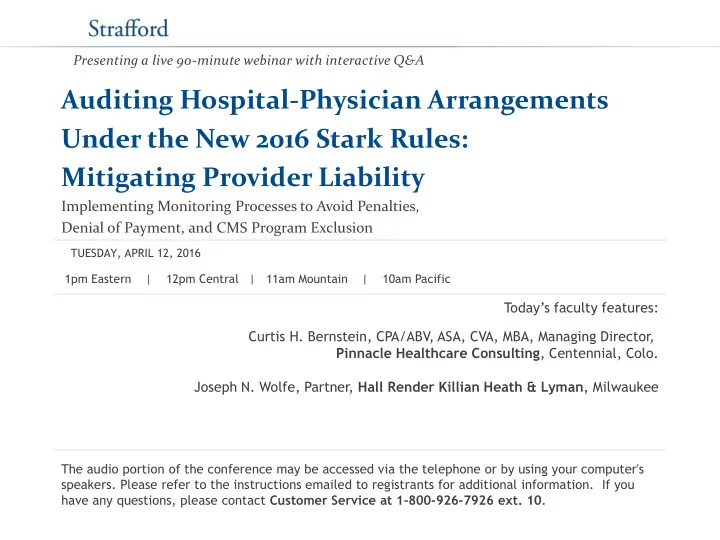
Presenting a live 90-minute webinar with interactive Q&A Auditing Hospital-Physician Arrangements Under the New 2016 Stark Rules: Mitigating Provider Liability Implementing Monitoring Processes to Avoid Penalties, Denial of Payment, and CMS


slide-1
SLIDE 1

The audio portion of the conference may be accessed via the telephone or by using your computer's

  • speakers. Please refer to the instructions emailed to registrants for additional information. If you

have any questions, please contact Customer Service at 1-800-926-7926 ext. 10.

Presenting a live 90-minute webinar with interactive Q&A

Auditing Hospital-Physician Arrangements Under the New 2016 Stark Rules: Mitigating Provider Liability

Implementing Monitoring Processes to Avoid Penalties, Denial of Payment, and CMS Program Exclusion

Today’s faculty features:

1pm Eastern | 12pm Central | 11am Mountain | 10am Pacific TUESDAY, APRIL 12, 2016

Curtis H. Bernstein, CPA/ABV, ASA, CVA, MBA, Managing Director, Pinnacle Healthcare Consulting, Centennial, Colo. Joseph N. Wolfe, Partner, Hall Render Killian Heath & Lyman, Milwaukee

slide-2
SLIDE 2

Tips for Optimal Quality

Sound Quality If you are listening via your computer speakers, please note that the quality

  • f your sound will vary depending on the speed and quality of your internet

connection. If the sound quality is not satisfactory, you may listen via the phone: dial 1-866-961-8499 and enter your PIN when prompted. Otherwise, please send us a chat or e-mail sound@straffordpub.com immediately so we can address the problem. If you dialed in and have any difficulties during the call, press *0 for assistance. Viewing Quality To maximize your screen, press the F11 key on your keyboard. To exit full screen, press the F11 key again.

FOR LIVE EVENT ONLY

slide-3
SLIDE 3

Continuing Education Credits

In order for us to process your continuing education credit, you must confirm your participation in this webinar by completing and submitting the Attendance Affirmation/Evaluation after the webinar. A link to the Attendance Affirmation/Evaluation will be in the thank you email that you will receive immediately following the program. For additional information about continuing education, call us at 1-800-926-7926

  • ext. 35.

FOR LIVE EVENT ONLY

slide-4
SLIDE 4

Program Materials

If you have not printed the conference materials for this program, please complete the following steps:

  • Click on the ^ symbol next to “Conference Materials” in the middle of the left-

hand column on your screen.

  • Click on the tab labeled “Handouts” that appears, and there you will see a

PDF of the slides for today's program.

  • Double click on the PDF and a separate page will open.
  • Print the slides by clicking on the printer icon.

FOR LIVE EVENT ONLY

slide-5
SLIDE 5

5

Auditing Hospital-Physician Arrangements Under the New 2016 Stark Rules: Mitigating Provider Liability

Implementing Monitoring Processes to Avoid Penalties, Denial of Payment and CMS Program Exclusion

Presented by: Curtis H. Bernstein, CPA/ABV, ASA, CVA, MBA Principal – Pinnacle Healthcare Consulting cbernstein@askphc.com Joseph N. Wolfe, Attorney/Shareholder Hall, Render, Killian, Heath & Lyman, P.C., Milwaukee jwolfe@hallrender.com

Tuesday, April 12, 2016 | 1:00 P.M.- 2:30 P.M. Eastern

slide-6
SLIDE 6

6

Session Agenda

  • Introductory Concepts
  • Applicable Regulatory Standards

– Stark Law Overview – Requirements of the Exceptions – The 2016 Changes

  • Reasons to Conduct a Stark Compliance Audit
  • Conducting Stark Compliance Audits
  • Strategies for Mitigating Risk
  • Question and Answer
slide-7
SLIDE 7

7

Introductory Concepts

slide-8
SLIDE 8

8

Introductory Concepts

  • The Enforcement Climate
  • More integration and financial relationships with physicians
  • Rigid and technical (e.g., Stark Law) regulatory framework
  • Aggressive government enforcement
  • Disproportionate Penalties = Enterprise Risk
  • Considerations for Managing Risk
  • Compensation arrangements with referring physicians must be defensible under

the applicable health care regulations

  • Must focus on demonstrating the Three (3) Tenets of Defensibility:

Fair market value (“FMV”), commercial reasonableness (“CR”) and not taking into account (“TIA”) referrals

  • Documentation and governance processes (e.g., business planning, valuation,

etc.) should support defensibility

slide-9
SLIDE 9

9

Focus on 3 Tenets of Defensibility

  • The Toumey Case

– FMV – CR – TIA

  • The Halifax Case

– FMV – CR – TIA

slide-10
SLIDE 10

10

Focus on Penalties and Enterprise Risk

slide-11
SLIDE 11

11

2014 Cases and Settlements

  • Enforcement Actions:
  • New York Heart Center

$1.33 million

  • Infirmary Health System

$24.5 million

  • All Children’s Health System

$7 million

  • Halifax Hospital

$85 million

  • King’s Daughters Medical Center

$40.9 million

  • Recurring Issues:
  • Executive, physician and compliance department whistleblowers
  • Allegations based on the Key Tenets of Defensibility: Fair Market Value, Commercial

Reasonableness and not TIA DHS Referrals

  • Testing of Internal Group Practice Requirements
  • Application of Stark to Medicaid
  • DHS Pooling Issues
slide-12
SLIDE 12

12

2015 Cases and Settlements

  • Enforcement Actions:
  • Memorial Health

$9.8 million

  • Tuomey Healthcare System

$72.4 million

  • Adventist Health System

$115 million

  • North Broward Hospital District

$69.5 million

  • Columbus Regional Health

$35 million

  • Dr. Andrew Pippas

$425 thousand

  • Westchester Medical Center

$18.8 million

  • Citizens Medical Center

$21.8 million

  • Recurring Issues:
  • Executive, physician and compliance department whistleblowers
  • Allegations based on the Key Tenets of Defensibility: Fair Market Value, Commercial

Reasonableness and not TIA DHS Referrals

  • Systematic Practice Losses and DHS “Referral Tracking” Processes
  • Allegations involving up-coding, billing issues and overlapping duties
  • Enforcement against physicians
slide-13
SLIDE 13

13

Overview of the Regulatory Standards

slide-14
SLIDE 14

14

Regulatory Standards

  • False Claims Act (1863)
  • Anti-Kickback Statute (1972)
  • Federal Stark Law (1989)
  • Other Relevant Laws

– Tax-Exemption Laws

  • Private Benefit and Private Inurement
  • Intermediate Sanctions

– Civil Monetary Penalties Law – State Equivalents

slide-15
SLIDE 15

15

The Stark Law Framework

  • If Physician + Financial Relationship + Entity:

– The Physician may not make a Referral to that Entity for the

furnishing of Designated Health Services (“DHS”) for which payment may be made under Medicare; and

– The entity may not bill Medicare, an individual or another payor for

the DHS performed pursuant to the prohibited Referral… ... unless the arrangement fits squarely within a Stark exception

  • Threshold Compliance Statute

– Strict liability – no intent required. Civil (non-criminal statute) – Triggered by “technical” violations, inadvertence and error – Your regulatory “Litmus Test” – 11 Categories of DHS (e.g., clinical lab services, radiology and certain

  • ther imaging services, radiation therapy and supplies, outpatient

prescription drugs, inpatient and outpatient hospital services, etc.)

slide-16
SLIDE 16

16

The Stark Exceptions

  • Commonly Used Stark Exceptions:

– Rental of Office Space or Equipment – Physician Recruitment – Personal Service and FMV Exceptions – Isolated Transactions – Bona Fide Employment – New in 2016 - Assistance to Compensate an NPP – New in 2016 - Time Share Arrangements

  • Common Elements of the Stark Exceptions:

– Signed, written agreement that specifies the services or property – Arrangement must be CR, and compensation must be consistent with FMV – Compensation must be set in advance and not TIA the volume or value of referrals generated between the parties

slide-17
SLIDE 17

17

Stark Rental Exceptions*

  • The arrangement must be set out in writing
  • Duration of the lease arrangement must be at least 1 year
  • Rental charges must be set in advance and be FMV
  • Rental charges must not be determined in a manner that TIA the

volume or value of any referrals or other business generated

  • Space or equipment rented must be reasonable and necessary (CR)
  • No per click or percentage-based formulas allowed
  • Exclusive use required
  • Special rules for allocating common area expenses
  • If the lease arrangement expires after a term of at least 1 year, new

writing clarification and/or indefinite holdover rules may apply * Actually two exceptions. Not all requirements listed.

slide-18
SLIDE 18

18

Personal Service Exception*

  • The arrangement must be set out in writing
  • Duration of the arrangement must be at least 1 year
  • Compensation must be set in advance and FMV
  • Compensation must not be determined in a manner that TIA the volume
  • r value of any referrals, or other business generated between the

parties

  • Aggregate services contracted for may not exceed those that are

reasonable and necessary for legitimate business purposes (CR)

  • Very similar to Stark’s fair market value exception
  • If the arrangement expires after a term of at least 1 year, new writing

clarification and/or indefinite holdover rules may apply *Not all requirements listed.

slide-19
SLIDE 19

19

Stark Employment Exception*

  • FMV remuneration required
  • Must not be determined in a manner that TIA the volume or value
  • f any DHS referrals by the referring physician.
  • Agreement must be CR “even if no referrals were made to the

employer”

  • No “in writing” requirement unless requiring or directing referrals
  • Recent enforcement actions in what is normally considered the

“safer” exception *Not all requirements listed.

slide-20
SLIDE 20

20

Stark Group Practices

  • Receive favored treatment with respect to physician

compensation:

– Stark group practices can compensate physicians for services ‘‘incident to’’ their personally performed services – Indirect bonuses and profit shares may include DHS revenues, if the distribution methodology meets certain conditions – This additional compensation latitude for group practices is statutory

  • Group Practice status is required for certain exceptions:

– In-Office Ancillary Services Exception – Physician Services Exception

slide-21
SLIDE 21

21

Group Practice Requirements*

  • Single Legal Entity Test. Must be a “single legal entity” operated primarily for the purpose
  • f being a group practice (e.g., a hospital cannot be a group practice, etc.)
  • Physicians. Two (2) physicians must be owners or employees of the group practice (i.e.,

not independent contractors)

  • Unified Business Test. A body representative of the group practice must maintain

“effective control” over its assets and liabilities

  • Distributions of Income and Expenses. Methods of distribution must be determined by

the group practice prospectively before the receipt of payment for services

  • Range of Care. Each physician must furnish substantially his or her full range of patient

care services through the group practice

  • “Substantially All” Test. At least 75% of the aggregate total patient care services of the

group practice members must be furnished and billed through the group

  • Physician-Patient Encounters. Members of the group (i.e., not independent contractors),

in the aggregate, must personally conduct no less than 75% of the physician-patient encounters of the group practice

  • Volume/Value Compensation Test. Shares of overall profits and productivity bonuses

cannot be determined in a manner that directly relates to the volume or value of a physician’s referrals of DHS *Not all detailed requirements are listed.

slide-22
SLIDE 22

22

Other Common Exceptions

Non-Monetary Compensation Exception*

– Covers non-monetary compensation transferred from a DHS entity to a referring physician. Is limited to $392 per year (increases each year by the applicable CPI). – Remuneration must be "non-monetary."

Medical Staff Incidental Benefits Exception*

– Covers incidental benefits transferred from a hospital to a referring physician member of the medical staff. Is limited to $33 per

  • ccurrence (increases each year by the applicable CPI).

– Examples: Parking, meals, internet access in physicians' lounge, etc.

*Not all requirements listed.

slide-23
SLIDE 23

23

2016 Stark Law Changes

slide-24
SLIDE 24

24

New Stark Rules

  • New Exceptions

– Assistance to Compensate an NPP – 411.357(x) – Time-Share Arrangements – 411.357(y)

  • Reducing Burdens on Health Care Organizations

– Writing requirement – Term Requirement – Holdover Requirement

  • Clarifications/Corrections

– Remuneration – Stand-in The Shoes – Temporary Noncompliance – Takes into Account

slide-25
SLIDE 25

25

Assistance to Compensate an NPP*

  • The arrangement is set out in writing and signed by the hospital, the physician and

the NPP.

  • The arrangement is not conditioned on the physician or NPP’s referrals to the

hospital.

  • The remuneration from the hospital:

– does not exceed 50% of NPP’s actual compensation paid by the physician to the NPP; and – is not determined in a manner that takes into account volume or value of referrals.

  • Compensation paid to the NPP by the physician does not exceed FMV.
  • NPP has not within the past year worked in the “geographic area.”
  • NPP has compensation arrangement with the physician and substantially all

services provided are primary care or mental health.

  • Physician does not unreasonably restrict NPP from providing patient primary care

services in the “geographic service area”. *Not all requirements listed.

slide-26
SLIDE 26

26

Time-Share Arrangements*

  • The arrangement is set out in writing, signed and specifies the

premises, equipment, personnel, items, supplies and services covered.

  • The arrangement is between a physician and a hospital or physician
  • rganization.
  • Items covered by the arrangement are used primarily for E&M

services and on the “same schedule.”

  • Any equipment used must be located in same building and only used

for DHS incidental to the E&M Services. (some equipment excluded)

  • Not conditioned upon the referral of patients by the physician.
  • Compensation is set in advance, FMV, and does not take into account

the volume or value of referrals.

  • The arrangement is Commercially Reasonable.

*Not all requirements listed.

slide-27
SLIDE 27

27

CMS - Reducing Stark Burdens

  • Writing Requirement

– Clarifies that the arrangement need not be reduced to a single “formal” written contract. – Moving away from the terms “agreement” and “contract” to the term “arrangement.”

  • Term Requirement

– Exceptions requiring “1 year” term may be satisfied by the arrangement lasting 1 year, even if there is no 1 year provision.

  • Holdover Requirement

– Indefinite holdovers are permitted if certain requirements are met:

  • Same terms and conditions
  • Continues to meet all of the requirements of the exception,

including FMV

slide-28
SLIDE 28

28

Clarifications/Corrections

  • Temporary Non-Compliance with Signature Requirement

– Now allows parties 90 days to obtain the required signatures, regardless

  • f whether or not the failure to obtain the signatures was inadvertent.

– Maintains the prior safeguards (e.g., applies narrowly to the signature requirement, must be set out in writing, can only be used once every three years for the same referring physician, etc.).

  • Conforming Terminology: “Takes Into Account”

– CMS declines to define or to discuss the term “takes into account.” – CMS modified the regulation to make use of the phrase consistent and uniform throughout the compensation exceptions in Section 411.357. – CMS is considering a commenter’s proposed definition of “takes into account.”

slide-29
SLIDE 29

29

Reasons to Conduct a Stark Compliance Audit

slide-30
SLIDE 30

30

Why Conduct a Stark Audit?

  • Period of Disallowance

– Begins – when the financial relationship fails to satisfy all of the requirements of an exception. – Ends – “no later than” when the financial relationship again fits squarely within a Stark exception. – During the disallowance period Stark’s “general prohibition” on referrals and billing applies. – Focus on appropriate strategies that shorten potential periods of disallowance.

  • Alternative Methods of Compliance

– Delayed signature rule (90 days to obtain signatures). – Collection of documents. – Holdover. – Indirect analysis.

slide-31
SLIDE 31

31

Self Referral Disclosure Protocol

  • For perceived problematic financial relationships with referring

physicians under Stark.

  • SRDP suspends the obligation to refund overpayments within 60

days.

– Submission consistent with SRDP specifications. – Importance of Corporate Responsibility Program. – Four-year “look back” period. – Process lengthy and hundreds of self-disclosing providers currently in the queue to settle with CMS.

slide-32
SLIDE 32

32

Disproportionate Penalties

  • Stark Sanctions

– Denial of payment/repayment of reimbursement – CMPs of up to $15,000 per item or service – CMPs of up to $100,000 for each arrangement considered to be a circumvention scheme – Exclusion from Medicare and Medicaid

  • Potential for False Claims Liability

– A Stark violation renders all related claims false or fraudulent

  • verpayments, thus giving rise to an FCA violation

– Retention of “identified” overpayments for over 60 days is a false claim unless repaid or self-disclosed – Triple (3x) the amount of damages suffered by the government – Mandatory CMPs of $5,500 to $11,000 for each claim

slide-33
SLIDE 33

33

Compensation-Focused Compliance

  • Health care organizations should adopt processes that support

compliance with: – Stark’s technical requirements – Stark’s key tenets of defensibility (i.e., FMV, CR and the prohibition on TIA DHS referrals)

  • No one-size-fits all strategy for demonstrating compliance

– Different market dynamics – Existing governance framework – Tax-exempt status – Organizational size and complexity – Risk tolerance

slide-34
SLIDE 34

34

Internal Controls and Processes

  • OIG Supplemental Guidance (2000 and 2005)

– Encourage development of internal controls to monitor regulatory compliance – Requires appropriate processes for making and documenting reasonable, consistent and objective determinations of FMV

  • Components of Effective Compliance Programs

– Designation of a compliance officer and compliance committee – Development of compliance policies and procedures, including standards of conduct – Developing open lines of communication – Appropriate training and education – Internal monitoring and auditing – Response to detected deficiencies – Enforcement of disciplinary standards

slide-35
SLIDE 35

35

Conducting Stark Compliance Audits

slide-36
SLIDE 36

36

Auditing Process

  • Compile a list of currently executed contract with physicians.
  • Interview individuals commonly involved in physician

relationships.

  • Reconcile interviews to currently executed physician contracts.
  • Reconcile physician payments to physician contracts.
  • Review time sheets or other attestation forms for completeness

and accuracy.

  • Verify that fair market value and commercial reasonableness is

documented for each agreement.

  • Verify that other terms of agreement and necessary steps are

performed in executing agreements.

slide-37
SLIDE 37

37

Common Physician Arrangements

  • Employment
  • Call Coverage
  • Medical Directorships
  • Subsidy/Stipend Arrangements
  • Equipment Lease/Other Services Agreements (e.g., lithotripsy,

perfusion, and dialysis)

  • Income Guarantees
  • Real Estate Leases
slide-38
SLIDE 38

38

Increasingly Common Arrangements

  • Clinical co-management agreements and other quality

based compensation arrangements

  • Gainsharing and demand matching agreements
  • Management and billing agreements
  • Risk-sharing agreements
slide-39
SLIDE 39

39

Interview Planning

  • Employees generally involved in physician relationships:

– Hospital and physician practice executive staff; – Department administrative staff; and – Development and recruiting staff.

  • Understand the following processes:

– Strategy; – Documentation; – Approval; and – Selection.

slide-40
SLIDE 40

40

Reconciliation of Contracts

Most common issues include:

  • Use of space, office equipment, and other items by

physicians for professional or personal use. – U.S. ex rel. Kosenske v. Carlisle HMA

  • Payment for services not provided.

– U.S. v. Campbell

slide-41
SLIDE 41

41

Verify Fair Market Value

  • Fair market value means the value in arm’s-length

transactions, consistent with the general market value.

  • General market value means “. . . the compensation that

would be included in a service agreement as the result of bona fide bargaining between well-informed parties to the agreement who are not otherwise in a position to generate business for the other party on the date of acquisition of the asset or at the time of the agreement.” Stark II, Phase III Final Rule (42 CFR Section 411.351).

slide-42
SLIDE 42

42

Using Benchmark Surveys

25th %ile = $49.41 50th %ile = $60.75 75th %ile = $75.65 90th %ile = $99.63 25th %ile = 5,432 $268,395 $329,994 $410,931 $541,190 $342,663 50th %ile = 7,012 $346,463 $425,979 $530,458 $698,606 $441,556 75th %ile = 8,955 $442,467 $544,016 $677,446 $892,187 $548,507 90th %ile = 11,471 $566,782 $696,863 $867,781 $1,142,856 $664,286 Compensation per wRVU wRVUs Specialty: General Cardiology Reported Compensation

slide-43
SLIDE 43

43

Commercial Reasonableness

  • An arrangement will be considered ‘commercially

reasonable’… if the arrangement would make commercial sense if entered into by a reasonable entity of similar type and size and a reasonable physician (or family member or group practice) of similar scope and specialty, even if there were no potential designated health services (“DHS”) referrals (69 Fed. Reg. 16093, March 26, 2004).

  • Factors to consider:

– Who is providing the services? – Why are the services required? – When are the services performed? – How are the services provided?

slide-44
SLIDE 44

44

Other Terms and Necessary Steps

  • Compensation Structure

– U.S. ex rel. Elin Baklid-Kunz v. Halifax Hospital – U.S. ex rel. Drakeford v. Toumey Healthcare System, Inc.

  • Length of fair market value opinion versus length of contract
  • Compensation set in advance
  • Agreements executed
  • Expired agreements
  • Improper documentation of arrangement that TIA the value or

volume of referrals – U.S. ex rel. Payne et al. v. Adventist Health System / Sunbelt, Inc. – U.S. ex rel. Dorsey v. Adventist Health System Sunbelt Healthcare Corp. et al. – U.S. ex rel. Reilly v. North Broward Hospital District et al.

slide-45
SLIDE 45

45

Strategies for Mitigating Risk

slide-46
SLIDE 46

46

Strategies for Mitigating Risk

  • Formalize your physician transaction process.
  • Audit and monitor all physician compensation arrangements.
  • Develop policies and procedures for self-disclosure.
  • Provide robust and accurate Stark compliance training.
  • Engage health care regulatory counsel and appraisers.
  • Ensure all physician contracts and/or templates are reviewed by legal.
  • Develop a centralized contract approval process.
  • Implement a contract database.
  • Do not include penalty provisions in physician contracts that you do not

intend to enforce.

  • Keep it simple – draft to fit the appropriate Stark exception.
slide-47
SLIDE 47

47

Implement A Medical Director Approval Process

  • For new Medical Directorships create approval form
  • Prior to expiration of agreement review necessity of position

and have staff physicians apply for position – Include required number of hours and hourly rate in application

  • Have panel (e.g., 5 members) comprised of constituents (e.g.,

department director) and non-constituents (e.g., peer physicians) interview applicants

  • Implement term limits
slide-48
SLIDE 48

48

Practical Takeaways

  • Compensation arrangements with referring physicians must be defensible
  • Focus on Stark’s updated technical requirements and the 3 Tenets of

Defensibility

  • Consider how to operationalize new Stark exceptions, requirements,

interpretations/ clarifications

  • Compensation-Focused Compliance - Documentation and governance

should support defensibility:

– Adopt a compensation philosophy, a written compensation plan, parameters for monitoring compensation, a compensation committee, etc. – Ensure policies align with the new technical requirements – Establish a consistent process for obtaining third-party valuation opinions – Periodically audit all physician compensation arrangements – Continue monitoring the enforcement climate

slide-49
SLIDE 49

49 Curtis Bernstein, CPA/BV, ASA, CVA, MBA Pinnacle Healthcare Consulting cbernstein@askphc.com Joseph N. Wolfe, Esq. Hall, Render, Killian, Heath & Lyman, P.C. jwolfe@hallrender.com LinkedIn: https://www.linkedin.com/in/josephwolfe1