SLIDE 1
Minimax (Ch. 5-5.3)
SLIDE 2 Announcements
Homework 1 solutions posted Test in 2 weeks (27th)
- Covers up to and including HW2
(informed search)
SLIDE 3
Single-agent
So far we have look at how a single agent can search the environment based on its actions Now we will extend this to cases where you are not the only one changing the state (i.e. multi-agent) The first thing we have to do is figure out how to represent these types of problems
SLIDE 4
Multi-agent (competitive)
Most games only have a utility (or value) associated with the end of the game (leaf node) So instead of having a “goal” state (with possibly infinite actions), we will assume: (1) All actions eventually lead to terminal state (i.e. a leaf in the tree) (2) We know the value (utility) only at leaves
SLIDE 5
Multi-agent (competitive)
For now we will focus on zero-sum two-player games, which means a loss for one person is a gain for another Betting is a good example of this: If I win I get $5 (from you), if you win you get $1 (from me). My gain corresponds to your loss Zero-sum does not technically need to add to zero, just that the sum of scores is constant
SLIDE 6 Multi-agent (competitive)
Zero sum games mean rather than representing
[Me=5, You =-5] We can represent it with a single number: [Me=5], as we know: Me+You = 0 (or some c) This lets us write a single outcome which “Me” wants to maximize and “You” wants to minimize
SLIDE 7
Minimax
Thus the root (our agent) will start with a maximizing node, the the opponent will get minimizing noes, then back to max... repeat... This alternation of maximums and minimums is called minimax I will use to denote nodes that try to maximize and for minimizing nodes
SLIDE 8
Minimax
Let's say you are treating a friend to lunch. You choose either: Shuang Cheng or Afro Deli The friend always orders the most inexpensive item, you want to treat your friend to best food Which restaurant should you go to? Menus:
Shuang Cheng: Fried Rice=$10.25, Lo Mein=$8.55
Afro Deli: Cheeseburger=$6.25, Wrap=$8.74
SLIDE 9
Minimax
Shuang Cheng Afro Deli 8.55 6.25 10.25 8.55 Wrap Fried rice Cheese- burger Lo Mein
SLIDE 10 Minimax
You could phrase this problem as a set of maximum and minimums as: max( min(8.55, 10.25), min(6.25, 8.55) ) ... which corresponds to: max( Shuang Cheng choice, Afro Deli choice) If our goal is to spend the most money on
- ur friend, we should go to Shuang Cheng
SLIDE 11
Minimax
One way to solve this is from the leaves up: 1 3 4 2 L F R L R L R
SLIDE 12 Minimax
max( min(1,3), 2, min(0, 4) ) = 2, should pick action F 1 3 4 2 L F R L R L R 1 2 Order:
- 1st. R (can swap
- 2nd. B B and R)
- 3rd. P
SLIDE 13
Minimax
Solve this minimax problem: 3 10 2 2 F L R L R L 1 F 8 F 2 4 R L 4 F R 14 F 5 20 R L
SLIDE 14
Minimax
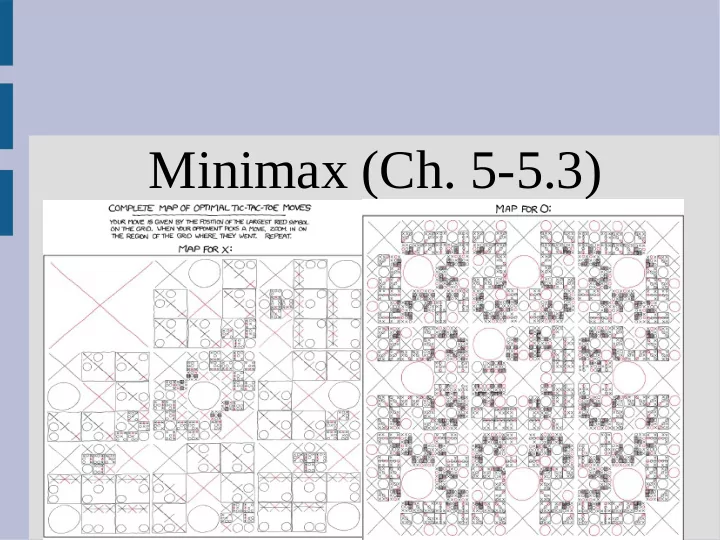
This representation works, but even in small games you can get a very large search tree For example, tic-tac-toe has about 9! actions to search (or about 300,000 nodes) Larger problems (like chess or go) are not feasible for this approach (more on this next class)
SLIDE 15
Minimax
“Pruning” in real life: “Pruning” in CSCI trees: Snip branch Snip branch
SLIDE 16
Alpha-beta pruning
However, we can get the same answer with searching less by using efficient “pruning” It is possible to prune a minimax search that will never “accidentally” prune the optimal solution A popular technique for doing this is called alpha-beta pruning (see next slide)
SLIDE 17
Alpha-beta pruning
Consider if we were finding the following: max(5, min(3, 19)) There is a “short circuit evaluation” for this, namely the value of 19 does not matter min(3, x) < 3 for all x Thus max(5, min(3,x)) = 5 for any x Alpha-beta pruning would not search x above
SLIDE 18
Alpha-beta pruning
If when checking a min-node, we ever find a value less than the parent's “best” value, we can stop searching this branch 4 2 L R L R 2 Parent's best so far = 2 Child's worst = 0 STOP
SLIDE 19
Alpha-beta pruning
In the previous slide, “best” is the “alpha” in the alpha-beta pruning (Similarly the “worst” in a min-node is “beta”) Alpha-beta pruning algorithm: Do minimax as normal, except: min node: if parent's “best” value greater than current node, stop & tell parent current value max node: if parent's “worst” value less than current node, stop search and return current
SLIDE 20
Let's solve this with alpha-beta pruning 1 3 4 2 L F R L R L R
Alpha-beta pruning
SLIDE 21 max( min(1,3), 2, min(0, ??) ) = 2, should pick action F 1 3 4 2 L F R L R L R 1 2 Order:
- 1st. Red
- 2nd. Blue
- 3rd. Purp
Do not consider
Alpha-beta pruning
SLIDE 22
Alpha-beta pruning
\rantOn I think the book is confusing about alpha-beta, especially Figure 5.5 range for node alpha (sort of) beta (sort of)
SLIDE 23
αβ pruning
Solve this problem with alpha-beta pruning: 3 10 2 2 F L R L R L 1 F 8 F 2 4 R L 4 F R 14 F 5 20 R L
SLIDE 24
Alpha-beta pruning
In general, alpha-beta pruning allows you to search to a depth 2d for the minimax search cost of depth d So if minimax needs to find: O(bm) Then, alpha-beta searches: O(bm/2) This is exponentially better, but the worst case is the same as minimax
SLIDE 25
Alpha-beta pruning
Ideally you would want to put your best (largest for max, smallest for min) actions first This way you can prune more of the tree as a min node stops more often for larger “best” Obviously you do not know the best move, (otherwise why are you searching?) but some effort into guessing goes a long way (i.e. exponentially less states)
SLIDE 26
Side note:
In alpha-beta pruning, the heuristic for guess which move is best can be complex, as you can greatly effect pruning While for A* search, the heuristic had to be very fast to be useful (otherwise computing the heuristic would take longer than the original search)