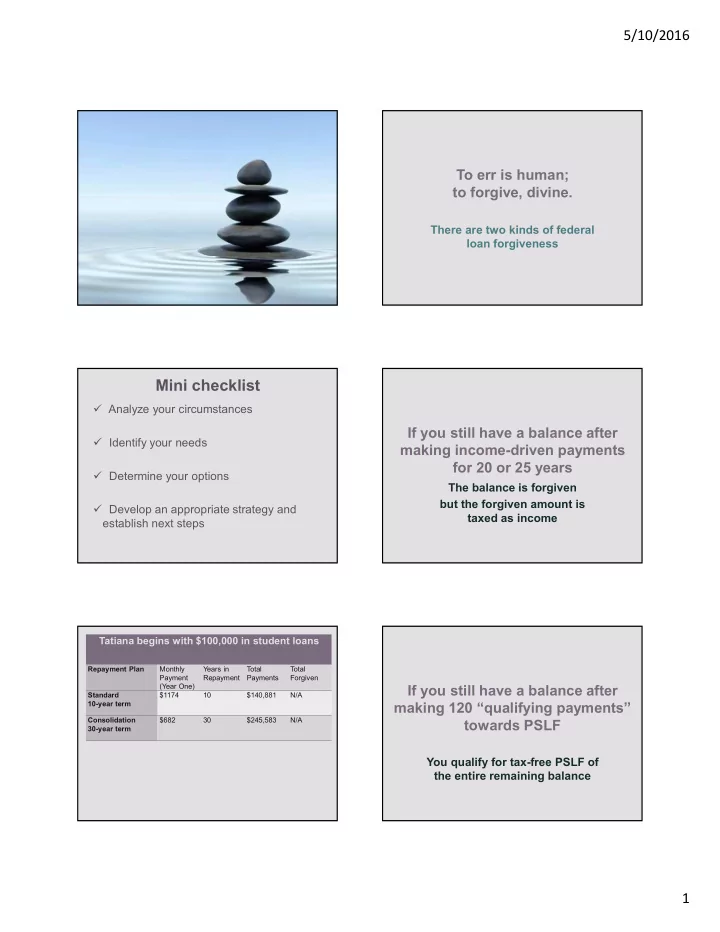
Mini checklist Analyze your circumstances If you still have a - - PDF document

mini checklist
SMART_READER_LITE
LIVE PREVIEW

Mini checklist Analyze your circumstances If you still have a - - PDF document

5/10/2016 To err is human; to forgive, divine. There are two kinds of federal loan forgiveness Mini checklist Analyze your circumstances If you still have a balance after Identify your needs making income-driven payments for 20 or 25


slide-1
SLIDE 1

5/10/2016 1

 Analyze your circumstances  Identify your needs  Determine your options  Develop an appropriate strategy and establish next steps

Mini checklist

Tatiana begins with $100,000 in student loans

Repayment Plan Monthly Payment (Year One) Years in Repayment Total Payments Total Forgiven Standard 10-year term $1174 10 $140,881 N/A Consolidation 30-year term $682 30 $245,583 N/A

To err is human; to forgive, divine.

There are two kinds of federal loan forgiveness

If you still have a balance after making income-driven payments for 20 or 25 years

The balance is forgiven but the forgiven amount is taxed as income

If you still have a balance after making 120 “qualifying payments” towards PSLF

You qualify for tax-free PSLF of the entire remaining balance

slide-2
SLIDE 2

5/10/2016 2

Forgiveness is tied to repayment

Income-driven repayment plans are necessary for BOTH long-term, income-driven forgiveness and public service forgiveness

Adjusted Gross Income

Income driven repayment

Married student loan borrowers must choose:

  • File taxes jointly and

have monthly payment based on joint AGI and combined student debt,

  • r
  • File taxes separately

and have monthly payment based on individual AGI and individual student debt (except under REPAYE)

Payments are 10 or 15 percent

  • f “discretionary income”

Long-term forgiveness takes either 20 or 25 years Public Service Loan Forgiveness takes 120 “qualifying” payments

Count payments.

…99, 100, 101, 102…

single married with 2 kids AGI 15% 10% 15% 10% $30,000 $154 $103 $40,000 $279 $186 $50,000 $404 $270 $60,000 $529 $353 $45 $30 $70,000 $654 $436 $170 $114 $80,000 $779 $520 $295 $197 $90,000 $904 $603 $420 $280 $100,000 $1,029 $686 $545 $364

Monthly Payments

slide-3
SLIDE 3

5/10/2016 3

Tatiana begins with $100,000 in student loans

Repayment Plan Monthly Payment (Year One) Years in Repayment Total Payments Total Forgiven Standard 10-year term $1174 10 $140,881 N/A Consolidation 30-year term $682 30 $245,583 N/A 15% of discretionary income $466 25 $209,362 $64,644 15% of discretionary income $310 20 $102,257 $142,743 AGI $54,000; 3% annual increases; family size = 1

Taxable as income

1. Make the right kind of payments,

Payments based on income (ICR, IBR, PAYE, REPAYE)

2.

  • n the right kind of loans,

Federal Direct Loans ONLY

3. while working in the right kind of job.

Full-time and paid government or nonprofit work

4. Repeat 120 times.

Any fewer gets you nothing

5. Prove it. Tatiana in a Public Service Career

Repayment Plan Monthly Payment (Year One) Years in Repayment Total Payments Total Forgiven Standard 10-year term

$1174 10 $140,881 N/A

Consolidation 30-year term

$682 30 $245,583 N/A

15% of discretionary income

$466 10 $68,438 $107,812

10% of discretionary income

$310 10 $45,625 $129,375

AGI $54,000; 3% annual increases; family size = 1

Not taxable!

Make the right kind of payments

Eligibility for specific repayment options

Depends on WHEN you got your first federal student loan

Did you have a balance on a federal student loan on: July 1, 2014? October 1, 2007?

slide-4
SLIDE 4

5/10/2016 4

New IBR 10%, 20 years

  • No balance on July 1, 2014

PAYE 10%, 20 years

  • No balance on Oct 1, 2007 &
  • A loan from after Oct 1, 2011

Old IBR 15%, 25 years

  • Loans from whenever

REPAYE 10%, 25 Years

  • Loans from whenever

Income-driven repayment plans:

ICR Old IBR New IBR PAYE REPAYE

Friends don’t let friends choose New IBR.

PAYE and REPAYE have better rules about interest accrual and capitalization

Partial Financial Hardship

Required debt to income ratio in order to qualify for most income-driven repayment plans

Old IBR

Partial Financial Hardship required Doesn’t matter when you borrowed

PAYE

Partial Financial Hardship required No balance on a federal loan on Oct, 1, 2007 Federal loan disbursed on or after Oct 1, 2011

REPAYE

No Partial Financial Hardship required Doesn’t matter when you borrowed

Old IBR

15% of joint

  • r separate

income

PAYE

10% of joint

  • r separate

income

REPAYE

10% of income Always based on BOTH spouses’ income

slide-5
SLIDE 5

5/10/2016 5

Old IBR

Qualifies for PSLF 25 year forgiveness

PAYE

Qualifies for PSLF 20 year forgiveness

REPAYE

Qualifies for PSLF

20 year forgiveness for borrowers with

  • nly undergrad

loans 25 year forgiveness for borrowers with any graduate or professional loans

Old IBR

No special limitation to interest capitalization

  • r accrual

PAYE

Capitalization limited to 10 percent of principal balance

REPAYE

Just 50 percent of interest accrues during periods of negative amortization

Mary and Joe

  • Mary earns $45,000 as a social worker.
  • Her husband Joe earns $60,000 as a vet.
  • Mary and Joe have no children.
  • Joe owes $25,000 on his eligible federal

student loans

  • Mary owes $75,000 on her loans (She
  • wes 75 percent of the total marital

student loan debt).

Comparing Taxation

Tax Filing Status Adjusted Gross Income Annual Tax Due Combined Annual Tax Due Jointly $102,500 $14,439 $14,439 Separately Hers: $60,000 His: $45,000 Hers: $9,401 His: $5,660 $15,061 Difference Filing jointly saves $622 on this year’s tax payment.

Comparing how much tax they’ll pay

Tax Filing Status Monthly IBR Payment Combined Monthly IBR Payment Combined Annual IBR Payment Jointly Hers: $743 (75% of total) His: $248 (25% of total) $991 $11,892 Separately Hers: $459 His: $272 $731 $8,772 Difference Filing jointly requires $260 more monthly in student loan payments Filing jointly requires $3,120 more annually in student loan payments

Comparing student loan payments

slide-6
SLIDE 6

5/10/2016 6

  • n the right kind of loan

ONLY FEDERAL DIRECT

FFEL Federal Direct

Federal Student Loans

Before July 2010, federal loans came from two different sources

Direct Consolidation Loan

Direct Stafford FFEL FFEL Stafford

FFEL Direct

So if you started borrowing before the summer of 2010

You need to check NSLDS for loans that don’t say “Direct” and consolidate those first

slide-7
SLIDE 7

5/10/2016 7

The right kind of job

Government 501(c)(3) Non-profit AmeriCorps Position Peace Corps Public Service Organization

Repeat 120 times Prove it The paperwork matters

apply for forgiveness certify employment annually verify income & family size annually

Must be in qualifying employment when each of 120 payments are made, AND when applying for forgiveness, AND when forgiveness is granted

slide-8
SLIDE 8

5/10/2016 8

Should I:  Anticipate any taxable loan forgiveness?  Choose a repayment plan tied to income?  Choose the “married filing separately” tax status?  Consolidate any federal loans? Why or why not? Which loans?  Analyze your circumstances  Identify your needs  Determine your options  Develop an appropriate strategy and establish next steps

Mini checklist Questions? askheatherjarvis.com