Microsoft Project Mid-market leader Has approx. 50% overall - - PDF document

microsoft project
SMART_READER_LITE
LIVE PREVIEW

Microsoft Project Mid-market leader Has approx. 50% overall - - PDF document

Microsoft Project Mid-market leader Has approx. 50% overall market share 70-80% MS-Project users never used automated project tracking prior (a first tool) Source: J. Musser, Columbia University 1 Project Pros Easy


slide-1
SLIDE 1
  • 1

Source: J. Musser, Columbia University

1

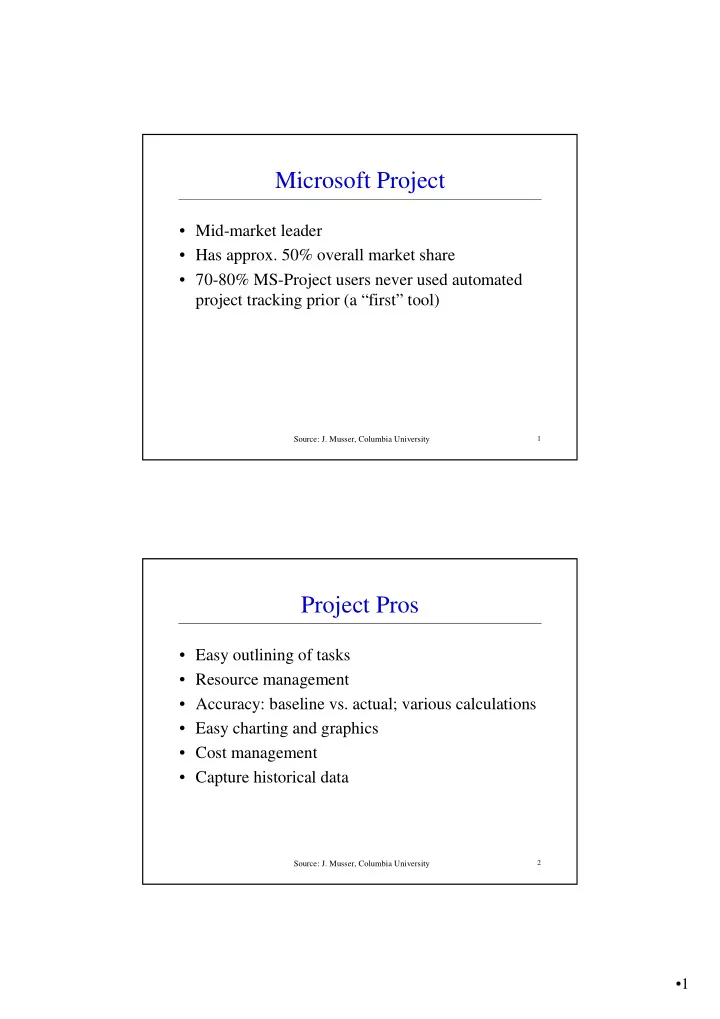
Microsoft Project

  • Mid-market leader
  • Has approx. 50% overall market share
  • 70-80% MS-Project users never used automated

project tracking prior (a “first” tool)

Source: J. Musser, Columbia University

2

Project Pros

  • Easy outlining of tasks
  • Resource management
  • Accuracy: baseline vs. actual; various calculations
  • Easy charting and graphics
  • Cost management
  • Capture historical data
slide-2
SLIDE 2
  • 2

Source: J. Musser, Columbia University

3

Project Cons

  • Illusion of control
  • Scaling
  • Remember:

– Being a MS-Project expert does not make you an expert project manager. – No more so than knowing MS-Word makes you a good writer.

Source: J. Musser, Columbia University

4

“The Illusion of Control”

slide-3
SLIDE 3
  • 3

Source: J. Musser, Columbia University

5

The MS-Project Process

  • Move WBS into a Project outline (in Task Sheet)
  • Add resources (team members or roles)
  • Add costs for resources
  • Assign resources to tasks
  • Establish dependencies
  • Refine and optimize
  • Create baseline
  • Track progress (enter actuals, etc.)

Source: J. Musser, Columbia University

6

Project UI

Indicators Task Sheet View Bar Enter Tasks Here Gantt Chart Timescale Task Bars Milestone Split Bar Outline Buttons (Un)Link Buttons Toolbars

slide-4
SLIDE 4
  • 4

Source: J. Musser, Columbia University

7

Create Your Project

  • File/New
  • Setup start date
  • Setup calendar

– Menu: Project/Project Information – Often left with default settings – Hours, holidays

Source: J. Musser, Columbia University

8

Enter WBS

  • Outlining
  • Sub-tasks and summary tasks
  • Do not enter start/end dates for each
  • Just start with Task Name and Duration for each
  • Use Indent/Outdent buttons to define summary

tasks and subtasks

  • You can enter specific Start/End dates but don’t

most of the time

slide-5
SLIDE 5
  • 5

Source: J. Musser, Columbia University

9

Establish Durations

  • Know the abbreviations

– h/d/w/m – D is default

  • Can use partial

– .5d is a half-day task

  • Elapsed durations
  • Estimated durations

– Put a ‘?’ after duration

Source: J. Musser, Columbia University

10

Add Resources

  • Work Resources

– People

  • Material Resources

– Things – Can be used to track costs

  • Ex: amount of equipment purshased

– Not used as often in typical software project

slide-6
SLIDE 6
  • 6

Source: J. Musser, Columbia University

11

Resource Sheet

  • Can add new resources here

– Or directly in the task entry sheet

  • Beware of mis-spellings (Project will create near-duplicates)
  • Setup costs

– Such as annual salary (put ‘yr’ after ‘Std. Rate’)

Source: J. Musser, Columbia University

12

Effort-Driven Scheduling

  • MS-Project default
  • Duration * Units = Work
  • Duration = Work / Units (D = W/U)
  • Work = Duration * Units (W = D*U)
  • Units = Work / Duration (U = W/D)
  • Adding more resources to a task shortens duration
  • Can be changed on a per-task basis
  • In the advanced tab of Task Information dialog box
  • Task Type setting
  • Beware the Mythical Man-month
  • Good for laying bricks, not always so for software

development

slide-7
SLIDE 7
  • 7

Source: J. Musser, Columbia University

13

Milestones

  • Zero duration tasks
  • Insert task ‘normally’ but put 0 in duration

Source: J. Musser, Columbia University

14

Make Assignments

  • Approach 1. Using Task Sheet

– Using Resource Names column – You can create new ones by just typing-in here

  • 2. Using Assign Resources dialog box

– Good for multiple resources – Highlight task, Tools/Resources or toolbar button

  • 3. Using Task Information dialog

– Resources tab

  • 4. Task Entry view

– View/More Views/Task Entry – Or Task Entry view on Resource Mgmt. toolbar