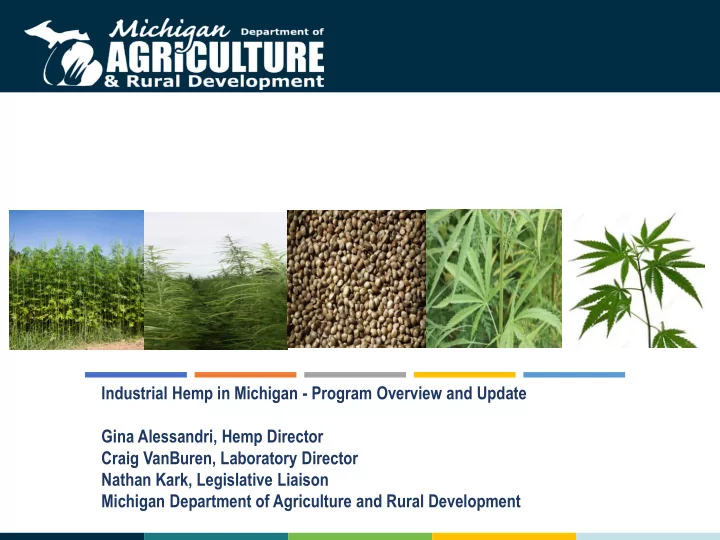
Industrial Hemp in Michigan - Program Overview and Update Gina Alessandri, Hemp Director Craig VanBuren, Laboratory Director Nathan Kark, Legislative Liaison Michigan Department of Agriculture and Rural Development
Michigan Department of Agriculture and Rural Development Overview - - PowerPoint PPT Presentation
Industrial Hemp in Michigan - Program Overview and Update Gina Alessandri, Hemp Director Craig VanBuren, Laboratory Director Nathan Kark, Legislative Liaison Michigan Department of Agriculture and Rural Development Overview Hemp what it
- Hemp – what it is and how it is different
from marijuana
- Brief history of hemp
- Federal and state legislative history
- 2019 ag. pilot program & what we
learned in 2019
- Testing results
- Plans for 2020
Overview
Cannabis sativa L. – specie of plant being raised for both industrial hemp and marijuana. “The plant Cannabis sativa L. and any part of that plant, including viable seeds of that plant and all derivatives, extracts, cannabinoids, isomers, acids, salts and salts of isomers, whether growing or not, with a delta-9-tetrahydrocannabinol (THC) concentration of not more than 0.3% on a dry weight basis.” THC
- One of at least 113 cannabinoids identified in
cannabis.
- Principal psychoactive constituent.
Cannabis sativa L. – 4 Key Differences Chemical Composition –
Industrial Hemp
- Less than 0.3% THC
- Non-intoxicating
Marijuana
- 5% - 35% THC
- Intoxicating
Cannabis sativa L. – 4 Key Differences Legality
Industrial Hemp
- Federally legal
- Removed from the Controlled
Substance List
- Agricultural commodity that may be
legally grown, processed, transported, possessed and sold.
Marijuana
- Federally illegal
- Remains on the Controlled
Substance List
Cannabis sativa L. – 4 Key Differences Cultivation
Industrial Hemp
- Typically grown outdoors
- Can grow up to 20 ft. depending on
variety and purpose of growth.
Marijuana
- Typically grown in very controlled
environments ▪ Temperature, Lighting & ▪ Humidity
- Grows up to 5 ft.
Cannabis sativa L. – 4 Key Differences Uses
Industrial Hemp
- +20,000 products and uses:
- Seed – Medications, health foods,
bio-fuels and plastics.
- Fiber – Paper, textiles, construction
materials, clothing, auto parts, animal bedding.
- Oil – CBD oil, medicine, cosmetics,
lotions.
Marijuana
- Commonly recognized for:
- Recreational uses
- Therapeutic uses
History of hemp
1600
First introduced in North America
1700s
Farmers in several colonies are required to grow hemp.
1776
Draft of the Declaration
- f Independence is
written on hemp paper.
1840
Abraham Lincoln uses hemp seed oil to fuel his household lamps.
1900s
Attitudes begin to change as the government increases efforts to fight drug use. Hemp is grouped together with its Cannabis cousin, marijuana.
History of hemp
1937
The Marijuana Tax Act placed a tax on all cannabis sales, heavily discouraging hemp production.
1942
A brief resurgence….. Government realized it needed hemp for the war
- effort. Taxation lifted.
1942-1945
400,000 acres planted.
1957
Last commercial hemp fields were planted in the U.S.
1970
Hemp farming officially banned with the passage
- f the Controlled
Substance Act.
- Classified hemp as an
illegal Schedule I drug, grouping this crop with drugs like heroin and LSD.
Hemp legislation 2014 2014
2014
2014 U.S. Farm Bill - authorizes state departments of agriculture and colleges and universities to administer pilot programs to study the growth, cultivation and marketing of industrial hemp.
2014
MI Public Act 547 of 2014 - Michigan’s Industrial Hemp Research Act became law.
- Allowed MDARD to create
an industrial hemp research pilot program.
Hemp legislation 2018 2018
2018
2018 U.S. Farm Bill
- Legalized industrial hemp
- USDA oversight
- Offers states the authority to regulate
- Requires USDA approved “state plan”
- Directs USDA to promulgate rules on
state plan submission.
- Maintains FDA authority.
2018
Michigan Industrial Hemp Research and Development Act, PA 641 signed December 2018.
- Amends Public Act
547
Hemp legislation 2019 2019
February 2019
Pending USDA rules, states may continue to operate under the authority of the 2014 Farm Bill which authorized the growth, cultivation and marketing of industrial hemp for research through Ag Pilot Programs.
April 2019
Michigan Ag Pilot Program launched
Michigan Ag Pilot Program
- Allowed hemp growing, processing and handling in
Michigan provided:
- Proper licensure
- Background check
- Research agreement
- 603 Registered Growers
- 850 outdoor locations, 15,477 acres identified
- 300 indoor locations, + 10 M square feet
identified
- 483 Licensed Processor-Handlers
2019 Laboratory ry Hemp Testing
- PA 641 requires growers to schedule a
test of their hemp prior to harvest to determine compliance with THC levels.
- Allows for repeat testing up to 3 times
- MDARD provided hemp testing services
in 2019
- 3 business day average turnaround on
results
- Crop must be harvested within 15 days
- f receiving results
2019 MDARD Laboratory Hemp Testing
Synopsis
- 847 Samples tested
- 84% Compliance rate
- Very few 2nd tests conducted
- Sample Issues
- Growers not following SOP
- US Postal Service detaining shipments
- 242 Growers did not submit any compliance sample
- 116 Growers did not send samples for all their
growing locations
- Check email regularly
2019 MDARD Laboratory Hemp Testing
0.00 1.00 2.00 3.00 4.00 5.00 6.00 7.00 8.00 9.00 10.00
% THC
Samples 8/21/19 - 12/13/19
2019 Hemp Testing Results (All)
2019 MDARD Laboratory Hemp Testing
0.00 0.10 0.20 0.30 0.40 0.50 0.60 0.70 0.80 0.90 1.00
% THC
Samples 8/21/19 - 12/13/19
2019 Hemp Testing Results (Trend)
2019 MDARD Laboratory Hemp Testing
2019 Hemp Compliance
< 0.30% 0.30% - 0.39% > 0.39%
2019 MDARD Laboratory Hemp Testing
Incorporating Uncertainty into 2020 Testing
Compliant Non- compliant
2019 MDARD Laboratory Hemp Testing
244 36 28 19 46 17% 6 35% 4 11% 2 5% 60 23 4 1
"Cherry" "Youngsim" "Boax" "Wife"
Most Popular Cultivars
2019 MDARD La Laboratory Hemp Testi ting
- Zero THC Detected
Cultivar CBD (%) 450 31 H8 0.15 450-31 E8 0.76 HLESIIA E2 0.00 HLESIIA H2 0.00 HLIANA E3 0.00 HLIANA H3 0.00 HLYKHOUSKII 51 E4 0.47 HLYKHOUSKII51 H4 0.00 HONOLA HONOLG HONOLY 0.29 USO-31 0.50 VARIETY=KATANI 0.26 X-59 0.65 X-59 H1 0.99
2019 MDARD Laboratory Hemp Testing
- Hot Samples
- Ninety-one above 0.5%
- Hottest 10
Cultivar Total THC (%) AC/DC 8.75 THERAPY 7.45 CHERRY WINE 4.57 JCOO2 4.30 CHERRY WINE 0 0 CHOICE CBDSEEDS.COM 4.04 CHERRY STRUCK 3.97 CHERRY WINE 3.78 JCOO1 3.33 OREGON CHERRY 3.15 CHERRY STRUCK CHOICE CBDSEEDS.COM 2.77
2019 MDARD La Laboratory Hemp Testi ting
- Highest (Compliant) CBD Samples
- All in the “gray” zone
Cultivar Total CBD (%) Total THC (%) CHERRY WINE (CW) 11.09 0.37 CHERRY WINE 10.69 0.39 SAMPLE 2 CBD HEMP 10.67 0.31 BERRY BLOSSOM 5 10.64 0.37 CHERRY WINE 10.37 0.33 CHERRY WINE 10.37 0.38 BERRY BLOSSOM PLOT 1 10.20 0.36 CHARDONAY X CHERRY WINE 9.96 0.37 C4 9.94 0.35 STORMI DANIELZ 9.90 0.37
2019 MDARD Laboratory Hemp Testing
- Highest (Compliant) CBD Samples
- All in the “green” zone
Cultivar Total CBD (%) Total THC (%) BOAX 9.09 0.29 WIFE 9.04 0.29 DREAMY CLOUDS 8.50 0.28 CHERRY WINE 8.47 0.29 ABACUS 8.44 0.30 CHERRY BLOSSOM 8.41 0.28 CAT LADY 8.25 0.30 CHERRY WINE 8.21 0.30 CHERRY WINE STRAIN 8.04 0.29 FEMINIZED CHERRY BLOSSOM 7.98 0.26
What have we learned so far in 2019?
- Federal guidance and interpretation is needed.
- Regulatory pathway for cannabis use in food, drugs
and cosmetics.
Policy and regulation – We don’t have all the answers.
- Primarily hand harvested in 2019
- Production processes & equipment need to evolve.
Growing hemp is very labor intensive.
- THC levels need to be monitored
- Lab analysis required for compliance must be
scheduled with harvest in mind.
This crop requires farmers to be very attentive.
- For hemp growers AND marijuana growers.
- Male plants must be removed.
Cross-pollination is a concern.
What have we learned so far in 2019?
- In state processing facilities are needed to
adequately support the industry.
Processors are needed
- Banking industry
- Local units of government
- Law enforcement
Ongoing need for
- utreach and education
- Balancing the need for security of growing
- perations with how we connect growers and
processors.
Connecting growers and processors
- Identification and review of roles and
responsibilities.
Intersecting issues with marijuana laws
Preliminary Data – Final Report will be available this spring
- +60% grew hemp for CBD
- ~15% seed
- ~7% GRAS (generally recognized as safe) food items
- Hemp was grown in 64 of 83 counties
- ~24% planted feminized seed
- Bulk seed, clones and seedlings were also planted
- ~31% had problems with their seed
- Weeds were the primary pest problem
- < 9% used pesticides
- ~58% harvested hemp (primarily by hand)
- <8% unable to harvest within 15-day window
- ~55% plan to process hemp in 2020 (~26% for hire)
USDA publishes Final Interim Rules October 31, 2019
https://www.ams.usda.gov/rules- regulations/establishment- domestic-hemp-production- program Establishes the U.S. Domestic Hemp Production Program.
- Creates a consistent regulatory
framework for hemp production throughout the United States.
Interim rule is subject to change pending public comment Compliance date 10/31/2020
28
Program Oversight – Two options
State Operated Program ▪ Approved state plan OR Federally Operated Program Absent an approved state plan, USDA would administer the hemp program in MI.
USDA Interim Final Rules
- Documentation of where hemp is being grown.
- NEW - Reporting requirements for growers
- Standards for testing to ensure compliance.
- NEW - Use of DEA Registered Laboratories
- NEW - Collection of samples by law
enforcement or other federal or state designated person.
- Effective disposal of non-compliant plants and
products.
- NEW - In accordance with the CSA and DEA
- NEW - Collection for destruction by a person
authorized under the CSA to handle marijuana.
- Communication with law enforcement.
- NEW - State reporting requirements
- f all licensees within 30 days of
receipt.
- Real time availability for law
enforcement
- Annual inspection requirements
- NEW - State and Federal
background check requirements
- Certification that resources are available
to carry out the plan.
Next Steps
Amend Public Act 641
- Legislation is being developed
- Discussing scope of change
needed.
- Late June – goal for completion.
Submit State Plan
- State plan will be submitted
immediately after PA 641 is updated.
- USDA has 60 days to review and
approve or reject.
- Oct. 31, 2020 - Compliance
deadline
@MichDeptofAg
@MIDeptofAgriculture
@MichiganAgriculture
Michigan Department
- f Agriculture & Rural
Development Michigan Department
- f Agriculture & Rural
Development