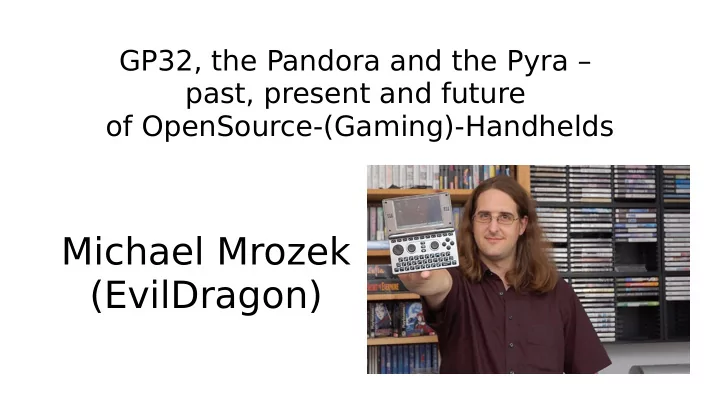
Michael Mrozek (EvilDragon) 1. The GP32 started it all (2001) - - PowerPoint PPT Presentation

michael mrozek evildragon 1 the gp32 started it all 2001
SMART_READER_LITE
LIVE PREVIEW

Michael Mrozek (EvilDragon) 1. The GP32 started it all (2001) - - PowerPoint PPT Presentation

GP32, the Pandora and the Pyra past, present and future of OpenSource-(Gaming)-Handhelds Michael Mrozek (EvilDragon) 1. The GP32 started it all (2001) Originally closed source, commercial handheld made by a small company from Korea


slide-1
SLIDE 1

GP32, the Pandora and the Pyra – past, present and future

  • f OpenSource-(Gaming)-Handhelds

Michael Mrozek (EvilDragon)

slide-2
SLIDE 2
  • 1. The GP32 started it all (2001)
  • Originally closed source, commercial handheld made by a small

company from Korea

  • Using standard

SmartMediaCards: Hacked and opened up for homebrew by the community

slide-3
SLIDE 3
  • 2. The successor: GP2X goes Linux (2005)
  • As the GP32 better thanks to the homebrew community, GPH

decided to focus on OpenSource, not locking down the community

  • GP2X was the most successful

OpenSource dedicated handheld out there

slide-4
SLIDE 4
  • 3. The split: Gaming handhelds and a mini PC suited for

gaming (2008)

  • Created by former community

members and distributors of the GP2X, the Pandora is born

  • A

mixture

  • f a

gaming PC and a miniature PC opens a lot more possibilities – for gamers, developers and business users

slide-5
SLIDE 5
  • 4. The Pandora
  • Created based on ideas from the community
  • Core team consisting of fjve people – scattered all over the world
  • First OpenSource handheld to run a Linux desktop with standard

libraries

  • Production issues (partly due to inexperience) lead to huge delays
  • Release was planned end of 2008 – in reality it happened in 2010.
  • The project nearly died thanks to one of the core members but has

been saved and resurrected by the others and the community.

  • Production running stable since 2011, over 7000 units sold and

delivered

  • End of Life 2014 (Some parts are impossible to be sourced)
slide-6
SLIDE 6
  • 5. Technical Details
  • Processor: OMAP3 Cortex A8 with 3D SGX GPU
  • Bluetooth + Wifj
  • Memory: 512MB internal NAND and 512MB RAM
  • 4,3” 800x480 touchscreen
  • 2 SDXC Card slots (up to 2x256GB)
  • Mini USB Port, USB2.0 Host Port
  • Analog TV Out, Serial out
  • Keyboard, Gaming Controls
  • Huge replaceable battery with more than 10 hours usage time
slide-7
SLIDE 7
  • 6. Pandora main uses overview
  • Play classic games via an emulator (consoles, computers,

handhelds, DOS)

  • Play native Linux games and ports / remakes
  • Use as general purpose mini PC (Internet, administration, offjce

suite, Music production, etc.)

  • Develop and compile directly on the system
  • Both suited for normal users (no Linux experience needed,

everything pre-installed, easy package manager available) → Large community has developed around it, consisting of all kinds of difgerent members (devs, musicians, users, gamers, etc.)

slide-8
SLIDE 8
  • 7. Things that can be improved
  • Small NAND: Special Linux distribution needed (OpenEmbedded)

→ a lot of work to keep up-to-date (you can run OS from SD Card) → But: Own, easy to use package format has been created

  • CPU is a bit slow for demanding tasks
  • Not enough RAM for proper desktop usage
  • HDMI port missing
  • Keyboard can't be seen in the dark
  • Screen resolution is less than 800x600 (which is what a lot of Linux

programs use as minimum resolution)

  • Case / Nub quality
  • Some closed-source drivers (Wifj, SGX)
slide-9
SLIDE 9
  • 8. Things that are great
  • Size, battery life, combination of keyboard and gaming controls
  • Standard Linux system: Easy to port programs and games to
  • Analog volume wheel
  • Standard I/O ports
  • Open, free, fmexible, no registration needed, unbrickable design
  • PND-System (incl. PNDManager):

Uses SD-Cards for programs System is not afgected if SD Card is lost / broken Easy to handle both directly on the system or from any PC

  • Standard hardware: Software is being optimized to run

perfectly on the system

slide-10
SLIDE 10
  • 9. Pyra
  • Internal storage: MicroSD Card and 8/16/32GB eMMc
  • CPU upgraded to OMAP5 Cortex A15 (about 8 times as fast)
  • RAM upgraded to 2GB
  • Standard HDMI port
  • Backlit keyboard (brightness can be adjusted in software)
  • 5” 1280x720 LCD T
  • uchscreen
  • Better nubs, Case designed and produced in Europe (Greece)
  • Standard Ports: USB2.0, Micro USB3.0 OTG, Micro USB Debug /

Charging Port, USB2.0/eSATA combo port

  • Working with European companies to ensure quality and faster

turnaround in development / production

  • … but still some closed-source drivers (at least SGX)
slide-11
SLIDE 11

Keep what's good Improve what can be improved Learn from the past to improve development / production.

slide-12
SLIDE 12
slide-13
SLIDE 13

Operating System:

  • Standard Debian ARM with optimized packages to support

hardware features (acceleration, power saving, etc.)

  • User-Friendly default setup
  • Include useful Pandora-Developments as standard (OpenGL

Wrapper (glshim), PND-System, etc.) → We provide our own repository with Pyra-optimized / specialized stufg on top of the standard Debian repository Goal: Not to create a custom distribution. Stick to main Debian as close as possible and ofger improvements

  • n top
slide-14
SLIDE 14

Case:

  • Designed and manufactured in Greece, based on the Pandora

case and community input and my ideas Current status:

  • Basic design fjnished, now being optimized together with the

PCB designer

  • Some things will still change (LCD, Battery, etc.) as we haven't

decided on those

slide-15
SLIDE 15

Keymat:

  • Keymat is

currently being designed

  • transparent

silicon keymat with plastic caps glued on top

slide-16
SLIDE 16

PCB:

  • Pyra has 3 PCBs:

Mainboard, CPU board (replaceable!), LCD-Driver board Current Status:

  • Mainboard Layout is mostly fjnished, currently being tweaked

together with the case designer

  • LCD Driver PCB layout is mostly fjnished as well
  • CPU PCB: Size and location of parts fjnished.

Layouting will start this month

slide-17
SLIDE 17

Follow the development: Development happens in the public! See how everything takes shape. Learn about production, issues, solutions with our blog posts and forum answers.

http://www.pyra-handheld.com/

T witter: EvilDragon1717 Forum:

http://boards.openpandora.org/

slide-18
SLIDE 18

Sales, availability, ordering, Price?

  • Preorders won't start before everything is ready for mass production

(means: Working prototypes with cases!)

  • Price: Not fjxed yet, probably about 500 EUR
  • First batch exclusively available from my own shop, distributors will

be setup worldwide after that

  • At least 1000 units need to be preordered
  • Kickstarter? Maybe – to increase popularity and ofger stretch goals
  • Availability? Most probably sometime 2015!
slide-19
SLIDE 19

Thanks for listening :) All kind of support (ideas, donations, development, sharing) is welcome!

Get the Pandora, more OpenSource handhelds and Retro stufg:

https://www.dragonbox.de/