Metrics and models for Web performance evaluation or, How to measure - - PowerPoint PPT Presentation

metrics and models for web performance evaluation
SMART_READER_LITE
LIVE PREVIEW

Metrics and models for Web performance evaluation or, How to measure - - PowerPoint PPT Presentation

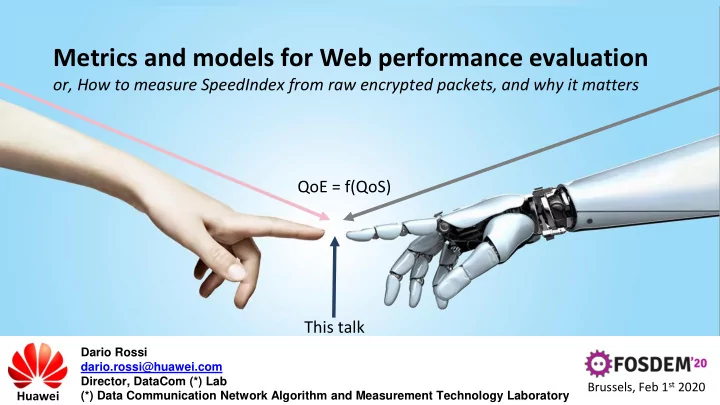
Metrics and models for Web performance evaluation or, How to measure SpeedIndex from raw encrypted packets, and why it matters QoE = f(QoS) This talk Dario Rossi dario.rossi@huawei.com Director, DataCom (*) Lab Brussels, Feb 1 st 2020 Huawei


slide-1
SLIDE 1

Dario Rossi dario.rossi@huawei.com Director, DataCom (*) Lab (*) Data Communication Network Algorithm and Measurement Technology Laboratory

This talk

Metrics and models for Web performance evaluation

  • r, How to measure SpeedIndex from raw encrypted packets, and why it matters

QoE = f(QoS)

Huawei Brussels, Feb 1st 2020

slide-2
SLIDE 2

Dario Rossi and, in alphabetical order, Alemnew Asrese, Alexis Huet, Diego Da Hora, Enrico Bocchi, Flavia Salutari, Florian Metzger, Gilles Dubuc, Hao Shi, Jinchun Xu, Luca De Cicco, Marco Mellia, Matteo Varvello, Renata Teixeira, Tobias Hossfeld, Shengming Cai, Vassillis Christophides, Zied Ben Houidi

This talk

Metrics and models for Web performance evaluation

  • r, How to measure SpeedIndex from raw encrypted packets, and why it matters

QoE = f(QoS)

slide-3
SLIDE 3

Offering G d user Q E is a common goal

ISP

Internet

slide-4
SLIDE 4

For ISPs/vendors encryption makes the inference harder

ISP

Internet

User QoE

Detect/forecast/prevent Q oE degradation is important!

App QoS Net QoS

slide-5
SLIDE 5

5

Network QoS Application QoS User QoE

affects influences Human influence factors System influence factors Context influence factors

31/01/2020

Quality at different layers Application Network User Context

slide-6
SLIDE 6

6

Network QoS Application QoS User QoE

affects influences

31/01/2020

Quality at different layers Application Network User

Page load time (PLT) Latency Engagement metrics Bandwidth Video bitrate Packet loss

Context

Device type Location Wi-Fi quality SpeedIndex Mean opinion score (MOS) User PLT (uPLT) Activity

slide-7
SLIDE 7

7

Network QoS Application QoS User QoE

affects influences

31/01/2020

Quality at different layers Application Network User

Latency Bandwidth Packet loss

Context

Device type Location Wi-Fi quality Mean opinion score (MOS) User PLT (uPLT) Activity

HTTP/2, QUIC… (true for any

  • ther apps)
slide-8
SLIDE 8

8

Network QoS Application QoS User QoE

31/01/2020

Agenda Application Network User Context

Metrics and models for Web performance evaluation

  • r, How to measure SpeedIndex from raw encrypted packets, and why it matters

Data collection (Crowdsourcing campaign) Browser metrics (Instant vs Integral vs Compound) Models (Data driven vs Expert Models) Models (From raw encrypted packets)

slide-9
SLIDE 9

9

31/01/2020

Agenda

Metrics and models for Web performance evaluation

  • r, How to measure SpeedIndex from raw encrypted packets, and why it matters
  • 1. Data collection

(Crowdsourcing campaign)

  • 3. Browser metrics

(Instant vs Integral vs Compound)

  • 2. Models

(Data driven vs Expert Models)

  • 4. Method

(From raw encrypted packets) Network QoS User QoE

slide-10
SLIDE 10

10

 Mean opinion score (MOS)

“Rate your experience from 1-poor to 5-excellent”

 User perceived PLT (uPLT)

“Which of these two pages finished first ?”

 User acceptance

“Did the page load fast enough ?”(Yes/No)

Data collection: Crowdsourcing campaigns

Lab experiments

  • Small user diversity, volounteers
  • Web browsing, but artificial websites
  • Artificial controlled conditions

Crowdsourcing (payed crowdworkers)

  • Larger userbase, but higher noise
  • Side-to-side videos ≠ Web browsing!
  • Artificial controlled conditions

Experiments from operational website

  • Actual service users
  • Browsing in typical user conditions
  • Huge heterogeneity (devices/browsers/nets)

Ongoing, with (Award winning) dataset [PAM18] Collab with [WWW19]

https://webqoe.telecom-paristech.fr/data

slide-11
SLIDE 11

11

Models: Data driven vs Expert models

Fit predetermined y=f(x) Learn y=f(x)

x=vector of input features

  • ptimal f(.) selected & tuned by machine learning

https://www.itu.int/rec/T-REC-G.1030/en Weber Fechner Standard ITU-T G1030

[1] M. Fiedler et al. "A generic quantitative relationship between quality of experience and quality of service." IEEE Network, 2010

IQX Hypotesis

x=single scalar metric, generally Page Load Time (PLT) f(.) = pre-selected by the expert

https://webqoe.telecom-paristech.fr/models

UserQoE y

[INFOCOM19] More flexible and (slightly) more accurate [PAM18] Still room for improvement (see [WWW19] ) Comparison of the two models in [QoMEX-18]

slide-12
SLIDE 12

12

TB DOM ATF PLT Visual Progress

t x(t)

1

www.iceberg.com

* Images by vvstudio, vectorpocket, Ydlabs / Freepik

t=DOM, page structure loaded

Browser metrics: Time Instant vs Time Integral (1/2)

slide-13
SLIDE 13

13

DOM PLT Visual Progress

t

1

* Images by vvstudio, vectorpocket, Ydlabs / Freepik

www.iceberg.com t=ATF, visible portion (aka Above the Fold) loaded

ATF

Browser metrics: Time Instant vs Time Integral (1/2)

slide-14
SLIDE 14

14

DOM ATF PLT Visual Progress

t x(t)

1

SpeedIndex 1 − 𝑦 𝑢 𝑒𝑢

* Images by vvstudio, vectorpocket, Ydlabs / Freepik

www.iceberg.com t=ATF, visible portion (aka Above the Fold) loaded

Browser metrics: Time Instant vs Time Integral (1/2)

slide-15
SLIDE 15

15

DOM ATF PLT Visual Progress

t x(t)

1

SpeedIndex 1 − 𝑦 𝑢 𝑒𝑢

* Images by vvstudio, vectorpocket, Ydlabs / Freepik

www.iceberg.com t=ATF, visible portion (aka Above the Fold) loaded

Browser metrics: Time Instant vs Time Integral (1/2)

slide-16
SLIDE 16

16

DOM ATF PLT Visual Progress

t x(t)

1

SpeedIndex 1 − 𝑦 𝑢 𝑒𝑢

* Images by vvstudio, vectorpocket, Ydlabs / Freepik

www.iceberg.com t=PLT, all page content loaded

Browser metrics: Time Instant vs Time Integral (1/2)

slide-17
SLIDE 17

17

31/01/2020

SpeedIndex, RUMSI, PSSI

› Processing intensive › Only at L7 (in browser) › Visual progress metric

ObjectIndex, ByteIndex and ImageIndex

› Lightweight › ByteIndex also at L3 (in network) › Higly correlated with SpeedIndex › Possibly far from user QoE ?

Browser metrics: Time Instant vs Time Integral (2/2)

?

SpeedIndex %of visual completeness (histogram, rectangles or SSim) ObjectIndex % of objects downloaded ByteIndex % of bytes downloaded ImageIndex % of bytes

  • f images
slide-18
SLIDE 18

18

31/01/2020

Browser metrics: Time Instant vs Time Integral (2/2)

SpeedIndex %of visual completeness (histogram, rectangles or SSim) ObjectIndex % of objects downloaded ByteIndex % of bytes downloaded

x’(t)

Same PLT but slower loading ImageIndex % of bytes

  • f images

SpeedIndex, RUMSI, PSSI

› Processing intensive › Only at L7 (in browser) › Visual progress metric

ObjectIndex, ByteIndex and ImageIndex

› Lightweight › ByteIndex also at L3 (in network) › Higly correlated with SpeedIndex › Possibly far from user QoE ? ?

slide-19
SLIDE 19

19

31/01/2020

Browser metrics: Time Instant vs Time Integral (2/2)

SpeedIndex %of visual completeness (histogram, rectangles or SSim) ObjectIndex % of objects downloaded ByteIndex % of bytes downloaded Different cutoffs ImageIndex % of bytes

  • f images

SpeedIndex, RUMSI, PSSI

› Processing intensive › Only at L7 (in browser) › Visual progress metric

ObjectIndex, ByteIndex and ImageIndex

› Lightweight › ByteIndex also at L3 (in network) › Higly correlated with SpeedIndex › Possibly far from user QoE ? ?

slide-20
SLIDE 20

20

DOM ATF PLT Visual Progress

t x(t)

1

SpeedIndex 1 − 𝑦 𝑢 𝑒𝑢

img1 img2 css js htm Domain x.com Individual

  • bjects

Method: From raw packets to browser metrics (1/2)

Single session

slide-21
SLIDE 21

21

DOM ATF PLT Visual Progress

t x(t)

1

SpeedIndex 1 − 𝑦 𝑢 𝑒𝑢

img1 img2 css js htm Domain x.com Individual

  • bjects

time

Packets Single session

??! !?!

Method: From raw packets to browser metrics (1/2)

slide-22
SLIDE 22

22

DOM ATF PLT Visual Progress

t x(t)

1

SpeedIndex 1 − 𝑦 𝑢 𝑒𝑢

img1 img2 css js htm Domain x.com Individual

  • bjects

time

Packets

??! !?!

Train ML models (XGBoost , 1D-CNN) Single session Single session

Method: From raw packets to browser metrics (1/2)

slide-23
SLIDE 23

23

slide-24
SLIDE 24

24

Browser (L7) Network (L3) User

Method: From raw packets to browser metrics (2/2) Works with encryption Handle multi-sessions (not in this talk) Exact online algorithm for ByteIndex Machine learning for any metric Accurate on joint tests with Orange Accurate for unseen pages & networks Available soon into Huawei products

slide-25
SLIDE 25

25

 Expert-driven feature engineering

› Explainable but inherently heuristic approach › Hard to keep in sync with application/network change

Aftermath (1/3): From raw packets to rough sentiments

Possible outputs Possible inputs

 Neural Networks

› Less interpretable but more versatile › Downside: requires lots of samples.... › Feed NN with x(t) signal › Still lightweight › Feed NN using a filmstrip › More complex › User feedback (e.g. MOS, user PLT, etc.) › Smartphone sensors (eg happiness

estimation via facial recognition)

› Brain signals acquired with sensors › Activity of brain areas correlated

with user happiness

slide-26
SLIDE 26

26

 World Wild Web

› Huge diversity, not captured by single model

 Increase accuracy

› Per-page QoE models › Inherently non scalable

 Increase accuracy & scalability

› Per-page QoE models (eg Alexa top 100 pages) › Aggregate QoE models (eg 100 clusters top 1M) › Generic QoE model (for the tail up to 1B pages)

Aftermath (2/3): Divide et impera

Many per-page models One average model Alexa Top 1M, 100 clusters

slide-27
SLIDE 27

27

 Other applications/players are doing this already! Sustained continuous user QoE indication benefits

› Useful samples for QoE management assessment, troubleshooting, regression detection, etc. › Get continuous stream of samples for improving QoE = f(QoS) models on the long run

Very limited downsides (risk of annoying users if leveraging small panels)

Aftermath (3/3): Keep collecting (and sharing) data

Facebook Skype Android Wikipedia Physical world

Did you find this suggestion useful ?

slide-28
SLIDE 28

28

[SIGCOMM-19] Huet, Alexis and Houidi, Zied Ben and Cai, Shengming and Shi, Hao and Xu, Jinchun and Rossi, Dario, Web Quality of Experience from Encrypted Packets ACM SIGCOMM Demo, aug. 2019 [INFOCOM-19] Huet, Alexis and Rossi, Dario, Explaining Web users QoE with Factorization Machines IEEE INFOCOM Demo apr. 2019 [WWW-19] F. Salutari, D. Da Hora, G. Dubuc and D. Rossi A large scale study of Wikipedia users' quality of Experience Proc. WWW, 2019 [SIGCOMM-18] D. da Hora, D. Rossi, V. Christophides, R. Renata, A practical method for measuring Web above-the-fold time, ACM SIGCOMM Demo, aug. 2018, [QOMEX-18] Hossfeld, Tobias and Metzger, Florian and Rossi, Dario, Speed Index: Relating the Industrial Standard for User Perceived Web Performance to Web QoE 10th International Conference on Quality of Multimedia Experience (QoMEX 2018) jun. 2018 [PAM-18] D. da Hora, A. Asrese, V. Christophides, R. Teixeira and D. Rossi, Narrowing the gap between QoS metrics and Web QoE using Above-the-fold metrics Proc. PAM 2018, Best dataset award ★ [PAM-17] Bocchi, Enrico and De Cicco, Luca and Mellia, Marco and Rossi, Dario, The Web, the Users, and the MOS: Influence of HTTP/2 on User Experience Proc. PAM 2017 [SIGCOMM-QoE-16] E. Bocchi, L. De Cicco, D. Rossi, Measuring the Quality of Experience

  • f Web users, ACM SIGCOMM Internet-QoE worshop 2016, Best paper award ★

Documents Datasets Code

9k real human grades 10k automated experiments 60k+ real user grades Chrome plugin implementation https://webqoe.telecom-paristech.fr/
slide-29
SLIDE 29

29

 Thanks for lis

?? || //