MEDP/FILMP 160: Film and Media in a Digital Age Hunter College - - PowerPoint PPT Presentation

medp filmp 160 film and media in a digital age
SMART_READER_LITE
LIVE PREVIEW

MEDP/FILMP 160: Film and Media in a Digital Age Hunter College - - PowerPoint PPT Presentation

MEDP/FILMP 160: Film and Media in a Digital Age Hunter College Dept. of Film and Media Studies FALL 2012 Profs Hurbis Cherrier & Lucas Camera plus film... ... a mechanical and a chemical medium The motion picture camera owes its
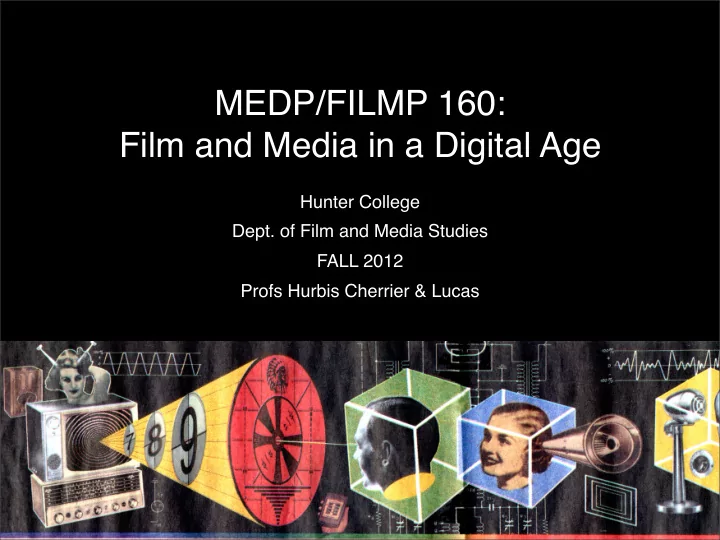

slide-1
SLIDE 1

MEDP/FILMP 160: Film and Media in a Digital Age

Hunter College

  • Dept. of Film and Media Studies

FALL 2012 Profs Hurbis Cherrier & Lucas

slide-2
SLIDE 2

Camera plus film...

... a mechanical and a chemical medium

slide-3
SLIDE 3
  • The motion

picture camera

  • wes its origins

to a variety of previous inventions…

slide-4
SLIDE 4

The Camera Obscura

  • Camera Obscura

means “Dark Chamber”. A hole in the wall allowed light to ‘paint a picture’ inside the room.

slide-5
SLIDE 5

A Painter’s Tool

  • Painters began

using the “camera obscura’

  • during the

Renaissance to help create ‘realistic’ images for new patrons.

“View of Delft” by Vermeer c.1660

View of Delft Today...

slide-6
SLIDE 6

Adding a Lens makes the unit portable and the image size adjustable

  • Artist Using a Portable ‘Camera Obscura’
slide-7
SLIDE 7

The Magic Lantern

Adding a light source to the Camera Obscura meant both a reversal of its logic, and a new form

  • f entertainment.

Here we see a Magic Lantern man with his projector.

slide-8
SLIDE 8

The Sewing Machine!

Mass Production & Repetitive Motion were developed in late 19th Century Devices such as the Sewing Machine, the Typewriter and the Repeating Rifle led to the production capability needed to make the movie camera.

slide-9
SLIDE 9

Victorian optical toys

Thaumatrope

Zoetrope

slide-10
SLIDE 10

The Zoetrope

This device was

  • ne of many

19th century toys to take advantage of

“SHORT RANGE APPARENT MOTION”

slide-11
SLIDE 11

The Invention of Film

In the late 1830’s the development of a science of chemistry meant that inventors in England and France were able to use the properties of SILVER NITRATE to create images with light.

slide-12
SLIDE 12

Talbot was an artist who used a ‘camera obscura’ as a drawing aid and made some of the first photographs. For him, film, even without a camera, was also an alternative to his sketchbook.

slide-13
SLIDE 13

Eadward Muybridge

Muybridge was a photographer who got involved in a settling a question for former California governor and race horse

  • wner Leland Stanford. “Did

all four hooves of the horse leave the ground in running,

  • r did one stay in touch?
slide-14
SLIDE 14
  • In the late 1870s Muybridge

invented a special high-speed shutter and a system of multiple cameras with strings that the horse would trip while galloping.

slide-15
SLIDE 15
  • While Muybridge

never animated his images himself, his work is considered a predecessor of both film and animated moving image making.

slide-16
SLIDE 16

Edison’s Kinetoscope 1891

slide-17
SLIDE 17

Lumiere’s movie camera - 1895

slide-18
SLIDE 18

The Flip Book

  • A modern version of

the zoetrope is the ‘flip book’, a short animated story designed to be watched by thumbing through it very quickly.

slide-19
SLIDE 19

Clip from Pioneers of Cinema

slide-20
SLIDE 20

20

slide-21
SLIDE 21

how film cameras work

link

slide-22
SLIDE 22

how the camera gate works

slide-23
SLIDE 23

the film shutter

slide-24
SLIDE 24

24

slide-25
SLIDE 25

frame rate

  • flip book = 10 fps
  • early film cameras = 16 fps
  • modern cameras = 24 fps
  • video = 30 fps (NTSC)
slide-26
SLIDE 26

double vs. single system sound

slide-27
SLIDE 27

The Portapak -1968

First easy-to-use and fairly portable alternative to film...

slide-28
SLIDE 28

DIGITAL VIDEO

Electronic binary data processing 30 frames per second (29.97 fps)

slide-29
SLIDE 29

The CCD

slide-30
SLIDE 30

Light-lens-CCD-voltage-data-storage Light-lens-CCD-voltage-data-storage Light-lens-CCD-voltage-data-storage Light-lens-CCD-voltage-data-storage Light-lens-CCD-voltage-data-storage Light-lens-CCD-voltage-data-storage

slide-31
SLIDE 31

LUMINANCE = Brightness (B&W) CHROMINANCE = Color Information (Red, Green, Blue)

COLOR SPACE = YRB Y = Green + Luminance R = Red B = Blue

slide-32
SLIDE 32
slide-33
SLIDE 33
slide-34
SLIDE 34

INTERLACED SCANNING

slide-35
SLIDE 35
slide-36
SLIDE 36
slide-37
SLIDE 37
slide-38
SLIDE 38

How Big is a Frame?

Standard Def video 720 x 486 pixels Hi Def video 1280 x 720 1920 x 1080px

slide-39
SLIDE 39
slide-40
SLIDE 40

1

slide-41
SLIDE 41

“uncompressed video”

slide-42
SLIDE 42

File Compression

slide-43
SLIDE 43

Compression

  • Storage method that involves

eliminating redundant information to reduce file size

  • Various “codecs” exist to do this
slide-44
SLIDE 44

Digital video formats

  • TAPE-BASED
  • Mini-DV
  • DV-Cam
  • DVC-Pro
  • DigiBeta

FILE-BASED AVCHD P2 XDcam

slide-45
SLIDE 45

time code

slide-46
SLIDE 46
slide-47
SLIDE 47

video standards (SD)

NTSC = 525 lines at 30 frames per second PAL = 625 at 25 frames per second.

slide-48
SLIDE 48

48