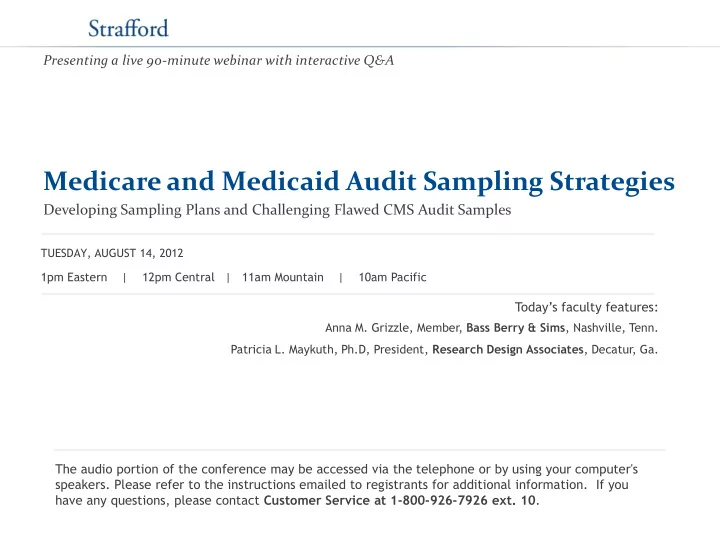
Medicare and Medicaid Audit Sampling Strategies Developing Sampling - - PowerPoint PPT Presentation

medicare and medicaid audit sampling strategies
SMART_READER_LITE
LIVE PREVIEW

Medicare and Medicaid Audit Sampling Strategies Developing Sampling - - PowerPoint PPT Presentation

Presenting a live 90-minute webinar with interactive Q&A Medicare and Medicaid Audit Sampling Strategies Developing Sampling Plans and Challenging Flawed CMS Audit Samples TUESDAY, AUGUST 14, 2012 1pm Eastern | 12pm Central | 11am


slide-1
SLIDE 1

Medicare and Medicaid Audit Sampling Strategies

Developing Sampling Plans and Challenging Flawed CMS Audit Samples

Today’s faculty features:

1pm Eastern | 12pm Central | 11am Mountain | 10am Pacific

The audio portion of the conference may be accessed via the telephone or by using your computer's

  • speakers. Please refer to the instructions emailed to registrants for additional information. If you

have any questions, please contact Customer Service at 1-800-926-7926 ext. 10.

TUESDAY, AUGUST 14, 2012

Presenting a live 90-minute webinar with interactive Q&A

Anna M. Grizzle, Member, Bass Berry & Sims, Nashville, Tenn. Patricia L. Maykuth, Ph.D, President, Research Design Associates, Decatur, Ga.

slide-2
SLIDE 2

Sound Quality If you are listening via your computer speakers, please note that the quality of your sound will vary depending on the speed and quality of your internet connection. If the sound quality is not satisfactory and you are listening via your computer speakers, you may listen via the phone: dial 1-866-370-2805 and enter your PIN -when prompted. Otherwise, please send us a chat or e-mail sound@straffordpub.com immediately so we can address the problem. If you dialed in and have any difficulties during the call, press *0 for assistance. Viewing Quality To maximize your screen, press the F11 key on your keyboard. To exit full screen, press the F11 key again.

slide-3
SLIDE 3

For CLE purposes, please let us know how many people are listening at your location by completing each of the following steps:

  • In the chat box, type (1) your company name and (2) the number of

attendees at your location

  • Click the word balloon button to send

FOR LIVE EVENT ONLY

slide-4
SLIDE 4

Medicare and Medicaid Audit Sampling Strategies

Anna M. Grizzle Partner Bass, Berry & Sims PLC Patricia Maykuth, Ph.D. President Research Design Associates, Inc.

August 14, 2012

slide-5
SLIDE 5

Agenda

  • When is statistical sampling and

extrapolation used?

  • What is the legal basis for statistical sampling

and extrapolation?

  • How is statistical sampling and extrapolation

performed?

  • How can I defend against extrapolated
  • verpayment results?

5

slide-6
SLIDE 6

Use of Statistical Sampling for Overpayment Estimation

  • Acceptable tool in different audits: Medicare,

Medicaid, tax, financial statements, etc.

  • Appropriate when records are too voluminous

for individual review

  • Used in Medicare overpayment reviews since

the 1970’s

6

slide-7
SLIDE 7

Use of Statistical Sampling for Overpayment Estimation

  • CMS overpayment audit
  • OIG self-disclosure protocol
  • Internal compliance audit

7

slide-8
SLIDE 8

Legal Basis for Statistical Sampling for Overpayment Estimation

“The use of statistical sampling to project an

  • verpayment. . . does not deny a provider or

supplier due process. Neither the statute nor regulations require that a case-by-case review be conducted in order to determine that a provider or supplier has been overpaid and to determine the amount of overpayment.” HCFA Ruling 86-1

8

slide-9
SLIDE 9

Legal Basis for Statistical Sampling for Overpayment Estimation

Statistical sampling does not violate due process “so long as extrapolation is made from a representative sample and is statistically significant.” Chaves County Home Health Service, Inc. v. Sullivan, 931 F.2d 914 (D.C. Cir. 1991), cert. denied, 402 U.S. 1091 (1992).

9

slide-10
SLIDE 10

Legal Basis for Medicare Statistical Sampling and Extrapolation

A Medicare contractor may not use extrapolation to determine overpayment amounts . . . unless . . . – There is a sustained or high level of payment error; or – Documented educational intervention has failed to correct the payment error 42 U.S.C. §1395ddd(f)(3)

10

slide-11
SLIDE 11

Legal Basis for Medicare Statistical Sampling and Extrapolation

  • Sustained or high level of payment error can be

determined by:

– Error rate determinations by MR unit, ZPIC – Probe samples – Data analysis – Provider/supplier history – Information from law enforcement investigations – Allegations of wrongdoing by current or former employees of provider or supplier – Audits or evaluations conducted by the OIG

Source: Chapter 8 – Benefit Integrity; Medicare Program Integrity Manual; available at: http://www.cms.gov/manuals/downloads/pim83c08.pdf (Previously found in Chapter 3) 11

slide-12
SLIDE 12

Legal Basis for Medicare Statistical Sampling and Extrapolation

  • Additional Factors to Consider

– Number of claims in universe – Dollar values associated with claims – Available resources – Cost effectiveness of expected sampling results

Source: Chapter 8 – Benefit Integrity; Medicare Program Integrity Manual; available at: http://www.cms.gov/manuals/downloads/pim83c08.pdf 12

slide-13
SLIDE 13

Legal Basis for Medicaid Statistical Sampling and Extrapolation

  • Dictated by state law
  • If no explicit authority, look to due process

requirements

13

slide-14
SLIDE 14

Numbers vs. Statistics

  • Numbers can readily be manipulated and
  • utcomes understood through the use of simple

math: addition, subtraction, multiplication, multiplication and division e.g., %s, differences, sums and averages.

  • Statistics is branch of applied math concerned

with the collection and interpretation of quantitative data and the use of probability theory to estimate universe parameters e.g. correlations, t-tests and point estimates

14

slide-15
SLIDE 15

MPIM Requirements

  • Key Rules

– Obtain and properly execute “probability sample” – Keep data and records so work can be replicated

  • More content and direction given in RAT-STATS

Manuals and standard of care expected of statisticians under Generally Accepted Statistics Procedures and Policies (“GASPP”)

15

slide-16
SLIDE 16

Validity Sample

If a particular probability sample design is properly executed, i.e., defining the universe, the frame, the sampling units, using proper randomization, accurately measuring the variables of interest, and using the correct formulas for estimation, then assertions that the sample and its resulting estimates are “not statistically valid” cannot legitimately be made. In other words, a probability sample and its results are always “valid.” MPIM § 8.4.2

16

slide-17
SLIDE 17

“Always Valid” Does Not Mean Results Cannot Be Challenged

Rather the “always valid” refers to the idea that internal operation

  • f a statistical process which, when executed, will (with respect

to its mathematical assumptions) yield internally consistent results. The concept of statistically “valid” includes the understanding that there is an expectation of error. “Valid” results include expectation of error: wrong 10 times in 100, precision demonstrated inaccuracy, validly rejecting hypothesis.

17

slide-18
SLIDE 18

Valid Outcomes Require Properly

  • defined universe
  • defined the frame
  • defined sampling units
  • use proper randomization
  • Accurate measuring the variables of interest
  • using the correct formulas for estimation
  • tests of key assumptions
  • accurate reporting of actual findings

18

slide-19
SLIDE 19

Typical Problems with Extrapolation

 Sample size, not associated with precision or confidence  Incorrect use of formulas  Use of wrong formulas - choose wrong method  Use of inapplicable methodology – simple, stratified, cluster, multi-stage  Non-representative sample  Fail to meet key assumptions of statistic – math basis of statistic  Exclusion of zero paid claims  Accuracy outside of recommended range – too little precision  Reporting precision and/or confidence levels that are wrong

19

slide-20
SLIDE 20

Unacceptable Departure From GASPP

  • too excessive a departure from even a lenient

interpretation of the MPIM

  • major departures from methodology
  • non-trivial mistakes in

audit definition application of method

  • non-sampling errors
  • lack of statistical oversight and quality control

20

slide-21
SLIDE 21

Overview of the sampling process

Universe (who; why; what data) Frame (dates; units; criteria) Sample Definition (simple; stratified; multi-stage) Sample Size (Chosen precision & confidence) Seed & Random Numbers Pick Out Sample

21

slide-22
SLIDE 22

Calculated Statistics of Sample

Before claim review

Choice of methodology Simple Stratified Cluster Multi-stage Sample size determination based

  • n
  • Universe size
  • Standard deviation or probe
  • Chosen Precision
  • Chosen Confidence interval

After claim review

Calcula ulate te overpay payment ment

  • Per claim
  • For sample

le

  • Proportion

ion of claims in error

Calcula ulate te point t estimate te

  • Mean
  • Error rates
  • Precis

isio ion n for confide idence nce interval al

  • Upper and lower CI

22

slide-23
SLIDE 23

Key Requirements for Use of Parametric Statistics

Use a sample that:

  • Is made up or independent observations
  • Randomly selected
  • Normally distributed
  • Is representative of the frame from which it

was chosen and over which it will be extrapolated

23

slide-24
SLIDE 24

Random

– … each distinct sample of the set has a known probability of selection…. – … one of the possible samples is selected by a random process according to which each sampling unit in the target population receives its appropriate chance of selection….

24

slide-25
SLIDE 25

25

slide-26
SLIDE 26

Representative Sample

26

slide-27
SLIDE 27

27

slide-28
SLIDE 28

SEED NUMBER: 50007.27 FRAME SIZE: 80 Frame Sort

Selection Order Value 3 4 10 6 11 7 13 40 9 42 5 43 1 49 6 51 14 56 15 60 4 62 7 64 2 73 12 76 8 77 16 13 17 45 18 70 19 15 20 5 SUMMATION OF RANDOM NUMBERS = 858

28

slide-29
SLIDE 29

Sample Size

Statistical sampling is used to calculate and project (i.e., extrapolate) the amount of overpayment(s) made on

  • claims. The Medicare Prescription Drug, Improvement,

and Modernization Act of 2003 (MMA), mandates that before using extrapolation to determine overpayment amounts to be recovered by recoupment, offset or

  • therwise, there must be a determination of sustained
  • r high level of payment error, or documentation that

educational intervention has failed to correct the payment error. By law, the determination that a sustained or high level of payment error exists is not subject to administrative or judicial review. MPIM, § 8.4.1.2

29

slide-30
SLIDE 30

Example Frame Frequency

N

70 Mean 49.99 Median 50.00 Mode 51

  • Std. Deviation

11.544 Variance 133.261 Skewness 0.156 Kurtosis 0.856 Minimum 20 Maximum 80 Sum 3,499

30

slide-31
SLIDE 31

Frame Distribution

31

slide-32
SLIDE 32

32

slide-33
SLIDE 33

Sample Size Determination Based on Chosen Precision and Confidence

33

slide-34
SLIDE 34

RAT-STATS Results

Confidence Level 80% 90% 95% 99% 1% 75 77 78 79 2% 63 68 71 75

Precision 5% 29 * 39 46 56 Level 10% 10 * 15 * 20 * 29 *

15% 5 * 8 * 10 * 16 *

34

slide-35
SLIDE 35

Probability Sample

Probability theory mathematics allow the comparison of sample data to a described distribution (in this case a “normal distribution”) to describe the pattern of that

  • data. Many inferential statistics are based on

the reality that the data being analyzed were “normally distributed”

35

slide-36
SLIDE 36

Normal Distribution

36

slide-37
SLIDE 37

This is the standard normal distribution’s mathematical formula.

37

slide-38
SLIDE 38

Basic statistical terminology

 Mean (average) the arithmetic sum of all scores divided by the number of cases  Median – the middle most real score  Mode the score that occurs most frequently in the data set (does not have to be unique – sometimes more than 1 value is equally likely)  Measures of variability (variance, standard deviation, precision and confidence interval)

38

slide-39
SLIDE 39

Lower Confidence Level Upper Confidence Level Point Estimate

39

slide-40
SLIDE 40

40

slide-41
SLIDE 41

Sample Frequency in $

N

15 Mean 430.93 Median 112.00 Mode 120

  • Std. Deviation

525.519 Variance 76,170.210 Skewness 0.816 Kurtosis 0.580 Minimum 10 Maximum 1,300 Sum 6,464

41

slide-42
SLIDE 42

Non Normal Mean and SD

Sample mean +/- 1 standard deviation Mean = $430.92 + sd = 525.510 = 956.43 430.92 - 525.510 = -94.18

42

slide-43
SLIDE 43

Posterior Distribution

  • Sample selected from amount paid to provider
  • Sample analyzed using overpayment data
  • Never know up front what the overpayment

amount is going to be unless

– There is a known history of overpayment dollar amount – Conduct a probe

  • Overpayment amounts must meet criteria for

using parametric statistic or the confidence levels are destroyed.

43

slide-44
SLIDE 44

Sample Overpay Frequency in $

N

15 Mean 339.333 Median 100.00 Mode 0.0

  • Std. Deviation

511.62 Variance 261,763.810 Skewness 1.197 Kurtosis

  • 0.524

Minimum 10 Maximum 1,300 Sum 6,464

44

slide-45
SLIDE 45

RAT-STATS Overpayment Estimation

Formulae: Confidence Level

45

slide-46
SLIDE 46

RAT-STATS Point Estimate & CI

POINT ESTIMATE 27,147 90% CONFIDENCE LEVEL LOWER LIMIT 10,368 UPPER LIMIT 43,925 PRECISION AMOUNT 16,778 PRECISION PERCENT 61.81% T-VALUE USED 1.761310135775 Lower 27,147 + 16,778 = $43, 925 Upper 27,147 - 16,778 = $ 10,368 Confidence Interval = 16,778 + 16,778 = 33,556

46

slide-47
SLIDE 47

Confidence Levels Non Normal Data

Point Estimate +/- ½ Confidence Interval Lower 27,147 + 16,778 = $43, 925 Upper 27,147 - 16,778 = $ 10,368 Confidence Interval = 16,778 + 16,778 = 33,556

Lower confidence Level ??? Unknowable 47

slide-48
SLIDE 48

Overpayment Calculations

POINT ESTIMATE $27,147 90% CONFIDENCE LEVEL LOWER LIMIT 10,368 UPPER LIMIT 43,925 PRECISION AMOUNT 16,778 PRECISION PERCENT 61.81% T-VALUE USED 1.761310135775

48

slide-49
SLIDE 49

Requirements of Every Study

  • Define objectives of study
  • Define the universe to be sampled
  • All relevant data sampled, none omitted or added
  • Ascertain the degree of precision acceptable
  • Specify people who conduct study with expertise necessary

and documented records

  • Define the frame
  • Select the sample (correct size, random, independent,

representative, normal) SVRS

  • Organize field work, quality controls and assurance
  • Summarize and analyze results of validity sample

49

slide-50
SLIDE 50

Poor Audit Design & Execution Produce Only “Invalid Results”

Statistics in the hands of an inept auditor are like a lamppost to a drunk--they're used more for support than illumination.

50

slide-51
SLIDE 51

Defending Against Extrapolation Results

  • Medicare Appeals Process

– Redetermination – Reconsideration – Administrative Law Judge Hearing – Medicare Appeals Council – Federal District Court

  • Medicaid Appeals Process

– Appeal rights under state law

51

slide-52
SLIDE 52

Defending Against Medicare Extrapolation Results

  • No administrative or judicial review of

determination of high level of payment error BUT determination must be made

  • Failure to follow one or more requirements in

Benefit Integrity Manual does not necessarily affect validity

  • Not sufficient to argue better or more precise

methods are available

52

slide-53
SLIDE 53

Defending Against Medicare Extrapolation Results

  • Can challenge validity of sampling methodology

based on “the actual statistical validity of the sample as drawn and conducted”

  • Test: Was the sample statistically valid?
  • Provider has burden of establishing sample was

not statistically valid

53

slide-54
SLIDE 54

Defending Against Extrapolation Results

  • Procedural Challenges

– Did the contractor follow the MPIM or state law requirements? – Were allowed claims included in overpayment sample calculation? – Were calculations performed correctly at each level of appeal?

54

slide-55
SLIDE 55

Defending Against Extrapolation Results

  • Substantive Challenges

– Likely need a statistician

  • Where can you find one?

– “One size does NOT fit all.” – It is not your job to explain how it should be done.

55

slide-56
SLIDE 56

Defending Against Extrapolation Results

  • Examples of Substantive Challenges

– Is the sample representative? – Is the sample statistically significant?

  • Is the sample size reliable?
  • Is the sample within the required precision and

confidence levels?

56

slide-57
SLIDE 57

Defending Against Extrapolation Results

  • Obtain all documentation related to sampling

calculations – Consider provider’s prior audit history

  • Know appeal timelines and requirements for

each level

  • Understand reasons for denial at each level
  • Present reasons in written protest or position

paper

  • Prepare for oral testimony at hearing

57

slide-58
SLIDE 58

Questions

Anna M. Grizzle Bass, Berry & Sims PLC agrizzle@bassberry.com Patricia Maykuth, Ph.D. pm@researchdesignassociates.com

58