Medical Futility: I have no actual or potential conflict of - - PDF document

medical futility
SMART_READER_LITE
LIVE PREVIEW

Medical Futility: I have no actual or potential conflict of - - PDF document

6/12/16 Disclosure Medical Futility: I have no actual or potential conflict of interest in relation to this program/ When is Enough Enough? presentation. Robert D. Truog, MD Professor of Medical Ethics, Anaesthesiology & Pediatrics


slide-1
SLIDE 1

6/12/16 1

Medical Futility:

When is Enough Enough?

Robert D. Truog, MD

Professor of Medical Ethics, Anaesthesiology & Pediatrics Harvard Medical School Senior Associate in Critical Care Medicine Boston Children’s Hospital

Disclosure

I have no actual or potential conflict of interest in relation to this program/ presentation.

I’m afraid there’s very little I can do

I’m afraid there’s really very little I can do…

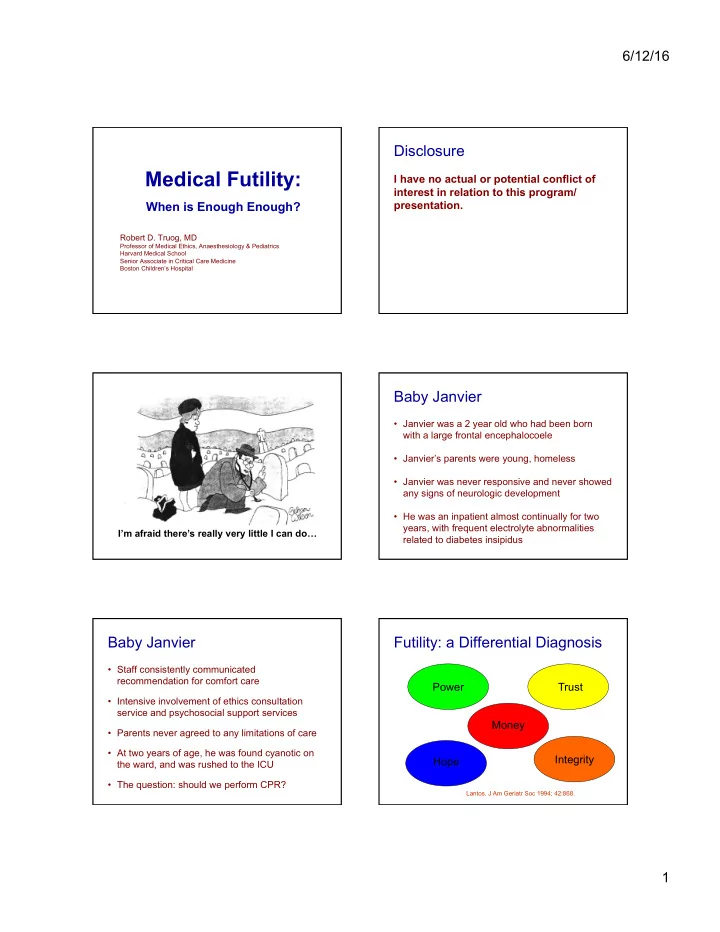
Baby Janvier

  • Janvier was a 2 year old who had been born

with a large frontal encephalocoele

  • Janvier’s parents were young, homeless
  • Janvier was never responsive and never showed

any signs of neurologic development

  • He was an inpatient almost continually for two

years, with frequent electrolyte abnormalities related to diabetes insipidus

Baby Janvier

  • Staff consistently communicated

recommendation for comfort care

  • Intensive involvement of ethics consultation

service and psychosocial support services

  • Parents never agreed to any limitations of care
  • At two years of age, he was found cyanotic on

the ward, and was rushed to the ICU

  • The question: should we perform CPR?

Futility: a Differential Diagnosis

  • Lantos. J Am Geriatr Soc 1994; 42:868.

Power Trust Money Hope Integrity

slide-2
SLIDE 2

6/12/16 2

What’s underneath the futility debate?

  • Power
  • Trust
  • Money
  • Hope
  • Integrity

Who gets to say NO?

  • The question of the 1970’s & 1980’s:

The rights of patients to refuse medical treatment

– Ethically and legally resolved, but still a problem in practice

  • The question of the 1990’s and 2000’s:

The rights of patients to demand medical treatment

– Ethically, legally, and politically controversial

How should we frame the issues?

  • Do patients and families have a right to force

doctors to squander scarce time and resources on therapies that have no benefit in order to satisfy their irrational wishes?

  • Do doctors have a right to arbitrarily ignore

the values and preferences of patients and families, using only their own value systems to make life and death decisions for others?

  • Lantos. J Am Geriatr Soc 1994; 42:868.

A debate about “Odds and Ends”

  • Questions about futility

ask: – What chance or probability of success is “worth it”? – What quality of

  • utcome is “worth it”?
  • Caplan. Ann Intern Med 1996; 125:688.

A debate about “Odds and Ends”

  • Are these questions within the expertise of

the medical profession?

Good Lord, Gilroy, it’s not for us to determine if they’re worth saving!

What’s underneath the futility debate?

  • Power
  • Trust
  • Money
  • Hope
  • Integrity
slide-3
SLIDE 3

6/12/16 3

Surrogates vs Physicians

  • 72% of surrogates think that patients have a

right to demand care their physicians think will not help. – Only 44% of physicians agreed

  • 21% of surrogates think that even when doctors

think there is “no hope of recovery,” all efforts should continue indefinitely. – Only 2.5% of physicians agreed

Lenworth et al. Archives Surgery 2008: 143:730

Get better data about the loss of trust

What’s underneath the futility debate?

  • Power
  • Trust
  • Money
  • Hope
  • Integrity

Is it all just a question of money?

Futility debates rarely arise around therapies that are cheap and easy to provide

Would futility guidelines save money?

“The low frequency of futility in an adult intensive care unit setting.” Halevy et al. Arch Int Med 1996; 156:100-4.

“The frequency of futile interventions appears to be low unless one is willing to accept a definition that includes patients who could survive for many months... this suggests that concepts of futility will not play a major role in cost containment.”

Would futility guidelines save money?

“Resource consumption and the extent of futile care among patients in a pediatric intensive care unit setting.” Sachdeva et al. J Pediatr 1996; 128:742-7.

“Despite our use of broad definitions of medical futility, relatively small amounts of resources were used in futile PICU care... attempts to reduce resource consumption in the PICU by focusing on medical futility are unlikely to be successful.”

slide-4
SLIDE 4

6/12/16 4

What’s underneath the futility debate?

  • Power
  • Trust
  • Money
  • Hope
  • Integrity

Hope

  • The issue of “miracles”
  • Insights from “lotteries”
  • Is hope just a denial of the facts?

Hope is a state of mind independent of the state of the world. If your heart’s full of hope, you can be persistent when you can’t be optimistic. You can keep the faith, despite the evidence, knowing that only in so doing does the evidence have any chance of changing. So, while I’m not

  • ptimistic, I’m always very hopeful.

Reverend William Sloane Coffin, as interviewed

  • n NPR radio in 1994

Hope

Hope has nothing to do with probabilities

Eric Cassell, MD

Hope

  • “High Hopes”
  • “Which was, in fact, the greater cruelty? Was

it the one she avoided, which would have condemned Jerry to a protracted death in the intensive care unit, all blood and tubes and pain? Or was it the one she committed, sitting

  • n Jerry’s bed, holding his hand, and

methodically erasing all the hope from his eager eyes?”

Abigail Zuger, JAMA 1989;262:2988

If the talk ended here…

  • Since futility judgments –

– Are often a power-play by clinicians to enforce their values on power-less patients and families – Are used as a trump card when trust has broken down in the patient-physician relationship – Can squash whatever therapeutic value there may be in hope, however irrational it may seem – Will save very little money under even the most

  • ptimistic of circumstances…
slide-5
SLIDE 5

6/12/16 5

Futility judgments should have no role in limiting treatments for patients and families who want them

Rise and Fall of Futility

Helft et al. N Engl J Med 2000; 343:293.

What’s underneath the futility debate?

  • Power
  • Trust
  • Money
  • Hope
  • Integrity

Integrity

  • In some cases, clinicians experience moral

distress from the belief that their efforts to keep patients alive are profoundly wrong.

  • “Moral distress is psychological disequilibrium

that occurs when the ethically right course of action is known but cannot be acted on.”

Meltzer et al. Am.J.Crit.Care 2004; 13:202.

Integrity

– “I often equate my job with ‘keeping dead people alive.’ On these days, I dread coming to work.” – “I’m scared that I’m causing undue pain and suffering, and this causes me great distress.” – “Some days I feel (physically) sick.”

Elpern et al. Am.J.Crit.Care 2005; 14:523

Resolution?

Is there a way to identify reasonable limits to what patients and families can demand, while adequately respecting different values and perspectives?

slide-6
SLIDE 6

6/12/16 6

Attempts to define “Futility”

  • When physicians conclude (either through personal

experience, experiences shared with colleagues, or consideration of published empiric data) that in the last 100 cases a medical treatment has been useless, they should regard that treatment as futile

  • If a treatment merely preserves permanent

unconsciousness or cannot end dependence on intensive medical care, the treatment should be considered futile

Schneiderman et al. Ann.Intern.Med. 1990; 112:949.

Justice Stewart on Pornography

"I shall not today attempt further to define... pornography; and perhaps I could never succeed in intelligibly doing so. But I know it when I see it..."

The Failure to Define Futility

  • This insight lies behind the movement to

develop procedural rather that definitional approaches to determining futility.

  • “Judgments of futility cannot be made by

reference to rules or definitions, but must be determined on a case by case basis.”

American Medical Association Plows et al. JAMA 1999; 281:937.

Beyond Hospital Policy…

  • Some states are now adopting futility legislation
  • These laws follow the procedural approach that

has been developing in hospitals

  • Most of the experience so far has been in Texas

Texas Advance Directives Act

  • The physician’s refusal to treat must be reviewed

by a hospital ethics committee.

  • The family must be given 48 hours notice and be

invited to participate in the process.

  • The hospital must make reasonable efforts to

transfer the patient’s care to others.

slide-7
SLIDE 7

6/12/16 7 Texas Advance Directives Act

  • If no provider can be found in 10 days, treatment

may be unilaterally withdrawn.

  • The family may request a court-ordered

extension, which a judge should grant only if there is a reasonable chance of finding a willing provider.

  • The treatment team is immune from civil or

criminal prosecution.

Emilio Gonzales

  • 17 mth old with Leigh’s disease at

Children’s Hospital of Austin

  • Dependent upon ventilator and

tube feeds

Advantages of the Texas Law

  • Even families who vigorously argue for maintenance
  • f life-sustaining treatments, sometimes seem

relieved by the process:

  • "If you are asking us to agree with the

recommendation to remove life support from our loved one, we cannot. However, we do not wish to fight the recommendation in court, and if the law says it is OK to stop life support, then that is what should happen."

Fine et al. Ann Intern Med 2003; 138:743.

Problems with the Texas law

  • Hospital ethics committees have sole

authority to decide whether treatment is futile

– Most members are physicians, nurses, etc. – Even “community members” are not impartial

  • Families have no legal recourse

– Judges can extend date to find alternative providers, but cannot change judgment – Denies “due process” protections to those who hold unpopular values

Children’s Policy vs Texas Law

  • Children’s Policy

– Has encouraged ethics consultation and defines a pathway for resolution – Unilateral withdrawal is possible, but has not yet been done

  • Texas Law

– Clearly effective at resolving conflict – But, is it “too easy” a way to “win”?

slide-8
SLIDE 8

6/12/16 8

Where should we go from here?

  • Futility disputes regularly identified as the

#1 ethical issue facing US hospitals

  • Although the actual legal risk is low, few

physicians will act unilaterally without civil & criminal immunity

  • Legislation is needed

The Texas law can be “fixed”

  • Extra-judicial committees and procedures

can be both fair and effective, but…

– They must be fully independent of the clinicians and the hospital – They must permit limited access to court appeal (eg, for issues of process, not substance)

Baby Janvier: coda

  • Full resuscitation attempted

– Ventilated through trach, CPR performed – Multiple failed attempts at PIVs, CVLs, IOs

  • Code called after ~15 min
  • Family notified
  • I met them in one of our family rooms

“I wish, and the hospital staff I work with wishes, almost beyond telling, that people could know what they are asking when they ask that “everything” be done.”

A cost / benefit approach

  • Benefit

“Even though we understand that you think it would be totally useless, all we are asking is for you and your team to spend 20 minutes doing

  • CPR. This will be of enormous help to our family in

coping with our loved-one’s death and in feeling reassured that “everything” was done.”

slide-9
SLIDE 9

6/12/16 9 A cost / benefit approach

  • Costs to Society:

– Money & resources

  • Costs to Patient and Family:

– Patient suffering – Patient dignity

  • Costs to Caregivers:

– Moral distress for caregivers – Caregiver burnout Medical Futility Psychological Benefit to Family Medical Futility Psychological Benefit to Family

Conclusions

  • Clinicians have no obligation to offer treatments

that do not offer a benefit

  • Futility policies are ethically defensible

– Legislation is probably necessary to make them effective – But the laws need to protect against the “tyranny of the majority”

  • Clinicians have no obligation to offer futile CPR,

but sometimes the cost / benefit ratio may make it permissible to do so

Bosslet GT, Pope TM, Rubenfeld GD, et al. An Official ATS/AACN/ACCP/ESICM/ SCCM Policy Statement: Responding to Requests for Potentially Inappropriate Treatments in Intensive Care Units. Am J Respir Crit Care Med 2015;191:1318-30.