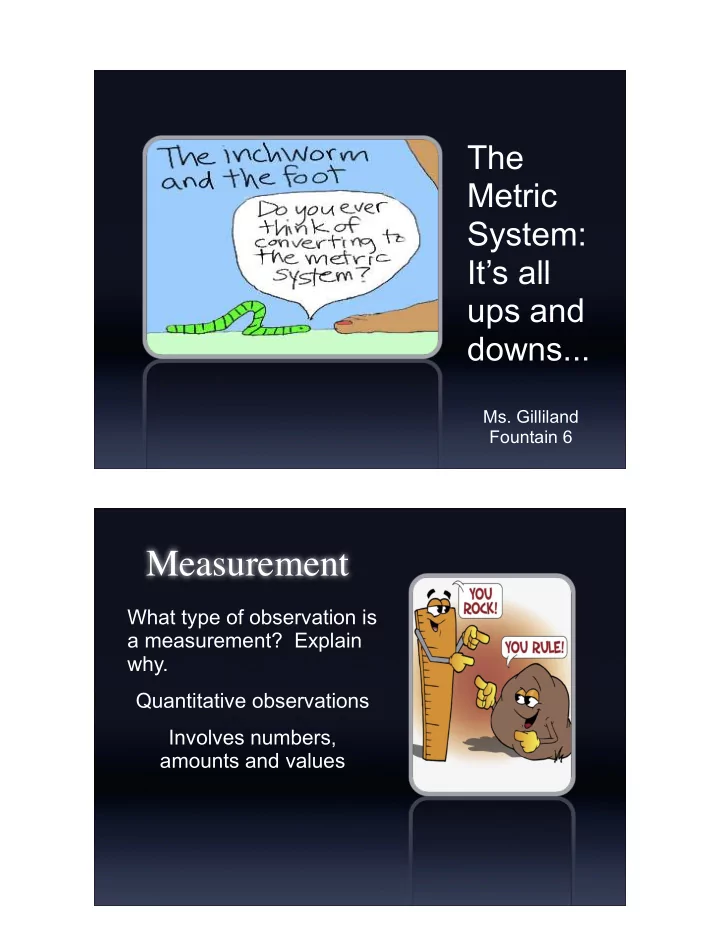
Measurement What type of observation is a measurement? Explain - - PDF document

measurement
SMART_READER_LITE
LIVE PREVIEW

Measurement What type of observation is a measurement? Explain - - PDF document

The Metric System: Its all ups and downs... Ms. Gilliland Fountain 6 Measurement What type of observation is a measurement? Explain why. Quantitative observations Involves numbers, amounts and values Why is the metric system used


slide-1
SLIDE 1

The Metric System: It’s all ups and downs...

  • Ms. Gilliland

Fountain 6

What type of observation is a measurement? Explain why. Quantitative observations Involves numbers, amounts and values

Measurement

slide-2
SLIDE 2
  • Important for accuracy

and comparability

  • Same meaning in all

languages In the past ... Uniform System of Measurement ... Why is the metric system used in Science when it is not the system used in the United States by the general public?

Used body parts as standards ...

slide-3
SLIDE 3

So, welcome to metric measurements -- International System of Measurement (SI)

The metric unit:

a specific amount used to measure something.

Basic Metric Unit Symbol or Abbreviation What is measured? What instrument(s) is used?

Meter m Length and distance Ruler, meter stick Liter L, l Liquid Volume -- amount of space Graduated cylinder, Beaker Gram g Mass -- amount of matter Balance

slide-4
SLIDE 4

Prefix:

describes the size of the unit.

Prefix kilo

(big)

hecto deka units

(medium) deci

centi

(small)

milli

(tiny)

Symbol k h da m, L, g d c m Value 1,000 100 10 1 0.1 0.01 0.001

smaller LARGER Basic Unit

Don’t forget ...

  • Measuring time in

metric is the same as in the English system

  • seconds (main unit),

minutes, hours

  • Instrument: stopwatch,

clock

slide-5
SLIDE 5

Temperature ...

Degrees Celsius -- C (no prefixes) Instrument: Thermometer

METRIC CONVERSION

slide-6
SLIDE 6

Key to remember ...

Kids have damaged underwear during camp months k h da m, L, g d c m Unit

Metric Conversion Steps

k h da m, L, g d c m

  • 1. Find the decimal point in the
  • riginal number.
  • 2. Mark the start and stop steps
  • n the ladder.
  • 3. Count the number of “jumps” and

note the direction.

  • 4. Move the decimal point the same

number of places in the same direction.