Means vs. ends Three Dimensions of SD Economics is the study of - - PowerPoint PPT Presentation

means vs ends
SMART_READER_LITE
LIVE PREVIEW

Means vs. ends Three Dimensions of SD Economics is the study of - - PowerPoint PPT Presentation

Human well-being, Sustainable Development ecosystem services and the value of nature Sustainable development is development that meets the needs of the present without compromising the ability of future generations to meet their own


slide-1
SLIDE 1

Human well-being, ecosystem services and the value of nature

Brynhildur Davidsdottir Environment and Natural Resources

UNIVERSITY OF ICELAND

Sustainable Development

“Sustainable development is development that meets the needs of the present without compromising the ability of future generations to meet their own needs"

Brundtland Commission “Our common future” 1987

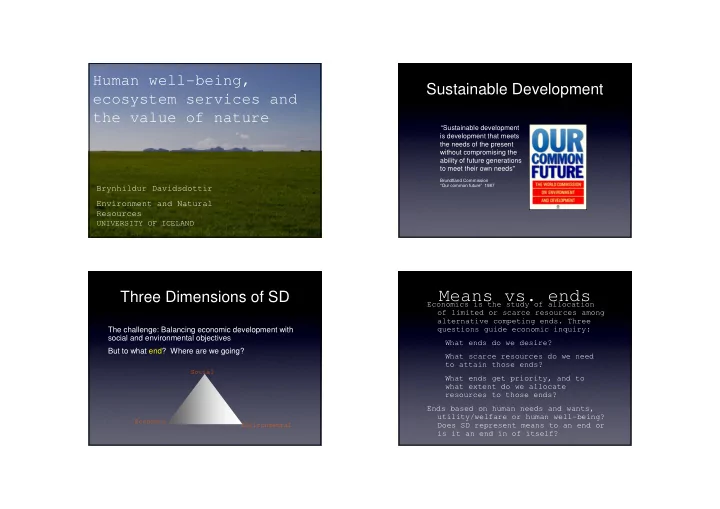
Three Dimensions of SD

Social Economic Environmental

The challenge: Balancing economic development with social and environmental objectives But to what end? Where are we going?

Means vs. ends

Economics is the study of allocation

  • f limited or scarce resources among

alternative competing ends. Three questions guide economic inquiry: What ends do we desire? What scarce resources do we need to attain those ends? What ends get priority, and to what extent do we allocate resources to those ends? Ends based on human needs and wants, utility/welfare or human well-being? Does SD represent means to an end or is it an end in of itself?

slide-2
SLIDE 2

Tradeoffs!

Tradeoffs between goods; market and non-market goods. The environment or natural capital provides non-market goods and services!

External to the market External to decision-making Undervalued Overused

Why should we care?

Valuing nature - putting values into perspective Global ecosystem assessment revealed the contribution of nature to economic value to be:

Between 16-54 trillion Average value 33 trillion Gross World Product about 25 trillion.

Costanza et al. in Nature 1997.

Implications of Costanza’s study:

Nature provides significant external economic value. Must be careful not to deplete the foundations for receiving this value. Diminishing the ability of nature to provide economic value can have significant implications for future wellbeing. Must include it in formal decision-making and illustrate the economic consequences of not doing so.

Study increased awareness of the importance of nature as a contributor to economic production and human wellbeing. Value of nature’s services not

  • nly large, but grossly

underrepresented.

1.Introduction

Why?

  • 1. Lack knowledge regarding the role

ecosystems serve in delivering services.

  • 2. Benefits often indirect and difficult to

measure.

  • 3. Difficult to capture value in

conventional markets.

slide-3
SLIDE 3

Overview

  • 1. Natural capital and human economies
  • 2. Natural capital and ecosystem services
  • 3. Human well-being and ecosystem

services

  • 4. Ecosystem services of the forest
  • 5. Valuation
  • 6. Conclusion

NATURAL CAPITAL

  • 1. Natural capital and human economy

NATURE SERVICES

RESOURCE INPUTS LIFE SUPPORT CULTURAL

Natural Capital

The environment or natural capital can be considered a stock, which similar to man- made capital yields through its multiple functions a flow of goods and services into the future. Natural capital thus has specific functions that then provide a flow of goods and services, which most often are called collectively ecosystem services.

  • 2. Natural capital and ecosystem services

Ecosystem Services

Ecosystem services are defined as those functions of natural capital that support (directly

  • r indirectly) human wellbeing

and therefore are defined by the benefits people obtain from the biosphere and its ecosystems. Anthropocentric concept

  • 2. Natural capital and ecosystem services
slide-4
SLIDE 4

Human well-being

Most agree that it includes: basic material needs for a good life the experience of freedom, health, personal security, and good social relations Together, these provide the conditions for physical, social, psychological, and spiritual fulfillment.

  • 3. Ecosystem services and human wellbeing

Ecosystem Services and Human Well-being

  • 3. Ecosystem services and human wellbeing

MEA Framework

  • 3. Ecosystem services and human wellbeing
  • 4. Example: The

ecosystem services of the forest

slide-5
SLIDE 5

Classifying Ecosystem Services

The benefits people obtain from

ecosystems

  • 4. Ecosystem services of the forest

Ecosystem services classification

  • i. Provisioning – Food, water,

fuel, ornaments

  • ii. Regulating – Carbon

sequestration

  • iii. Supporting – Biodiversity,

water supply

  • iv. Cultural – Aesthetic,

recreational, educational Each system can provide multiple services – but use of one service may affect the provision of

  • thers – e.g. recreational

services – represents a loss that

  • 4. Ecosystem services of the forest

Provisioning services

  • i. Provisioning – direct inputs

Timber, fibers, fuel Non-fiber products Mushrooms, berries, fruits Maple syrup! Rubber etc. Saving energy and GHG emissions!

  • 4. Ecosystem services of the forest

Regulating services

  • ii. Regulating – life support

services Flood prevention – e.g. stormwater runoff Water purification Erosion control Cleaning the air Climate regulation – e.g. carbon sequestration

  • 4. Ecosystem services of the forest
slide-6
SLIDE 6

Supporting services

  • iii. Supporting – life support

services Biodiversity Soil formation Water retention - supply

  • 4. Ecosystem services of the forest

Cultural services

  • iv. Amenity - cultural services

Recreational Educational Spiritual Aesthetic - existence

  • 4. Ecosystem services of the forest
  • 5. Valuation

Types of value

Use values “active use” Direct (consumptive, non consumptive) Indirect Non-use values “passive use” Existence value Option value, bequest value

Total Economic Value = UV + NUV

  • 5. Valuation
slide-7
SLIDE 7

Valuation tools

Use values – revealed preferences Market prices Travel cost Hedonic pricing Cost-based measures Non-use values – stated preferences Contingent evaluation

  • 5. Valuation

Why evaluation?

Is no value better than an incorrect one? Value already being put on ecosystem services – close to zero At least by trying to put a value

  • n ecosystem services we are

approaching a more accurate picture of the costs and benefits involved – enabling better informed decisions. Giving nature a chance

  • 5. Valuation

Valuing Ecosystem Services - Heiðmörk

3 year multifaceted ecosystem services evaluation project Collaborative project between UI, Reykjavik, Gardabaer, Reykjavik Energy, The Forest Service

  • 5. Valuation

To evaluate the services of a popular recreational area close to Reykjavik that gives multiple services

Valuing Ecosystem Services - Heiðmörk

  • i. The forest
  • Cristmas trees,berries, mushrooms
  • Carbon sequestration
  • ii. Water catchment area
  • Water provision and purification
  • iii. The lakes
  • Recreation
  • Reservoir for power plant
  • Maintaining/regulating water flow and

nutrients, waste dilution

  • iv. Cultural; Recreation, education
  • v. Existence value
  • 5. Valuation
slide-8
SLIDE 8
  • 6. Conclusion

Natural capital provide multiple important services Need to further understanding of those services, identify, value them, cherish them! General recognition of the value of ecosystem services to human-wellbeing demands rethinking how projects are evaluated. Investing in natural capital is one of the best investments we can make