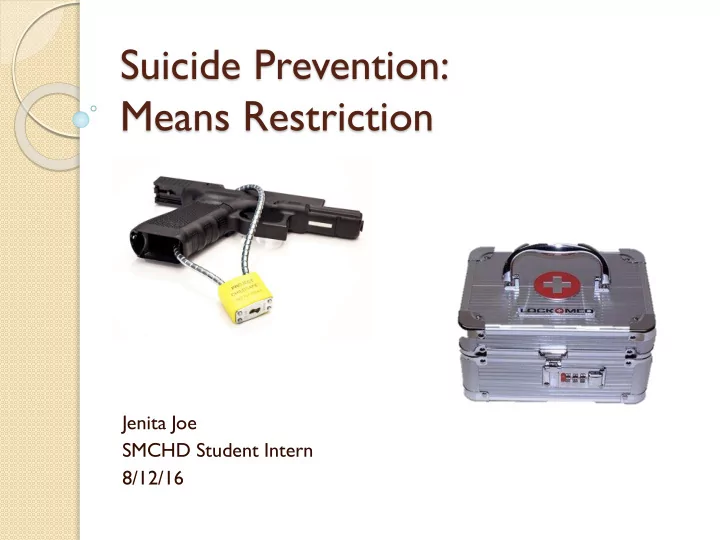
SLIDE 1 Suicide Prevention: Means Restriction
Jenita Joe SMCHD Student Intern 8/12/16
SLIDE 2 13 8 19 11 12 13
2 4 6 8 10 12 14 16 18 20 2010 2011 2012 2013 2014 2015
Deaths due to Suicide
Years Number
Suicides
Deaths due to Suicide among St. Mary's County Residents
SLIDE 3 Suicides by Means 2010-2015
2 4 6 8 10 12 2010 2011 2012 2013 2014 2015
Firearms Hanging, strangulation, suffocation Drugs/Alcohol Other
SLIDE 4 24.3% 16.1% 12.5% 27.0% 17.0% 13.4% 26.8% 15.9% 12.7%
0% 10% 20% 30% Felt sad or hopeless Seriously considered attempting suicide Made a suicide plan 2014 MD 2014 SMC 2013 SMC
YRBS MENTAL HEALTH DATA
SLIDE 5
What is Means Restriction?
Reducing a suicidal individual’s access to highly lethal and commonly used suicide methods
SLIDE 6
Why Means Restriction works?
1.
Many suicide attempts are short-lived.
1.
The method that people choose to commit suicide depends largely on its availability.
1.
The amount of suicide attempts that result in death depends on the lethality of the method.
2.
90% of attempters who survive a nonfatal attempt will not go on to die by suicide after.
SLIDE 7
Types of Means Restriction
Guns – gun locks, lock and store ammunition
separately
Overdose – medication take-back, lock meds Jumping – barriers at high bridges/places Carbon monoxide – catalytic converters Hanging/strangulation – avoid publicizing in
traditional and social media
Educating ED/UC, PCP, and mental health
treatment providers about Means Restriction counseling
SLIDE 8
Focus on Guns
Distributing Gun Locks and/or safety boxes to
lock up ammunition
Educating ED, UC, PCP, and mental health
treatment providers about Means Restriction
Educating families about suicide and Means
Restriction
SLIDE 9
Who can get involved?
Gun owners Gun shop owners Gun safety educators ED and UC clinicians and mental health
treatment providers
Families of suicidal individuals BHAT of HSMP Local law enforcement Military base command personnel
SLIDE 10
DISTRIBUTING GUN LOCKS AND/OR SAFETY BOXES TO LOCK UP AMMUNITION
SLIDE 11 Partnering with Gun Store Owners
Working with gun owner groups or gun store
- wners to incorporate means restriction
message in firearm safety class, brochures, and website.
Based on a program implemented in New
Hampshire
48% of gun shops participated in their campaign
SLIDE 12
Plan
Create material to distribute to gun
shops.
Ask owners their opinions about
materials.
Educate owners about the importance of
means restriction.
Return back to check if materials are
being displayed in stores.
Clarify that means restriction does NOT
equal gun control
SLIDE 13
Gun Lock Campaign
Providing gun locks to individuals that own guns
but do not have anything to lock them up with.
Based on a program in Montana in 2008 They purchased around 1,400 gun locks with
gun safety information on them
SLIDE 14
Plan
Start with a survey for gun owners to
understand the number of people that protect their guns
If needed, gun locks can be distributed
first internally
Advertise about the availability of gun
locks
Ask gun safety classes and gun owner
groups to distribute gun locks
Lastly, distribute gun locks at public events
SLIDE 15 Cable Gun Locks
What it is: A device that blocks the chamber to prevent a cartridge from being fired. How it works: Chamber locks are inserted in or through the magazine well or chamber, or are inserted through the gun barrel and chamber to block a cartridge from moving into position. A combination lock or key opens the lock. Features: Metal cylinders, vinyl covered wire cables, or other designs. Locks may be "universal" or may only fit certain guns Advantages:
Long cables may be threaded through several guns. Inexpensive
Disadvantages:
Thin cables could be cut
SLIDE 16
Labeling of Gun Locks
When gun locks are distributed they
should include Suicide helpline stickers
A 24/7 text line could also be developed
similar to a program in Wisconsin called HOPELINE.
Individuals can text in to receive
emotional help for any situation before it becomes a crisis
If developed the text line info could also
be included on gun locks
SLIDE 17
EDUCATING ED, UC, PCP , AND MENTAL HEALTH TREATMENT PROVIDERS ABOUT MEANS RESTRICTION
SLIDE 18
Educating Providers
Help emergency room staff and mental
health counselors implement counseling strategies to help individuals at risk of suicide and their families reduce access to lethal means
CALM trainings were first developed in
New Hampshire
SLIDE 19 CALM Trainings
Developed by Elaine Frank and Mark Ciocca
as a project of Harvard Injury Control Research Center.
Program includes:
- An overview of youth suicide data and lethal
means data
- an introduction into firearms
- a video presentation that models the counseling
strategies
- information on conducting a counseling session.
SLIDE 20
Plan
Schedule for a workshop to be conducted Plan out a possible place that can host the
workshop
Invite anyone who works with people in a
clinical/counseling situation such as health and mental health
Evaluate the effectiveness of the program
SLIDE 21
EDUCATING FAMILIES ABOUT SUICIDE AND MEANS RESTRICTION
SLIDE 22
Strategies
Train health care providers to give means
restriction counseling and info to families
Community-wide communications
campaign about suicide risks and helpline
Community-wide communications
campaign about means restriction (guns)
SLIDE 23
SLIDE 24
SLIDE 25
SLIDE 26
Key Points for Success
Stress that we are enforcing gun safety not
gun control
Present suicide prevention as a combination
message with safety
Practice how to deal with resistant
individuals
Law Enforcement must be key partners
SLIDE 27
Thoughts for Budget
Costs for a program coordinator $1.60 per gun lock (bulk order) through
Regal Industrial Sales (not including logos/stickers about suicide helpline)
$750 for one CALM workshop (not
including travel costs)
SLIDE 28
Questions