MBARC Model Based Amphibious Racing Challenge Student can be - - PowerPoint PPT Presentation

mbarc
SMART_READER_LITE
LIVE PREVIEW

MBARC Model Based Amphibious Racing Challenge Student can be - - PowerPoint PPT Presentation

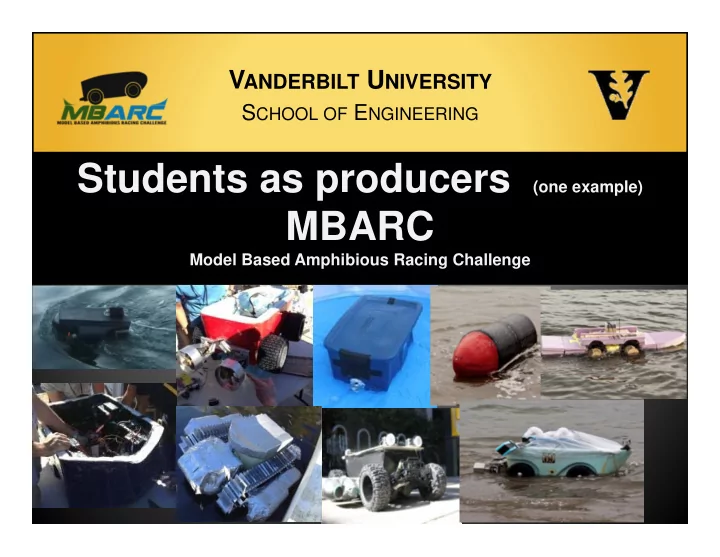
V ANDERBILT U NIVERSITY S CHOOL OF E NGINEERING Students as producers (one example) MBARC Model Based Amphibious Racing Challenge Student can be producers MBARC (Model Based Amphibious Racing Challenge) Challenge to make the 1/5 th scale model


slide-1
SLIDE 1

VANDERBILT UNIVERSITY

SCHOOL OF ENGINEERING

Students as producers (one example) MBARC

Model Based Amphibious Racing Challenge
slide-2
SLIDE 2

V

ANDERBILT UNIVERSITY

Student can be producers

MBARC (Model‐Based Amphibious Racing Challenge) Challenge to make the 1/5th scale model based amphibious vehicle The culmination of the design competition matched the vehicle’s performance with the simulation and dynamics models of the vehicles. This was done at VU in the course ME210

slide-3
SLIDE 3

V

ANDERBILT UNIVERSITY

The focus of the course

the design, development, fabrication and validation of a 1:5th scale amphibious vehicle to meet a set of realistic design requirements.

(<20kg, 2MJ of Energy on board, <1m length, carry 20kg etc….)

  • Built a series of models in software to create an

amphibious vehicle with the design tools (that are under development )

  • Complete the complementary hardware

development and design (and re‐design) in one term

slide-4
SLIDE 4

V

ANDERBILT UNIVERSITY

THE CHALLENGE in general terms

  • Robust Training “to be an engineer” with all the things that can’t

classically be done in a classroom:

  • Rigid deadlines
  • logistical concerns
  • Solve several open ended challenges simultaneously
  • Student driven solution to a complex design problem
  • The student will need to be encouraged‐
  • Student leaders sometimes are reluctant to lead
  • Motivating students can be a tricky*
  • Set up problem so students have to solve a hard problems‐ often this is a

lot of work upfront to get things in place for a short time cycle

  • Bigger than any of the students had ever had
  • MUST ALLOW students to “fail” in early designs
slide-5
SLIDE 5

V

ANDERBILT UNIVERSITY

What I wanted this course to be:

  • Experience in using modern engineering design and modeling tools
  • Models needed to significantly IMPACT the design
  • Build complete vehicle Simulation in CAD, Modelica, Matlab

and , CyPhy ML

  • Complete Hardware product cycle
  • design, manufacture, assemble and validate their solution
  • Create an experimental testing protocol
  • Instrument and validate their design
  • REDESIGN – several times
  • Redesign is part of the design cycle
slide-6
SLIDE 6

V

ANDERBILT UNIVERSITY

Software Design tools process‐ briefly

The software tools Modeling library of sample components Challenge rules

slide-7
SLIDE 7

V

ANDERBILT UNIVERSITY

Team modeling and fabrication

slide-8
SLIDE 8

V

ANDERBILT UNIVERSITY

MBARC Prototype 1

Verification of Land and Water Powertrains

slide-9
SLIDE 9

V

ANDERBILT UNIVERSITY

MBARC Prototype 2

Complete Hull Integration

slide-10
SLIDE 10

V

ANDERBILT UNIVERSITY

MBARC Prototypes (across the schools)

Verification of Land and Water Powertrains

slide-11
SLIDE 11

V

ANDERBILT UNIVERSITY

MBARC Race Course

The Camp Pendleton Basin

L

Southern Camp Pendleton, just north

  • f San Diego

Site has significant

  • bstacles and

roughness for a 1/5th scale vehicle

slide-12
SLIDE 12

V

ANDERBILT UNIVERSITY

Ariel view of the amphibious Course

L 4 challenges were run: Sprints on both land and water‐ straight line trajectories that would be the more direct for the teams to model/ simulate And 2 challenges on an amphibious course: the first was 1.2km (6 lap) event and the final challenge was an endurance event Each lap was 200m – multiple laps were run for the amphibious trials

slide-13
SLIDE 13

V

ANDERBILT UNIVERSITY

MBARC Final Vehicle

slide-14
SLIDE 14

V

ANDERBILT UNIVERSITY

MBARC Final Vehicles

slide-15
SLIDE 15

V

ANDERBILT UNIVERSITY

Successes and Difficulties

Successes

  • Completed vehicles
  • Teams ran well during competition
  • Student fabrication

Difficulties

  • Reliability of the power train
  • Sealing of the hull
  • Getting high fidelity models
slide-16
SLIDE 16

V

ANDERBILT UNIVERSITY

My view of what that the students learned

  • Design can be a LOT of work ( *and perhaps fun)
  • Most liked the engineering challenges
  • All were all very good when then applied themselves
  • All significantly built up their personal design tools
  • Things became a lot more complex when one dove into the

details

  • We need to do this more in our courses
  • Good modeling is complex and difficult, but highly beneficial to

design

  • TEST EVERYTHING
  • learned to Verify/ validate your model with experiments
  • REDESIGN is a NEEDED part of design
  • The first design never fully works like you plan
  • We need to do this more
slide-17
SLIDE 17

V

ANDERBILT UNIVERSITY

Thanks for listening