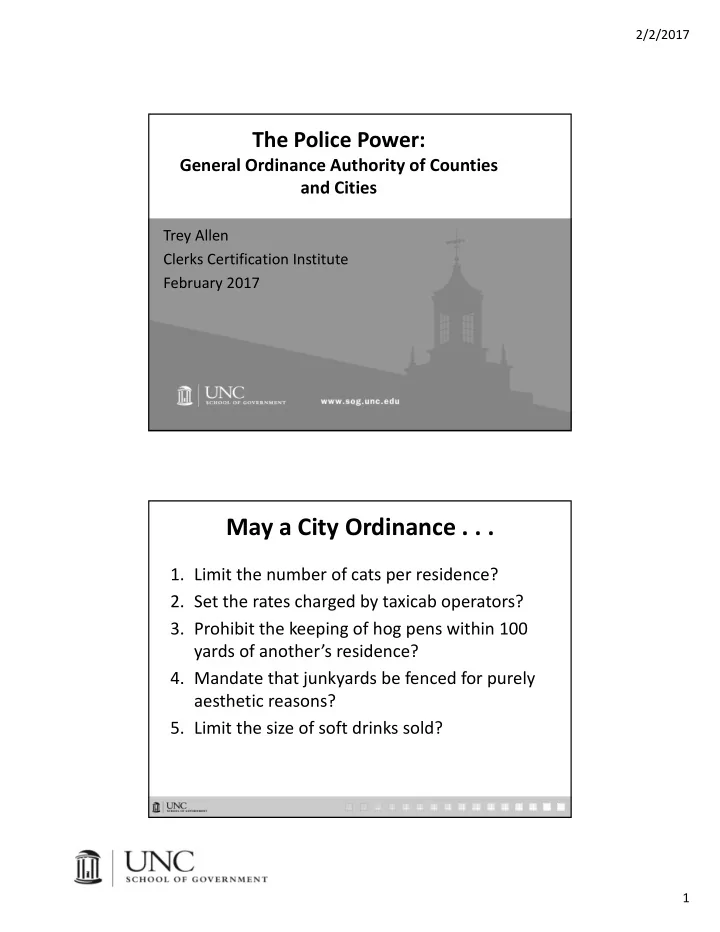
May a City Ordinance . . . 1. Limit the number of cats per residence? - - PDF document

may a city ordinance
SMART_READER_LITE
LIVE PREVIEW

May a City Ordinance . . . 1. Limit the number of cats per residence? - - PDF document

2/2/2017 The Police Power: General Ordinance Authority of Counties and Cities Trey Allen Clerks Certification Institute February 2017 May a City Ordinance . . . 1. Limit the number of cats per residence? 2. Set the rates charged by taxicab


slide-1
SLIDE 1

2/2/2017 1

The Police Power:

General Ordinance Authority of Counties and Cities

Trey Allen Clerks Certification Institute February 2017

May a City Ordinance . . .

  • 1. Limit the number of cats per residence?
  • 2. Set the rates charged by taxicab operators?
  • 3. Prohibit the keeping of hog pens within 100

yards of another’s residence?

  • 4. Mandate that junkyards be fenced for purely

aesthetic reasons?

  • 5. Limit the size of soft drinks sold?
slide-2
SLIDE 2

2/2/2017 2

  • I. “Police Power” Defined
  • “Police power” doesn’t

refer primarily to law enforcement.

  • Police power is a state’s

authority “to govern men and things within the limits

  • f its dominion.” Brown v.

Maryland, 25 U.S. (12 Wheat.) 419, 443 (1827).

  • Police power has two

main attributes:

– (1) “it aims directly to secure and promote the public welfare,” and – (2) “it does so by restraint and compulsion.” Ernst Freund, The Police Power, Public Policy and Constitutional Rights § 3 (1904).

slide-3
SLIDE 3

2/2/2017 3

  • II. Local Gov’t Police Power Statutes
  • General Assembly has delegated some of state’s

police power to counties and cities.

  • State law authorizes a county or city to “by
  • rdinance” define, regulate, prohibit, or abate

“acts, omissions, or conditions detrimental to the health, safety, or welfare of its citizens and the peace and dignity of the [city or county],and [to] define and abate nuisances.” G.S. 153A‐121, 160A‐174.

  • For local gov’ts, the police power =

general ordinance‐making authority.

  • Chapter 153A, Article 6 (police power
  • f counties)
  • Chapter 160A, Article 8 (police power
  • f cities)
slide-4
SLIDE 4

2/2/2017 4

We’re not talking about:

– Zoning Authority under Chapter 153A, Article 18,

  • r Chapter 160A, Article 19

– Minimum Housing Codes under Chapter 160A, Article 19 – Repair, Closing, Demolition of Nonresidential Structures under Chapter 153A, Article 18, or Chapter 160A, Article 19 – Nuisance Abatement Actions under Chapter 19, Article 1

slide-5
SLIDE 5

2/2/2017 5

  • Enumeration of powers in Chapter 153A,

Article 6 and 160A, Article 8 is not exclusive. G.S. 153A‐124, 160A‐177.

  • III. Scope of Police Power
  • Dillon’s Rule
slide-6
SLIDE 6

2/2/2017 6

  • G.S. 160A‐4: Provisions of Chapter 160A

and of city charters “shall be broadly construed and grants of power shall be construed to include any additional and supplemental powers . . . reasonably necessary or expedient to carry them into execution and effect.”

  • G.S. 153‐4 imposes nearly identical rule of

construction for Chapter 153A.

  • NC Supreme Court hasn’t uniformly applied G.S.

160A‐4 and 153A‐4 when evaluating lawfulness

  • f ordinances.
  • Unanswered question: Does broad construction

mandate apply to G.S. 153A‐121 and 160A‐174?

slide-7
SLIDE 7

2/2/2017 7

King v. Town of Chapel Hill, 743 S.E.2d 666 (2013)

  • Towing operator challenged Town’s towing and

mobile phone ordinances.

  • Supreme Court first ruled that 160A‐174

must be interpreted broadly.

  • Broadly construed, 160A‐174

encompasses power to require posted towing notices and acceptance of different methods of payment.

slide-8
SLIDE 8

2/2/2017 8

  • Broadly construed, 160A‐174 does not allow a

municipality to cap fees for non‐consensual towing from private lots.

– Express statutory authorization required.

  • State statutes limiting drivers’ mobile phones

preempted the Town’s mobile phone

  • rdinance.

Test for Valid Ordinance After King

  • Does the ordinance concern a plausible

risk to the public’s well‐being?

  • Are the ordinance’s specific requirements

reasonably calculated to mitigate or avoid that risk?

  • Is the ordinance preempted by higher

law?

slide-9
SLIDE 9

2/2/2017 9

  • King v. Town of Chapel Hill: The Supreme

Court Issues a Major Decision on the Police Power of Local Governments (Part 1)

  • King v. Town of Chapel Hill: The Supreme

Court Issues a Major Decision on the Police Power of Local Governments (Part 2)

  • IV. Exercising Police Power
  • What if another

statute regulates a matter that falls under G.S. 160A‐174

  • r 153A‐121?
slide-10
SLIDE 10

2/2/2017 10

  • Where do police power ordinances apply?
  • City Council unanimously adopts resolution

banning door‐to‐door solicitations between the hours of 9:00 p.m. and 6:00 a.m.

– Resolution exempts individuals going door‐to‐door to promote political or religious causes.

  • Valid exercise of police power conferred by G.S.

160A‐174?

slide-11
SLIDE 11

2/2/2017 11

  • V. Limits on Police Power

An ordinance is preempted if it:

  • Infringes a liberty protected by the N.C. or U.S. Constitution
  • Outlaws something lawful under higher law
  • Permits something unlawful under higher law
  • Regulates a subject that higher law expressly forbids the

local gov’t to regulate

  • Regulates a field subject to implied preemption
  • Defines and punishes an act already defined as a crime or

infraction under higher law

  • Craig v. Chatham

County (2002): Ordinance regulating large-scale hog farming

  • perations in Chatham

County was preempted by state’s comprehensive hog farm statutes and regulations.

slide-12
SLIDE 12

2/2/2017 12

  • VI. Enforcing Ordinances
  • G.S. 160A‐175 & 153A‐123
  • Criminal sanctions

– Ordinance violation = Class 3 misdemeanor unless governing board provides otherwise.

  • What if ordinance regulates operation or parking of

vehicles?

– Max fine of $500

  • $50 max penalty for infraction

– Where does the money go?

  • Civil penalty

– No statutory maximum, but constitutional limits – Where does the money go?

  • Each day’s continuing violation may be a

separate and distinct offense.

  • “[A]ppropriate” equitable remedy issued

by court

slide-13
SLIDE 13

2/2/2017 13

  • If unlawful condition or use of real property,

local gov’t may seek injunction or order of abatement from court.

  • Local government may use combination of

remedies to enforce ordinance unless

  • rdinance provides otherwise.
  • Liens may be available for cost of nuisance

abatement.

  • Ordinance Enforcement Basics

May a City Ordinance . . .

1. Limit the number of cats per residence?

  • Yes. State v. Maynard,

195 N.C. App. 757 (2009).

slide-14
SLIDE 14

2/2/2017 14

2. Set the rates charged by taxicab

  • perators?
  • NO under G.S. 160A‐

174.

  • YES under G.S. 160A‐

304(a).

3. Prohibit the keeping of small hog pens within 100 yards

  • f another’s

residence?

  • YES under State v.

Hord, 122 N.C. 1092 (1898).

  • What about G.S.

153A‐145.4 & 160A‐ 203.1?

slide-15
SLIDE 15

2/2/2017 15

4. Mandate that junkyard be fenced for purely aesthetic reasons?

  • MAYBE. State v.

Jones, 305 N.C. 520 (1982). 5. Limit the size

  • f soft drinks sold in

restaurants or convenience stores?

  • NO. G.S. 153A‐

145.2; 160A‐203.