Mathematical notions I Set Omitted Sequence and tuples Sequence: - - PowerPoint PPT Presentation

mathematical notions i
SMART_READER_LITE
LIVE PREVIEW

Mathematical notions I Set Omitted Sequence and tuples Sequence: - - PowerPoint PPT Presentation

Mathematical notions I Set Omitted Sequence and tuples Sequence: Objects in order (7 , 21 , 57) = (57 , 7 , 21) Repetition set : { 7 , 21 , 57 } = { 7 , 7 , 21 , 57 } sequences : (7 , 21 , 57) = (7 , 7 , 21 , 57) September 17, 2020 1


slide-1
SLIDE 1

Mathematical notions I

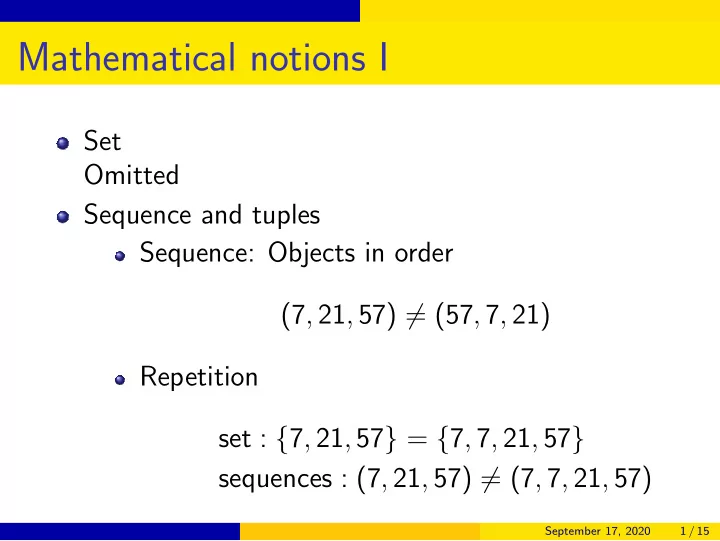
Set Omitted Sequence and tuples Sequence: Objects in order (7, 21, 57) = (57, 7, 21) Repetition set : {7, 21, 57} = {7, 7, 21, 57} sequences : (7, 21, 57) = (7, 7, 21, 57)

September 17, 2020 1 / 15
slide-2
SLIDE 2

Mathematical notions II

Tuples: finite sequence (7,21,57): 3-tuple Cartesian product: A = {1, 2}, B = {x, y} A × B = {(1, x), (1, y), (2, x), (2, y)} Function: single output Relation: scissors-paper-stone beats scissors paper stone scissors F T F paper F F T stone T F F

September 17, 2020 2 / 15

slide-3
SLIDE 3

Mathematical notions III

Equivalence relation

1

reflexive ∀x, xRx

2

symmetric xRy ⇔ yRx

3

transitive xRy, yRz ⇒ xRz e.g. “=”

September 17, 2020 3 / 15

slide-4
SLIDE 4

Mathematical notions IV

Example: i ≡7 j if 0 = i − j mod 7 i − i mod 7 = 0 i − j = 7a, j − i = −7a i − j = 7a, j − k = 7b ⇒ i − k = 7(a + b) Graph Undirected Directed

September 17, 2020 4 / 15

slide-5
SLIDE 5

Mathematical notions V

Nodes (vertices) Edges: connection between nodes Degree = # edges at a node Subgraph: G is subgraph of H if G is a graph node(G) ⊂ node(H) edge(G) = subset of edge(H) connecting node(G) In our example,

September 17, 2020 5 / 15

slide-6
SLIDE 6

Mathematical notions VI

is a subgraph, but is not Strings and languages alphabet: {0, 1} string: 1001 language: set of strings Boolean logic true and false

September 17, 2020 6 / 15

slide-7
SLIDE 7

Mathematical notions VII

0 (false) and 1 (true) 0 ∧ 0 = 0, 0 ∨ 0 = 0, ¬0 = 1 (negation

  • peration)

xor ⊗ 0 ⊗ 0 = 0 0 ⊗ 1 = 1 1 ⊗ 0 = 1 1 ⊗ 1 = 0 implication

September 17, 2020 7 / 15

slide-8
SLIDE 8

Mathematical notions VIII

P Q P → Q 1 1 1 1 1 1 1 Why P = 0, Q = 1, then P → Q = 1 Consider rainy → wet land If not rainy, saying rainy implies wet land is ok.

September 17, 2020 8 / 15

slide-9
SLIDE 9

Mathematical notions IX

P → Q ≡ ¬P ∨ Q P Q P → Q ¬P ¬P ∨ Q 1 1 1 1 1 1 1 1 1 1 1 1

September 17, 2020 9 / 15

slide-10
SLIDE 10

Proof I

Direct proof: A → B Proof by contradiction ¬B → ¬A P Q P → Q ¬Q ¬P ¬Q → ¬P 1 1 1 1 1 1 1 1 1 1 1 1 1 1

September 17, 2020 10 / 15

slide-11
SLIDE 11

Proof II

Example 1: Every graph ⇒ sum of degrees is even An example: # degrees = 1 + 2 + 1 = 4 Each edge: 2 nodes total # degrees = 2× # edges Example 2: √ 2 is irrational

September 17, 2020 11 / 15

slide-12
SLIDE 12

Proof III

The implication Definition of rational numbers ⇒ √ 2 is not rational That is, If a rational number is ... ⇒ √ 2 is not rational The opposite is If √ 2 is rational ⇒The rational number cannot be defined as ...

September 17, 2020 12 / 15

slide-13
SLIDE 13

Proof IV

If √ 2 is rational √ 2 = m n and m, n have no common factor Then 2n2 = m2 Looks impossible. But how to write this formally? First we prove that m must be even. This is also proof by contradiction

September 17, 2020 13 / 15

slide-14
SLIDE 14

Proof V

If m is not even, m = 2k + 1. Then m2 = 4(k2 + k) + 1 is not even and m2 = 2n2 does not hold.

September 17, 2020 14 / 15

slide-15
SLIDE 15

Proof VI

Now suppose m is even m = 2k Then n2 = 2k2 By the same argument, n is even Thus m, n have a common factor 2 and there is a contradiction

September 17, 2020 15 / 15