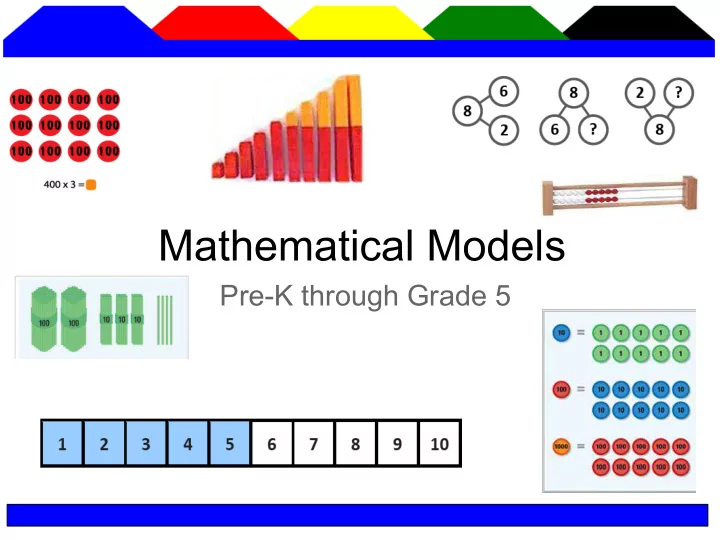
Mathematical Models Pre-K through Grade 5 1. Array and Area Model - - PowerPoint PPT Presentation

mathematical models
SMART_READER_LITE
LIVE PREVIEW

Mathematical Models Pre-K through Grade 5 1. Array and Area Model - - PowerPoint PPT Presentation

Mathematical Models Pre-K through Grade 5 1. Array and Area Model (Grades 1-5) An array or area model is an arrangement of a set of objects organized into equal groups in rows and columns. Arrays or area models help make counting easy in the


slide-1
SLIDE 1

Pre-K through Grade 5

Mathematical Models

slide-2
SLIDE 2
  • 1. Array and Area Model (Grades 1-5)

An array or area model is an arrangement of a set of objects

  • rganized into equal groups in rows and columns. Arrays or

area models help make counting easy in the lower grades. Counting by equal groups is more efficient than counting

  • bjects one by one. Later, children use arrays and area models

to learn about multiplication and area. Array and Area Model Video Connecting the Standard Algorithm for Multiplication to Area Models (grade 3,4,5)

slide-3
SLIDE 3
  • 2. Number Bond (Grades PK-5)

A number bond is a picture or visual way to see a number and the parts that can make up a number. Number bonds help children “see” addition as putting things together and subtractions as taking things apart. Number Bond Video Number Towers, Number Paths and Number Bonds: (Pre-K, K, 1st, 2nd grades)

slide-4
SLIDE 4
  • 3. Number Disks (Place Value Disks) (Grades 2-5)

Number disks are used to help students develop their understanding of place value. Number Disks Video (note this video is stored on Vimeo which is blocked on FCS network) Instructional Strategies for Place Value grades 2,3,4 featured on this video

slide-5
SLIDE 5
  • 4. Number Path (Grades PK-1)

The number path is used in K and 1st Grade math lessons to help children understand that each whole numbers represents one unit (one space, one number). Number Tower Video Number Towers, Number Paths and Number Bonds: (Pre-K, K, 1st)

slide-6
SLIDE 6
  • 5. Number Tower (Grades PK-3)

Number towers help children see the concept of “one more” and “one less”. Number Tower Video Number Towers, Number Paths and Number Bonds: (Pre-K, K, 1st)

slide-7
SLIDE 7
  • 6. Place Value Bundle (Grades PK-2)

Place Value Bundles provide students with hands-on experience with place value and regrouping. Place value bundles video shows a 2nd grade example

slide-8
SLIDE 8
  • 7. Rekenrek (Grades PK-5)

The rekenrek helps kids build fluency with numbers by visualizing groups of 5 and 10. Rekenrek Video features a Georgia teacher explaining the use of a Rekenrek

slide-9
SLIDE 9
  • 8. Tape Diagram (Grades 1-5)

In the early grades, the tape diagram is used to help students visualize the numbers in their word problems. In the upper grades, tape diagrams are used to help students learn fractions and to prepare for algebra. Tape Diagram Video provides a grades 3-5 experience with tape diagrams

slide-10
SLIDE 10
  • 9. Ten Frame (PK-3)

In the lower grades, ten frames help children learn counting and place value. Ten frames teach children to add and subtract within 20 by recognizing patterns of 5 and 10. Ten Frame Video Shows the Progression of Addition and Subtraction through the use

  • f Ten Frames
slide-11
SLIDE 11

This Presentation in a condensed form along with other Parent Handbooks, Homework and Classwork Solutions, Sample Videos and other resources can be accessed on the Math Tutor site of the Floyd County Schools Homepage

www.floydboe.net