Massachusetts Partnership for Health Promotion and Chronic Disease - - PowerPoint PPT Presentation

massachusetts partnership for health promotion and
SMART_READER_LITE
LIVE PREVIEW

Massachusetts Partnership for Health Promotion and Chronic Disease - - PowerPoint PPT Presentation

Massachusetts Partnership for Health Promotion and Chronic Disease Prevention Achieving Health Equity through Community-Clinical Linkages January 16, 2014 Partnership Goals Prevent 20,000 heart attacks and strokes (10% reduction in heart

slide-1
SLIDE 1

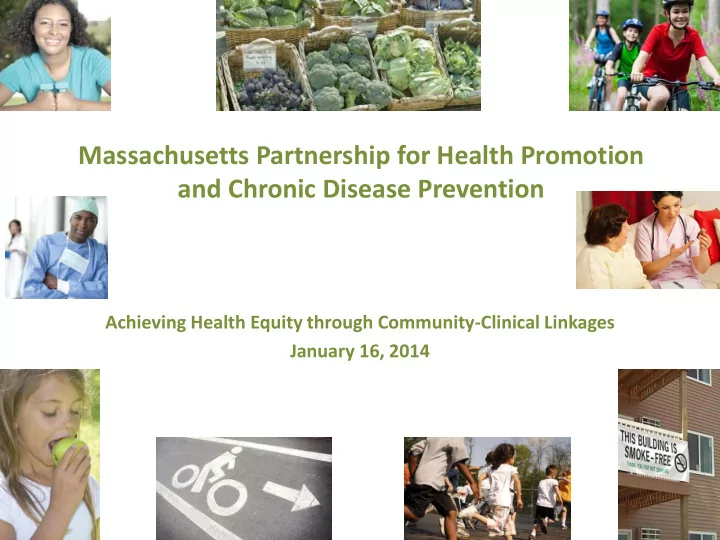
Massachusetts Partnership for Health Promotion and Chronic Disease Prevention

Achieving Health Equity through Community-Clinical Linkages January 16, 2014

slide-2
SLIDE 2

Partnership Goals

  • Prevent 20,000 heart attacks and strokes (10% reduction in heart attack

and strokes by 2017)

  • Prevent 1,500 diabetes-related hospitalizations (1% decrease in diabetes

related hospitalizations by 2017)

  • Prevent 800 cancer deaths (6% decrease in cancer deaths by 2017)
  • Prevent 1,000 asthma-related hospitalizations (1.5% decrease in asthma-

related hospitalizations by 2017)

  • Decrease obesity among Massachusetts youth and adults by 5% by 2017
  • Engage an additional 34,000 adults with arthritis in the recommended

amount of physical activity (5% increase in adults with arthritis that are getting the recommended physical activity by 2017)

slide-3
SLIDE 3

Leadership Team

CoP Representatives

James Buszkiewecz, MDPH Joanne Calista, Central MA AHEC Kathy Cunningham, BPHC Heather Drake, MassDOT/SRTS Patti Henley, MDPH Phyllis Kaplan, MassPRO Steve Winslow, Mass in Motion Gloucester

At-large Members

Robyn Alie, Mass Medical Society Rick Buckley, MassPRO Carol Girard, MDPH Lea Susan Ojamaa, MDPH Ruth Palombo, Tufts Health Plan Foundation Annette Peele, EOEA Allyson Perron, AHA/ASA

Staff Support

Jennica Allen Peggy Kocoras Jean Zotter

slide-4
SLIDE 4

Communities of Practice

Healthy Eating

Ruth Walsh, Tufts Health Plan and Cynthia Bayerl, MDPH

Physical Activity

Marybeth Allen, Tufts Health Plan and Chris Nordstrom, MDPH

Built Environment

David Watson, MassBIKE and Ben Wood, MDPH

Tobacco-Free Living

Chris Banthin, Public Health Advocacy Institute and Esmirna Damaso, MDPH

Clinical Preventive Services and Population Health Management

Phyllis Kaplan, MassPRO and Patricia Daly, MDPH

Community and Healthcare Linkages

Joanne Calista, Central MA AHEC and Gail Hirsch, MDPH

Improved Access to State and Local Data

Joshua Nyambose, MDPH

slide-5
SLIDE 5

Prevention and Wellness Trust Fund

  • Established under MGL Chapter 224
  • How funds are allocated:

– $57 million in trust for 4 years – No requirement for spending equal amounts annually – At least 75% must be spent on grantee awards – No more than 10% on worksite wellness programs – No more than 15% on administration through MDPH

slide-6
SLIDE 6

Outcome Measures Defined by Chapter 224

  • Reduction in prevalence of preventable health conditions
  • Reduction in health care costs and/or growth in health care

cost trends

  • Beneficiaries from the health care cost reduction
  • Employee health, productivity and recidivism through

workplace-based wellness or health management programs

  • Outcomes in 4 years or less
slide-7
SLIDE 7

Health Conditions Addressed

slide-8
SLIDE 8

Interventions

Priority and Optional conditions proposed must include interventions in each of 3 domains:

  • Community – Supports behavioral change to improve health through

individual, social and physical environments where people live and work

  • Clinical – Improves clinical environment – delivery and access
  • Community-Clinical Linkages – Strengthens connection between

community-based services and healthcare providers

slide-9
SLIDE 9

Massachusetts Partnership for Health Promotion and Chronic Disease Prevention

Activating Community Healthcare Linkages CHWs: Synergies and Opportunities

Joanne L. Calista Central MA AHEC, Inc.

slide-10
SLIDE 10

The Accomplishments of the CHL CoP

Identified 3 Models of Practice

– The Engagement and Utilization of CHWs – The Utilization of Evidence Based Practices – The Utilization of Mobile Health/ Community Based Care

Impact

Prevention and Wellness Trust Fund: Model for the U.S. Core Component: Community Healthcare Linkages Includes CHWs as well as Mobile/ VNA Practices Incorporation of 3 Models of Practice CHWs—Pediatric Asthma Evidence based programs-Geriatric Falls Prevention/Hypertension

slide-11
SLIDE 11

Interventions

Priority and Optional conditions proposed must include interventions in each of 3 domains:

  • Community – Supports behavioral change to improve health through

individual, social and physical environments where people live and work

  • Clinical – Improves clinical environment – delivery and access
  • Community-Clinical Linkages – Strengthens connection between

community-based services and healthcare providers

slide-12
SLIDE 12

Community and Healthcare Linkages

  • Surge in National Attention

– Agency for Healthcare Quality and Research (AHRQ) – Centers for Disease Control and Prevention (CDC)

  • Core Element>>>CHWs
  • Emerging ROI Evidence
slide-13
SLIDE 13

Community Healthcare Linkages CoP: Sharpening Our Focus/ Broadening Our Partnerships

  • Workforce Sustainability
  • Further Integration of CHW Efforts with:

– ACA – MA HCR – MA Payment Reform *chapter 224” – Triple Aim and….

  • CMS Ruling
slide-14
SLIDE 14

MA History: Collaboration, Leadership, and Identification of Opportunities

  • MA Department of Public Health
  • Tenacious Leadership, 2005 Study, Support of CHW

Professional Association

  • MACHW: Importance of a CHW Professional

Organization/ Network

  • Allies: Legislators, Training Entities, Payers…
slide-15
SLIDE 15

Section 110 of the Health Care Reform Law of 2006: Legislative Mandate to MDPH

  • Conduct investigation of the CHW workforce:
  • Use and funding of CHWs
  • CHW role in increasing access to health care
  • CHW role in eliminating health disparities
  • Convene a statewide CHW Advisory Council
  • Inform the investigation & interpret the findings
  • Develop recommendations for a sustainable CHW program in MA,

including training, certification and financing

  • Submit a report of the findings and recommendations to the Legislature

Source: Gail Hirsch and Stephanie Anthony: Raising Awareness and Making Change through Public- Private Partnerships: Lessons Learned from a Statewide Community Health Worker Advisory Council in Massachusetts 10/4/09.

15

Section 110 of the Health Care Reform Law of 2006: Legislative Mandate to MDPH

slide-16
SLIDE 16

Strengthen Workforce Development: Training and Certification

  • Stabilize current funding for training of CHWs and

CHW supervisors;

  • Expand statewide access to training;
  • Establish a Board of Certification of CHWs.

Source: Gail Hirsch and Stephanie Anthony: Raising Awareness and Making Change through Public-Private Partnerships: Lessons Learned from a Statewide Community Health Worker Advisory Council in Massachusetts 10/4/09.

16

Advisory Council Recommendations

slide-17
SLIDE 17

Chapter 322, Acts of 2010

  • Resulted from CHW Advisory Committee policy

recommendations

  • Intent: address provider, payer, and CHW needs for workforce

standards

  • 11 members, appointed by governor
  • Chaired by DPH commissioner or designee
  • MACHW nominates 4 members
  • Also reps from CHW training, health plans, CHCs, employers,

MPHA, public

  • Statewide geographic representation

Geoff Wilkinson, Senior Policy Advisor to the Commissioners, MDPH, 5/1/12

Chapter 322, Acts of 2010

slide-18
SLIDE 18

Chapter 322, Acts of 2010: Summary

(continued)

§108 establishes the board’s powers and duties, some

  • f which include:
  • to develop and administer a certification program and establish the

education, training and qualifications for certification, the application requirements and standards of practice;

  • to set standards to approve CHW education and training programs;
  • to set continuing education standards and requirements for biennial

renewal of CHW certificates;

  • to establish minimum qualifications for CHW trainers;
  • to develop methods of evaluating CHW qualifications;

(“Grandparenting”).

Source: Gail Hirsch, Director, Office of Community Health Workers, MDPH: Summary of the Chapter 322, Acts of 2010 (2011).

Chapter 322, Acts of 2010

slide-19
SLIDE 19

Chapter 322, Acts of 2010: Summary

(continued)

to establish procedures to review applications for certification,

including renewals;

  • to adopt, amend and enforce relevant rules and regulations;
  • to collect fees and create a trust fund;
  • to develop means to assess CHW competency;
  • to establish tiered levels of certification;
  • to certify CHWs already certified in other states; (reciprocity)
  • to establish grounds for complaints; to establish disciplinary

actions;

  • to develop rules for the mandatory certification of CHWs,

effective five years after the board’s inception.

Source: Gail Hirsch, Director, Office of Community Health Workers, MDPH: Summary

  • f the Chapter 322, Acts of 2010 (2011).

Chapter 322, Acts of 2010 (cont’d)

slide-20
SLIDE 20

Board of Certification of CHWs

  • Review of the Field
  • Created the CHW Advisory Workgroup
  • Review and Determination of Core Competencies
  • Determination of Hours of Training
  • Development of a CHW Code of Ethics
  • Design of “Grandparenting” Parameters

– Pathways to Certification

  • Next Steps

– Draft Regulations to Legal Counsel – Public Comment – Revisions…

Board of Certification of CHWS

slide-21
SLIDE 21

The Centers for Medicare and Medicaid Services Rule

CMS created a new rule which allows state Medicaid agencies to reimburse for preventive services provided by professionals that may fall outside of a state's clinical licensure system, as long as the services have been initially recommended by a physician or

  • ther licensed practitioner. The new rule for the first time offers

state Medicaid agencies the option to reimburse for more community-based preventive services, including those of CHWs. The rule went effect on January 1, 2014.

Source: Adapted from: http://www.nhlbi.nih.gov/health/healthdisp

slide-22
SLIDE 22

The Centers for Medicare and Medicaid Services Rule

"(c) Preventive services means services recommended by a physician or other licensed practitioner of the healing arts acting within the scope of authorized practice under State law to…

  • 1. Prevent disease, disability, and other health conditions or their

progression;

  • 2. Prolong life; and
  • 3. Promote physical and mental health and efficiency."

Centers for Medicare & Medicaid Services. 78 Fed Reg 42160 (July 15, 2013). Section is, "a. Diagnostic, Screening, Preventive, and Rehabilitative Services (Preventive Services) (§ 440.130)" (paragraph citation: 78 FR 42226)

slide-23
SLIDE 23

The Centers for Medicare and Medicaid Services Rule

State must file Medicaid State Plan Amendment (in a few states this requires legislative authorization) Must specify what non-licensed occupations are covered and qualifications (skill requirements) – not necessarily certification Must specify what services will be paid for (CPT codes)

slide-24
SLIDE 24

The Centers for Medicare and Medicaid Services Rule

Opportunity to provide stability and funding mechanism to CHW Workforce Receiving significant attention on a national level. Like other Massachusetts CHW initiatives—should be CHW driven and proceed systematically.

slide-25
SLIDE 25

Massachusetts Partnership for Health Promotion and Chronic Disease Prevention Community and Healthcare Linkages CoP Meeting:

1:00 February 13, 2014 @ MDPH For more information contact: Joanne L. Calista jlcalista@cmahec.org.