Marylands Commitment to Breastfeeding Begin with an end in mind - - PowerPoint PPT Presentation

maryland s commitment to breastfeeding
SMART_READER_LITE
LIVE PREVIEW

Marylands Commitment to Breastfeeding Begin with an end in mind - - PowerPoint PPT Presentation

Marylands Commitment to Breastfeeding Begin with an end in mind 1 Breastfeeding is a public health priority: Given the documented short and long-term medical and neurodevelopmental advantages of breastfeeding, infant nutrition


slide-1
SLIDE 1

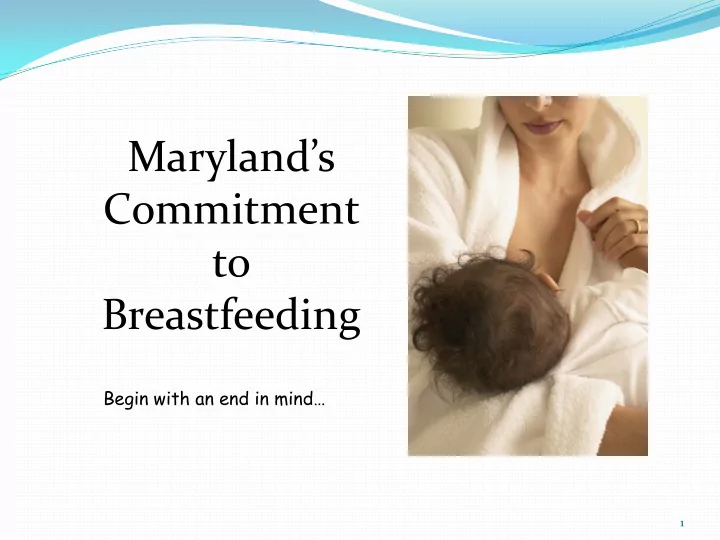
Maryland’s Commitment to Breastfeeding

Begin with an end in mind…

1
slide-2
SLIDE 2

“For nearly all babies, breastfeeding is the best source of infant nutrition and Immunologic protection…” (Regina Benjamin, U.S. Surgeon General)

2

“Given the documented short and long-term medical and neurodevelopmental advantages of breastfeeding, infant nutrition should be considered a public health issue and not only a lifestyle choice.” – American Academy of Pediatrics, 2012

Breastfeeding is a public health priority:

slide-3
SLIDE 3

3 Breastfeeding Physical activity Genetics Child care, school, worksite, health care environments Economic Factors Education Built Environment

? ?

Breastfeeding helps protect against childhood

  • besity.

A baby's risk of becoming an overweight child goes down with each month

  • f breastfeeding.

Healthy food access Marketing Pricing strategies

Obesity is associated with many factors….some known, some unknown

slide-4
SLIDE 4

Childhood

  • besity is an

epidemic.

In the US, 1 preschooler in 5 is at least

  • verweight, and

half of these are

  • bese.

4

slide-5
SLIDE 5

Obesity and overweight in Maryland, 2010

  • 32% of low-income

children ages 2-4 are

  • verweight or obese
  • 28% of high school

youth report being

  • verweight or obese
  • 66% of Maryland

adults report being

  • verweight or obese

5

Prevalence of Obesity* among Children aged 2-4 Years, by County, 2010

slide-6
SLIDE 6

How might breastfeeding protect against

  • verweight?
  • Breastfeeding mothers may choose a healthier lifestyle, including

diet and exercise.

  • Endocrine response in formula-fed infants may result in higher

insulin levels leading to increased deposition of fat tissue.

  • Infants fed at the breast control the amount of milk they consume –

learn to better recognize hunger and satiety cues

  • More research is needed….

Data source: Research to Practice Series, No. 4, July 2007, National Center for Chronic Disease Prevention and Health Promotion, CDC

6

slide-7
SLIDE 7

A snapshot of breastfeeding in Maryland

7

slide-8
SLIDE 8

Maryland’s Breastfeeding Report Card, 2011

Categories of Infant Feeding Healthy People 2020 Breastfeeding Objectives 2011 CDC Breastfeeding Report Card Maryland Rates Ever Breastfed 81.9% 78.5% Breastfed at 6 months 60.6% 45.2% Breastfed at 1 year 34.1% 27.0% Exclusively breastfed at 3 months 46.2% 32.0% Exclusively breastfed at 6 months 25.5% 13.1% Reduced percent of breastfed newborns receiving formula supplementation in first two days of life (goal) 14.2% 30.9% 8

http://www.cdc.gov/breastfeeding/pdf/2011breastfeedingreportcard.pdf http://www.usbreastfeeding.org

slide-9
SLIDE 9

Maryland PRAMS Report: 2010 Births

9

slide-10
SLIDE 10

19 26 11 34 23 24 12 11 11 30 12

Characteristics of the 19% of Mothers Who Reported Never Breastfeeding, Maryland, 2010

*Includes only mothers ages 20 and above. Note: Percentages are not reported if the number of respondents was less than five. Data Source: Maryland PRAMS

Race/ethnicity Age Years of education*

10

slide-11
SLIDE 11
  • Mothers and families
  • Communities
  • Health care providers and

facilities

  • Employers
  • Public health leadership
  • Researchers

11

slide-12
SLIDE 12

Maryland’s First Steps

12

slide-13
SLIDE 13

2010 Legislation

  • Maryland License to Breastfeed
  • Maryland was the first state to allow tax exemption

for supplies that may be used by nursing mothers.

13

slide-14
SLIDE 14

Programming: WIC Breastfeeding Support

  • Established breastfeeding coordinators at the

state and local levels

  • Loving Support Peer Counseling Program

established in 2004

  • Employs 20 International Board Certified

Lactation Consultants.

  • WIC breastfeeding incidence rates in Maryland:
  • April 1995 – 32.6%
  • April 2004 – 51.5%
  • April 2012 - 63.9%

14

slide-15
SLIDE 15

Collaboration with Maryland State Department of Education for breastfeeding support in child care settings

  • Implement infant feeding standards
  • Allow infant to stop feeding on cue
  • Hold infants while bottle feeding
  • Introduce age appropriate solid foods
  • Serve breast milk to at least 12 months
  • Professional Development and Training
  • Preparing, feeding, storing human milk
  • Ensure on-site accommodations
  • Designated place for breastfeeding
  • Source: “Preventing Childhood Obesity in Early Care and Education Programs”
  • http://nrckids.org/CFOC3/PDFVersion/preventing_obesity.pdf

15

slide-16
SLIDE 16

Promoting breastfeeding resources to employers

  • Healthiest Maryland Businesses Website
  • Worksite wellness training events and forums

http://dhmh.maryland.gov/healthiest/SitePages/Home.aspx

16

slide-17
SLIDE 17

Maryland State Workplace Wellness Campaign

Goal: Develop a supportive environment for breastfeeding. Action: The state will establish a model support for breastfeeding policy and track the number of state worksites that adopt it.

17

slide-18
SLIDE 18

18

Nearly all births in the United States

  • ccur in hospital settings…
slide-19
SLIDE 19

More breastfeeding support in Maryland birthing facilities is needed

“ Improvement is needed in maternity care practices and policies in Maryland.” “Many opportunities exist to protect, promote, and support breastfeeding mothers and infants in Maryland.”

Maternity Practices in Infant Nutrition and Care In Maryland —2009 mPINC Survey

19

slide-20
SLIDE 20

20

Maryland Hospital Breastfeeding Policy Recommendations

slide-21
SLIDE 21

Development of a Model Breastfeeding Policy: A Collaborative Process

21

August 2011: DHMH workgroup formed and reviewed hospital policies in Maryland and other states December 2011: Stakeholder’s meeting held January 2012: Draft recommendations created February 2012: Draft recommendations posted on the DHMH website for public comment

  • Over 130 comments were received and evaluated
  • Subsequent draft policy created

Next steps: Second draft of breastfeeding policy recommendations will be posted again for comment and review.

slide-22
SLIDE 22

22

Thank you.