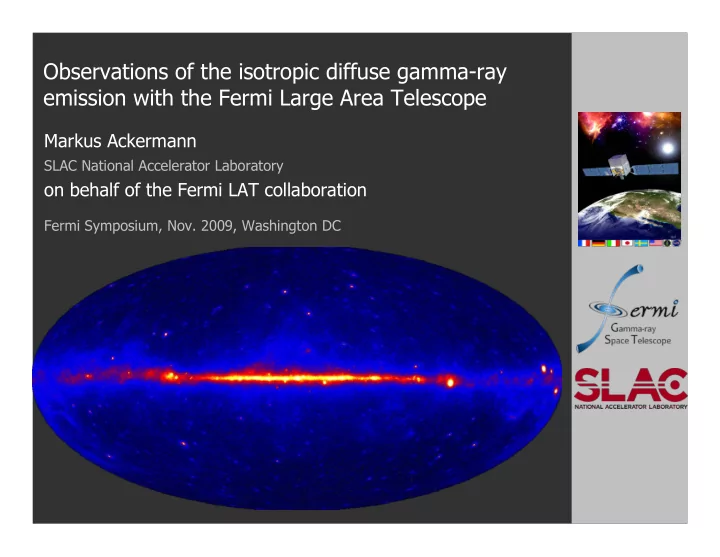
SLIDE 1 Observations of the isotropic diffuse gamma-ray emission with the Fermi Large Area Telescope
Markus Ackermann
SLAC National Accelerator Laboratory
- n behalf of the Fermi LAT collaboration
Fermi Symposium, Nov. 2009, Washington DC
SLIDE 2 Fermi Symposium, 11/02/09-11/05/09 ● Markus Ackermann for the LAT collaboration ● 2
Main contributions to the Fermi gamma-ray sky
LAT (E>100 MeV) 9 month observation
Inverse Compton π0-decay Bremsstrahlung
Galactic diffuse emission
(CR interactions with the interstellar medium)
Resolved sources Isotropic diffuse emission
cosmic rays surviving background rejection filters
γ-rays from the earth albedo
SLIDE 3 Fermi Symposium, 11/02/09-11/05/09 ● Markus Ackermann for the LAT collaboration ● 3
Potential contributions to the isotropic diffuse continuum gamma-ray emission in the LAT energy range (100 MeV-300 GeV):
unresolved point sources
- Active galactic nuclei (see talk by M. Ajello)
- Star-forming galaxies
- Gamma-ray bursts
diffuse emission processes
- UHE cosmic-ray interactions with the
Extragalactic Background Light
- Structure formation
- large Galactic electron halo
- WIMP annihilation
The isotropic diffuse gamma-ray emission
Isotropic diffuse flux contribution
from unresolved sources depends on LAT point source sensitivity Contribution expected to decrease with LAT observation time
Incomplete collection of model predictions (Dermer, 2007)
SLIDE 4 Fermi Symposium, 11/02/09-11/05/09 ● Markus Ackermann for the LAT collaboration ● 4
Cosmic-ray background
Primary cosmic-rays + secondary CR produced in earth atmosphere
Charged and neutral cosmic-rays
gamma-rays by many orders of magnitude
CR contamination strongly suppressed by Anti-coincidence detector (ACD) veto and multivariate analysis of event properties
Residual CR produce unstructured, quasi-isotropic background (after sufficient observation
time) primary protons alpha + heavy ion
- sec. protons
- sec. positrons
- sec. electrons
albedo-gammas
SLIDE 5 Fermi Symposium, 11/02/09-11/05/09 ● Markus Ackermann for the LAT collaboration ● 5
Data selection for the analysis of the isotropic flux
3 event classes defined in standard LAT
event selection
LAT isotropic flux expected to be below
EGRET level (factor »10 improvement in point source sensitivity)
LAT on-orbit background higher than
predicted from pre-launch model
More stringent background rejection
developed for this analysis
Event parameters used:
- Shower shape in Calorimeter
- Charge deposit in Silicon tracker
- Gamma-ray probability from classification
analysis
- Distance of particle track from LAT corners
LAT standard event classes:
Event class Background contamination transient <~ 100 x EGRET EGB flux source <~ 20 x EGRET EGB flux diffuse <~ 1 x EGRET EGB flux
MC study
(Atwood et al. 2009)
SLIDE 6
Fermi Symposium, 11/02/09-11/05/09 ● Markus Ackermann for the LAT collaboration ● 6
Performance of the dedicated event selection
Improved residual
background suppression compared to diffuse class
Improved agreement
between simulation and data from rejection of hadronic shower and heavy ions Uncertainty: +50%/-30%
Retained effective area for
γ-rays simulation
SLIDE 7 Fermi Symposium, 11/02/09-11/05/09 ● Markus Ackermann for the LAT collaboration ● 7
Analysis technique
Pixel-by-pixel max. likelihood fit of |b|>10º sky
- equal-area pixels with ~ 0.8 deg2 (HEALPIX grid)
- sky-model compared to LAT data
- point source /diffuse intensities fitted simultaneously
- 9 independent energy bins, 200 MeV - 100 GeV
- 10 month of LAT data, 19 Ms observation time
Sky model:
- Maps of Galactic foreground γ-rays considering
individually contributions from IC and local HI
- Individual spectra of TS>200 (~>14σ) point sources
from LAT catalog
- Map of weak sources from LAT catalog
- Solar IC and Disk emission
- Spectrum of isotropic component
Subtraction of residual background (derived from
Monte Carlo simulation) from isotropic component
+ + =
LAT sky
point sources isotropic
SLIDE 8 Fermi Symposium, 11/02/09-11/05/09 ● Markus Ackermann for the LAT collaboration ● 8
Model of the Galactic foreground
Diffuse gamma-ray emission of Galaxy modeled using GALPROP Spectra of dominant high-latitude components fit to LAT data:
- Inverse Compton emission (isotropic ISRF approximation)
- Bremsstrahlung and π0-decay from CR interactions with local (7.5kpc < r < 9.5kpc)
atomic hydrogen (HI)
HI column density estimated from 21-cm observations and E(B-V) magnitudes of
reddening
4 kpc electron halo size for Inverse Compton component (2kpc - 10kpc tested)
γ-ray emission model HI (7.5kpc < r < 9.5kpc) γ-ray emission model Inverse Compton scattering
SLIDE 9
Fermi Symposium, 11/02/09-11/05/09 ● Markus Ackermann for the LAT collaboration ● 9
The LAT isotropic diffuse flux (200 MeV – 100 GeV)
|b| > 10º extragalactic diffuse CR background LAT
Spectrum can be fitted
by power law: γ = 2.41 +/- 0.05
Flux above 100 MeV:
F100 = 1.03 +/- 0.17 x 10⁻⁵ cm-2 s-1 sr-1
(extrapolated) Foreground modeling
uncertainty not included in error bands PRELIMINARY
SLIDE 10
Fermi Symposium, 11/02/09-11/05/09 ● Markus Ackermann for the LAT collaboration ● 10
Systematic uncertainties from foreground modeling
RMS of residual map (averaged over 13.4 deg2 bins) is 8.2%,
3.3 % expected from statistics
Residuals show some correlation to structures seen in the galactic foreground
emission Foreground model is not perfect.
Impact of foreground model variations on derived EGB intensity studied: Table items are NOT independent and cannot be added to provide overall
modeling uncertainty
Flux in band 200 MeV – 400 MeV 1.6 GeV - 3.2 GeV 51 GeV – 102 GeV Extragalactic 2.4 +/- 0.6 12.7 +/- 2.1 11.1 +/- 2.9 HI column density +0.1 / -0.3 +0.1 / -3.6 +0.1 / -1.1 Halo size + IC +0.1 / -0.3 +0.1 / -1.8 +2.9 / -0.5 CR propagation model +0.1 / -0.3 +0.1 / -0.8 +3.0 / -0.1 Subregions of |b|>10 +0.2 / -0.3 +1.9 / -2.1 +2.7 / -0.9
x 10-6 cm-2 s-1 sr-1 x 10⁻⁸ cm-2 s-1 sr-1 x 10⁻¹⁰ cm-2 s-1 sr-1
SLIDE 11
Fermi Symposium, 11/02/09-11/05/09 ● Markus Ackermann for the LAT collaboration ● 11
Comparison with EGRET results
Considerably steeper
than the EGRET spectrum by Sreekumar et al.
No spectral features
around a few GeV seen in re-analysis by Strong et al.
2004
Flux, E>100 MeV spectral index LAT (this analysis) 1.03 +/- 0.17 2.41 +/- 0.05 EGRET (Sreekumar et al., 1998) 1.45 +/- 0.05 2.13 +/- 0.03 EGRET (Strong et al. 2004) 1.11 +/- 0.10 LAT + resolved sources below EGRET sensitivity 1.19 +/- 0.18 2.37 +/- 0.05
x 10-5 cm-2 s-1 sr-1
PRELIMINARY
SLIDE 12
Fermi Symposium, 11/02/09-11/05/09 ● Markus Ackermann for the LAT collaboration ● 12
Summary
A new low-background data selection was developed to obtain a measurement of
the EGB. This data selection will be made public with the next update of the Fermi event classification.
The EGB found by the LAT is compatible with a simple power law of index
2.41+/-0.05 between 200 MeV and 100 GeV.
It is softer than the EGRET spectrum and does not show distinctive peaks
(compared at EGRET sensitivity level).
~ 15% of the EGRET EGB is resolved into sources by the LAT. From Blazar population study: ~20%-30% of LAT EGB is due to unresolved
Blazars (see M. Ajello’s talk).
Ongoing work to extend the energy range and reduce systematic uncertainties of
this measurement.
SLIDE 13
Fermi Symposium, 11/02/09-11/05/09 ● Markus Ackermann for the LAT collaboration ● 13
SLIDE 14
Fermi Symposium, 11/02/09-11/05/09 ● Markus Ackermann for the LAT collaboration ● 14
Cosmic Ray background in data and simulation
Sample A: events classified as γ-rays by on-board filters, |b|>45 deg Sample B: events accepted in medium purity (“source”), but rejected in high
purity (“diffuse”) standard event class, |b|>45 deg Both samples are strongly dominated by CR background !
Sample A bulk of the CR background Sample B extreme tails of CR distribution which mimic γ-rays
+ shower shape and charge deposit cuts Tails of the CR distribution agree within +50%/- 30% uncertainty of the CR background for this analysis
SLIDE 15 Fermi Symposium, 11/02/09-11/05/09 ● Markus Ackermann for the LAT collaboration ● 15
Data selection for the analysis of the isotropic diffuse background
Example for improved background rejection: Transverse shower size in Calorimeter
- clean dataset (observations with high γ-ray flux, low CR flux)
- contaminated dataset (observations with low γ-ray flux, high CR flux)
- predicted distribution from LAT simulation
clean contaminated simulation
SLIDE 16
Fermi Symposium, 11/02/09-11/05/09 ● Markus Ackermann for the LAT collaboration ● 16
The Fermi Large Area Telescope
Energy range: 100 MeV – 300 GeV Peak effective area: > 8000 cm2
(standard event selection)
Field of view: 2.4 sr Point source sensitivity (>100 MeV):
3x10⁻⁹ cm-2 s-1
No consumables onboard LAT
Steady response over time expected
Standard operation in ‘sky survey’
mode allows almost flat exposure of the sky
LAT effective area for vertically incident γ-rays LAT exposure @ 3GeV (1-year sim.) 2.8 1010 cm2s 3.8 1010 cm2s