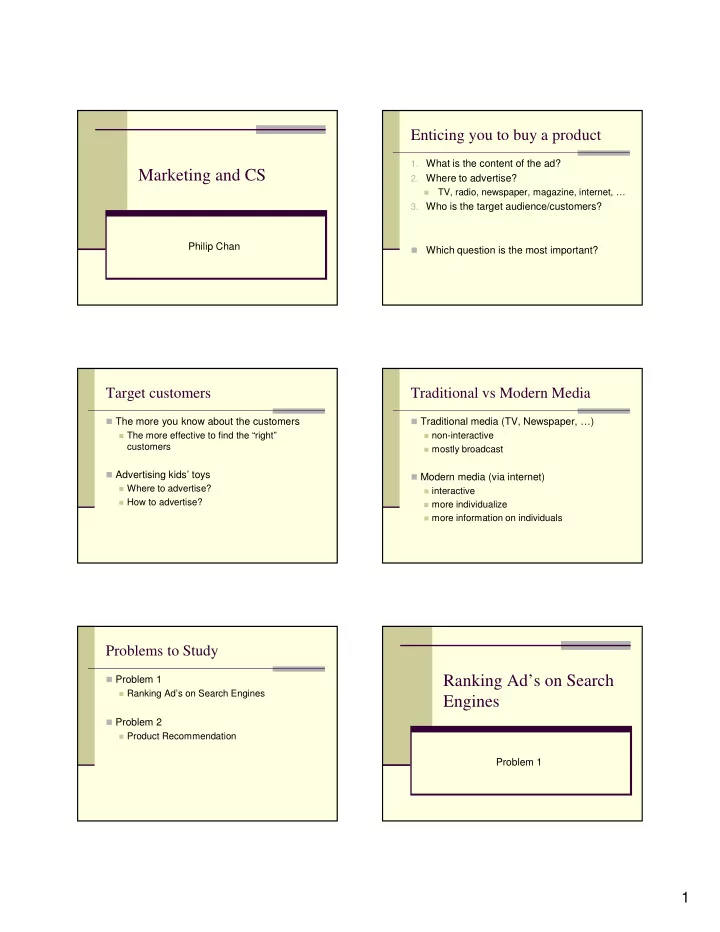
Marketing and CS 2. Where to advertise? TV, radio, newspaper, - - PDF document

marketing and cs
SMART_READER_LITE
LIVE PREVIEW

Marketing and CS 2. Where to advertise? TV, radio, newspaper, - - PDF document

Enticing you to buy a product 1. What is the content of the ad? Marketing and CS 2. Where to advertise? TV, radio, newspaper, magazine, internet, 3. Who is the target audience/customers? Philip Chan Which question is the most


slide-1
SLIDE 1

1

Marketing and CS

Philip Chan

Enticing you to buy a product

  • 1. What is the content of the ad?
  • 2. Where to advertise?
  • TV, radio, newspaper, magazine, internet, …
  • 3. Who is the target audience/customers?
  • Which question is the most important?

Target customers

The more you know about the customers

The more effective to find the “right”

customers Advertising kids’ toys

Where to advertise? How to advertise?

Traditional vs Modern Media

Traditional media (TV, Newspaper, …)

non-interactive mostly broadcast

Modern media (via internet)

interactive more individualize more information on individuals

Problems to Study

Problem 1

Ranking Ad’s on Search Engines

Problem 2

Product Recommendation

Ranking Ad’s on Search Engines

Problem 1

slide-2
SLIDE 2

2 Advertising on Search Engines

User

Query

Advertiser

Ad Keyword

for triggering the ad to be considered

Bid on a keyword

How much it’s willing to pay

https://adwords.google.com/select/KeywordToolExternal?defaultView=3

Search Engine

Score and rank ad’s to display Advertiser pays only when its ad is clicked

Factors affecting the score

Advertiser’s bid

Highest bidder wins (auction) Is that sufficient?

Factors affecting the score

Advertiser’s bid

Highest bidder wins (auction) Is that sufficient? Bigger companies have deeper pocket… What if the ad is not relevant?

Bid on keywords that are very popular

e.g. “ipod” but selling furniture What if the ad/company/product is not “well

received”?

Importance of audience/customer

If the ad is not relevant

The users don’t click Doesn’t matter how high the advertiser bids

Importance of audience/customer

If the ad is not relevant

The users don’t click Doesn’t matter how high the advertiser bids

Displaying ad’s relevant to users is important

Advertisers get more visits/revenue Search engines get more revenue User experience is better

Problem Formulation

Given (Input)

Ad Keyword Bid Query (part of the algorithm is to decide other

factors) Find (Output)

Score of Ad

slide-3
SLIDE 3

3 Ad Rank score [Google AdWords]

Cost Per Click (CPC) bid Quality Score

  • https://support.google.com/adwords/answer/1722122

Quality Score [Google AdWords]

Ad’s relevance Keyword relevance Landing page experience

Quality Score [Google AdWords]

  • Clickthrough Rate (CTR) of ad via that keyword [clicks / displays]
  • CTR of display URL (URL in the ad)
  • CTR of other ad’s of the advertiser

Quality Score [Google AdWords]

  • Clickthrough Rate (CTR) of ad via that keyword [clicks / displays]
  • CTR of display URL (URL in the ad)
  • CTR of other ad’s of the advertiser
  • Relevance of keyword to ad
  • Relevance of keyword to query

Quality Score [Google AdWords]

  • Clickthrough Rate (CTR) of ad via that keyword [clicks / displays]
  • CTR of display URL (URL in the ad)
  • CTR of other ad’s of the advertiser
  • Relevance of keyword to ad
  • Relevance of keyword to query
  • Usefulness and clarity of landing page
  • Relevance of landing page

Quality Score [Google AdWords]

  • Clickthrough Rate (CTR) of ad via that keyword [clicks / displays]
  • CTR of display URL (URL in the ad)
  • CTR of other ad’s of the advertiser
  • Relevance of keyword to ad
  • Relevance of keyword to query
  • Usefulness and clarity of landing page
  • Relevance of landing page
  • Advertiser’s performance in geographical location
  • Ad’s performance on a site
  • Ad’s performance on devices
  • Others
  • https://support.google.com/adwords/answer/2454010
  • https://support.google.com/adwords/answer/1659694
slide-4
SLIDE 4

4 Weighted Linear Sum

Score = w1x1 + w2x2 + w3x3 + ... + wnxn

Product Recommendation

Problem 2

Product Recommendation

Shopping sites: amazon, netflix, … To sell more products

Recommend products the customers might

buy

Can you read minds?

“Can you read minds?” (amazon.com

recruitment T-shirt)

Why does amazon.com want employees who

can read minds?

Recommendation Systems

amazon.com

based on what you have looked at, bought, on

your wish list, what similar customers bought, …

recommends products

netflix.com

based on your ratings of movies, what similar

customers rate, …

recommends movies

Netflix Prize (2006)

Task

Given customer ratings on some movies Predict customer ratings on other movies

If John rates

“Mission Impossible” a 5 “Over the Hedge” a 3, and “Back to the Future” a 4, how would he rate “Harry Potter”, … ?

Performance

Error rate (accuracy)

www.netflixprize.com

slide-5
SLIDE 5

5 Performance of Algorithms

Root Mean Square Error (RMSE)

n prediction real

n i i i

2

) (

Cash Award

Grand Prize

$1M 10% improvement by 2011 (in 5 years)

Leader Board

Announced on Oct 2, 2006 Progress

www.netflixprize.com/community/viewtopic.php?id=386

Improvement by the top algorithm

after 1 week: ~ 0.9% after 2 weeks: ~ 4.5% after 1 month: ~ 5% after 1 year: 8.43% after 2 years: 9.44% after ~3 years: 10.06% [July 26, 2009]

Problem Formulation

Given (input)

Movie

MovieID, title, year

Customer:

CustID, MovieID, rating, date

Find (output)

Rating of a movie by a user

Simplification: no actors/actresses, genre, …

Netflix Data (1998-2005)

Customers

480,189 (ID: 1 – 2,649,429)

Movies

17,770 (ID: 1 – 17,770) ID, title, year

Ratings given in Training Set

100,480,507 min=1; max=17,653; avg=209 ratings per customer Rating scale: 1 – 5 Date

Ratings to predict in Qualifying Set

2,817,131

About 1 GB (700 MB compressed)

Naïve Algorithm 1

Calculate the average rating for each movie Always predict the movie average

with no regard to the customer

RMSE =1.0515 “improvement” = -11%

slide-6
SLIDE 6

6 Naïve Algorithm 2

For each movie

Instead of simple average Weighted average

customers who have rated more movies are

weighted higher

RMSE = 1.0745 “Improvement” = -13%

Naïve Algorithm 3

Calculate the average rating for a customer Always predict the customer average

with no regard to the movies

RMSE = 1.0422 “Improvement” = -10%

Naïve Algorithm 4

Weight the two average ratings by their standard

deviation

sm = stdev of movie ratings sc = stdev of customer ratings RMSE = 0.9989 “Improvement” = - 5%

sm sc custID avgRating sm movID avgRating sc movID custID rating + × + × = ) ( ) ( ) , (

Getting more serious…

  • Find customers who:
  • Rated the same movies
  • Gave the same ratings

Getting more serious…

  • Find customers who:
  • Rated the same movies and
  • Gave the same ratings
  • How likely you’ll find such customer?

Getting more serious…

  • Find customers who:
  • Rated the same movies?
  • Gave the same ratings?
  • Rated the same movies and more?
  • Ratings might not be the same
slide-7
SLIDE 7

7 Superset customers

  • For each customer X

1.

Find “superset” customer Y

2.

Use the “superset” customers to predict X’s rating

Superset Example

m1 m2 m3 m4 m5 m6 m7 m8 m9 c1 ? 1 3 4 ? c2 2 3 1 4 5 c3 4 5 3 3 3 4 4 1 c4 3 2 4 c5 3 4 1 3 3

  • ? = unknown rating to be predicted
  • (for simplicity, only for c1)
  • c2 and c3 are supersets of c1
  • How to predict “?”

Algorithm for Rating Prediction

Average the movie ratings of the “superset”

users

Can we improve this algorithm?

Algorithm for Rating Prediction

Average the movie ratings of the “superset”

users

Weighted average based on how “close” the

“superset” users are

distance(X, Y) = ?

Algorithm for Rating Prediction

Average the movie ratings of the “superset”

users

Weighted average based on how “close” the

“superset” users are

distance(X, Y) = “RMSE(X , Y)”

Algorithm for Rating Prediction

Average the movie ratings of the “superset”

users

Weighted average based on how “close” the

“superset” users are

distance(X, Y) = “RMSE(X , Y)” But smaller distance, higher weight, so we

want “similarity(X, Y) ” not “distance(X, Y) ”

similarity(X, Y) = ?

slide-8
SLIDE 8

8 Algorithm for Rating Prediction

Average the movie ratings of the “superset”

users

Weighted average based on how “close” the

“superset” users are

distance(X, Y) = “RMSE(X , Y)” But smaller distance, higher weight, so we

want “similarity(X, Y) ” not “distance(X, Y) ”

similarity(X, Y) = maxDist - distance(X, Y) maxDist = ?

Algorithm for Rating Prediction

Average the movie ratings of the “superset”

users

Weighted average based on how “close” the

“superset” users are

distance(X, Y) = “RMSE(X , Y)” But smaller distance, higher weight, so we

want “similarity(X, Y) ” not “distance(X, Y) ”

similarity(X, Y) = maxDist - distance(X, Y) maxDist = 4

Euclidean Distance

2-dimensional

A: (x1 , y1 ) B: (x2 , y2 ) sqrt ( (x1 – x2 )2 + (y1 – y2 )2 )

n-dimensional

A: (a1 , a2 , ... , an) B: (b1 , b2 , ... , bn) sqrt( Σι ( ai - bi )2 )

Similarity

1 / EuclideanDistance

Prediction Range

Netflix allows rating prediction in fractional

values, e.g. 3.4, but users can only rate in integers

Why?

Do we want to predict smaller than 1 or larger

than 5?

Why?

What if a customer doesn’t have a superset

What to predict?

Key operation

  • For each customer X

1.

Find “superset” customer Y

2.

Use the “superset” customers to predict X’s rating

  • Which step is more time consuming?
slide-9
SLIDE 9

9 Superset Problem

O(C2) problem

C = number of customers C(C - 1) pairs of customers

check if A is a superset of B check if B is a superset of A could be neither, why?

To find the supersets

ignore ratings

B is potentially a superset of A

B A Y N ? Y N ?

B is potentially a superset of A

B A Y N ? Y T F F N T T T ? T F F

Implementation for Superset

Key operation:

Find supersets of customer X

How to store which customer rated which

movie?

2D Boolean Array

C = number of customers M = number of movies C x M Boolean array

480189 * 17770 * 1 = ~8 GB

Bit Vector

Movie ID list for each customer

c1: 1,4,7,8 c2: 1,7 c1 is a superset of c2

Bit (Boolean) Vectors

slide-10
SLIDE 10

10 Bit Vector

Movie ID list for each customer

c1: 1,4,7,8 c2: 1,7 c1 is a superset of c2

Bit (Boolean) Vectors

c1: 10010011 c2: 10000010 c1 is a superset of c2

Bit Vectors

1 bit per Boolean value

  • = 556 words per customer

480189 * 556 * 4 = ~1 GB If you have 1GB physical memory, is this a

good idea?

  • 32

17770 ÷

Array of Linked Lists

100,480,507 ratings Each movie ID needs 2 bytes

100,480,507 * 2 = ~0.2 GB

Each pointer needs 4 bytes

~0.4 GB

Array of ~500K pointers, 4 bytes each

~0.002 GB

Total: ~0.6 GB If you have 1GB physical memory, is this a good

idea?

Just storing the data

Data Structure Size in GB 2D Boolean array ~8 Array of bit vectors ~1 Array of linked lists ~0.6

What is in the memory?

Running on my office Linux machine:

Operating system Web browser Email reader emacs xterm Viewer for pdf, ps …

Superset Implementation 1

Instead of storing the movie IDs in memory

Read from the text files when needed Each customer has two text files

Training set Qualifying set

Use pointer arithmetic, inlining, … Run the program for a while and extrapolate

its completion time

How long was the extrapolated completion

time?

slide-11
SLIDE 11

11 Some Hints

~230 billion pairs of customers to compare

average 209 movies per customer ~48.2 trillion movie comparisons

1 day = 86,400 seconds (~100K) walk clock time

  • n the background with medium priority

How many days? Probably making your head hurt

Estimated Completion 1

~109 days ~41 microseconds per customer pair

Superset Implementation 2

Text files were preprocessed into binary files Read from the binary files when needed Run the program for a while and extrapolate

its completion time

Estimated Completion 2

~9 days (> 10x faster) ~3.4 microseconds per customer pair

Superset Implementation 3

One binary file:

all movie IDs in customer order (~.2 GB) index to the offset for each customer (~2 MB)

Read from the file and store in memory Basically most of the data are memory

resident

Run the program for a while and extrapolate

its completion time

Estimated Completion 3

~4 days (~2x faster) ~1.5 microseconds per customer pair

slide-12
SLIDE 12

12 Just storing the data

Data Structure Size in GB 2D Boolean array ~8 Array of bit vectors ~1 Array of linked lists ~0.6 Array + Offset ~0.2

Revisit customers without supersets

Find customers Y that intersect (overlap) X If intersection(X, Y) = X

Y is a superset of X

If no supersets

Find Y such that intersection(X, Y) is a subset

  • f X

Overlap is less than 100% of X

Intersection Algorithm: 3 cases

  • 1. intersection(X, Y) = X

[superset]

  • 2. intersection(X, Y) is a subset of X [subset]
  • 3. intersection(X, Y) is empty

Intersection example

m1 m2 m3 m4 m5 m6 m7 m8 m9 c1 ? 3 3 4 c2 4 3 3 4 1 c3 4 3 3 3 c4 3 3 4 c5 3 3 4 3 3

  • X is c1
  • How to compute/compare similarity(X, Y) if the

intersections are of different sizes?

  • c2, c3, c4 all have the same RMSE=0

Intersection example

m1 m2 m3 m4 m5 m6 m7 m8 m9 c1 ? 3 3 4 c2 4 3 3 4 1 c3 4 3 3 3 c4 3 3 4 c5 3 3 4 3 3

  • X is c1
  • How to compute/compare similarity(X, Y) if the

intersections are of different sizes?

  • c2, c3, c4 all have the same RMSE=0
  • are they all equally similar to c1?

Distance

Two factors

RMSE %NotRated

Distance = RMSE + %NotRated

RMSE is 4 times more important because max is 4.

Distance = RMSE/4 + %NotRated

If we want them to be equally important/weighted

slide-13
SLIDE 13

13 Distance

Error is automatically 4 (MaxDist)

When there is no rating

Missing Rating

Replace it with:

0 [MaxDist is 5]

Good: Bad:

Missing Rating

Replace it with:

Good: more zeros, more error Bad: no rating means Y “hates” the movie?

3

Neutral value No rating means Y is neutral on the movie

Missing Rating

Replace it with:

Good: more zeros, more error Bad: no rating means Y “hates” the movie?

3

Neutral value No rating means Y is neutral on the movie

a predicted value

global averages weighted by standard deviation

Intersection Algorithm: 3 cases

  • 1. intersection(X, Y) = X

[superset]

  • weighted average of supersets
  • 2. intersection(X, Y) is a subset of X [subset]
  • weighted average of subsets
  • 3. intersection(X, Y) is empty
  • global averages weighted with standard

deviation

Summary of Intersection Algorithm

If X has supersets, use supersets only If X does not have supersets, but has

subsets, use subsets

If X does not have supersets nor subsets, use

naïve algorithm.

slide-14
SLIDE 14

14 k-Nearest Neighbor Algorithm

Distance/Similarity for any pair of customers Find the top k most similar customers

(nearest neighbors)

Weighted by similarity

Customers with no supersets or subsets do

not have neighbors—use naïve alg

One issue is how to determine k

Summary

Problem 1

Ranking Ad’s on Search Engines

Problem 2

Product Recommendation