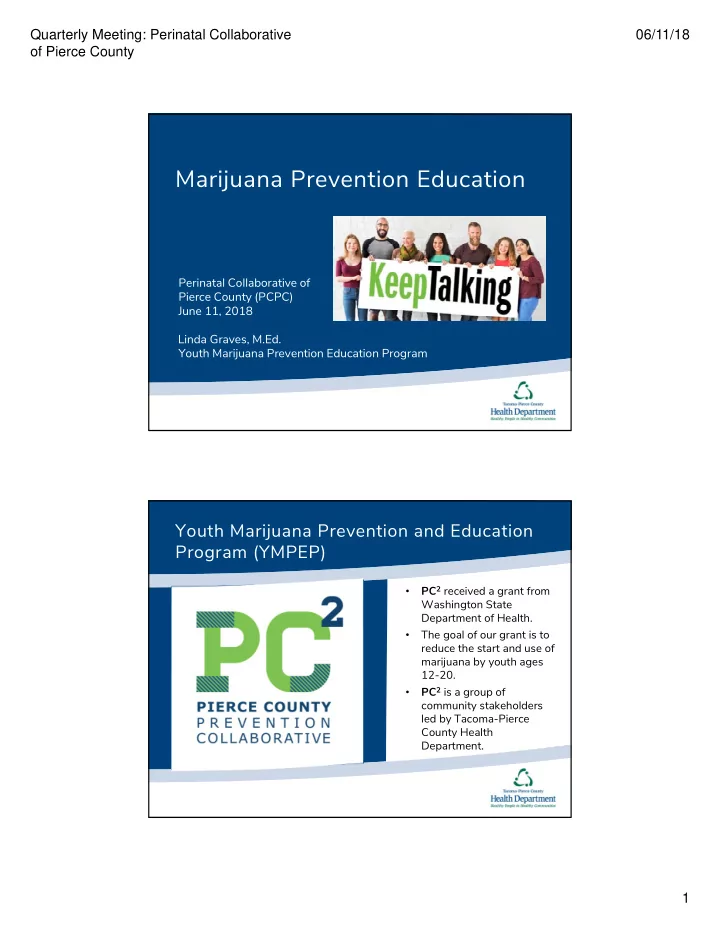
Marijuana Prevention Education Perinatal Collaborative of Pierce - - PDF document

marijuana prevention education
SMART_READER_LITE
LIVE PREVIEW

Marijuana Prevention Education Perinatal Collaborative of Pierce - - PDF document

Quarterly Meeting: Perinatal Collaborative 06/11/18 of Pierce County Marijuana Prevention Education Perinatal Collaborative of Pierce County (PCPC) June 11, 2018 Linda Graves, M.Ed. Youth Marijuana Prevention Education Program Youth


slide-1
SLIDE 1

Quarterly Meeting: Perinatal Collaborative

  • f Pierce County

06/11/18 1

Marijuana Prevention Education

Perinatal Collaborative of Pierce County (PCPC) June 11, 2018 Linda Graves, M.Ed. Youth Marijuana Prevention Education Program

Youth Marijuana Prevention and Education Program (YMPEP)

  • PC2 received a grant from

Washington State Department of Health.

  • The goal of our grant is to

reduce the start and use of marijuana by youth ages 12-20.

  • PC2 is a group of

community stakeholders led by Tacoma-Pierce County Health Department.

slide-2
SLIDE 2

Quarterly Meeting: Perinatal Collaborative

  • f Pierce County

06/11/18 2

  • Create awareness of marijuana products

currently available on the market.

  • Show existing paraphernalia.
  • Educate the public on Washington State

laws around marijuana use.

  • Inform parents, teachers and other adults
  • n the health effects of teen marijuana

use.

Parents, Teachers, Adults Keep Talking—It matters!

2016 Healthy Youth Survey

  • 82% of Pierce County youth

reported NOT using marijuana in the past 30 days.

  • Half of teens do not consider

marijuana harmful.

  • Teens think marijuana is “easy to

get” and “everyone is doing it”.

  • Half of 12th graders reported

having driven a car within three hours of using marijuana.

Basic Overview

If you think that most youth use marijuana, think again!

slide-3
SLIDE 3

Quarterly Meeting: Perinatal Collaborative

  • f Pierce County

06/11/18 3

People under 21 cannot:

  • Use, buy, sell, or possess marijuana.
  • Visit a marijuana retail store (without a

medical card). It is illegal to:

  • Provide marijuana to minors.
  • Consume marijuana in public.
  • Drive under the influence of marijuana
  • r have open product in a vehicle.
  • Take marijuana out of Washington

State.

Washington State Law

Marijuana use can lead to:

  • Addiction.
  • Academic problems.

Marijuana use can cause:

  • Anxiety, paranoia, or

depressed feelings.

  • Lost interest in activities.
  • Risk taking behaviors.

Health Effects of Youth Marijuana Use

Marijuana use can effect:

  • Brain development.
  • Learning and memory.
  • Mood and motivation.
  • Judgment.
  • Driving, playing sports,
  • r activity

performance.

  • Has an effect on

coordination and reaction time.

slide-4
SLIDE 4

Quarterly Meeting: Perinatal Collaborative

  • f Pierce County

06/11/18 4

Marijuana Use During Pregnancy & Breastfeeding

  • Little research exists.
  • One study showed 20% of pregnant

women 24 years or younger tested positive for marijuana use.

  • Research has shown pregnant marijuana

users have 2.3 times greater risk of still birth.

  • May have problems with neurological

development.

5 Things to Know about Marijuana Use While Pregnant

  • 1. There are safer ways to manage pregnancy

discomforts without risk of harming the baby.

  • 2. The chemical in marijuana that makes you feel “high”

(THC) can transfer to your baby.

  • 3. Smoking and storing marijuana in the home has risks.
  • 4. Marijuana can affect your ability to protect your baby.
  • 5. “Natural” does not mean safe.
slide-5
SLIDE 5

Quarterly Meeting: Perinatal Collaborative

  • f Pierce County

06/11/18 5

What is Cannabis or Marijuana?

  • THC or delta-9-tetrahydrocannabinol (the

part of the plant that gives the “high”).

  • CBD or Cannabidiol (non-psychoactive and

used more for medicinal purposes).

  • It is no longer just the dried flowers and

leaves of the plant. People now make and use marijuana concentrates which are much higher in potency than the marijuana of yesterday.

  • These products are now available in

Washington State.

Cannabis Slang Terms

  • The Cannabis industry uses

several terms to describe marijuana and marijuana concentrate products.

  • Kief, BHO, budder, hash oil,

honeycomb, blunt, honey oil, butter, amber, shatter, wax, Moroccan, gorilla glue, strawberry cough, rocky, black, Acapulco Red, Chocolate Thai, Kona Gold, Mary Jane, ganja, gangster, Columbus Black and moon rocks.

slide-6
SLIDE 6

Quarterly Meeting: Perinatal Collaborative

  • f Pierce County

06/11/18 6

Marijuana A mixture of dried, shredded flowers and leaves of the plant Cannabis Sativa. Hashish Made from the resin of the plant. It is dried and pressed into small blocks. Hash Oil Extracted from the plant. This type

  • f oil is more concentrated than the

flower.

Cannabis Come in Different Forms

  • Shatter, wax and Butane Hash

Oil (BHO) are potent types of concentrated marijuana.

  • Shatter can be very thin and/or

hard wax substance. The colors can vary from light amber to dark brown glass shards.

  • The potency of these types of

concentrates may range from 60% to 90% THC.

Shatter, Wax and Butane Hash Oil (BHO)

slide-7
SLIDE 7

Quarterly Meeting: Perinatal Collaborative

  • f Pierce County

06/11/18 7

  • Smoking is still the most commonly

used method for consuming marijuana and marijuana concentrates.

  • A bowl (hand pipe), water pipe

(bong), hookah, or rolling it in paper (joint or cigar known as a blunt) are most commonly used to consume marijuana.

Inhalation

  • Once designed to vape nicotine,

people now use electronic cigarette devices to vape marijuana and marijuana concentrates.

  • The most popular electronic device

among youth and young adults is the JUUL. It resembles a flash drive and charges in the USB drive of a computer.

Vaporizing or Vaping

slide-8
SLIDE 8

Quarterly Meeting: Perinatal Collaborative

  • f Pierce County

06/11/18 8

  • Vaping can produce higher-

potency THC content and can be dangerous to the development of teens and young adults.

  • Vaping marijuana does not have

a strong scent as compared to smoking marijuana.

  • Hash oil and nicotine oil look

similar making it more difficult to detect marijuana use.

Vaporizing or Vaping

  • Dabbing is another method
  • f consumption.
  • Similar to vaping but the

heating process produces smoke rather than vapor.

  • Dabbing provides very potent

THC levels.

Dabbing

slide-9
SLIDE 9

Quarterly Meeting: Perinatal Collaborative

  • f Pierce County

06/11/18 9

  • Edibles are foods that

contain THC or CBD.

  • Labeling shows many of

these products as containing 10 mg of THC per serving.

  • Adults should label and

lock up these items.

Marijuana Infused Edibles

  • Topicals are cannabis-

infused products for use on the surface of the skin.

  • Tinctures come in

eyedropper bottles.

  • This consumption method is

not common for youth.

Topicals and Tinctures

slide-10
SLIDE 10

Quarterly Meeting: Perinatal Collaborative

  • f Pierce County

06/11/18 10

  • The number 710 refers

to oils and other concentrates.

  • As you begin to look

deeper, many drug references are NOT that clear.

Marijuana References on Clothing Marketing to Youth

  • The marijuana industry is aware of the grey areas in advertising laws. Like the

tobacco industry, the marijuana industry uses sex appeal, popular media and celebrities to promote sales.

  • There are events like Seattle Hempfest who find ways around the law, such as

putting up tents out of the view of the general public.

slide-11
SLIDE 11

Quarterly Meeting: Perinatal Collaborative

  • f Pierce County

06/11/18 11

Stash Compartments

  • Stash or hidden pockets

for house keys, ID and or

  • ther valuables.
  • These hidden

compartments might be located in hats, shoes and clothing making it easy for youth to hide marijuana or other drugs.

  • As of February 2017, the “Not

for Kids” logo was mandated on all marijuana edible packaging. If you use marijuana, label it clearly as Marijuana - Not for Kids.

  • If you or any adult you know

uses marijuana, lock it up!

  • Washington State Poison

Center: https://www.wapc.org/programs /services/not-for-kids/

Lock It Up!

slide-12
SLIDE 12

Quarterly Meeting: Perinatal Collaborative

  • f Pierce County

06/11/18 12

  • Research shows if teens know we

think it is wrong for them to use marijuana, they are less likely to use.

  • Parents or the primary adult are the

number one influence in a child’s life.

  • Tell your teens it is against the law!
  • Children really do care about what

their parents or supporting adult has to say.

Keep Talking!

What you can do:

  • Educate yourself.
  • Have frequent conversations.
  • Join the Pierce County

Prevention Collaborative. Learn more:

  • www.tpchd.org/keeptalking.
  • www.YouCanWA.org.
  • www.StartTalkingNow.org.

Call to Action!

slide-13
SLIDE 13

Quarterly Meeting: Perinatal Collaborative

  • f Pierce County

06/11/18 13

Linda Graves, M.Ed. Health Promotion Coordinator Strengthening Families Youth Initiatives (253) 320-8495 lgraves@tpchd.org www.keeptalking.org

Contact Information