Many ways forward: Working with Indigenous communities to address - - PowerPoint PPT Presentation

many ways forward working with indigenous communities to
SMART_READER_LITE
LIVE PREVIEW

Many ways forward: Working with Indigenous communities to address - - PowerPoint PPT Presentation

Many ways forward: Working with Indigenous communities to address gambling harm Dr Marisa Fogarty Centre for Aboriginal Economic Policy Research (CAEPR) Research School of Social Sciences College of Arts and Social Sciences Australian National


slide-1
SLIDE 1

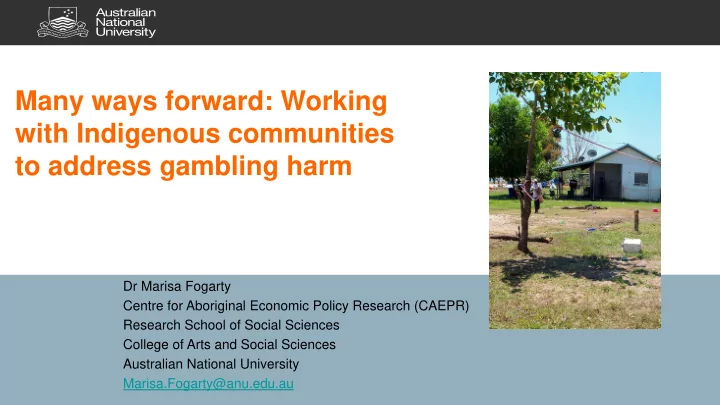
Many ways forward: Working with Indigenous communities to address gambling harm

Dr Marisa Fogarty Centre for Aboriginal Economic Policy Research (CAEPR) Research School of Social Sciences College of Arts and Social Sciences Australian National University Marisa.Fogarty@anu.edu.au

slide-2
SLIDE 2

Overview

  • Brief overview of work in NT Indigenous communities
  • Research findings – understandings of gambling

problems

  • Working with Indigenous communities around Australia to

address gambling harm

2

slide-3
SLIDE 3

The context in which gambling occurs for Indigenous people in the NT

  • Extreme variances in remoteness and access to

commercial gambling

3

Unregulated gambling i.e. card games Regulated commercial gambling

slide-4
SLIDE 4

4

slide-5
SLIDE 5

5

slide-6
SLIDE 6

Community card games.

6

slide-7
SLIDE 7

7

Number of games by days of the week (wet season)

5 10 15 20 25 30 Monday Tuesday Wednesday Thursday Friday Days of the week Jan 29 - Feb 2 Feb 5- Feb 9 Feb 12-Feb 16 Feb 19 - Feb 23 Feb 26-Mar 2 Mar 5 - Mar 9 Mar 12- Mar 16 Mar 19 - Mar 23 Mar 26 - 30 Number of games

slide-8
SLIDE 8

8

slide-9
SLIDE 9

Social Regulation

9

slide-10
SLIDE 10

10

Single Kunt Game Medium/High Very Low High Double Kunt Game Kunt Game and Buta Game Low/Medium Double Buta Game Between Language Groups Between Language Groups Within Language Group Immediate Family

Social Arrangement Game Type Expenditure

slide-11
SLIDE 11

Darwin Casino

11

slide-12
SLIDE 12

Problem gambling is characterised by difficulties in limiting money and/or time spent on gambling which leads to adverse consequences for the gambler, others, or for the community (Neal, Delfabbro and O’Neil 2005) .

12

slide-13
SLIDE 13

Problem gambling: different perspectives… as a person neglecting or rejecting social relationships and

  • bligations as a result of gambling (Fogarty 2013).

Marisa Fogarty, 2013, From card games to poker machines: Gambling in remote Aboriginal communities in the NT, Phd Thesis, Charles Darwin University

13

slide-14
SLIDE 14
  • The excerpt below sums up the plethora of existing work on Indigenous health and mental

health expressing holistic worldviews… Social and emotional wellbeing is often defined as ‘not just the physical wellbeing of the individual, but the social, emotional and cultural wellbeing of the whole community’ (NAHSWP, 1989). It reflects belief systems that are based on complex social relationships between people, land and all living creatures and the interconnectedness of relationships between spiritual, emotional, ideological, political, social, economic, mental, cultural and physical factors on health

  • utcomes for individuals, communities and populations (AUSEINET, 2008, p. 22).

14

slide-15
SLIDE 15

Dr Matt Stevens Preliminary results from the 2015 Gambling Prevalence and Wellbeing Survey

slide-16
SLIDE 16

Types of harms experience from

  • wn gambling

16.0 0.2 0.2 4.6 1.5 4.6 2.7 8.8 18.2 15.3 3 6 9 12 15 18

Felt stress, anxiety or depression Kids did not attend school Debt collectors repossessed goods Borrowed money from family or friends Ran out of money for food p=0.03 p=0.013 p<0.001 p=0.026 p<0.001

% Non-Indigenous Indigenous

slide-17
SLIDE 17

Harms experienced because of someone else’s gambling

3.6 0.3 2.9 0.1 2.6 2.5 9.8 1.8 10.8 1.2 6.7 12.2 2 4 6 8 10 12

Stress, anxiety, depression Kids missed out on something Family relations problems Debt collectors repossessed goods Borrowed money from someone Ran out of money for bills p=0.015 p=0.001 p=0.002 p<0.001 p=0.018 p=0.015

% Non-Indigenous Indigenous

slide-18
SLIDE 18

Health Promotion Framework:

A landmark commitment in 1986 by the World Health Organization produced the Ottawa Charter for Health Promotion (WHO 1986). The five principles for action of the Ottawa Charter are:

  • Building healthy public policy
  • Creating supportive environments
  • Strengthening community action
  • Helping people develop skills
  • Reorienting health services

18

slide-19
SLIDE 19

Talk about 3 aspects of a health promotion approach:

  • Developing skills
  • Reorienting services
  • creating supportive environments

19

slide-20
SLIDE 20

What does developing skills look like?

  • Education and awareness
  • In particular, developing resources for community health and education services, community
  • rganisations and institutions to

educate and develop skills in understanding and addressing gambling issues.

  • Developing guidelines for ‘best practice’ in service delivery to address gambling and the

impacts on Indigenous families and communities in culturally appropriate ways.

  • Developing resources within communities, for communities, to address gambling issues (i.e.

community guidelines for ‘safe’ gambling)

  • Having a multi-level, multi-service approach working simultaneously at individual, family,

community levels.

20

slide-21
SLIDE 21

Holistic development of skills

Holistic development of skills Strengths based approach Incorporation of Indigenous knowledge and understandings Individual Family Community Identifying different skill sets

21

slide-22
SLIDE 22

Create supportive environments

  • Creating safe, supportive, appropriate gambling help services – this looks

very different in different states around Australia (what constitutes ‘best practice’ in Australia?)

  • Cultural competency of services, cultural safety
  • Looking at a community, town, or city as a ‘whole’ environment with multiple

resources available to address gambling (for example, the schools, health clinics, early childhood centres, women's centres, police services, child protection services, councils, local business).

22

slide-23
SLIDE 23

Reorienting services

  • A significant amount of expertise and resources already exist – so its about

engaging and educating those people outside of gambling services in the broader ‘community environment’.

  • Counselling services, gambling help-lines, financial counselling, parenting

programs, youth diversionary programs, school programs, community councils and boards, family, presented to people as an accessible package – creates supportive environments

  • Then, self-sustaining supportive environments addressing gambling issues

are born.

23

slide-24
SLIDE 24

Thank you

24