Many Variables and Constraints Equation vs. inequality constraints - - PDF document

many variables and constraints equation vs inequality
SMART_READER_LITE
LIVE PREVIEW

Many Variables and Constraints Equation vs. inequality constraints - - PDF document

ECO 305 FALL 2003 September 18 Many Variables and Constraints Equation vs. inequality constraints Budget line (equation): P x x + P y y = I Inequality budget constraint: P x x + P y y I At optimum ( x , y ) , constraint is


slide-1
SLIDE 1

ECO 305 — FALL 2003 — September 18

Many Variables and Constraints Equation vs. inequality constraints Budget line (equation): Px x + Py y = I Inequality budget constraint: Px x + Py y ≤ I At optimum (x∗, y∗), constraint is called “binding” or “tight” if =, “slack” if < Number of equation constraints must be less than number of choice variables Any number of inequality constraints OK but

  • no. of binding constrs. ≤ no. of choice variables

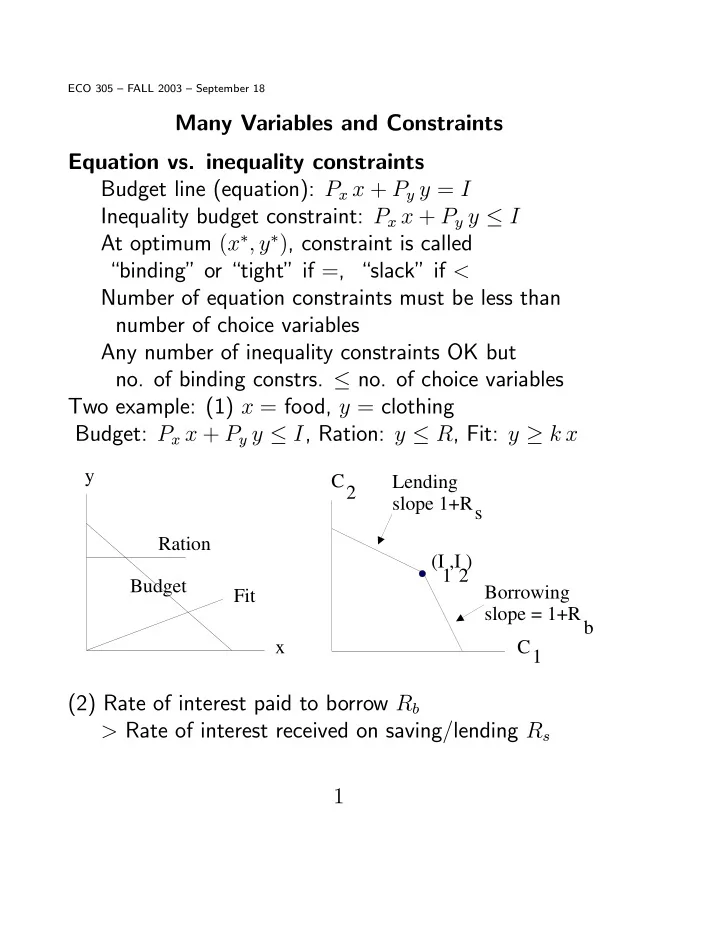
Two example: (1) x = food, y = clothing Budget: Px x + Py y ≤ I, Ration: y ≤ R, Fit: y ≥ k x

x y Ration Fit Budget C C (I ,I ) 1 1 2 2 Lending slope 1+Rs Borrowing slope = 1+Rb

(2) Rate of interest paid to borrow Rb > Rate of interest received on saving/lending Rs 1

slide-2
SLIDE 2

Kuhn-Tucker Theory Vector x = (x1, x2, . . . xn) Maximize F(x) subject to Gi(x) ≤ ci (i = 1, 2, . . . m) Lagrangian (with λi ≥ 0) L(x, λ) = F(x) +

m

X

i=1

λi [ci − Gi(x)] FONCs for x∗ to be interior smooth local maximum: ∂L/∂xi = 0 for i = 1, 2, . . ., n Need another m equations to find the λi also. Principle of Complementary Slackness If Gi(x∗) < ci, then λi = 0 If λi > 0, then Gi(x∗) = ci This agrees with previous interpretation

  • f Lagrange multiplier as marginal increase

in objective when constraint is relaxed: A slack constraint has zero shadow price; a constraint with positive shadow price cannot be slack Can have Gi(x∗) = ci and λi = 0 in exceptional situations where constraint about to become slack 2

slide-3
SLIDE 3

Which of these is true at the optimum remains to be found out, at worst by investigating all 2m possible combinations one at a time. Can also do non-negativity constraints using this theory. All this sounds difficult, best learned by doing examples: many to come in class, precepts, problem sets, exams. Topics from textbook chs. 2—3 omitted here: Comparative Statics and Envelope Theorem

  • pp. 46—50, 75

Second-order conditions: Appendixes pp. 54—55, 90—91 Will do specific versions of these in the context of economic applications; general theory not needed. 3-D pictures of constrained maximization and duality:

  • pp. 60, 63, 71—72, 77.

I am doing equivalent approach in 2-D using contours. 3

slide-4
SLIDE 4

CONSUMER CHOICE THEORY — BASIC ISSUES Choice-making unit — individual, household, . . . ? Dimensions of choice — quantities of goods and services Labor supply (leisure demand) — income “endogenous” Borrowing or saving, portfolio choice Risk choices — purchase of insurance, gambling Quantities taken to be continuous variables unless explicitly stated otherwise (rarely) Constraints — budget line or nonlinear schedule because of quantity discounts or premia Other constraints like rationing Time-span — If too short, whims and errors may dominate If too long, available goods, tastes may change Economics — methodological individualism, rational choice Rationality — (1) internally consistent preferences (2) maximization of these subject to constraints Preferences need not be selfish, purely money-oriented, short-run, conformist . . . Maximization can be “as if” Even then, should not take theory literally Look for explanation of average over people, time Judge success of theory by empirical evidence Start simple and gradually build more complex models 4