Managing Your Global Antitrust Risk (and Rewards) Panelists MCCA - - PowerPoint PPT Presentation

managing your global antitrust risk and rewards
SMART_READER_LITE
LIVE PREVIEW

Managing Your Global Antitrust Risk (and Rewards) Panelists MCCA - - PowerPoint PPT Presentation

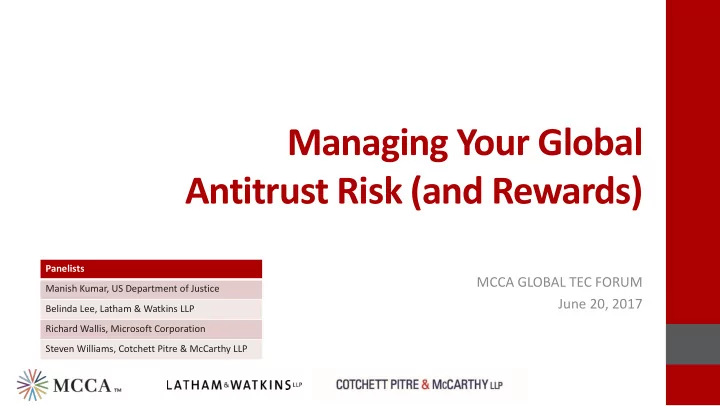
Managing Your Global Antitrust Risk (and Rewards) Panelists MCCA GLOBAL TEC FORUM Manish Kumar, US Department of Justice June 20, 2017 Belinda Lee, Latham & Watkins LLP Richard Wallis, Microsoft Corporation Steven Williams, Cotchett


slide-1
SLIDE 1

Managing Your Global Antitrust Risk (and Rewards)

MCCA GLOBAL TEC FORUM June 20, 2017

Panelists Manish Kumar, US Department of Justice Belinda Lee, Latham & Watkins LLP Richard Wallis, Microsoft Corporation Steven Williams, Cotchett Pitre & McCarthy LLP

slide-2
SLIDE 2

Agenda

  • 1. Antitrust 101
  • 2. Practical Tips
  • 3. Managing Your Risks and Rewards

Note: The views expressed do not necessarily reflect those of the United States Department of Justice

slide-3
SLIDE 3

Background

  • Section 1 of the Sherman Act
  • Prohibits agreements that unreasonably restrict competition
  • Some agreements are “per se” → always illegal
  • Everything else is “rule of reason” → do benefits to consumers outweigh

harm to competition?

slide-4
SLIDE 4

Examples Of “Per Se” Illegal Behavior

  • Any agreement NOT to compete is “per se” illegal, including:
  • Price fixing (broadly defined)
  • Bid rigging
  • Allocating customers, products, or territories
  • Output restrictions
  • No defense to “per se” illegal behavior
slide-5
SLIDE 5

What is an “Agreement”?

  • Does not matter if agreement is only verbal
  • Does not matter if agreement is ultimately ineffective or not even

carried out

  • How do you prove an agreement?
slide-6
SLIDE 6
  • Private plaintiffs (class actions, customers, and consumers)
  • Also DOJ, FTC, and State Attorneys General
  • Joint and several liability for treble (3x) damages
  • Attorneys’ fees and costs

Section 1 Enforcement (Civil)

slide-7
SLIDE 7

Section 1 Enforcement (Criminal)

  • Individuals
  • Up to 10 years imprisonment, $1M in fines
  • Exclusion from US for minimum of 15 years
  • Possible arrest and extradition in other countries
  • Corporations
  • Up to $100 million in fines; or
  • “Twice the gain, twice the loss”
  • Compliance Programs and Monitors
  • Leniency Program = immunity for first to self-report
slide-8
SLIDE 8

Conspiracies Come in All Shapes & Sizes

  • Increasing government and private enforcement of non-traditional

conspiracies

  • Horizontal Conspiracies
  • “Hub and Spoke” Conspiracies
  • Other Conspiracies
slide-9
SLIDE 9

Agenda

  • 1. Antitrust 101
  • 2. Practical Tips
  • 3. Managing Your Risks and Rewards
slide-10
SLIDE 10
  • Don’t talk with competitors about price (even generally) or specific

customers

  • Can be legitimate, such as for industry benchmarking studies or merger due

diligence; but, it can appear to be a way of monitoring adherence to a cartel

  • Never do it without the law department’s involvement
  • Don’t verify customer claims about competing bids
  • Do not contact competitors to verify that a customer is telling you the truth about

a competing bid

  • It could be interpreted as coordinating
  • Note, information exchange is “per se” illegal in EU and elsewhere

Minimizing Contacts

slide-11
SLIDE 11

What If Competitors Contact Me?

  • Explicitly reject any offers or invitations to fix prices
  • Even when rejected, this imposes risks on the company, so alert the legal

department

  • e.g.: You are planning to raise prices, and a competitor suggests you should

both raise prices by 10%. Now it looks like price fixing

  • Be careful of social interactions with competitors
  • These can lead to anticompetitive business discussions if you are not

careful

slide-12
SLIDE 12
  • Discuss only what is necessary to do business
  • Don’t get into unnecessary discussions about the market, customers, input

costs, other products

  • Avoid discussing non-public information
  • Keep notes about who attended, what is discussed
  • Make an agenda and create minutes of meetings
  • Politely, but firmly stop the conversation if necessary
  • Get legal department involved

What If The Job Requires Contact?

slide-13
SLIDE 13

A Few Rules of Email Practice

The “New York Times” Rule

  • How would it look in a newspaper, devoid of context or explanation?

The “Aging Humor” Rule

  • It's never as funny later on, even if plainly untrue or sarcastic

The “Full Story” Rule

  • If you are collecting or passing along information from a competitor, always

include your lawful source of the information

Emails Last Forever

  • Assume everything you write will be read by the person you least want to read it
slide-14
SLIDE 14

Agenda

  • 1. Antitrust 101
  • 2. Practical Tips
  • 3. Managing Your Risks and Rewards
slide-15
SLIDE 15

Managing Risks and Rewards

  • How does antitrust litigation differ from managing other types of

investigations and cases?

  • How should companies evaluate whether to seek leniency?
  • How should companies decide whether to become antitrust

plaintiffs?

  • What are the top mistakes that companies make in an antitrust

case? What are the best practices?

slide-16
SLIDE 16

Managing Your Global Antitrust Risk (and Rewards)

MCCA GLOBAL TEC FORUM June 20, 2017

Panelists Manish Kumar, US Department of Justice Belinda Lee, Latham & Watkins LLP Richard Wallis, Microsoft Corporation Steven Williams, Cotchett Pitre & McCarthy LLP