Managing Complexity from a Legal and Operational Viewpoint Rakesh - - PDF document

managing complexity from a legal and operational viewpoint
SMART_READER_LITE
LIVE PREVIEW

Managing Complexity from a Legal and Operational Viewpoint Rakesh - - PDF document

7/19/2018 CRE/FM Outsourcing in a Technology Driven Environment: Managing Complexity from a Legal and Operational Viewpoint Rakesh Kishan, Managing Principal Trascent +1 973 420 7253 rkishan@trascent.com Kevin Rang, Partner Mayer Brown +1


slide-1
SLIDE 1

7/19/2018 1

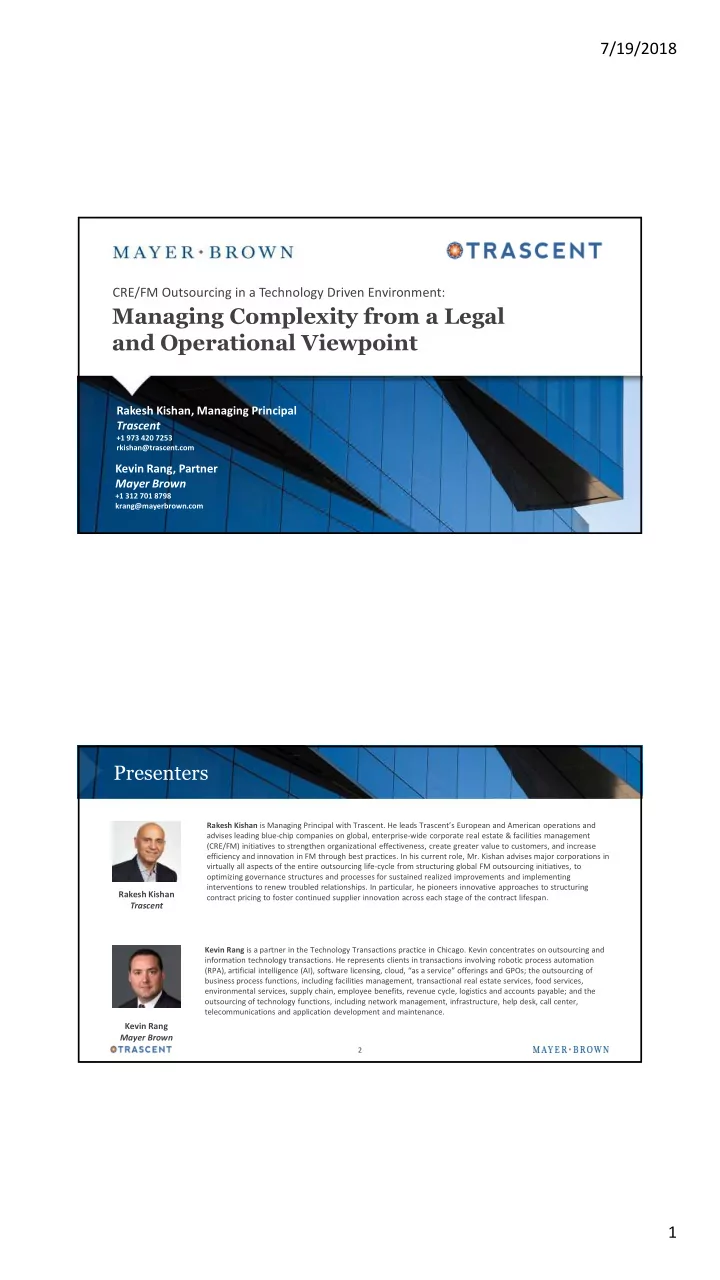
Managing Complexity from a Legal and Operational Viewpoint

Rakesh Kishan, Managing Principal Trascent

+1 973 420 7253 rkishan@trascent.com

Kevin Rang, Partner Mayer Brown

+1 312 701 8798 krang@mayerbrown.com

CRE/FM Outsourcing in a Technology Driven Environment:

Presenters

2

Rakesh Kishan Trascent Kevin Rang Mayer Brown Kevin Rang is a partner in the Technology Transactions practice in Chicago. Kevin concentrates on outsourcing and information technology transactions. He represents clients in transactions involving robotic process automation (RPA), artificial intelligence (AI), software licensing, cloud, “as a service” offerings and GPOs; the outsourcing of business process functions, including facilities management, transactional real estate services, food services, environmental services, supply chain, employee benefits, revenue cycle, logistics and accounts payable; and the

  • utsourcing of technology functions, including network management, infrastructure, help desk, call center,

telecommunications and application development and maintenance. Rakesh Kishan is Managing Principal with Trascent. He leads Trascent’s European and American operations and advises leading blue-chip companies on global, enterprise-wide corporate real estate & facilities management (CRE/FM) initiatives to strengthen organizational effectiveness, create greater value to customers, and increase efficiency and innovation in FM through best practices. In his current role, Mr. Kishan advises major corporations in virtually all aspects of the entire outsourcing life-cycle from structuring global FM outsourcing initiatives, to

  • ptimizing governance structures and processes for sustained realized improvements and implementing

interventions to renew troubled relationships. In particular, he pioneers innovative approaches to structuring contract pricing to foster continued supplier innovation across each stage of the contract lifespan.

slide-2
SLIDE 2

7/19/2018 2

RE and FM Market is a Growing Sector

  • CAGR nearly 10% over last 7 years
  • Focus on 3 Primary Service Categories:

– Real Estate (RE) Services – Facilities Management (FM) Services – Project Management (PM) Services

  • Market Consolidation

– M&A – Outside Industry Talent – Geographic and Capability Reach – Limited client options

  • Selective Supplier Market, Margin Focus

3

Capital Inflows

  • 2013: SPIE (France) acquired Hochtief FM (Germany)
  • 2013: Cofely/GDFSuez (France) acquired Balfour Beatty (UK)
  • 2013: CBRE (US) acquired Norland (UK)
  • 2014: Bilfinger (Germany) acquired GVA (UK), Europe (UK)
  • 2014: DTZ (US) acquired by TPG (Australia) and merged with Cassidy

Turley (US)

  • 2014: ISS (Denmark) went IPO
  • 2014: Dalkia (France) Spin off to EDF (France) and Veolia (France)
  • 2014: MITIE (UK) acquired Procius (UK)
  • 2015: JCI acquired by CBRE, Cushman & Wakefield acquired by DTZ

Service Capability GeographicReach Veolia CBRE Cofely Bilfinger Spie

High Medium Low Market Maturity Latin America: $30 - 50B North America: $160 - 220B Africa: $30B

  • BROLL
  • TSEBO
  • EFS
  • Excellerate

Asia Pacific: $130-170B Europe: $180 - 260B

Gen 2/3 Gen 1/2 Gen 1

Market Maturity Varies

4

slide-3
SLIDE 3

7/19/2018 3

Key Characteristics

  • Labor Enabled Services, Delivered On-Site

– Fractional Use – Gen 1 people - transfer issues – Next generation – exit liabilities (especially in ARD countries)

  • Data constrained
  • Limited definitions
  • Limited use of performance metrics and SLA’s

5

Client Requirements

  • Innovation
  • Shift to Quality
  • Brand image as provider of progressive workplace
  • Technology enablement of services
  • Geography specific performance
  • Compliance and risk

6

slide-4
SLIDE 4

7/19/2018 4

How Will Technology Transform CRE

  • Iot Enabled Smart Workplaces that engage employees
  • Workplace experience customized to the individual
  • User centric, anticipatory services
  • Predictive analytics and machine learning based solutions
  • Mobile based access and solutions
  • More flexible and adaptive footprint
  • Greater integration of services and social networking

7

Tech Companies Are Leading The Way….

  • Workplace Design

– Activity Based – New concepts – libraries, lounges, etc. (Salesforce, Amazon, Linkedin WeWork, etc.) – Purpose & culture (Airbnb, Linkedin, etc.)

  • Monitoring Usage to Adapt

– Facial recognition (NVIDIA) – Tracking & interactive usage (Deloitte, WeWork) – Work patterns

  • Concierge & Amenity Services (that save time)

– Enhance lifestyle – Services afforded by the wealthy – housing, pet adoption, etc. – Campuses becoming villages offering life-style and amenities

8

…But use 25% Less SF/Employee

Source: Economist

slide-5
SLIDE 5

7/19/2018 5

RE/FM System Models Require Supplier-Client Interfaces

9

REFM TECHNOLOGY

Client Technology RE PM FM RE PM FM Supplier Technology

1 2

RE PM FM Lead Technology Supplier

3

RE PM FM Hybrid – Supplier/Client

4

Commercial Structure

10

Materials Client Labor & Sub- Contracts Acct Team Supplier Labor & Sub- Contracts Fee Tech Transition Materials

Net Savings Gross Savings One-time

  • Fixed Fee and Cost Plus models dominate
  • Variable (non-controllable) and Recurring

(controllable) Cost

  • Transparency
  • Baseline
  • Technology Charges
slide-6
SLIDE 6

7/19/2018 6

XaaS Issues

XaaS

  • Overview of RE and FM Market Trends
  • Client Requirements and Issues
  • New types of Real Estate Service offerings

– RPA – Cloud based services – AI

  • Need to Understand HOW services are being delivered
  • Need to understand WHAT is being used to provide services
  • Need to understand SCOPE of rights customer is receiving to Data and Services
  • Need to understand Exit rights

12

slide-7
SLIDE 7

7/19/2018 7

Data Issues and Compliance Obligations

Data Issues and Compliance Obligations

  • The GDPR Revolution – global not regional concerns
  • High-risk processing, (e.g. facial recognition technologies)
  • GDPR increases fines for non-compliance to focus attention on compliance –

maximum fine 4% of worldwide revenues of the undertaking

  • Negotiation of arrangements between data controllers and data processors – a legal

and technical negotiation

14

slide-8
SLIDE 8

7/19/2018 8

Connected Devices (IoT)

Example IoT Scenario

16

Property Management System Smart Devices

S1

Software (SaaS)

S2

CLOUD (PaaS)

S3

Data Analytics Solution

S4

slide-9
SLIDE 9

7/19/2018 9

IoT Issue: Contracting Challenges with New Suppliers

  • IoT Reliance on Open Source Licenses

– If Target becomes subject to these licenses, is Target obligated to disclose Target IP to Open Source community? – Can the Supplier identify the Open Source in its supply chain? – Rep and warrant as to Open Source

  • “As-Is” Contract Terms

– One-sided, supplier-oriented – Subject to unilateral change at an URL

  • Interoperability / “Walled Gardens”

17

IoT Issue: Technology Currency Challenges

  • Difficulties in patching/updating
  • Related integration problems
  • Allocate responsibility for maintenance and updates
  • End-of-life issues

– How long will devices be supported? – Deprecation/sunset policies – Notice period before support ends

18

slide-10
SLIDE 10

7/19/2018 10

IoT Issue: Increased Security Concerns

  • IoT device manufacturers may not prioritize security
  • Standardized iot devices = increased risk of breach
  • Increased physical access = increased vulnerabilities
  • Highly networked = more openings to your network
  • Example:

– DDOS attack by “an army of IoT devices protected only by factory default passwords.”

19

IoT Issue: New Potential Liability/Regulatory Oversight Concerns

  • Risks of harm to a person or property (e.g., smart floor cleaners, car charging)
  • Additional data from IoT sensors may increase discovery obligations (and data

available to plaintiffs)

  • Increased liability for product defects or other safety problems, because more

harms are arguably foreseeable

  • Commentators have noted that ease of availability of compliance and risk data may

increase risk of more regulatory oversight

  • Regulators may demand data relating to regulatory

compliance issues (e.g., work site safety compliance)

20

slide-11
SLIDE 11

7/19/2018 11

Facilities & Transactional Real Estate Services

Facilities & Transactional Real Estate Services

  • Pricing models and impact on contract terms
  • Approach to liability and indemnification
  • Ownership of materials and IP
  • Exit protections

22

slide-12
SLIDE 12

7/19/2018 12

Technology Issues in Real Estate Acquisitions and Dispositions

Why Are Technology Issues Important in Real Estate Acquisitions and Dispositions?

  • Technology and related contracts should not be an afterthought

– Technology is important to how a smart building operates – Continued access to technology impacts valuation of the building – For the seller, it may be difficult to separate technology in a smart building from seller’s wider operations – For the buyer, it may be difficult to replace technology in a smart building or to integrate that smart building into buyer’s wider operations

24

slide-13
SLIDE 13

7/19/2018 13

What Can Sellers do to Maximize Value of Smart Building?

  • Present a smart building that the buyer is confident it understands and can

successfully use and integrate

1. Analyze the building’s capabilities and needs from the operational and legal perspectives 2. Standardize favorable disposition-ready contract terms with vendors

  • Maintain a database of agreements

3. Suspend new technology projects

25

What Can Buyers do in Advance to Use and Integrate a Smart Building?

  • 1. Ensure there is focused technology due diligence done during acquisition process
  • 2. Prepare a form Transition Services Agreement
  • 3. Prepare a thorough integration plan
  • 4. Standardize favorable acquisition-ready contract terms with vendors (i.e.,

expansion rights)

– Maintain a database of agreements

26

slide-14
SLIDE 14

7/19/2018 14

Questions?

Rakesh Kishan Trascent

+1 973 420 7253 rkishan@trascent.com

Kevin Rang Mayer Brown

+1 312 701 8798 krang@mayerbrown.com

Mayer Brown is a global services provider comprising legal practices that are separate entities, including Tauil & Chequer Advogados, a Brazilian law partnership with which Mayer Brown is associated (collectively the “Mayer Brown Practices”), and affiliated non-legal service providers, which provide consultancy services (the “Mayer Brown Consultancies”). The Mayer Brown Practices and Mayer Brown Consultancies are established in various jurisdictions and may be a legal person or a partnership. Details of the individual Mayer Brown Practices and Mayer Brown Consultancies can be found in the Legal Notices section of our website. "Mayer Brown" and the Mayer Brown logo are the trademarks of Mayer Brown.