Managing Change Olivia Roche HELLO! I am Olivia Roche I am a - - PowerPoint PPT Presentation

managing change
SMART_READER_LITE
LIVE PREVIEW

Managing Change Olivia Roche HELLO! I am Olivia Roche I am a - - PowerPoint PPT Presentation

Managing Change Olivia Roche HELLO! I am Olivia Roche I am a trainer since 2014. You can contact me at olivia@dcmlearning.ie Agenda Why is change necessary? The link between change management and business results How company


slide-1
SLIDE 1

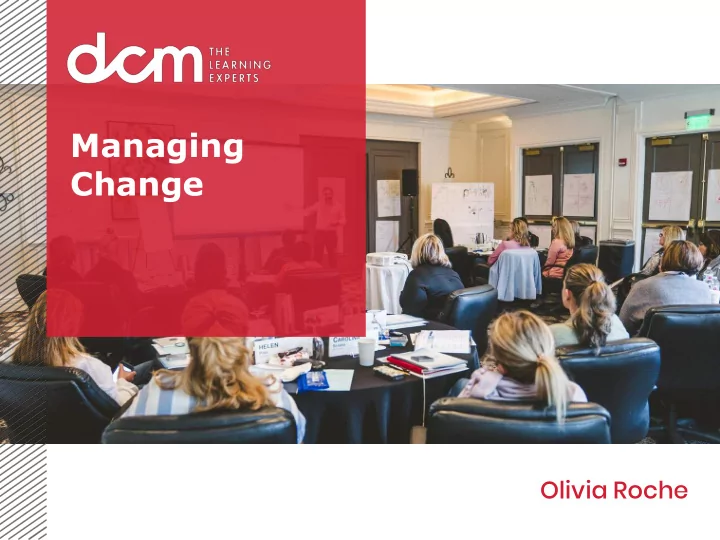
Managing Change

Olivia Roche
slide-2
SLIDE 2

HELLO!

I am Olivia Roche I am a trainer since 2014. You can contact me at olivia@dcmlearning.ie

slide-3
SLIDE 3

Agenda

  • Why is change necessary?
  • The link between change management and business results
  • How company culture can impact change
  • Barriers and resistance to change
  • Change management models, tools and techniques
  • Developing a robust change strategy
  • Maintaining momentum
  • Q&A session
slide-4
SLIDE 4

Internal

  • Systems
  • Processes
  • Culture
  • Not meeting
  • bjectives/targets
  • Acquisitions
  • Mergers
  • Outsourcing
  • Continuous

improvement External

  • Competition
  • Innovation
  • Economy
  • New technology
  • Legislation
  • Changing market

demands

Why is change necessary?

slide-5
SLIDE 5

The link between change management and business results

  • Employees must reach their own future states within their jobs.

Change occurs at employee level when we expect improvement by creating a new way of employees doing their jobs.

  • If this is mismanaged then organisations can incur costs that
  • therwise may have been avoided if managed correctly –

resistance (time wasting), inefficiencies, high staff turnover (loss

  • f valued staff)
  • It is essential to get the people side of change management

correct

  • This is a people management practice
  • There is a direct correlation between effective change

management and meeting operational objectives

slide-6
SLIDE 6

How company culture can impact change

slide-7
SLIDE 7

Discussion

Barriers to change

slide-8
SLIDE 8

Performance

  • r

Self Esteem Time Shock Denial Anger Action Planning/ Moving Forward Accept & Adapt Negativity

Kubler-Ross Change Model

slide-9
SLIDE 9

Managing resistance to change

Prevent the resistance Expect and be planned for the resistance Formally manage the resistance Identify the route causes for the resistance Bring in the right people – trust/experts

slide-10
SLIDE 10

John Kotter’s 8 step change model

Create Urgency Form a powerful coalition Create a vision for change Communic ate the vision Empower action Create quick wins Build

  • n the

change Make it stick Creating the climate for change

Engaging and enabling the

  • rganisation

Implementi ng and sustaining the change

slide-11
SLIDE 11

Questions to ask before the change

  • What do we need to achieve?
  • Why?
  • How?
  • When?
  • Who will be affected?
  • How will they react?
  • Do we have the resources to manage the change?
  • How do we communicate change and facilitate buy in?
  • How do we deal with resistance?
  • What part of the change do we need help with?
  • How do we know what success is and how is it going to

be measured?

  • After the change then what?
slide-12
SLIDE 12

Introducing change

1

  • Build trust – be open and honest

2

  • Build a compelling logical case for organisational change

3

  • Match what you say with action

4

  • Involve the people affected from as early as is possible

5

  • Communicate a sense of confidence in the change

6

  • Repeat your main messages and be consistent
slide-13
SLIDE 13

Awareness Desire Knowledge Ability Reinforcement Announce the change to employees well ahead of time Explain the reason behind the change – current pain points and potential ROI Give an employee an opportunity to ask Qs and make suggestions Gauge employee’s reaction to the change Identify champions If employees are resistant or indifferent address their concerns/show how change benefits them Provide training/ coaching to show what employees need to do after the change takes place Address any skills gaps Provide literature/graphs Schedule practice runs before change is implemented Monitor performance immediately and provide feedback Set reasonable goals and metrics at the start Monitor change over time to insure its fulfilling desires Use positive feedback, rewards and recognition to encourage employees to keep following the new process

slide-14
SLIDE 14

Maintaining momentum

slide-15
SLIDE 15

Recap

  • Why is change necessary?
  • The link between change management and business results
  • How company culture can impact change
  • Barriers and resistance to change
  • Change management models, tools and techniques
  • Developing a robust change strategy
  • Maintaining momentum
  • Q&A session
slide-16
SLIDE 16

THANKS!

Any questions? 30 min Q&A

slide-17
SLIDE 17