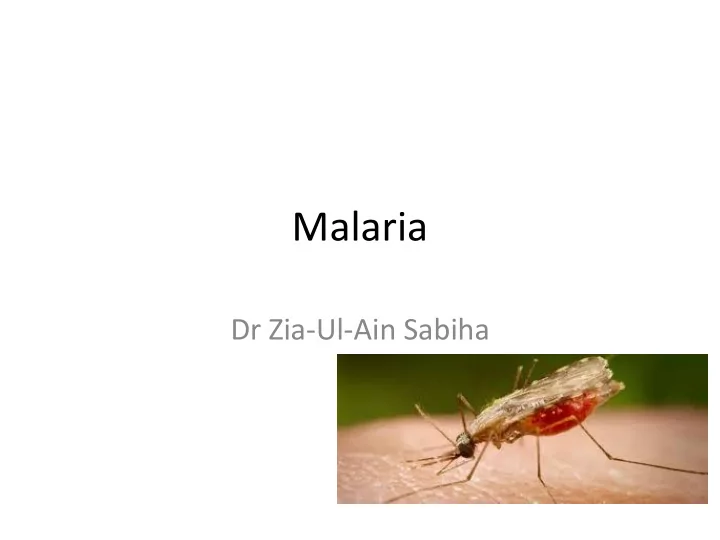
Malaria Dr Zia-Ul-Ain Sabiha Introduction A protozoal Disease - - PowerPoint PPT Presentation

malaria
SMART_READER_LITE
LIVE PREVIEW

Malaria Dr Zia-Ul-Ain Sabiha Introduction A protozoal Disease - - PowerPoint PPT Presentation

Malaria Dr Zia-Ul-Ain Sabiha Introduction A protozoal Disease Caused by genus Plasmodium Transmitted to man by certain species of infected female Anopheline mosquito. Typical attack Comprises 3 distinct stages Cold stage, hot stage,


slide-1
SLIDE 1

Malaria

Dr Zia-Ul-Ain Sabiha

slide-2
SLIDE 2

Introduction

  • A protozoal Disease Caused by genus

Plasmodium

  • Transmitted to man by certain species of

infected female Anopheline mosquito.

  • Typical attack Comprises 3 distinct stages

Cold stage, hot stage, and sweating stage

slide-3
SLIDE 3

Severity of disease

  • Severity of disease vary form mild to severe

and complicated according to

– Species of parasite present – The patient state of immunity – The intensity of infection – Malnutrition – Other diseases

slide-4
SLIDE 4
slide-5
SLIDE 5

Who Is Most Vulnerable?

  • Young children
  • Non- immune pregnant women

– ( miscarriage ,Low birth weight)

  • Semi -immune pregnant women(high transmission areas)
  • Semi -immune HIV infected pregnant women
  • People with HIV/AIDs
  • International travelers from non endemic areas
  • Immigrants From endemic areas and their

children

slide-6
SLIDE 6

Statistics

  • 3.2 billion people (half the world’s population)

live in areas at risk of malaria transmission in 106 countries and territories

  • In 2012, malaria caused an estimated 207

million clinical episodes, and 627,000 deaths. An estimated 91% of deaths in 2010 were in the African Region.

https://www.cdc.gov/malaria/malaria_worldwi de/impact.html

slide-7
SLIDE 7
slide-8
SLIDE 8

Situation in Pakistan

  • With an estimated burden of 1.6 million cases annually, malaria is

considered as a major public health problem in Pakistan.

  • It contributes 22% of total disease burden in the Eastern

Mediterranean Region (EMR) and has been grouped with Sudan and Yemen in category 3 countries .

  • Epidemiologically, Pakistan is classified as a moderate malaria

endemic country with national API( annual parasite index) averaging at 1.69 and important diversity within and between the provinces and districts.

  • The two parasites which account for malaria in Pakistan are

Plasmodium Vivax and Falcipaum.

  • The main vectors in the country are Anopheles Culicifacies and

Anopheles Stephensi.

slide-9
SLIDE 9

Diagnosis and Treatment

  • Early Diagnosis( WHO recommends)

– Parasite based diagnostic testing

  • Microscopy
  • Rapid diagnostic test
  • Treatment

– ACT(Artemisinin- based combination therapy)

slide-10
SLIDE 10

Preventive Measures

  • Insecticides- treated mosquito nets
  • Indoor spraying with residual insecticides
  • Insecticide resistance

– Vector control with Pyrethroids

  • Elimination
slide-11
SLIDE 11

Elimination

  • Elimination is defined as interrupting local

mosquito born malaria transmission in a defined geographical area, i,e zero incidence

  • f locally contracted cases.
  • Malaria eradication as defined as the

permanent reduction to zero of the world wide incidence of malaria infection caused by a specific agent; i.e applies to a particular malaria parasite species.

slide-12
SLIDE 12

Malaria control strategic plan 2015- 2020

Pakistan entails developing innovative strategies that will:

  • a. Improve the performance and impact of malaria control

in Pakistan with maximizing public sector investment and accountability in malaria control activities

  • b. Reduce diagnostic delay related to malaria and improve

the efficacy of treatment

  • c. Prevent malaria disease by effective vector control

interventions with universal coverage of LLINs(long lasting insecticides nets) and selective IRS(indoor residual spraying)

  • d. Better surveillance and program management
  • e. Prioritize research that has the potential to change policy

and practice in malaria care in the province

slide-13
SLIDE 13

MALARIA CONTROL PROGRAM PAKISTAN: VISION, GOAL AND OBJECTIVES

  • Vision
  • Malaria free Pakistan
slide-14
SLIDE 14

Goal

  • By 2020, reduce the malaria burden by 75% in

high and moderate endemic districts/agencies

  • and eliminate malaria in low endemic districts
  • f Pakistan
slide-15
SLIDE 15
  • Objectives
  • 1. To achieve <5 API in high endemic areas of

province of Balochistan, Sindh, KP and FATA region by 2020

  • 2. To achieve <1% API within moderate

endemic districts of Balochistan, Sindh, KP and Punjab by 2020

  • 3. To achieve Zero API within low endemic

districts of Sindh, KP and Punjab by 2020

slide-16
SLIDE 16

Roll back Malaria

slide-17
SLIDE 17

Action and investment to defeat malaria 2016 and 2030

Goals Milestones 2020 2025 Targets 2030 Reduce malaria mortality rates globally compared with 2015 At least 40 % At least 75% At least 90 % Reduce malaria case incidence globally compared with 2015 At least 40 % At least 75% At least 90% Eliminate malaria from countries in which malaria was transmitted in 2015 At least 10 countries At least 20 countries At least 35 countries Prevent re-establishment of malaria in all countries that are malaria free Re- establishmen t prevented Re- establishme nt prevented Re- establishme nt prevented

slide-18
SLIDE 18
  • Recent years have seen extraordinary advances in the fight against

malaria,but the gains are fragile and unevenly distributed. Victory against the malaria parasite would rank among the highest achievements in human history. To reach the 2030 malaria goals and bring our vision of a malaria-free world within reach, we must:

  • Combine forces to defeat malaria and recognize the important role that

all stakeholders, including non-health sectors, play in the reduction and elimination of malaria,

  • Demonstrate continued progress and show that reducing malaria is

critical to achieving the Sustainable Development Goals,

  • Expand partnerships work across countries, and call on stakeholders in all

areas to participate and intensify their engagement in the fight against malaria, and

  • Accelerate efforts and act with urgency to reduce the number of people

suffering and dying from a preventable and treatable illness and achieve malaria elimination locally, nationally, and regionally as soon as possible.