MAIN ST RESILIENCE PLAN Community Workshops St. Bernard Ave. Meeting - - PowerPoint PPT Presentation

main st resilience plan
SMART_READER_LITE
LIVE PREVIEW

MAIN ST RESILIENCE PLAN Community Workshops St. Bernard Ave. Meeting - - PowerPoint PPT Presentation

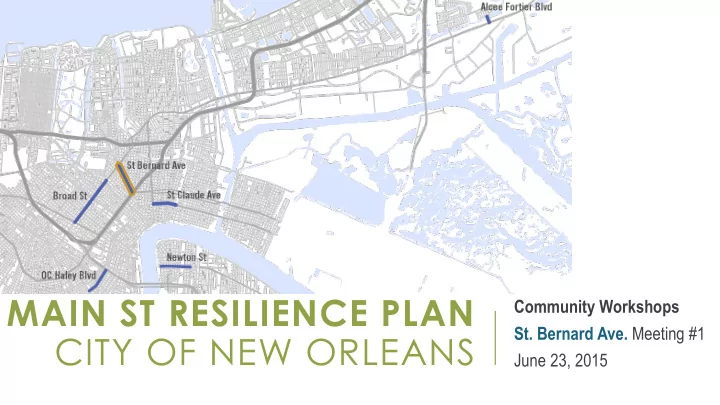
MAIN ST RESILIENCE PLAN Community Workshops St. Bernard Ave. Meeting #1 CITY OF NEW ORLEANS June 23, 2015 AGENDA Welcome & Introductions Project Overview Defining resilience Coordination with other planning efforts What


slide-1
SLIDE 1

MAIN ST RESILIENCE PLAN CITY OF NEW ORLEANS

Community Workshops

  • St. Bernard Ave. Meeting #1

June 23, 2015
slide-2
SLIDE 2

AGENDA

  • Welcome & Introductions
  • Project Overview
  • Defining resilience
  • Coordination with other planning efforts
  • What We’ve Learned (so far)
  • Residential and Commercial Market
  • Infrastructure / Built Environment
  • Risk and Other Resilience Elements
  • Discussion on Corridor Vulnerability

2

slide-3
SLIDE 3

MEETING #1 OBJECTIVES:

  • Introduce this project and understand relationships between related activities
  • Understand resilience as applied to commercial corridors
  • Review key indicators and input gathered so far on St. Bernard
  • Understand priority concerns and opportunities for improving corridor and

business resilience

3

slide-4
SLIDE 4

Goals Schedule Community Engagement

PROJECT OVERVIEW

slide-5
SLIDE 5

PROJECT GOALS

1. Developed a shared definition of resilient commercial corridors for New Orleans 2. Create a measurable and actionable methodology for assessing the resilience of commercial corridors or Main Streets. 3. Apply methodology to 6 corridors (5 State-designated Main Streets), in the city and develop individualized recommendations for each to address resiliency gaps 4. Develop how-to guides for businesses for improving resiliency as applied to business operations and for businesses/property-owners for improving building resiliency

5

City Planning Commission Metro-So Source, urce, llc llc

slide-6
SLIDE 6

OVERVIEW OF PLANNING PROCESS

6

Initialization

  • Defining Resilience for Main Streets
  • Review Previous Efforts

Assessment

  • Develop standardized assessment
  • Data collection (primary)
  • Business occupant survey

Analysis & Recommendations

  • Commercial and residential market analysis
  • Resilience gap analysis
  • Infrastructure improvements and revitalization strategies

Final Plan

  • Technical guides: business operations & building hardening
  • Draft and final plan; public presentations

PAC Meeting #3 PAC Meeting #1 PAC Meeting #2 PAC Meeting #4

March / April May / June July / August August / September Corridor workshops 1 Business workshops Community meetings Corridor workshops 2 Public presentations

slide-7
SLIDE 7

DEFINING RESILIENCE:

CITY RESILIENCE FRAMEWORK

“Capacity of cities to function so that the people living and working in the cities – particularly the poor and vulnerable – survive and thrive no matter what stresses or shocks they encounter”

drawn from the Rockefeller Foundation 100 Resilient Cities

7

MASTER PLAN: RESILIENCE (Chapter 12)

  • Capacity to anticipate significant multi-hazard threats, to reduce overall the community’s

vulnerability to hazard events, and to respond to and recover from specific hazard events when they occur

  • Capacity to cope with and recover from present-day risks
  • Capacity to adapt to changing conditions, including uncertain, unknown, or unpredictable

risks

drawn from the Community and Regional Resilience Institute (CARRI)

slide-8
SLIDE 8

ASSESSING A RESILIENT COMMERCIAL CORRIDOR

  • How vulnerable are corridor businesses, buildings and infrastructure to shock events?
  • What infrastructure investments are required to facilitate economic prosperity and mitigate

risks/hazards?

  • Are corridor businesses able to weather and reduce stresses, particularly economic

forces?

  • Does the corridor provide local (adjacent) community…

…essential services on an ongoing basis & immediately following a shock event? …emergency shelter? …social & community gathering spaces?

  • Do corridor businesses have access, availability, and the capacity to engage resources

needed to weather shocks & stresses?

  • Are adequate social networks in place to support corridor businesses during shocks and

stresses?

8

slide-9
SLIDE 9

COORDINATING WITH OTHER EFFORTS

9

  • HUD NDRC Application
  • Rockefeller 100 Resilient Cities
  • NORA Commercial Corridor Market Value Analysis
slide-10
SLIDE 10

Residential and Commercial Market Infrastructure / Built Environment Risk and Other Resilience Elements

WHAT WE’VE LEARNED (SO FAR…)

slide-11
SLIDE 11

CORRIDOR PROFILE: BUSINESSES

11

  • 71 Businesses
  • 6 Non business organizations
slide-12
SLIDE 12

CORRIDOR PROFILE: ESSENTIAL SERVICES

12

slide-13
SLIDE 13

CORRIDOR PROFILE: BUSINESSES

Number Industry Examples 17 Eating and Drinking Places Restaurants, bars, takeout food 9 Personal Services Beauty salons, barbers, dry cleaning, tax preparation 8 Miscellaneous retail Cell phones, pharmacies, beauty supplies 6 Food stores Groceries, convenience stores 5 Membership Organizations Churches 5 Automotive Repairs, Services and Parking Mechanics, carwashes

13

  • Mostly serve the immediate neighborhood
  • Cluster of eating and drinking places and personal services

Sources: InfoUSA, 2015; City of New Orleans

  • ccupancy licenses, 2015
slide-14
SLIDE 14

CORRIDOR PROFILE: BUSINESSES

14

  • Establishments are predominantly newer, like those in other corridors as a whole

Sources: InfoUSA, 2015; City of New Orleans

  • ccupancy licenses, 2015

50 100 150 200 250 300 350 400 450 before 1990 1990 to 1994 1995 to 1999 2000 to 2004 2005 to 2009 2010 to 2015

Establishments by Year Started - All Corridors

Business Non-Business 5 10 15 20 25 30 35 40 45 before 1990 1990 to 1994 1995 to 1999 2000 to 2004 2005 to 2009 2010 to 2015

Establishments by Year Started – St. Bernard

Business Non-Business

slide-15
SLIDE 15

CORRIDOR PROFILE: PEOPLE

Population immediately surrounding St. Bernard has grown at a slightly faster pace than the rest of the city

15

0% 5% 10% 15%

  • St. Bernard 0.25 Mile

Radius New Orleans

Percentage Population Change, 2010- 2015

slide-16
SLIDE 16

CORRIDOR PROFILE: PEOPLE

  • Median Age is similar

to city (36.3 vs. 35.6)

  • Corridor is aging at

roughly the same rate as the city

  • Younger age groups

are growing at a faster rate

16

0% 10% 20% 30% 0-19 20-34 35-49 50-64 65-79 80+

2015 Population, by Age Group

  • St. Bernard 1/4 Mile

New Orleans 0% 20% 40% 60% 0-19 20-34 35-49 50-64 65-79 80+

Age Group Rate of Change, 2010-2015

  • St. Bernard 1/4 Mile

New Orleans Change

slide-17
SLIDE 17
  • Median household income is 40% lower than city as a whole ($22,399 vs.

$37,146)

  • Significantly more households in lower income groups; fewer in high income

groups

17

CORRIDOR PROFILE: PEOPLE

$22,399 $37,146 $- $10,000 $20,000 $30,000 $40,000

  • St. Bernard 1/4 Mile

New Orleans

2013 Median HH Income

0% 10% 20% 30% 40% 50% Over $100,000 $50,000-$99,999 $35,000-$49,999 $20,000-$34,999 Under $20,000

Houshold Income Groups, 2013

New Orleans

  • St. Bernard 1/4 Mile
slide-18
SLIDE 18

CORRIDOR PROFILE: AFFORDABILITY

  • Median rent and median home values are lower near St. Bernard than

in the rest of the city

18

$122,576 $183,700 $- $50,000 $100,000 $150,000 $200,000 Median Home Value

Median Home Value

  • St. Bernard 1/4 Mile

New Orleans $638 $765 $500 $600 $700 $800 Median Rent

Median Rent

  • St. Bernard 1/4 Mile

New Orleans

slide-19
SLIDE 19
  • More people rent near St. Bernard, and rent is a higher percentage of

household income than the rest of the city

19

CORRIDOR PROFILE: AFFORDABILITY

65% 35% 53% 47%

Own vs. Rent Homes

% Rent % Own 34% 25% 0% 10% 20% 30% 40%

  • St. Bernard 1/4 Mile

New Orleans

Rent as Percentage of Income

slide-20
SLIDE 20

AFFORDABILITY: HOUSING + TRANSPORTATION

  • Median Income Family
  • 4 People
  • 2 Commuters
  • $47,429 annual income

20

slide-21
SLIDE 21

AFFORDABILITY: HOUSING + TRANSPORTATION

  • Moderate Income Family
  • 3 People
  • 1 Commuter
  • $37,943 annual income

21

slide-22
SLIDE 22

AFFORDABILITY: HOUSING + TRANSPORTATION

  • Very Low Income

Individual

  • 1 Person
  • 1 Commuter
  • $11,720 annual income

22

slide-23
SLIDE 23

MARKET ASSESSMENT

23

Examined three markets:

  • Neighborhood: 1/2-mile buffer
  • The “convenience” market (groceries,

take-out food, pharmacy)

  • 25% capture rate
  • Community: 5-mile drive distance
  • Comparison shopping (restaurants,

clothing, furniture, electronics, hobby goods)

  • 5% capture rate
  • Region: 10-mile drive distance
  • Destination retail and entertainment

(cultural institutions, specialty items)

  • 0. 5% capture rate

Source: Esri 2015

slide-24
SLIDE 24

MARKET ASSESSMENT

. 24

Raw SUPPLY and DEMAND indicators suggest that there is High unmet demand for:

  • General merchandise store (dollar stores, City Target): $26.6 million leakage
  • Automobile dealer: $21 million leakage

And Modest unmet demand for:

  • Small grocery store: $7.8 million leakage
  • Gasoline station: $8.2 million leakage
  • Small electronics/appliance store: $3.4 million leakage

Source: Esri and Dun & Bradstreet, 2015, GCR Analysis

slide-25
SLIDE 25

MARKET ASSESSMENT

25

BUT….

  • What kind of Corridor does the St. Bernard Ave. community want to

be?

  • What space is available for business growth?
  • How will the market change?
slide-26
SLIDE 26

FLOOD ZONES

26

PRELIMINARY FEMA DFIRM

  • St. Bernard is not in a

flood zone

slide-27
SLIDE 27

INFRASTRUCTURE: SEWER & DRAINAGE

27

slide-28
SLIDE 28

CORRIDOR ELEVATION

28

slide-29
SLIDE 29

CORRIDOR BUILDINGS

  • Appear occupied: 78%
  • In ‘average’ or better condition: 74%
  • Elevated foundations: 48%
  • ADA accessible entrance: 38%
  • Elevated Mechanical, Electrical, or Plumbing systems (usually HVAC): 40%
  • Protection for windows or doors: 37%
  • Appendages, such as signs, awnings, or overhangs: 41%

29

slide-30
SLIDE 30

BUSINESS SURVEY

  • 3 of 71 listed business surveyed

30

slide-31
SLIDE 31

OTHER FACTORS: CRIME & SAFETY

  • Overall calls to NOPD have decreased along

with the rest of the city

  • Property & violent crime calls have increased

31

Highest concentration of 911 call in 2014

  • 30%
  • 20%
  • 10%

0% 10% 20% Other Property Traffic Vice Violent All Calls

Change in NOPD Calls, 2012-2014

New Orleans

  • St. Bernard
slide-32
SLIDE 32

OTHER FACTORS: SOCIAL NETWORKS

  • ?

32

slide-33
SLIDE 33

DISCUSSION: CORRIDOR VULNERABILITY

slide-34
SLIDE 34

TOPICS OF DISCUSSION:

  • What weather, economic, demographic, or social events have/can impact the

corridor?

  • What were/are the impacts to the corridor?
  • For past events, what was the recovery time?
  • What infrastructure investments would facilitate the capacity of the corridor to

withstand and recover?

  • What non-infrastructure public investments would facilitate the capacity of the

corridor to withstand and recover? (i.e. police patrols, Main Streets funding, etc.)

  • What social services or social places are needed on the corridor?

34

slide-35
SLIDE 35

DISCUSSION: BUSINESSVULNERABILITY

slide-36
SLIDE 36

TOPICS OF DISCUSSION:

  • What individual, business and private investments

would facilitate the capacity of the corridor to withstand and recover?

  • How can/do businesses on the corridor work

together to withstand and recover?

  • What are essential services are currently lacking

from the corridor?

36

Photo credit: Robert Morris, Uptown Messenger

slide-37
SLIDE 37

NEXT STEPS

  • Complete resilience assessments (June 30)
  • Business Continuity Workshops (June 29 – July 1)
  • Develop preliminary strategies for each corridor (July)
  • Corridor Workshop #2 (St. Bernard: July 21)
  • Prioritize and refine

37

slide-38
SLIDE 38

THANK YOU

Dwight Norton – GCR dnorton@gcrincorporated.com Judith Dangerfield – Metro Source judithdangerfield@metro-source.com

38