Main Points 1. Virginia schools are safer than the public - - PDF document

main points
SMART_READER_LITE
LIVE PREVIEW

Main Points 1. Virginia schools are safer than the public - - PDF document

School Safety in Virginia July 24, 2018 Dewey G. Cornell, Ph. D. School Safety in Virginia Professor of Education in the Curry School of Education at the University of Virginia. Dew ey Cornell, Ph.D. Director of the UVa Youth Violence


slide-1
SLIDE 1

July 24, 2018 Dewey Cornell, Ph.D. 1 School Safety in Virginia

School Safety in Virginia

Dew ey Cornell, Ph.D. Curry School of Education University of Virginia

434-924-8929 Email: youthvio@virginia.edu Website: youthviolence.edschool.virginia.edu

Dewey G. Cornell, Ph. D.

  • Professor of Education in the Curry

School of Education at the University of Virginia.

  • Director of the UVa Youth Violence

Project and faculty associate of the Institute of Law, Psychiatry, and Public Policy.

  • Trained as forensic clinical psychologist
  • Lead author of Authoritative School Climate Survey
  • Developed Virginia Student Threat Assessment Guidelines

2 0 1 7 -1 8 Research Team

Rear: Patrick Meyer, Jennifer Maeng, Yuane Jia, Tim Konold Middle: Francis Huang, Anna Grace Burnette, Dewey Cornell, Brittany Crowley Front: Whitney Hyatt, Shelby Stohlman, Katrina Debnam, Marisa Malone

Grant Funding for School Clim ate and Threat Assessm ent Research in Virginia

2018-20 Improvement of school climate assessment in Virginia secondary

  • schools. U.S. Department of Justice, National Institute of Justice.

2015-18 Student threat assessment as a safe and supportive prevention strategy. U.S. Department of Justice, National Institute of Justice. 2013-14 Student threat assessment as an intervention to reduce racial disparities in school suspension. Open Society Foundations and Indiana University. 2012-16 Development of a standard model for school safety assessment. U.S. Department of Justice, Office of Juvenile Justice and Delinquency Prevention. 2009-13 Mental health counseling and bullying prevention for safe schools/ health

  • students. Contract as part of the Albemarle/ Charlottesville Safe

Schools/ Healthy Students Project awarded by the U.S. Department of Education to Albemarle/ Charlottesville Schools. 2009-10 Effects of school structure and support on youth violence. U.S. Department of Justice, Office of Juvenile Justice and Delinquency Prevention. 2006-08 School-based protective factors for youth violence. U.S. Department of Justice, Office of Juvenile Justice and Delinquency Prevention.

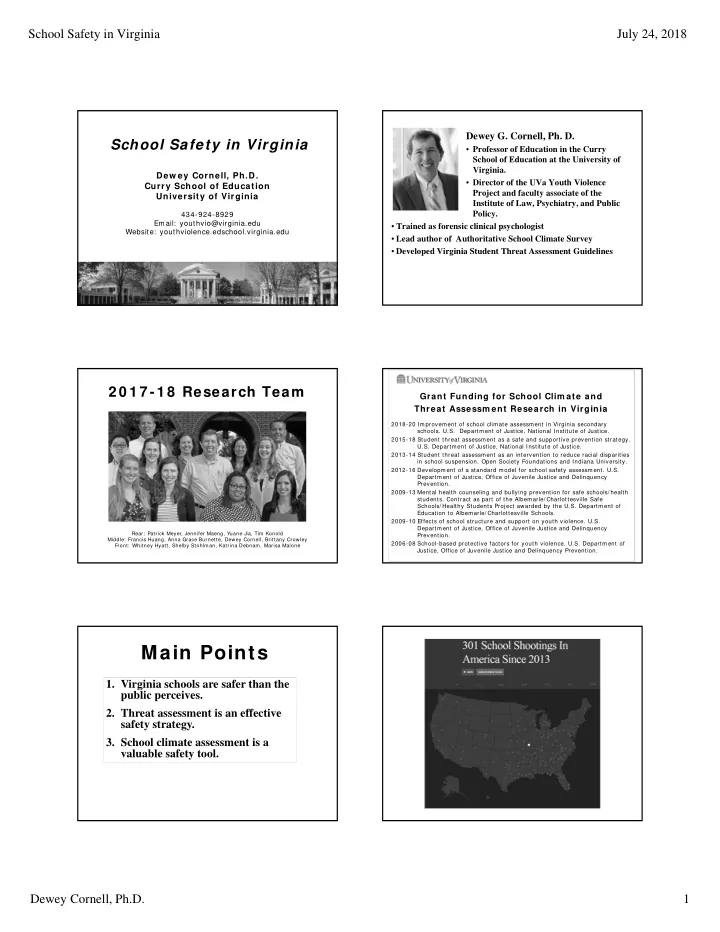
Main Points

  • 1. Virginia schools are safer than the

public perceives.

  • 2. Threat assessment is an effective

safety strategy.

  • 3. School climate assessment is a

valuable safety tool.

slide-2
SLIDE 2

July 24, 2018 Dewey Cornell, Ph.D. 2 School Safety in Virginia Annual Gun Toll

  • 3 3 ,0 0 0 deaths
  • 6 7 ,0 0 0 injuries

1 0 0 ,0 0 0 total

2 7 5

Shootings per day

APA report is available at http:/ / w w w .apa.org/ pubs/ info/ reports/ gun-violence- prevention.aspx Shooting deaths from : National Vital Statistics http:/ / w ebappa.cdc.gov/ sasw eb/ ncipc/ dataRestriction_inj.htm l Shooting injuries from : http:/ / w ebappa.cdc.gov/ sasw eb/ ncipc/ nfirates2 00 1.htm l

5 yrs x 100,000 =

5 0 0 ,0 0 0

  • utside of schools

For every shooting in a school, there are 1 ,6 0 0 + outside of schools

Schools are m uch safer than the surrounding com m unity.

9847 4455 1209 629 533 492 288 211 49

2000 4000 6000 8000 10000 12000

Residence Street Parking lot/garage Outdoors Restaurant/bar Store/gas station Public building/business Hotel/motel School

2005‐2010 Homicides in 37 States

Restaurants are 10x more dangerous than schools. Homes are 200x more dangerous than schools.

Source: FBI National Incident-Based Reporting System (NIBRS) database. Selected locations. School includes colleges. See Nekvasil & Cornell (2015) Psychology of Violence, 5, 236-245.

W hen w as the last tim e a student w as m urdered at one

  • f Virginia’s K-1 2 public

schools?

slide-3
SLIDE 3

July 24, 2018 Dewey Cornell, Ph.D. 3 School Safety in Virginia

The fear of school violence has generated costly and ineffective reactions.

Costly Reactions to School Violence

http: / / www.bloomberg.com/ news/ articles/ 2013-11-14/ schools-boosting-security-spending-after-newtown-massacre

  • Copy cat hoaxes
  • Attention-seeking
  • Students in crisis

The Expansion of Zero Tolerance

From No Guns to

  • No Toy Guns
  • No Nail clippers
  • No Plastic utensils
  • No Finger-pointing
  • No Jokes
  • No Drawings
  • No Rubber band

shooting No accidental violations

slide-4
SLIDE 4

July 24, 2018 Dewey Cornell, Ph.D. 4 School Safety in Virginia

3 .3 Million Suspensions Per Year Fuel the School to Prison Pipeline

Latest available data April 2 0 1 8 https:/ / ocrdata.ed.gov/ StateNationalEstim ations/ Estim ations_ 2 0 1 3 _ 1 4

W e should prevent shootings rather than just prepare for them .

Prevention m eans “to keep som ething from happening” Crisis response is not prevention.

A crisis occurs w hen prevention has failed.

Photo of gunman

This illustrates the we imagine when we think of school

  • shootings. It is an image that directs us to crisis response rather

than prevention.

slide-5
SLIDE 5

July 24, 2018 Dewey Cornell, Ph.D. 5 School Safety in Virginia

Prevention m ust start before the gunm an is at your door. Prevention m ust start before the gunm an is at your door. Prevention m ust start before the gunm an is at your door. Prevention m ust start before the gunm an is at your door.

Threat Assessm ent in Virginia

2 0 0 8 – Higher Education 2 0 1 3 – K-1 2 Schools

W hat is Threat Assessm ent?

Threat assessm ent is a problem - solving approach to violence prevention that involves assessm ent and intervention w ith persons w ho have threatened violence in som e w ay.

slide-6
SLIDE 6

July 24, 2018 Dewey Cornell, Ph.D. 6 School Safety in Virginia Threat Assessm ent is a violence prevention strategy.

  • 1. A classmate, teacher, or someone else

reports concern about a person in distress

  • r who is threatening violence.
  • 2. The threat assessment team evaluates the

seriousness of the threat.

  • 3. The team initiates assistance to address

the underlying problem, conflict or need. In the most serious cases, protective action is taken.

Accurate Threat Assessm ent Avoids 2 Errors … 1 . Over-reaction Accurate Threat Assessm ent Avoids 2 Errors … 2 . Under-Reaction

  • Developed at

University of Virginia in 2 0 0 1

  • Extensively

studied in Virginia schools

  • Dissem inated in

schools nationw ide.

Disclosure: Dr. Cornell sells this book and conducts w orkshops on this m odel.

Threat Reported to Principal

Step 1. Evaluate Threat. Step 2. Decide if threat is clearly transient or substantive. Step 3. Respond to transient threat. Step 4. Decide if the substantive threat is serious or very serious. Step 5. Respond to serious substantive threat. Step 6. Conduct Safety Evaluation.

Threat is serious. Threat is clearly transient. Threat is substantive. Threat is very serious.

Step 7. Follow up on action plan.

Research on Threat Assessm ent

1. Cornell, D., Sheras, P. Kaplan, S., McConville, D., Douglass, J., Elkon, A., McKnight, L., Branson, C., & Cole, J. (2004). Guidelines for student threat assessment: Field-test findings. School Psychology Review, 33, 527-546. 2. Kaplan, S., & Cornell, D. (2005). Threats of violence by students in special education. Behavioral Disorders, 31, 107-119. 3. Strong, K., & Cornell, D. (2008). Student threat assessment in Memphis City Schools: A descriptive report. Behavioral Disorders, 34, 42-54. 4. Allen, K., Cornell, D., Lorek, E., & Sheras, P. (2008). Response of school personnel to student threat assessment training. School Effectiveness and School Improvement, 19, 319-332. 5. Cornell, D., Sheras, P., Gregory, A., & Fan, X. (2009). A retrospective study of school safety conditions in high schools using the Virginia Threat Assessment Guidelines versus alternative approaches. School Psychology Quarterly, 24, 119-129. 6. Cornell, D., Gregory, A., & Fan, X. (2011). Reductions in long-term suspensions following adoption of the Virginia Student Threat Assessment Guidelines. Bulletin of the National Association of Secondary School Principals, 95, 175-194. 7. Cornell, D., Allen, K., & Fan, X. (2012). A randomized controlled study of the Virginia Student Threat Assessment Guidelines in grades K-12. School Psychology Review, 41, 100-115. 8. Cornell, D. & Lovegrove, P. (2015). Student threat assessment as a method for reducing student suspensions. In D. Losen (Ed.). Closing the School Discipline Gap: Research for Policymakers. New York, NY: Teachers College Press. 9. Nekvasil, E., Cornell, D. (2015). Student threat assessment associated with positive school climate in middle schools. Journal of Threat Assessment and Management 2, 98-113. http://dx.doi.org/10.1037/tam0000038 10. Burnette, A. G., Datta, P. & Cornell, D. G. (2017). The distinction between transient and substantive student threats. Journal of Threat Assessment and Management. http://psycnet.apa.org/record/2017-56103-001 11. Cornell, D., Maeng, J., Burnette, A.G., Jia, Y., Huang, F., Konold, T., Datta, P., Malone, M., Meyer, P. (2017). Student threat assessment as a standard school safety practice: Results from a statewide implementation study. School Psychology Quarterly. http://dx.doi.org/10.1037/spq0000220 12. Cornell, D., Maeng, J., Huang, F., Shukla, K., & Konold, T. (in press). Racial/ethnic parity in disciplinary consequences using student threat assessment. School Psychology Review.

slide-7
SLIDE 7

July 24, 2018 Dewey Cornell, Ph.D. 7 School Safety in Virginia

Research on Threat Assessm ent

  • 1. 99% of threats not carried out.
  • 2. Only 1% expelled, 1% arrested.
  • 3. Suspension rates decreased.
  • 4. Racial disparities reduced or absent.
  • 5. Counseling used more often.
  • 6. More positive school climate.

Virginia m andates K-1 2 threat assessm ent in 2 0 1 3

Student Threat Assessm ent as a Safe and Supportive Prevention Strategy 4-year project (2015-2018)

This project supported by Grant # NIJ 2014-CK-BX-0004 awarded by the National Institute of Justice, Office of Justice Programs, U.S. Department of Justice. The opinions, findings, and conclusions or recommendations expressed in this publication/ program/ exhibition are those of the author(s) and do not necessarily reflect those of the Department of Justice.

Virginia School Threat Assessm ent: Positive Findings

  • Schools are resolving thousands of threats

w ithout serious violence.

  • Schools are m aking differentiated

assessm ents, recognizing that m ost cases are not serious.

  • Most students are able to return to school,

w ith few arrests or expulsions.

  • Sim ilar outcom es for Black, Hispanic, and

W hite students.

Three Areas of Concern

  • 1. State law requires threat assessment for

individuals who pose a “threat of violence to self

  • r others” (expanding threat assessment to

include suicide assessment).

  • 2. DCJS developed some general guidelines for

threats assessment and provides training in regional workshops.

  • 3. Teams required to report “quantitative data on

its activities according to guidance developed by the Department of Criminal Justice Services.”

Threat Assessm ent in Virginia K-1 2 Schools

  • 1. State law requires threat assessment for

individuals who pose a “threat of violence to self

  • r others” (expanding threat assessment to

include suicide assessment).

Concerns

  • Mental health field already has established procedures for

suicide assessment.

  • Suicide assessment does not need team involvement,

interviewing of witnesses, law enforcement, etc.

– Only 5% of cases involve threat to self and others – 50% threat to self only – 45% threat to others only

slide-8
SLIDE 8

July 24, 2018 Dewey Cornell, Ph.D. 8 School Safety in Virginia

Threat Assessm ent in Virginia K-1 2 Schools

  • 1. State law requires threat assessment for

individuals who pose a “threat of violence to self or others” (expanding threat assessment to include suicide assessment).

Recom m endation

Conduct threat assessments for threats to others and suicide assessments for threats to self. Coordinate assessments when they co-occur.

Threat Assessm ent in Virginia K-1 2 Schools

  • 2. DCJS developed some general guidelines for

threats assessment and provides training in regional workshops.

Concerns

  • 35% of team members lack training.
  • 47% of high school staff members unaware their

school has a team.

Sources: 2018 Virginia Secondary School Climate Survey and 2017 Virginia School Safety Audit Survey Results

Threat Assessm ent in Virginia K-1 2 Schools

  • 2. DCJS developed some general guidelines for

threats assessment and provides training in regional workshops.

Recom m endations

  • Require training for team members.
  • Require schools to provide a general safety
  • rientation to all staff that includes threat

reporting procedures.

  • Give DCJS the resources needed to provide

statewide training and consultation.

Threat Assessm ent in Virginia K-1 2 Schools

  • 3. Teams required to report “quantitative data
  • n its activities according to guidance

developed by the Department of Criminal Justice Services.”

Concerns

  • 34% of schools are not conducting threat

assessments.

  • Schools resist reporting case data to DCJS.

Threat Assessm ent in Virginia K-1 2 Schools

  • 3. Teams required to report “quantitative data on

its activities according to guidance developed by the Department of Criminal Justice Services.”

Recom m endations

  • Clarify that DCJS can collect standard data on all

threat cases (student demographics, nature of threat, school actions, outcome).

  • Direct DCJS to examine data to identify safety

training needs for schools.

Threat assessm ent is effective w hen students trust the adults in their school and are w illing to seek help to prevent violence.

slide-9
SLIDE 9

July 24, 2018 Dewey Cornell, Ph.D. 9 School Safety in Virginia

Prevention begins w ith a safe and supportive school clim ate. W e can prevent violence by helping all students to be successful in school.

I m provem ent of School Clim ate Assessm ent in Virginia Secondary Schools 3-year project (2018-2020)

  • Assess how climate surveys being used
  • Improve survey scoring and reporting
  • Answer longitudinal questions over 8 years

– Factors linked to improved safety – Factors linked to lower suspension and dropout rates – Role of SROs in school safety

This project supported by Grant # NIJ 2017-CK-BX-007 awarded by the National Institute of Justice, Office

  • f Justice Programs, U.S. Department of Justice. The opinions, findings, and conclusions or

recommendations expressed in this publication/ program/ exhibition are those of the author(s) and do not necessarily reflect those of the Department of Justice.

School Clim ate Survey Developm ent

1998-2007 developed school climate surveys for Albemarle, Roanoke, and Virginia Beach 2007 tested first statewide school climate survey in 9th grade 2009-13 development of surveys for grades 4-12 in Albemarle and Charlottesville 2013-18 conducted statewide school climate surveys (alternate years grades 6-8 and 9-12) Each year we have examined the reliability and validity the survey, incorporated feedback, and made improvements.

School Clim ate Survey Developm ent

1. Lacey, A., & Cornell, D. (2013). The impact of bullying climate on schoolwide academic performance. Journal of Applied School Psychology 29, 262-283. 2. Mehta, S., Cornell, D., Fan, X., & Gregory, A. (2013). Bullying climate and school engagement in ninth grade students. Journal of School Health, 83, 45-52. 3. Cornell, D., Gregory, A., Huang, F., & Fan, X. (2013). Perceived prevalence of bullying and teasing predicts high school dropout rates. Journal of Educational Psychology, 105, 138-149. 4. Gregory, A., Cornell, D., & Fan, X. (2012). Teacher safety and authoritative school climate in high schools. American Journal of Education, 118, 401-425. 5. Cornell, D., Klein, J., Konold, T., & Huang, F. (2012). Effects of validity screening items on adolescent survey data. Psychological Assessment, 24, 21-33. doi: 10.1037/a0024824 6. Huang, F., & Cornell, D. (2012). Pick your Poisson: A tutorial on analyzing counts of student victimization data. Journal of School Violence, 11, 187-206. 7. Gregory, A., Cornell, D., & Fan, X. (2011). The relationship of school structure and support to suspension rates for Black and White high school students. American Educational Research Journal, 48, 904-934. doi: 10.3102/0002831211398531 8. Cornell, D., Gregory, A., & Fan, X. (2011). Reductions in long-term suspensions following adoption of the Virginia Student Threat Assessment Guidelines. Bulletin of the National Association of Secondary School Principals, 95, 175-194. 9. Lee, T., Cornell, D., Gregory, A., & Fan, X. (2011). High suspension schools and dropout rates for black and white students. Education and Treatment of Children, 34, 167-192.

  • 10. Gregory, A., Cornell, D., Fan, X., Sheras, P., Shih, T., & Huang, F. (2010). Authoritative school discipline: High school practices associated with lower student bullying and
  • victimization. Journal of Educational Psychology, 102, 483-496.
  • 11. Eliot, M., Cornell, D., Gregory, A., & Fan, X. (2010). Supportive school climate and student willingness to seek help for bullying and threats of violence. Journal of School Psychology,

48, 533-553.

  • 12. Klein, J., & Cornell, D. (2010). Is the link between large high schools and student victimization an illusion? Journal of Educational Psychology, 102, 933-946. doi: 10.1037/a0019896
  • 13. Gregory, A., & Cornell, D. (2009). “Tolerating” adolescent needs: Moving beyond zero tolerance policies in high school. Theory into Practice, 48, 106-113.
  • 14. Bandyopadhyay, S., Cornell, D., & Konold, T. (2009). Internal and external validity of three school climate scales from the School Climate Bullying Survey. School Psychology Review,

38, 338-355.

  • 15. Cornell, D., Sheras, P., Gregory, A., & Fan, X. (2009). A retrospective study of school safety conditions in high schools using the Virginia Threat Assessment Guidelines versus

alternative approaches. School Psychology Quarterly, 24, 119-129.

  • 16. Konold, T., Cornell, D., Huang, F., Meyer, P., Lacey, A., Nekvasil, E., Heilbrun, A., & Shukla, K. (2014). Multi-level multi-informant structure of the Authoritative School Climate
  • Survey. School Psychology Quarterly, 29, 238-255. http://dx.doi.org/10.1037/spq0000062
  • 17. Huang, F., Cornell, D., & Konold, T. (2014). Aggressive attitudes in middle schools: A factor structure and criterion-related validity study. Assessment, 22, 497-512. doi:

1073191114551016

  • 18. Lacey, A., & Cornell, D. (2014). School administrator assessments of bullying and state-mandated testing. Journal of School Violence, 15, 189-212. doi: 10.1080/15388220.2014.971362
  • 19. Konold, T., & Cornell, D. (2015). Multilevel, multitrait - multimethod latent analysis of structurally different and interchangeable raters of school climate. Psychological Assessment, 27,

1097-1109. http://dx.doi.org/10.1037/pas0000098

  • 20. Cornell, D., Shukla, K., & Konold, T. (2015). Peer victimization and authoritative school climate: A multilevel approach. Journal of Educational Psychology, 107, 1186-1201.

http://dx.doi.org/10.1037/edu0000038

  • 21. Heilbrun, A., Cornell, D., & Lovegrove, P. (2015). Principal attitudes and racial disparities in school suspensions. Psychology in the Schools, 52, 489-499. doi: 10.1002/pits.21838
  • 22. Huang, F., Cornell, D., Konold, T., Meyer, P., Lacey, A., Nekvasil, E., Heilbrun, A., & Shukla, K. (2015). Multilevel factor structure and concurrent validity of the teacher version of the

Authoritative School Climate Survey. Journal of School Health, 85, 843-851. doi: 10.1111/josh.12340

  • 23. Lacey, A., Cornell, D., & Konold, T. (2015). The relations between teasing and bullying and middle school standardized exam performance. The Journal of Early Adolescence, 37, 192-
  • 221. doi: 10.1177/0272431615596428
  • 24. Millspaugh, S., Cornell, D., Huang, F., & Datta, P. (2015). Prevalence of aggressive attitudes and student willingness to report threats of violence in middle schools. Journal of Threat

Assessment and Management, 2, 11-22. doi: http://dx.doi.org/10.1037/tam0000031

  • 25. Nekvasil, E., & Cornell, D. (2015). Student threat assessment associated with positive school climate in middle schools. Journal of Threat Assessment and Management, 2, 98-113. http:/

School Clim ate Survey Developm ent

  • 26. Berg, J., & Cornell, D. (2015). Middle school aggression toward teachers, authoritative school climate, and teacher distress. School Psychology Quarterly, 31, 122-139.

ttp://dx.doi.org/10.1037/spq0000132

  • 27. Huang, F., & Cornell, D. (2015). Using multilevel factor analysis with clustered data: Investigating the factor structure of the Positive Values Scale. Journal of Psychoeducational Assessment, 34,

3-14. doi: 10.1177/0734282915570278

  • 28. Berg, J., & Cornell, D. (2016). Authoritative school climate, aggression toward teachers, and teacher distress in middle school. School Psychology Quarterly, 31, 122-139.

http://dx.doi.org/10.1037/spq0000132

  • 29. Datta, P., Cornell, D., & Huang, F. (2016). Aggressive attitudes and prevalence of bullying bystander behaviors in middle schools. Psychology in the Schools, 53, 804-816. doi: 10.1002/pits.21944
  • 30. Cornell, D., Shukla, K., & Konold, T. (2016). Authoritative school climate and student academic engagement, grades, and aspirations in middle and high schools. AERA Open, 2, 1-18, doi:

10.1177/2332858416633184.

  • 31. Malone, M., Cornell, D., & Shukla, K. (2017). Association of grade configuration with school climate for 7th and 8th grade students. School Psychology Quarterly, 32, 350.

http://dx.doi.org/10.1037/spq0000174

  • 32. Heilbrun, A., Cornell, D., & Konold, T. (2018). Authoritative school climate and suspension rates in middle schools: Implications for reducing the racial disparity in school discipline. Journal of

School Violence, 17, 324-338. doi: 10.1080/15388220.2017.1368395

  • 33. Huang, F., & Cornell, D. (2015). Multilevel factor structure, concurrent validity, and test-retest reliability of the high school teacher version of the Authoritative School Climate Survey. Journal of

Psychoeducational Assessment, 34, 536-549. doi: 10.1177/0734282915621439

  • 34. Konold, T., & Cornell, D. (2015). Measurement and structural relations of an Authoritative School Climate model: A multi-level latent variable investigation. Journal of School Psychology, 53,

447-461. doi:10.1016/j.jsp.2015.09.001

  • 35. Huang, F. & Cornell, D. (2015). The impact of definition and question order on the prevalence of bullying victimization using student self-reports. Psychological Assessment, 27, 1484-1493.

http://dx.doi.org/10.1037/pas0000149

  • 36. Jia, Y., Konold, T., & Cornell, D. (2015). Authoritative school climate and high school dropout rates. School Psychology Quarterly, 31, 289-303. http://dx.doi.org/10.1037/spq0000139
  • 37. Cornell, D., & Huang, F. (2016). Authoritative school climate and high school student risk behavior: A cross-sectional multi-level analysis of student self-reports. Journal of Youth and

Adolescence, 45, 2246-2259. doi: 10.1007/s10964-016-0424-3

  • 38. Jia Y., Konold T., Cornell D., & Huang F. (2016) The impact of validity screening on associations between self-reports of bullying victimization and student outcomes. Educational and

Psychological Measurement, 0, 1-23. doi: 10.1177/0013164416671767

  • 39. Shukla, K., Konold, T., & Cornell, D. (2016). Profiles of student perceptions of school climate: Relations with risk behaviors and academic outcomes. American Journal of Community Psychology,

57, 291-307. doi: 10.1002/ajcp.12044

  • 40. Konold, T. R., & Shukla, K. (2017). Estimating School Climate Traits Across Multiple Informants: An Illustration of a Multitrait–Multimethod Validation Through Latent Variable
  • Modeling. Educational Assessment, 22(1), 54-69. http://dx.doi.org/10.1080/10627197.2016.1271705
  • 41. Konold, T., Cornell, D., Shukla, K., & Huang, F. (2017). Racial/ethnic differences in perceptions of school climate and its association with student engagement and peer aggression. Journal of

Youth and Adolescence, 46(6), 1289-1303. doi: 10.1007/s10964-016-0576-1

  • 42. Huang, F. & Cornell D. (2017). Student attitudes and behaviors as explanations for the Black-White suspension gap. Children and Youth Services Review, 73, 298-308.
  • 43. Konold, T.R. (2016). A multilevel MTMM approach to estimating the influences of contextual factors on trait and informant based method effects in assessments of school climate. Journal of

Psychoeducational Assessment. doi: 0734282916683286.

  • 44. Shukla, K., & Konold, T.R. (2018). A two-step latent profile method for identifying invalid respondents in self-reported survey data. Journal of Experimental Education. 86, 473-488

http://dx.doi.org/10.1080/00220973.2017.1315713.

  • 45. Huang, F., & Cornell, D. (2015). Question order affects the measurement of bullying victimization. Educational and Psychological Measurement, 76, 724-740, doi: 10.1177/0013164415622664
  • 46. Huang, F., Eklund, K., & Cornell, D. (2016). Authoritative school climate, family structure, and academic achievement. School Psychology Quarterly. Advance online publication.

http://dx.doi.org/10.1037/spq0000182

  • 47. Datta, P., Cornell, D., & Huang, F. (2017). The toxicity of bullying by teachers and other school staff. School Psychology Review, 46, 335-348. doi: 10.17105/spr-2017-0001.v46-4
  • 48. Malone, M., Cornell, D., & Shukla, K. (under review). Grade configuration is associated with standardized test pass rates for 6th, 7th, and 8th grade students.
  • 49. Cornell, D., & Huang, F. (in press). Collecting and analyzing local school safety and climate data. In Mayer, M. & Jimerson, S. (Eds.) School safety and violence prevention: Science, practice, and

policy driving change. Washington, DC: American Psychological Association.

  • 50. Datta, P., Cornell, D., & Konold, T. (in press). The association of teen dating aggression with risk behaviors and academic adjustment. Journal of Interpersonal Violence.
slide-10
SLIDE 10

July 24, 2018 Dewey Cornell, Ph.D. 10 School Safety in Virginia

Virginia Secondary School Clim ate Study

  • Surveys of students and teachers
  • 700+ middle and high schools
  • Biannually since 2013
  • Funded by federal grants
  • In collaboration with DCJS

2 0 1 8 High School Results

3 2 2 high schools 8 5 ,7 5 0 students 1 6 ,5 2 5 staff

Median com pletion 1 4 .5 m inutes, 9 2 % < 3 0 m inutes

Schools receive individual reports of their school clim ate and safety

2 3 pages, detailed findings for students and staff, com parisons to state and regional norm s

Selected Student Responses 2 0 1 8 Statew ide

Strongly Disagree Disagree Agree Strongly Agree I feel safe in this school. 7% 19% 59% 15% If another student talked about killing someone, I would tell one of the teachers or staff at school. 3% 11% 36% 50% If another student brought a gun to school, I would tell one of the teachers

  • r staff at school.

3% 5% 26% 66%

Selected Staff Responses 2 0 1 8 Statew ide

Strongly Disagree Disagree

Somewhat Disagree Somewhat Agree

Agree Strongly Agree

I feel physically safe at this school. 3% 4% 7% 17% 42% 27% I feel there is adequate safety and security in this school. 8% 10% 13% 22% 31% 16% The school administration responds and supports staff when they have problems with student aggression. 5% 6% 9% 20% 35% 24%

Survey Use

  • 92% share results with staff
  • 67% share with students
  • 65% share with parents
  • 63% use for school planning
slide-11
SLIDE 11

July 24, 2018 Dewey Cornell, Ph.D. 11 School Safety in Virginia

Principal Feedback

  • More questions on safety
  • More recommendations on school

improvement

  • More breakdown by student

demographics

Principal Com m ents

  • Report was very helpful.
  • We look forward to the results.
  • Used to improve our school safety

and security protocols.

  • The survey is too long.
  • We have multiple surveys to

complete.

W hat is Authoritative School Clim ate?

Developm ental research has found that the m ost effective parents are authoritative, not authoritarian or perm issive. They have high expectations and are dem anding, but they are also w arm and supportive. Our research suggests that schools are m ost effective w hen teachers are dem anding and w arm , too.

Four types of schools?

Structure

Low Support High Authoritarian Authoritative Disengaged Permissive Low Structure High

2.6 2.6 3 2.8 2.4 2.7 2.6 2.7

The punishm ent for breaking school rules is the sam e for all students Students at this school only get punished w hen they deserve it Students are treated fairly regardless of their race or ethnicity Students are suspended w ithout good reason ( reverse scored) The adults at this school are too strict ( reverse scored) The school rules are fair W hen students are accused of doing som ething w rong, they get a chance to explain it Overall STRUCTURE

1 -Strongly Disagree 2 -Disagree 3 -Agree 4 -Strongly Agree

Discipline - Strict, but Fair

2.9 3.1 2.7 2.8 2.9 3 3.1 3.4 3

Most teachers and other adults at this school care about all students Most teachers and other adults at this school w ant all students to do w ell Most teachers and other adults at this school listen to w hat students have to… Most teachers and other adults at this school treat students w ith respect There are adults at this school I could talk w ith if I had a personal problem I f I tell a teacher that som eone is bullying m e, the teacher w ill do… I am com fortable asking m y teachers for help w ith m y school w ork There is at least one teacher or another adult at this school w ho really w ants… Overall SUPPORT

1 -Strongly Disagree 2 -Disagree 3 -Agree 4 -Strongly Agree

Support - Caring and W illing to Help

slide-12
SLIDE 12

July 24, 2018 Dewey Cornell, Ph.D. 12 School Safety in Virginia

Disciplinary Structure and Support established in m ulti-level structural factor analysis

Konold et al (2014), Multilevel multi-informant structure of the Authoritative School Climate Survey, School Psychology Quarterly, 29, 238-255.

Authoritative School Clim ate leads to higher SOL scores and graduation rates

27 46 52 73

20 40 60 80

Low Str/ Low Supp Disengaged Hi Str/ Low Supp Authoritarian Lo Str/Hi Supp Permissive Hi Str/Hi Supp Authoritative

School Percentile in Student Engagement

Student Engagement

slide-13
SLIDE 13

July 24, 2018 Dewey Cornell, Ph.D. 13 School Safety in Virginia

2013-14 school year

Authoritative School Clim ate

  • Higher student engagement
  • Less teasing and bullying
  • Teachers report less aggression from

students

  • Less fighting and weapon carrying
  • Lower suspension rates

Authoritative School Clim ate

Findings consistent across schools varying in:

  • School size
  • Student poverty %
  • Minority students %
  • Urbanicity

School Clim ate Concerns

  • 1. Many schools are burdened with

multiple surveys.

  • 2. Multiple state agencies want to

survey staff and students.

  • 3. Biannual surveys do not provide

timely information for annual planning.

  • 4. Surveys must be reliable and valid to

be useful.

Recom m endations

  • 1. Authorize DCJS to conduct a single

school climate survey that encompasses safety, education, and health interests.

  • 2. Survey students and staff in

secondary schools (grades 6-12) on an annual basis.

slide-14
SLIDE 14

July 24, 2018 Dewey Cornell, Ph.D. 14 School Safety in Virginia

Concluding Points

1. Place more emphasis on prevention rather than preparation for violence. 2. Help schools to use threat assessment to prevent violence. 3. Encourage statewide use of an annual school climate and safety survey.

http:/ / youthviolence.edschool.virginia.edu