
SLIDE 1
1
Magnetism of Atoms and Ions
Wulf Wulfhekel Physikalisches Institut, Karlsruhe Institute of Technology (KIT) Wolfgang Gaede Str. 1, D-76131 Karlsruhe
Magnetism of Atoms and Ions Wulf Wulfhekel Physikalisches Institut, - - PowerPoint PPT Presentation
Magnetism of Atoms and Ions Wulf Wulfhekel Physikalisches Institut, Karlsruhe Institute of Technology (KIT) Wolfgang Gaede Str. 1, D-76131 Karlsruhe 1 0. Overview Literature J.M.D. Coey, Magnetism and Magnetic Materials, Cambridge University
1
Wulf Wulfhekel Physikalisches Institut, Karlsruhe Institute of Technology (KIT) Wolfgang Gaede Str. 1, D-76131 Karlsruhe
2
Literature J.M.D. Coey, Magnetism and Magnetic Materials, Cambridge University Press, 628 pages (2010). Very detailed Stephen J. Blundell, Magnetism in Condensed Matter, Oxford University Press, 256 pages (2001). Easy to read, gives a condensed overview
John Whiley and Sons (2005). Solid state aspects
3
Chapters of the two lectures
4
The equation of motion The Hamilton function: with T the kinetic energy and V the potential, q the positions and p the momenta gives the equations of motion: Hamiltonian gives second order differential equation of motion and thus p(t) and q(t) t q p Initial conditions needed for Classical equations need information on the past!
5
The Schrödinger equation Quantum mechanics replacement rules for Hamiltonian: Equation of motion transforms into Schrödinger equation: t Initial conditions needed for Schrödinger equation does not need information on the past! Schrödinger equation operates on wave function (complex field in space) and is of first order in time. Absolute square of the wave function is the probability density to find the particle at selected position and time. q How is that possible? We know that the past influences the present!
6
Limits of knowledge
7
Eigenstates To determine an observable quantity O (for example average position q) you calculate: In case the Hamiltonian is no function of the time, you get the time independent equation: and the energy is conserved The Schrödinger equation usually has more than one solution with different energies Solutions with a particular energy are called eigenstates of the system For an eigenstate you find: For all eigenstates, expectation values of observables (that do not explicitly depend on time) are time independent and the energy has no spread (sharp value)
8
Quantum numbers Often, the Hamiltonian does not change under particular transformations (change of time, position, rotation in space, etc.) Each of these “symmetries” gives conserved quantities (just like time translation and energy) See→ Noether theorem Especially, if H and O commute, you can find states that are eigenstates of both H and O
9
Quantum numbers A complete set of commuting operators (commute pairwise) gives a full basis set of eigenfunctions of the quantum mechanical problem There is no need to write down the wave function, you can characterize it by giving the eigenvalues of the complete set of operators Since we are “lazy”, we will use this nomenclature and only show pictures Any quantum state can than be written by a superposition of eigenstates and it is sufficient to give the complex coefficients Since eigenstates and coefficients do not depend on time, all time dependence comes from the energy of the eigenstates
10
Central potentials and the angular moment Neither the kinetic energy nor the potential energy changes, if we rotate the coordinate system around the origin Two rotation angles are needed to describe this → we expect two conserved quantities Angular momentum Standard choice of set of commutating operators is l2 and lz Solutions of the angular part of the Schrödinger equation are the spherical harmonics with
11
Spherical harmonics Eigenvalues are: Phase of Ylm: Useful: i.e. like s-orbital, no angular momentum The moon?
12
Central potentials and the angular moment Individual components of l do not commute Ylm has an exact value for l2 and lz, i.e. you can measure them exactly and at the same time The x and y components are widely spread on circles, when you measure them but the average value, i.e. the expectation value, vanishes Correspondence ?
13
The orbital magnetic moment B= e ℏ 2m=9.27×10
−24 J /T
Magnetic moment of ring current (orbital moment) Bohr magneton Attention: The magnetic moment behaves like an angular momentum Quantum mechanics
14
The spin magnetic moment Landé factor of the electron g S=2.0023≈2 Stern Gerlach experiment Atomic Ag beam in inhomogeneous magnetic field leads to sorting of atoms with respect to the z-component of their magnetic moment Two spots found (Spin) angular momentum s=½ with sz = +- ½ gS=2 for relativistic Dirac equation Einstein de Haas experiment: g=1 (data fiddled)
15
The Hydrogen problem We still need to solve the radial part of the Schrödinger equation with 1/r potential We find radial wave functions with principal quantum number n and energy Radial wave function has (n-1)-l nodes, l<n
16
Relativistic corrections In the rest frame of the electron, a proton current circulates creating a magnetic field that acts on the spin moment of the electron (+other relativistic effects) A small energy shift arises depending on the direction of s with respect to l l and s couple to total angular momentum j g jls=1+ j( j+1)s(s+1)−l(l+1) 2 j( j+1) For the ls-coupled states we find an intermediate g-factor between 1 and 2
17
Pauli principle The many particle wave function
Example: If both electrons have the very same quantum numbers including spin: 1,2=− 2,1 Wave function of electron is a product of spatial and spin part: 1= r1× 1 For antiparallel spins (singlet): (↑↓ - ↓↑) antisymmetric For parallel spins (triplet) : = ↑↑, (↑↓ + ↓↑), ↓↓ symmetric 1,2 1
1,2= 1
→ Spatial part ans pin part of wave function have opposite symmetry Ψ(1,1)=−Ψ(1,1)=0 This cannot happen!
18
Exchange energy r1,r2= 1
2 ar1 br2 ar2 br1
→ Coulomb repulsion of two electrons in He is lower for antisymmetric spatial wave function and thus its energy Is lower than that of the symmetrical spatial wave function Spin triplet states are lower in energy r1,r2= 1
2 ar1 br2− ar2 br1
symmetric for singlet antisymmetric for triplet For the antisymmetric wave function : r1, r2=− r2, r1 In case r1=r2 follows : r ,r=0
19
Exchange energy Exchange interaction between two spins: difference of the coulomb energy due to symmetry E S−ET=2∫ a
*r1 b *r2
e
2
4 0∣r1−r2∣ ar2 br1dr1dr2 Δ E=−2 E Ex S1S 2 For He, the ground state is easy to find: We can put two electrons in the 1s state only with opposite ms, same ms not allowed We can put one electron in the 1s and the second in the 2s and make the wave function antisymmetric Here the exchange favours the triplet state Exchange is smaller than difference between 1s and 2s energy
20
Problems of many electron states
21
Problems of many electron states Let us put n electrons in the system, e.g. Fe with 26 electrons Alone the spin part of the wave function has 226 = 67.108.864 combinations / dimensions Nobody can write down, calculate or store this totally antisymmetric wave function We need an educated guess with some simplified quantum numbers Angular and spin momenta of all electrons add up We only care for the lowest energy states and determine the number of electrons in a shell and the spin, orbital and total angular momentum We are left with a J multiplet with J(J+1) states
22
Hund´s rule A complete atomic shell has one electron for each spin and each magnetic state For complete shells, we have only one choice to fill the states → Both the total spin and orbital angular momentum vanish, as well as J Complete shells have no magnetic moment Hund´s rules describe how to fill in the electrons with spin-orbit interaction in incomplete shells and take into account the exchange interaction Bare in mind that in e.g. in Fe the 1s, to 4s shells are full (20 electrons) To store the wave function requires for the principle quantum number (1...4)=320, angular momentum (0 or 1)=220, magnetic quantum number (-1,1,0)=312 an spin (+-1/2)=220 coefficient….... This is about 1035 complex numbers!
23
Hund´s rule
because for maximal S, spins are mostly parallel, i.e. symmetric spin part and antisymmetric spatial part of wave function, where electrons cannot be at same position minimizing Coulomb repulsion
because Coulomb repulsion is smaller, if electrons orbit in the same rotation sense (sign of magnetic quantum number) around the nucleus
because spin-orbit interaction is given by , in which λ changes sign from positive to negative at half filled shell L S
24
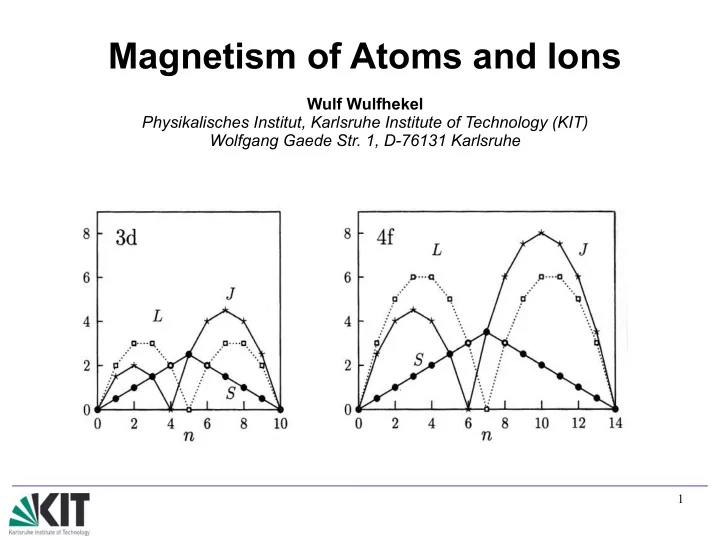
Hund´s rule from: Blundell Side note: Half filled shells have L=0 and shells with one less electron have J=0.
25
Hund´s rule Example: Fe 3d6
½ ½ ½ ½
1
2 1
|L+S| half full S=½(5-1)=2 L=0+2=2 J=|L+S|=4, g=3/2 µ=6µB 3d
6= 5 D6
Spectroscopic term (2S+1)LJ bcc Fe with 2 atoms per unit cell of (286 pm)3 leads to M= 12 μB / (286 pm)3 =4,75 MA/m2 But experimental value is 1.71 MA/m2
26
Problems with Hund´s rules Hund's rules work well for free atoms and ions
neighboring atoms, quenching of orbital momentum Hund´s rule work well for rare earth atoms and ions
Hund’s rule fails near half filled shells minus one (second order corrections) from Coey
27
The Zeeman effect
Magnetic moment of atom couples to external field (along z-axis) Zeeman operator commutes as it is proportional to Jz Splitting of the states Atom can be excited by microwaves (magnetic dipole approx.) when you hit the right frequency → ESR/EPR/NMR Δ E=ℏ ω=g JLSμB Bz
28
The Zeeman energy and the Brillouin function With partition function Z, the expectation value of mJ can be calculated
Z= ∑
mJ=−J + J
e
mJ g JLSμB B /k BT
slope 1 slope 1/3 BJ y=2J1 2J coth 2J1 2J y− 1 2J coth y 2J y= g μB J B k BT
<mJ >=−k BT d ln(Z) d B =g JLSμB J ×BJ(g JLSμB J B/k BT )
29
The Zeeman energy and the Brillouin function from: Kittel Curie - Weiss
y=g μB J B k BT
30
Adiabatic demagnetization
31
Adiabatic demagnetization NASA: X-ray calorimeter of the international X-ray observatory PTB: Micro-Kelvin nuclear demagnetization of Cu
32
Superposition states Eigenstates have trivial dynamics with a mere phase change of the wave function What about superposition states? Example: spin ½ But with
33
Bloch sphere
34
Bloch sphere Precession in magnetic field: Note that when you measure an ensemble of spins, you will see two effects:
Electron paramagnetic resonance: you induce transitions between magnetic states mJ in a magnetic filed Bz and study time evolvement of superposition states
35
The crystal field The electric fields of neighboring atoms can perturb the centro-symmetric potential of the free atom The new eigenstates are thus mixtures of the free atom eigenstates In 3d elements, the crystal field is typically larger than the spin-orbit interaction and you need to go back to L and S states In 4f elements, the crystal field is typically smaller than the spin-orbit interaction and you can keep the J states If crystal field is not too strong, the orbital states in the presence of a crystal field are states with a good L2 but not with a good Lz
36
The orbital states in a cubic crystal field =Y 20 = i
2 Y 21−Y 2−1
= 1
2 −Y 21Y 2−1
= i
2 Y 22−Y 2−2
= 1
2 Y 22Y 2−2
37
Quenching of the orbital momentum While L2 is not influenced Lz is quenched <d xy| L2|d xy >=ℏ2 L(L+1) < d xy | Lz|d xy >=1 2 <Y 22| Lz|Y 22 ><Y 2−2| Lz|Y 2−2 >= 1 2 2−2=0 So, if you apply a magnetic field along z, you see to first order no magnetic moment along z In second order perturbation theory, you see eventually an orbital momentum Perturbation: L=∑n
excited
−2B B x|< 0| Lx| n >|
2
En−E0 x− 2 B B y |< 0| Ly| n >|
2
E n−E0 y−2 B Bz|< 0| Lz| n >|
2
E n−E0 z n : multi-electron wave function V i= B Li Bi < Li>= E
i
38
Quenching of the orbital momentum L=∑n
excited −2B B x|< 0| Lx| n >| 2
En−E0 x− 2 B B y |< 0| Ly| n >|
2
E n−E0 y−2 B Bz|< 0| Lz| n >|
2
E n−E0 z A closer look: Lz can only be caused by mixing of states that contain same Lz components d xz ,d yz and d xy ,d x
2− y 2
Lx or Ly can only be caused by mixing of states that contain Lz components that differ by one as Lx and Ly can be written as superpositions of L- and L+
39
Crystal field splitting in an octahedral crystal field eg: t 2g: e1=d z
2=Y 20
e2=d x
2−y 2= 1
2 Y 22Y 2−2
fully quenched t1= 1
2 d xz−id yz=Y 2−1
t 2= 1
2 −id xzd yz=Y 21
t3=d xy=−i
2 Y 22−Y 2−2
partially quenched
40
Weak octahedral crystal field Hund´s rules hold: S=2 L quenched
41
Strong octahedral crystal field Hund´s rules fail: S=1 Degenerate ground state! L is not fully quenched
42
High-spin low-spin transitions High spin Low spin S=2 S=0
43
Stevens operators
i=1 N
n=0 ∞
0O n 0+∑ m=1 n
mOn m+∑ m=1 n ̃
m ̃
m)
m ,̃
m: Crystal field parameters
m ,̃
m: Stevens' Operators
0: only J z up to power n (and J )
m , ̃
m: also ( J ±) m
Which terms contribute?
44
Stevens operators
45
Zero filed splitting
<Sz> <Sz>
1/2 3/2 Energy Energy
ΔSz = ±2
Sz
1/2 3/2 Sz
1 Energy Energy
Co2+, S = 3/2 (4 states) Ni2+, S = 1 (3 states) +
46
Ways to determine the crystal field parameters
Solve the crystal field + Zeeman Hamiltonian: Compute partition function: Compute magnetic moment: Fit to experimental data of magnetization Use different directions of magnetic field (easy and hard directions) Er/Pt(111) Er/Cu(111) B2
0=-96µeV for Pt(111)
Easy axis along z B2
0=96µeV for Cu(111)
Easy plane
Donatti et al. PRL 2014