
SLIDE 1
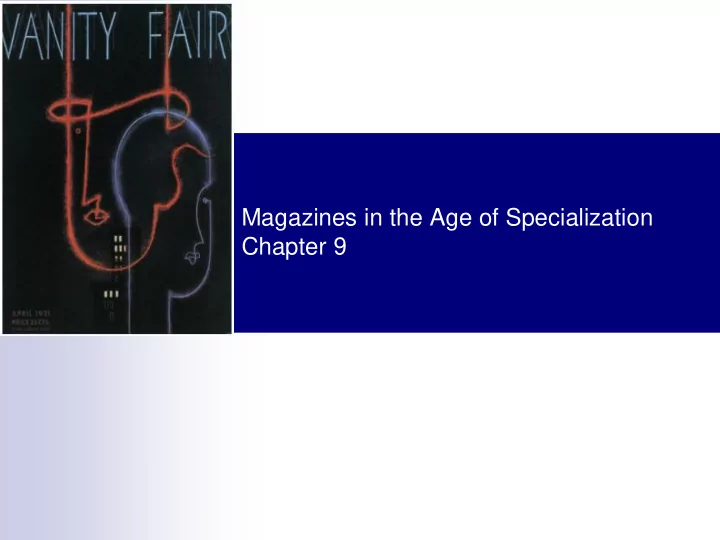
Magazines in the Age of Specialization Chapter 9 The Story of - - PowerPoint PPT Presentation
Magazines in the Age of Specialization Chapter 9 The Story of Cosmopolitan The story of how a 60s babe named Helen Gurley Brown (you ve probably heard of her) transformed an antiquated general- interest mag called Cosmopolitan into
Nearly all consumer
In fact, the U.S.
By the turn of the 19th century,
advertisers increasingly used national magazines to capture consumers’ attention and build a national marketplace.
Throughout that time,
magazine pages have generally maintained an even balance of about 50 percent editorial content and 50 percent ad copy.
But now, for fashion
magazines in particular, the line between editorial content and advertising is becoming increasingly less important.
The idea of specialized
Literary magazines also
In 1821, two young Philadelphia
printers, Charles Alexander and Samuel Coate Atkinson, launched the Saturday Evening Post
It was the first major magazine to
appeal directly to women, starting the “Lady’s Friend,”—a column that addressed women’s issues.
During the 1800s, the weekly Post
became the first important general- interest magazine aimed at a national audience.
longest-running magazine in
U.S. history.
Saturday Evening Post
When Cyrus Curtis bought the Post in 1897 for $1,000, it had a circulation of approximately ten thousand.
Curtis’s strategy for reinvigorating the magazine included printing popular fiction and romanticizing American virtues through words and pictures (a Post tradition best depicted in the three-hundred-plus cover illustrations by Norman Rockwell).
Reader’s Digest
The most widely circulated general- interest magazine during this period was Reader’s Digest.
Started in 1922 by Dewitt Wallace and Lila Acheson Wallace for $5,000 in a Greenwich Village basement,
Reader’s Digest championed one of the earliest functions of magazines: printing condensed versions of selected articles from other magazines.
Postal Act of 1879
Lowered postage rates Increased magazine
Advertising revenues
soared.
Advertisers
Used magazines to
One magazine that took advantage of these changes was Ladies’ Home Journal, begun in 1883 by Cyrus Curtis.
Prior to LHJ, many women’s magazines had been called cookie-and-pattern publications because they narrowly confined women’s concerns to baking and sewing.
Ladies’ Home Journal
First with a circulation of one
million in 1903
Launched in 1886 as a magazine
for “first-class families,” Cosmopolitan began as a literary publication, offering both general- interest articles and fiction..
McClure’s Magazine inaugurated
the era of muckraking in 1902 with Ida Tarbell’s investigative series on the Standard Oil Company monopoly.
Time During the general-interest
era, national newsmagazines such as Time were also major commercial successes.
Begun in 1923 by Henry Luce
and Briton Hadden,
Time developed a magazine
brand of interpretive journalism, assigning reporter-researcher teams to cover stories while a rewrite editor would put the article in narrative form with an interpretive point of view.
General-interest
Prominent after WWI
Combined
Photojournalism
Gave magazines a
visual advantage over radio
In 1970, Life’s circulation peaked at 8.5 million, with an estimated pass-along readership of nearly 50 million. Life’s chief competitor, Look, founded by Gardner Cowles in 1937, reached 2 million in circulation by 1945 and 4 million by 1955. It climbed to almost 8 million in 1971.
Dramatically, though, both magazines suspended
popular periodicals at the peak of their circulations seems inexplicable, but their fall illustrates a key economic shift in media history as well as a crucial moment in the conversion to an electronically oriented culture.
In March 1974, Time Inc. launched
People, the first successful mass market magazine to appear in decades.
Instead of using a bulky oversized
format and relying on subscriptions, People downsized and generated most of its circulation revenue from newsstand and supermarket sales.
For content, it capitalized on our
culture’s fascination with celebrities. Supported by plenty of photos, its articles were short, with about one- third as many words as those of a typical newsmagazine piece.
The general trend away from mass market
With the rise of television in that decade, magazines
They adapted, trading the mass audience for smaller,
discrete audiences that could be guaranteed to advertisers.
Two major marketing innovations also helped ease the
industry into a new era: the development of regional and demographic editions.
As television advertising
national magazines whose
content is tailored to the interests
example, Reader’s Digest for years had been printing different language editions for international markets.
Other magazines
Often called split-run
editions, these national magazines tailor ads to different geographic areas.
Most editions of Time,
Newsweek, and Sports Illustrated, for example, contain a number of pages of regional ads.
Another variation of
specialization includes demographic editions, which target particular groups of
market researchers identify subscribers primarily by
In an experiment conducted in
1963, Time pioneered demographic editions by carrying advertising from a drug company that was inserted into copies of its magazine. These editions were then sent only to 60,000 doctors chosen from Time’s subscription rolls.
By the 1980s, aided by
developments in computer technology, Time had also developed special editions for top management, high-income zip- code areas, and ultrahigh-income professional/managerial households.
Certain high-income zip-code
editions, for instance, would include ads for more expensive consumer products.
Webzines Online-only
Magazines move online.
Magazine companion
Feature original
Magazines grouped
Advertiser type
Consumer Business or trade Farm
Target demographics
Gender, age, or ethnic
group
Audience interest area
(sports, literature, tabloids)
Magazines are also
Men and women Sports, entertainment,
Age-group specific Elite magazines aimed
Minorities Supermarket tabloids
Contemporary commercial magazines provide essential
information about politics, society, and culture, thus helping us think about ourselves as participants in a democracy.
Unfortunately, however, these magazines often identify
their readers as consumers first and citizens second. With magazines’ growing dependence on advertising, controversial content sometimes has difficulty finding its way into print.
More and more, magazines define their readers merely as viewers
In the midst of today’s swirl of images, magazines and their
advertisements certainly contribute to the commotion.
But good magazines also maintain our connection to words,
sustaining their vital role in an increasingly electronic and digital culture.